Wednesday, February 6, 2013

Howler monkeys face dangers in Laguna de Apoyo Nature Reserve

Even in fairy tales, not all endings are happy. This week, we were witnesses to a tragic story with a silver lining. Along the northern shore of Lake Apoyo, howler monkeys have proliferated, so much so, that Laguna de Apoyo Nature Reserve is now among the best locations in Nicaragua for monkey watching. Golden-mantled howler monkeys regularly enter the areas where housing was constructed in the 1960's and 1970's, between the access road and the lake. (White-faced capuchin monkeys also inhabit our area, but are fewer and occupy very limited ranges.) This means they are entering yards of homes and coming into contact with electric transmission wires. As a group of monkeys moved through the forest and into a neighboring yard, one female monkey managed to cross wires and was electrocuted. When we learned of the event, we were mobilized to do what we could. When we arrived on the scene, the lifeless body of the monkey was still attached to the electric wires, which had shorted out and no longer carrying current. Clinging to her waist was a terrified baby, still very alive.
wildlife in Nicaragua
This baby golden-mantled howler monkey clings to her lifeless mother. Photo by Susana de Winne.
We asked ourselves whether the infant monkey had survived. Mother and baby were about five meters above the ground, the mothers tail and paw locked around the wire and the baby clinging to her mother's lifeless body. After several minutes, the baby monkey raised her head and blinked. We didn't know what to do next, but we were happy to know that one life may not be lost.
howler monkey
Tense moments when a baby monkey's life was at risk. Photo by Susana de Winne.
We were concerned the baby would fall with or without her mother, and suffer a bad injury or death. Additionally, the monkeys had now attracted the attention of several neighbors, and we were also concerned that the wrong neighbors would capture and keep the monkey as a pet. The baby howler monkey was disoriented and anything was possible. We quickly installed a sheet beneath the wires to catch the animals in case the grip of the dead mother would release. And we watched and waited.
howler monkey
The baby monkey continues to cling to her mother. Photo by Susana de Winne.
After another half-hour, the infant monkey 
After another half-hour, the infant monkey climbed off her mother and into the nearby trees. We contemplated whether we should capture the baby, while the baby continued to move. Soon, she was in a tall tree, and we sighed from relief. There are folks who would not hesitate to capture her if they could, to enslave her to the pet trade, a fate nearly as bad as death. We only hoped the infant would quickly reintegrate with her troop, which had departed after the horrible death of the poor mother monkey.
monkeys in Nicaragua
Electrocution by electric utility wires is perhaps the greatest factor in mortality of howler monkeys and other animals in Laguna de Apoyo Nature Reserve. Photo by Susana de Winne.
While we watched the infant monkey, the unscrupulous people who had gathered knocked down the dead mother monkey from the electric cable. We returned to recover her body and prevent others from selling her or using her body for any other purpose. We lingered while watching her body lying on the sheet where she had fallen. Her tail and two limbs were locked in their contracted positions, an adaptation among these animals to allow them to sleep in trees without falling. There were small burns on her hands and tail, otherwise, she looked a perfect specimen in the prime of her life. No fleas or mites were jumping from her body, no injuries or scars were evident. Her half-opened eyes betrayed her final moments when death stole her away. Her breast was full, vainly awaiting her offspring.
We recovered her body, from which we will conserve her skin and skull for scientific and educational purposes. It is our hope to make Laguna de Apoyo Nature Reserve safe and prosperous for the wild animals which need its forests and water. Part of what we do, at times, is no more than give witness to what we see.
Life is hard for humans, and even harder for wildlife. Mortality among monkeys is very high, from our casual observations, sometimes from falling from trees, other times from the cruelty of people, and sometimes, electric wires. Our electrical connections in Laguna de Apoyo Nature Reserve need protectors to save wildlife from the risks of electrocution. Too often, arboreal animals are killed by the wires. FUNDECI/GAIA has discussed the issue of electric transmission wires with MARENA and will be seeking solutions to the risks to wildlife by this modern convenience of man. It is the least we owe our wild neighbors. After all, we live in their yard, not vice versa!
Click on the "escudo" to contact us.

Monday, February 4, 2013

Jaguar cichlid in Laguna de Apoyo, Nicaragua

-->
Many cichlid fish species evolved in the Nicaraguan Great Lakes system. Among the more popular of the fish of this region are the guapotes, fish of the genus Parachromis. Guapotes can make a very nice fish dinner. The most abundant of the guapotes in the San Juan River and the Nicaraguan Great Lakes is the Jaguar cichlid, Parachromis managuensis. In Nicaragua, it is known as the guapote barcino, in reference to its checkerboard spotted pattern. Along with several species from the Midas cichlid species complex, the Jaguar cichlid make nests in which parental care observations can be made easily during SCUBA diving.
All the mating cichlids native to Nicaragua protect their young for several weeks after hatching. The guapotes have some important structural advantages to parental care over the more common Midas cichlids found in their range. First of all, the guapotes are large, and therefore can sustain large egg loads. It is not uncommon to see over 2000 fry at Jaguar cichlid nest. Secondly, the guapotes all have large mouths adapted to capture fast-swimming fishes. A bite of the Jaguar cichlid could be fatal even to a medium-sized fish. Potential predators know this and tend to avoid the risk of a bad bite.
These hatchling Jaguar cichlids are less than a week old. They stay near the parental units within reach of a natural or dug cave, and they receive parental care up to about 60 days after hatching. Photo by Martin Cabrera. 
Along with several bird species, the Jaguar cichlid sits atop the food web in Lake Apoyo, Nicaragua. It is the only fish in the lake that can kill and consume up to medium-size fish. Adult Jaguar cichlids only eat fish and perhaps crabs.
Hatchling P. managuensis are prone to move toward the diver, a camera, a hand. Photo by Martin Cabrera.
Male Jaguar cichlids differ morphologically from females in its upturned mouth and other aspects of head shape. Like all the other cichlids native to Nicaragua, the males in breeding pairs always exceed the females in size.
This female Jaguar cichlid is never far from her free-swimming fry. Photo by Martin Cabrera.
All cichlid nests can be fascinating, and the Jaguar cichlids are not unique in this respect. Parents may move little in defense of their fry, but they usually don't have to do much, to get the point across to potential predators.
Most cichlids in Nicaragua utilize natural features such as caves and holes to defend their offspring. This Jaguar cichlid is watching her fry just outside of this crevice. Photo by Martin Cabrera.
Breeding seasonality of the Jaguar cichlid is not as strong as in the Midas cichlids in Lake Apoyo. Whereas the Midas cichlids may reproduce in only two to four months during the year, the Jaguar cichlid is found in reproduction most of the year.
A female Jaguar cichlid (P. managuensis) in her nesting site. Photo by Martin Cabrera.
All cichlid fishes in Nicaragua provide extensive parental care to their fry for the first several weeks after they hatch. There is fierce competition among the Jaguar cichlids for high-quality breeding sites such as this one in our photographs. This site is actually a cave under a large rock, with openings on both ends. The male parent of this nest has little or no continued relation with the nest, however. Big male P. managuensis are scarce, and the males tend to abandon nests earlier than the female, in contrast with many other Nicaraguan cichlids. Big males are easily harpooned when on nest, and unscrupulous SCUBA divers often harvest this fish, as a trophy and for a great meal.
This female is emaciated from the physical stress and reduced food intake associated with reproduction. Photo by Martin Cabrera.
Fry feed on detritus and phytoplankton/zooplankton. They stay close to their fellow fry at all times, depending on the maxim safety in numbers. Among the most dangerous predators of cichlid fry are the Bigmouth Sleepers (Gobiomorus dormitor), introduced into Lake Apoyo only 22 years ago. Both adults and juveniles can catch cichlid fry, especially when a single fish has separated from the group. Fry face a much greater risk of capture when separated from their siblings.
Mother P. managuensis and her fry in Lake Apoyo, Nicaragua. Photo by Martin Cabrera.
We at FUNDECI/GAIA are working to determine the population structure of the fishes, plants and other life in Lake Apoyo, Nicaragua. This delicate lake is under tremendous pressure from people who want to do things that affect the lake: fish unsustainably, cultivate agricultural products using agrochemicals, build houses and install grassy gardens which use copious quantities of water and leave pollution in the lake. With a population baseline, we can determine variations in populations of the different fishes and plants which may result from human-induced alterations in the lake.
Parachromis managuensis
This female guapote barcino tends to thousands of fry. Photo by Martin Cabrera.
Click on the "escudo" to contact us.

Friday, February 1, 2013

Bird Studies in Nicaragua

Anyone who has done some birdwatching in Nicaragua knows there are some great birds in this country. Observing birds by binoculars, however, still leaves many details unseen, as the photos below can demonstrate. We get a special opportunity to observe birds up close when mist netting. There are few tasks as gratifying as one involving the observation of a living, wild bird up close, especially our birds here.
birdwatching
Leslie patiently waits for this Blue-tailed Hummingbird (Amazilia cyanura) to fly away. Photo by Emily Williams.
By studying the birds in Laguna de Apoyo Nature Reserve, we are learning about bird communities in the Nicaraguan tropical dry forest habitat that dominates the terrestrial areas in this protected area. We are also learning, however, about land use, by determining which birds are found in different areas according to the human activities in each. Some birds can use only good forest habitats, and they may be getting forced out by forest degradation. We are hoping to demonstrate consistent patterns in bird populations according to land use and to the changing forest structure as a reforested area grows back into a relatively mature, natural forest.
A Yellow-throated Vireo (Vireo flavifrons) wants to make his disagreement known. Photo by Emily Williams.
At least 225 bird species have been documented in Laguna de Apoyo Nature Reserve, to date. Mist netting has helped us confirm several species which had been poorly documented by sightings. Many of the birds captured during mist netting, in appropriate season, are migratory birds, such as the Yellow-throated Vireo (Vireo flavifrons) and the Painted Bunting (Passerina ciris). Perhaps a quarter of the species found in Laguna de Apoyo Nature Reserve are migratory. Almost all migratory birds here nest further north and spend the non-breeding season here.
The male Painted Bunting (Passerina ciris) has dramatic coloration. Photo by Emily Williams.
Some migratory birds winter in mixed-sex flocks, and others segregate by sex and/or age in their southern, nonbreeding range. By counting the birds by sex and age in Laguna de Apoyo, we can help to determine migration patterns for these birds. Appropriate habitat is required for all migratory birds, especially the Red-Listed species such as the Painted Bunting (Near Threatened), and for all sexes and age classes.
Painted Bunting males are bright, whereas the females are drab. Photo by Emily Williams.
Even when the migratory birds have returned to their nesting ranges, the forests and shoreline of Laguna de Apoyo Nature Reserve continue to be conspicuously occupied with birds. The year-round resident birds, which will have become even more evident when the migratory birds have gone, may even reproduce during the stay of most migratory birds, during winter in the northern hemisphere.
The White-tipped Dove (Leptotila verreauxi) is among the larger species we catch commonly in mist netting activities in Laguna de Apoyo Nature Reserve. Photo by Emily Williams.
Not all birds use the same resources, of course. Many resident birds avoid areas with certain kinds of human impacts, such as the elimination of large, old trees, or the clearing of ground cover. The White-tipped Dove (Leptotila verreauxi) is an example. It is common in forest, but quite uncommon in yards, even where the yards have large, old trees. Another resident bird which is affected by human activity is the Northern Barred Woodcreeper (Lepidocolaptes sanctithomae). This species is common on the south side of Lake Apoyo, but absent from the north side, where greater human impacts are found on the vegetation structure. 
The Northern Barred Woodcreeper (Dendrocolaptes sanctithomae) is not well-documented west of Lake Nicaragua. Photo by Emily Williams.
Some of the local people brand us as tree-huggers, which is fine by us. We seem to get in the way of some people who have big plans for building inside the Laguna de Apoyo Nature Reserve, and they would rather that we go away. That gives us even more motivation to continue to work to save the forest and lake of this reserve. The greatest aspect of our bird studies is that of the people-those who are dedicated and even thrilled by the birds, and learn along the way. Our conservation science interns and volunteers bring life to our projects.
Nicaragua birdwatching
Work as a volunteer in wildlife monitoring is exhausting but worthwhile. Photo by Emily Williams.
The most thrilling of the birds we catch with mist nets must be the most demanding for our technicians, the hummingbirds. They are the smallest and, by far, the most delicate of the birds we catch. Hummingbirds keep very little "reserve" to fuel their activities, requiring that they feed and drink often. We give the hummingbirds water when they are captured, and we process them as quickly as possible to allow them to resume their activities with little interruption. Hummingbirds are usually docile in the hand, and sometimes won't fly away immediately when released.

Hummingbirds are not easy to see well when on the wing, so having one in the hand is particularly special. One can appreciate so many particular features of these birds when they are still and close.
With all the information we gather, we are trying to find which birds are segregated by land use and what can be done about it. We are looking for clear recommendations to promote the entire reserve as good forest and lakeshore for the birds.

birds Nicaragua
Click on the "escudo" to contact us.

Thursday, January 31, 2013

What we do, and why

We at Estacion Biologica FUNDECI/GAIA have been working a long time in Laguna de Apoyo Nature Reserve. Several years ago, we appealed to the local authorities and the Ministry of Natural Resource and the Environment (MARENA) to provide a presence in the area, which was until the late 1900's, only a paper tiger. People were cutting trees, constructing houses, hunting, boating, and all kinds of other activities which were incompatible with the identity of Laguna de Apoyo as a natural area and, furthermore, illegal. 
The area was designated part of the Sistema Nacional de Areas Protegidas in 1991, but this decree did not save the area from the ravenous pressure of unsustainable uses, because there were no park guards nor any other kind of systematic vigilance in the area. Timber cutters, weekend boaters and hunters, and developers had a free-for-all in the area. Dozens of lots were cleared and houses built, including a 65-house development aimed at the US market for timeshares. 
While all this was going on, FUNDECI/GAIA was quietly (and at times, not so quietly) working with the community and the local and national government offices to save Laguna de Apoyo as a natural area. Among the first projects executed in this area was the construction of a guardhouse for the reserve, located at the main entrance to the Laguna de Apoyo Nature Reserve on the edge of the volcanic crater. 
nature Nicaragua
Jeffrey McCrary of FUNDECI/GAIA and Cruz Palacios of MARENA at the Laguna de Apoyo guard station. Photo by Rebecca Orr.
To perform this feat, several negotiations were required. First, MARENA agreed to hire a park guard to provide vigilance in the reserve. Until then, this area had no one to count on for vigilance and control. The mayor of Catarina, Juan Manuel Gallegos, donated a small piece of municipal land for the guardhouse. MARENA supplied a series of design criteria for the guardhouse, also. A local builder, Francisco Aguilar, agreed to perform the construction at a very reasonable cost. The Small Projects Fund of the Canadian Embassy provided part of the financing, the remainder paid by funds from FUNDECI/GAIA and from Patricia and Olga Lopez. 
This guardhouse was finished July 6, 2000, approximately one hour before a mortal earthquake destroyed hundreds of houses in Masaya and the Laguna de Apoyo area. The rustic design for our guardhouse, however, held fast, and no more than a crack or two resulted. And the timing was perfect, because the structure was immediately put into use by the authorities in the rescue efforts, as hundreds were evacuated from Laguna de Apoyo Nature Reserve and its vicinity with the participation of the Civil Defense, National Police, and Red Cross. 
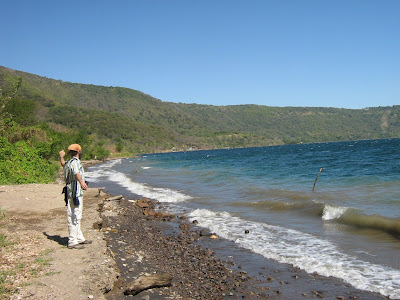
nature Nicaragua
Counting birds can not be done at a more pleasing location. Pier-Olivier Boudreault, intern with FUNDECI/GAIA, takes a break by the shore of Lake Apoyo. Photo by Catherine Bard-Duchesneau.
We have been very busy with many other projects since then, too. Some of our projects are direct actions in conservation, others are in research and monitoring of the natural resources in our beautiful natural area. Our studies of the endemic fishes of Laguna de Apoyo began many years ago, and continue into the present. In 2008, we began a long-term bird monitoring project, in which many volunteers and interns have worked alongside the staff at Estacion Biologica Laguna de Apoyo. Data on bird populations is gathered monthly in several points. Our monitoring efforts have been expanded to include vegetation, bats, butterflies, and moths. Several students have done internships in these areas in conjunction with the monitoring project.
internships Nicaragua
Our interns work on their data as dinner is getting prepared. Life is good at Estacion Biologica. Photo by  Rebecca Orr.
Our volunteers and interns work on projects of benefit to the wild nature of Laguna de Apoyo Nature Reserve and the communities in and around the reserve. Some of the projects involve wildlife, other recent projects have included erosion control, reforestation, recycling, and environmental education. Many volunteers and interns also study Spanish at Apoyo Spanish School, which is also located in Estacion Biologica Laguna de Apoyo. Our school is the oldest in Nicaragua, and our teachers have trained the teachers of many other schools in Nicaragua in our successful methodology. 
Our Spanish students sometimes get hands-on experience in Nicaraguan cooking styles. Photo by Rebecca Orr.
Protecting the environment in Laguna de Apoyo Nature Reserve goes beyond prohibiting hunting and cutting trees. There are several competing uses for the natural resources of this area, and far too many people to police. The best protection mechanisms for the forests and lake are those which take advantage of natural forces, such as the economic benefits the natural resources provide the local people. We at FUNDECI/GAIA work as closely as we can with the National Tourism Institute (INTUR), the National Police and MARENA to protect the natural resources of this gem.
Among our most notable projects is the development and approval of the first management plan for Laguna de Apoyo Nature Reserve. GAIA worked closely with the sponsoring NGO, Liga de Cooperativas de Nicaragua (CLUSA) on contract by MARENA, to collect data and organize community participation in the management plan. There was plenty of opposition to the process, particularly on the part of unscrupulous land developers and real estate brokers, all of which was eventually overcome, and the management plan was approved by MARENA in 2010.
Some of these trees in our reforestation nursery are grown in re-used plastic milk bags. Photo by Phil Johnson.
Our guests are invited to help us in the ways that fit best their capacities. Many people actually enjoy "playing in dirt", which is essentially what is entailed by our reforestation project. Each year, we plant hundreds or even thousands of trees in critical points in the Laguna de Apoyo Nature Reserve. Our homegrown trees are produced with compost made from kitchen waste and leaves, and the seeds collected from the natural forest of our reserve. We are not paid by anyone to plant trees, because our intention is not to grow trees for commercially lucrative harvest. Instead, we are re-creating forest where it once was. Planting trees requires a small amount of capital, but lots of labor, so we depend heavily on volunteers. Want to donate your time to make the world a greener place? 
Swimming in Laguna de Apoyo is beyond words. Photo by Rebecca Orr.
In everything we do at Estacion Biologica Laguna de Apoyo, we try to enjoy ourselves and have fun. Between it all, a dip in the clear, warm water of the lake is an absolute requirement. Day or night, the lake invites.
nancite
Nancite (Byrsonima crassifolia) is a wild fruit of our area, abundant in season and worth a taste. Photo by Jeffrey McCrary.
We eat well at Estacion Biologica, and sometimes, we even eat from the forest. a variety of chile is native to our forests, and we harvest it in season for our use, from plants which grow right in our yard. Other edible fruits abound, most of them alien to the uninitiated. Learning about the wild fruits which Nicaraguans consume is part of learning about this wonderful country. 
Dawn is gorgeous over the lake, but you must get up to enjoy it. Photo by Catherine Bard-Duchesneau.
While we are picking up trash, recycling, planting trees, counting monkeys, or SCUBA diving, we are also living. We have bills to pay, too, and your contribution helps. Please come by to have dinner with us, or stay a few days in our rustic lodge. If you wish to make a financial contribution to our program, we are always grateful, too.
nature
You are being watched. Photo by Hans Rademaker.
Every day we see something new, often something very pleasant, about Laguna de Apoyo Nature Reserve. For instance, howler monkeys once were a rare sight at Estacion Biologica, as they generally stayed at least 500 meters away. The forests have improved in the past decade, thanks to numerous conservation measures implemented in the reserve; now we have them in the yard practically every day. We are not far from the city, but the nature is still here, and we are working to keep it that way. Want to help? Please contact us.
nature
Click on the "escudo" to contact us.
nature Nicaragua
Just add water, and you are there. Photo by Catherine Bard-Duchesneau.

Monday, January 28, 2013

Downtown Managua

Tourists visiting Nicaragua often avoid the capital, Managua. The city is not too large, as capital cities go, but it's not particularly user-friendly for the uninitiated, especially for those who don't speak Spanish. Nonetheless, Managua is the epicenter of Nicaraguan society, and all Nicaraguans refer to it for its abundant cultural activities. 
An identifying feature of Managua is the legacy of a terrible earthquake in 1972, in which thousands were killed and most citizens of the capital were left homeless. Rubble can still be found in the capital, and half-destroyed buildings are occupied by squatters living in unimaginably insecure and degrading conditions, in an area once graced with urban, middle-class architecture. Nonetheless, a few structures remain from the past, and there are other gems in Managua, too. Here are some photos from downtown Managua, near the epicenter of the terrible 1972 earthquake. 

managua cathedral
Managua "old" cathedral, now in ruins. Photo by Joyce Procure.
The former downtown area of Managua languished for decades after the earthquake. The cathedral unusable, entire neighborhoods turned to rubble, and shells of buildings inhabited by indigent people in appallling conditions. Some functions continued in downtown Managua after the earthquake, for instance, the National Palace was left strong, as was the Bank of America building. But ruins and extreme poverty were everywhere, along with all the social ills that accompany them.
Managua cathedral
Side view of the ruins of the "old" Managua cathedral. Photo by Joyce Procure.
The area has recently become dramatically revitalized through the injection of large sums of money from the government. Parks have been restored and police are present day and night to make them safe. Slums and rubble have been cleared in several areas, replaced by housing projects. Decent housing for poor people has become a primary priority again, after a long hiatus.
Nicaraguan architecture
The National Palace withstood the 1972 earthquake intact. Its strong, imposing lines suggest  German styles from the 1930's. Photo by Joyce Procure.
Only a few years back, a visit to this area was best left to the valiant. Today, the area is safe and is gaining traffic and life. Managua once again has a center.
Carlos Fonseca
The banners strung on the poles are based on the blue-and-white national flag, and the red-and-black Sandinista flag. Behind the flags are found the tombs of  Sandinista leaders Carlos Fonseca, Santos Lopez, and Tomas Borge. Photo by Joyce Procure.
Managua continues to be the center for culture in Nicaragua, where concerts and plays are found and all kinds of attractions are found, particularly for the person who speaks Spanish.
Nicaragua
The Presidential Palace was built during the last decade of the twentieth century with financing from Taiwan. Photo by Joyce Procure.

The Nicaraguan National Assembly occupies what is known as the Bank of America Building in downtown Managua. This building was among the very few multistory structures that survived the 1972 Managua earthquake. Photo by Joyce Procure.

Prior to the 1972 earthquake, the Managua Cathedral was utilized by the upper classes of Managua.


Nicaragua
Click on the "escudo" to contact us.

Thursday, January 17, 2013

Illegal traffic in Nicaraguan wildlife II

Human nature drives us to want to acquire things that are beautiful. We can't be satisfied to see a beautiful object in nature and then leave it there. For instance, some kinds of Nicaraguan wildlife are subject to the willfulness of humans to treat wild animals as objects that can be bought and sold.
Macaws are the largest members of the New World Parrot family (Psittacidae); they are spectacular, gregarious, and "smart" birds. Two species of this group are found in nature in Nicaragua: the Scarlet Macaw (Ara macao), and the Great Green Macaw (Ara ambiguus, previously named Ara ambigua). The Nicaraguan populations of both these species have suffered greatly because of the pet trade.
CITES
This is a Scarlet Macaw (Ara macao), which has been subjected to coloration, through chemicals such as hydrogen peroxide, to make it appear to be something even more exotic. Sale of these majestic animals should be banned, as well as mistreatment by processes such as feather bleaching. Photo by Matthias Geiger.
Scarlet Macaws (Ara macao) no longer inhabit almost all of the Pacific region of Nicaragua, thanks to the illicit pet trade. This species is listed on CITES Appendix I, which means, basically, that it is quite difficult to export an individual. In spite of the ban on international trade, Scarlet Macaws are much easier found on tethered to sticks on roadsides than in the skies overhead, in Nicaragua. There is a robust trade and virtually no prosecution of pet owners. Many birds find their way to small watercraft which transit contraband from Nicaragua to the much wealthier neighbor, El Salvador, where the birds bring much more money. A Scarlet Macaw in good condition in Nicaragua can cost much more than five hundred dollars. 
macaw
Bumbelina is a pet rescue, Great Green Macaw (Ara ambiguus).  She is receiving care at Estacion Biologica in Laguna de Apoyo Nature Reserve. Photo by Joyce Procure.
We have handled a number of rescue animals over the years at Estacion Biologica. Most of these animals have been taken from people who captured them for use as pets, or the animals have been found injured in or around Laguna de Apoyo Nature Reserve. When we have a little success, the animals survive, heal, and eventually, return to the wild. Not all can heal and return to the wild, however. One pet rescue bird in Estacion Biologica FUNDECI/GAIA, is a Great Green Macaw (Ara ambiguus). Its native range is considerably more limited than that of the Scarlet Macaw. The majority of the birds of this species are found in southeastern Nicaragua, where jungles are thick and rain is practically year-round. Bumbelina is a female, like her fellow rescue Scarlet Macaw, Midorna. Bumbelina is very angry and aggressive, and large and heavy, so she is best admired from a safe distance!
The Great Green Macaw is Endangered and is also listed on CITES Appendix I. Nonetheless, current law enforcement does not prevent the ownership of these birds inside Nicaragua, and they can be found in many homes.
macaws in Nicaragua
Bumbelina was captured in the wild, and her injuries were severe from the brutal mistreatment. She still dreams of flight, but her amputated right wing prevents her from ever returning to the wild. Photo by Joyce Procure.
Midorna is a Scarlet Macaw, also a pet rescue living at Estacion Biologica Laguna de Apoyo. Bumbelina weighs about twice Midorna, much bulkier with a much heavier bill and larger claws, but the two birds make great friends. Like Bumbelina, she has been mistreated in captivity, and her permanently injured wing prevents her from taking flight. During her lifetime of incarceration in a cage, she has developed a feather-plucking disorder, making her look much less majestic than she would look if living in the wild. We are hoping that her feather plucking will reduce with lots of activity and contact. The two birds are destined for delivering the message that wild animals deserve to be free, not in cages! They will be visiting schools and social events around our area, throughout 2013.
Ara macao
Midorna is affectionate with those whom she trusts. Photo by Joyce Procure.
As lovers of nature, we are disturbed by the illegal traffic in wild animals. Our desire to "own" a beautiful bird has harmed many birds, and their loud screeches are no longer heard in much of the forests they once inhabited. Would you like to help us prevent the capture and trade in endangered wild animals in Nicaragua? There is plenty to do. Please contact us!
wildlife in Nicaragua
Click on the "escudo" to contact us.