Showing posts with label bird monitoring. Show all posts

Wednesday, July 15, 2015

Migratory Birds II: Mist net studies in Laguna de Apoyo Nature Reserve, Nicaragua

Everyone is aware of how some bird species are quite evident and others are incredibly reclusive and difficult to note. This difference extends into most natural habitats that the birds use, especially forest habitats where birds can find lots of different places and ways to avoid detection. Birds are somewhat uniform anatomically, however, there are about ten thousand existing species, each with some distinguishing features, showing how feathers along with other features can make such a large number of distinctions which serve to fit ecological niches for feeding, defense and predator avoidance, migration, compatibility with the elements, and reproduction.

We have conducted several cycles of mist netting studies of the birds of Laguna de Apoyo Nature Reserve in Nicaragua, where there are tropical dry forest habitats facing several levels of human intervention. We have noted how several species of birds can be found commonly in one of our study sites but rare or almost not at all in another site of different vegetation structure and composition. The following are a sampling of the migratory birds that appear in our nets in our studies.

birds
Indigo Bunting (Passer cyaneus) males are not nearly so spectacular on the wintering grounds as they are during breeding season. Photo Pier-Oliver Boudreault.
This remarkable partitioning of the habitats of the reserve is also noted among migratory birds. About a quarter of all the bird species found in Nicaragua conduct well-defined, seasonal migrations, in which nesting occurs in a northward habitat during the North American summer, and leaves the area along with most or all the birds of the same species southward for several months, once the chicks have hatched, fledged and gained independence. The birds remain in a southern habitat until time to return to the nesting grounds again.

Laguna de Apoyo Nature Reserve offers winter habitats to many migratory bird species which nest further north. One example is the Indigo Bunting (Passerina cyanea), which nests as far south as extreme northern Mexico, but all the birds of this species disappear move southward into a range extending from central Mexico , the southern tip of Florida, throughout the Antilles and to Panama.

The male Indigo Bunting is appropriately named for its attractive, practically solid blue coloration exhibited during reproduction. A feather molt in the fall, however, leaves the males with mostly drab, brown color, with some deep blue highlights. Hence, the male Indigo Bunting only uses the bright colors during reproduction and maintains a muted appearance when in Nicaragua, which may be driven by predator avoidance and possibly direct physiological costs to produce and maintain the bright plumage.

The female Indigo Bunting is never brightly colored, and lacks the blue wash seen in the male when not in reproductive plumage. Many bird species use color dimorphism in which males demonstrate their reproductive fitness with bold colors and plumage as secondary sexual characteristics which the females use in mate selection. Presumably, a male which will sire offspring more successfully will also have a nice wardrobe.

indigo bunting
This male Indigo Bunting is an adult with well-developed flight feathers, with rounded tips. Photo Pier Boudreault. 

Passerina cyanea
This female Indigo Bunting insisted on a fight so she got one-with the stem of a leaf. Photo Pier Boudreault. 
As a seed-eating species, the Indigo Bunting is generally found in open areas, where grasses may be found around large trees for perching and refuge. This species is found less often in the deeper forest.

In contrast to the Indigo Bunting, the Black-and-White Warbler (Mniotilta varia) feeds on insects found on the bark of trees, especially on the trunk and vertical limbs. It prefers more closed forest canopy and tends to stay low in the forest, climbing along on the trunk, then flying to another, nearby tree to land on the trunk and continue foraging. Its plumage is by no means camouflage for the bird, and there are more bold patterns on the male than on the female, in obvious use in mate selection. 

Like the Indigo Bunting, the Black-and-White Warbler breeding range, in eastern US and Canada, does not overlap with its winter range, which encompasses the extreme southern US, Mexico and Central America, and the Antilles and extreme northern South America. 
Mniotilta varia
Female Black-and-White Warbler. Photo Vera Neumann.

Another group of migratory birds which spend winter in Laguna de Apoyo Nature Reserve are found in the thrush family (Turdidae). In its breeding range, the Wood Thrush (Hylocichla mustelina) is known particularly for its haunting song, which is not given on its winter range. How fortunate are those who hear its song, for as Henry David Thoreau wrote, "wherever he hears it, it is a new world and a free country, and the gates of Heaven are not shut against him." Unlike the other two birds mentioned above, there are no significant differences in plumage between the sexes in this species. This species can be found foraging on the open ground beneath the shade of large trees, in similar actions to the common resident Clay-colored Thrush (Turdus grayi). 

Hylocichla mustelina
Wood Thrush. Photo Pier-Oliver Boudreault.
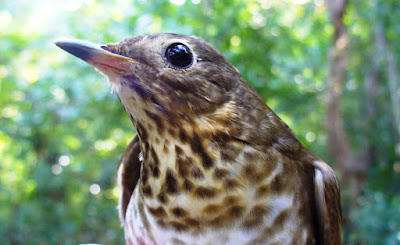
Less striking in appearance is another migratory thrush: the Swainson's Thrush (Catharus ustulatus), which is common in shaded areas in the Laguna de Apoyo Nature Reserve. Like the Wood Thrush, the sexes are similarly colored. Its muted color pattern may be of great advantage, especially when foraging on the ground, as it provides an even greater degree of camouflage than the Wood Thrush. The breeding range, across much of the US and Canada, is completely abandoned by this species during the winter. Birds from the western US and Canada pass the winter from Mexico into Costa Rica, whereas birds from the eastern US and Canada migrate across the Caribbean to Panama and South America for winter.


Swainson's Thrush
The Swainson's Thrush (Catharus ustulatus) is frequently captured by mist nets in appropriately shaded habitats in Laguna de Apoyo Nature Reserve. Photo Pier-Oliver Boudreault.

Another family of migratory landbirds consists of the tanagers, which are distributed into multiple families in spite of similar external characteristics. The Western Tanager (Piranga ludovicianus) has recently been placed in the cardinal family (Cardinalidae). It is less common than the Summer Tanager (Piranga rubra), and has a similar but less melodic, more raspy call on its winter habitat. The Western Tanager tends to stay close to the top of tall trees, coming down to lower levels only occasionally, for which we have relatively few capture records.

The mature male Western Tanager has a red head which fade to yellow neck and throat and olive-yellow body, over which bold black markings are found on the wings. The females lack red on the head and have fewer wing markings. As in many species, the males attain adult plumage after the first winter season, during which only vestiges of the adult male color pattern are noted. This species prefers more well-developed forest structure in Laguna de Apoyo Nature Reserve.

Piranga ludoviciana
Immature male Western Tanager. Photo Vera Neumann.
Not all migratory birds spend winter in Nicaragua and breed further north. One bird which breeds in Nicaragua during the US summer months and then migrates to South America in September is the Sulfur-bellied Flycatcher (Myiodynastes luteiventris). The forests in Laguna de Apoyo Nature Reserve will be punctuated by its squeaky call, which can be compared to a child's squeaky bathroom toy. As a tyrant flycatcher (Family Tyrannidae), it catches insects in flight in open areas, whether above trees in the canopy or over clearings, making sallies from perches at medium or high levels in trees.

Sulphur-bellied flycatcher
Sulphur-bellied Flycatcher (Myiodynastes luteiventris). Photo Marlene Krone.
The tyrant flycatchers are generally very aggressive birds, vigorously defending nesting territories from any bird or other animal it perceives to be a threat. Among the defense mechanisms is the use of its bright orange mouth, which it displays to frighten any threatening animal. A yellow flash can also be seen on the crest when excited.

Sulphur-bellied flycatcher
Sulfur-bellied Flycatcher. Photo Vera Neumann.
Migrating birds enjoy a special legal status internationally, thanks to the increasing recognition of the special needs involved in twice-yearly migrations. Among the oldest of legislation to protect wildlife is the Migratory Bird Treaty Act, signed by the US government in 1918. Although Nicaragua is not a co-signatory on this or other, similar legislation, foreign investment may require all the stipulations in this law to be applied, even when the investment is made in Nicaragua.

migratory birds
Click on the "escudo" to contact us.


Saturday, July 11, 2015

Bird Studies in Laguna de Apoyo Nature Reserve, Nicaragua: Long-tailed Manakin

Gaia has conducted studies of the birds of Laguna de Apoyo Nature Reserve now several years, during this period more than 225 bird species have been documented and some very interesting trends have been noted. One important finding is that the reserve is an important host for a very special bird, the Long-tailed Manakin (Chiroxiphia linearis). This small, reclusive bird is found in the canyons, at low and middle levels of the forest, beneath the cover of canopy.

Long-tailed Manakin
The adult male Long-taile Manakin is jet-black with a baby-blue back and crimson-red head. Two long tail-covert feathers stream behind the bird. Photo Pier-Oliver Beaudrault. 
 Although this species is uncommon in open areas, it is easily heard in its shaded habitat, with unique calls and songs that let one know where it can be found. Although the adult males are spectacular, with brilliant red head, baby blue back and bright orange legs, it can still be missed because it moves little, often remaining still for long periods, and prefers deep shade.

Juveniles and females are even more difficult to sight, because the base color is olive green. Once the bird is sighted, the legs are often the diagnostic feature, because of the angle of view and limited light where the bird is perched.
birdwatching
An immature male Long-tailed Manakin is just beginning to show blue on the back. Photo Joe Taylor.
We usually think of small birds reaching sexual maturity after one year and perhaps only living two or a few years. The long-tailed Manakin is distinctly long-lived. The males, in fact, only reach sexual maturity after four years, during which their changes in plumage occur in several stages. Two or three males work together to perform a song and dance to attract the females, and the females choose the group with the most accomplished performance. The senior male of the group mates and the others await their turn to move up in the hierarchy. Females build nests and raise young alone.

Chiroxiphia linearis
A male Long-tailed Manakin captured in a mist net. This is among the most commonly captured bird species in Laguna de Apoyo Nature Reserve. Photo Lukas Betthaueser.
The Gaia mist netting studies of birds in Laguna de Apoyo Nature Reserve is finally yielding some useful data, after several years of capturing thousands of birds. The Long-tailed Manakin counts among the most frequently captured bird species, in the most densely forested sites, although its capture numbers are considerably lower where the forest canopy is incomplete and undergrowth is removed. We are just learning which birds are the most important species in the reserve, and definitely, the Long-tailed Manakin ranks highly.

Long-tailed Manakin
A female Long-tailed Manakin. Photo Joe Taylor.
Laguna de Apoyo Nature Reserve is an interesting location to study this species, as it has a very high population density in some locations, where as many as 20 individuals have been captured in a three-day period. The high population found in our study area is also interesting because of its proximity to the southern range limit of the species, found in northwestern Costa Rica.

birds
An adult male Long-tailed Manakin has lent a few minutes of his time to our scientists for study. Photo Pier-Oliver Beaudrault.
In our next phase of study of this species, we hope to undertake population dynamics and nesting success. If you are interested in participating in bird studies in Laguna de Apoyo Nature Reserve, we would love to work with you. This is also a relatively easy bird to find, and we would love to take you on a birdwatching excursion. Please contact us if you would like to volunteer or undertake an internship in the study of this bird or other birds in the area or simply to go birdwatching with one of our expert guides.

Long-tailed Manakin
Two male Long-tailed Manakins in a courtship ritual. Photo Jesse Bickley and Anna James.
Chiroxiphia linearis


Tuesday, May 19, 2015

Tropical Kingbird III: Feeding the babies

As we earlier posted, a pair of Tropical Kingbirds (Tyrannus melancholicus) produced three eggs this past Mother's Day in a vigorous courtship, which has now become three rapidly-growing chicks. Both parents spend all the daylight hours defending them and providing food for them. Here, we present more photos of this growing family, with special thanks to Rebecca Brown for camera donation.
birdwatching
The Tropical Kingbird watches over an open area from a high perch, in plain view of the nest where three chicks are in constant desire of food. Photo Jeffrey McCrary. 
Within a week of hatching, incipient wing-feathers became visible among the hair-like plumage characteristic of most nestlings. The Tropical Kingbird chicks have grown rapidly, but sleeping and eating are their only activities.

baby birds
A week after hatching, these Tropical Kingbird (Tyrannus melancholicus) chicks are beginning to show flight feathers. Photo Jeffrey McCrary.
One parental bird remains with the nest at night, but both parents are seeking food for the chicks all day long. They mostly catch items on the wing, capturing all kinds of insects in the sky, grabbing arthropods from leaves or even plucking tiny fruits such as hot peppers. Although little idle time remains for the adults, they communicate constantly, bicker, and they even occasionally perform a "dance"-each flying in tandem about four meters high, from a perch, while singing.
tropical kingbird
Once the Tropical Kingbird chicks awaken, only one thing can be on their minds-food. The parents feed them small insects and fruits, and even larger insects such as butterflies and dragonflies. Photo Jeffrey McCrary.
Both parents are near the nest during all daylight hours and nothing happens there of which they are not immediately aware. They squabble with other birds, especially Social Flycatchers which have a nest only some twelve meters away. The Tropical Kingbirds are adept flyers and fearless, taking on any animal that enters its territory, even humans, who will feel their presence from behind if lingering nearby.
birdwatching nicaragua
The orange flash colors in the crest of this Tropical Kingbird are visible when the bird feels threatened, although the chicks are all oblivious to any danger nearby. Photo Jeffrey McCrary.
Far from being free of danger, these chicks at one week of life after hatching would represent a merry morsel to most other animals. The parents must continue their protection aggressively, given that the nest and chicks are readily visible and accessible from land and air.
baby birds
Upon waking, the chicks immediately open wide and beg, expecting a tasty insect or fruit. Whereas in the first couple of days, all food brought was regurgitated, the chicks now must ingest their food items without as much prior treatment. Photo Jeffrey McCrary.
The Tropical Kingbird is not only valiant, it is also somewhat tolerant of humans, permitting some great opportunities for nature photography. While by no means the rarest or most spectacular bird in Nicaragua, it is nonetheless an interesting and somewhat willing subject, and an example of what a birdwatcher can expect beyond just seeing a lot of different birds. These birds are available to the observer in both forested and altered settings, and they can make a fine show.
birdwatching
Parental Tropical Kingbirds both deliver food in turn throughout the day. Photo Jeffrey McCrary.

tyrannus melancholicus
A parental Tropical Kingbird observes in loving contemplation of the chicks. Photo Jeffrey McCrary.
The chicks still have considerable growth ahead of them before fledging, and even then, dependence continues, as they learn to fly and feed themselves. This parental pair will continue to be busy for weeks to come. 
tyrannus melancholicus
Foods provided to the chicks include vegetable matter, as is shown in the bill of one of the parental units. Photo Jeffrey McCrary.
We at FUNDECI/GAIA organize birdwatching tours in Laguna de Apoyo Nature Reserve and elsewhere, and we would love to take you on a birdwatching excursion. Even common birds such as the Tropical Kingbird can make a marvelous camera model and give plenty to watch. This is only one of more than 220 bird species found in Laguna de Apoyo Nature Reserve and more than 700 species in Nicaragua. Please contact us if you would like to go birdwatching with us, or if you would like to participate in bird research or monitoring with us.


You can help us keep nature wild in Nicaragua, by volunteering your time with us or making a small donation to support our projects in wild nature conservation.


Click on the "escudo" to contact us. 

Thursday, November 13, 2014

Birdwatching in Laguna de Apoyo Nature Reserve III-Land birds

As camera technologies advance, photography continues to become a more interesting option for birdwatching activities. Today, one does not have to be a professional or invest thousands into a hobby to take good pictures of birds. Many of our visitors at Estacion Biologica Laguna de Apoyo come especially for the birds, and some of them even take great photographs. Here, we present the second blog entry highlighting the photography of birdwatchers Jesse Bickley and Anna James.

kiskadee
Great Kiskadee (Pitangus sulfuratus) is very common in the Laguna de Apoyo Nature Reserve and throughout wooded areas in the Pacific region of Nicaragua. Photo Jesse Bickley and Anna James.

Ramphastos
The Keel-billed Toucan (Ramphastos sulfuratus) are always pleasant discoveries here, where they are easier heard than seen. Great photo shots of this species may be difficult, because they prefer forest canopy. Photo Jesse Bickley and Anna James.

birding
Long-tailed Manakins (Chiroxiphia linearis) males dance and sing to attract a mate. The senior male dances in tandem with a junior male who requires up to four years to reach sexual maturity. Photo Jesse Bickley and Anna James.

elegant trogon
The male Elegant Trogon (Trogon elegans) makes an unattractive growl but is quite a beauty to see. Photo Jesse Bickley and Anna James.
trogon
The Black-headed Trogon (Trogon melanocephalus) is quite common on the north side of Lake Apoyo, where Estacion Biologica is located. Photo Jesse Bickley and Anna James.

motmot
Our national bird is the Turquoise-browed Motmot (Eumomota superciliosa). The abundance of steep banks with loose, volcanic soils make Laguna de Apoyo Nature Reserve ideal habitat for this bird. Photo Jesse Bickley and Anna James.

eumomota superciliosa
The pendulum-like swing of the tail of the Turquoise-browed Motmot (Eumomota superciliosa) is thought to discourage predators. Photo Jesse Bickley and Anna James.


clay-colored thrush
The Clay-colored Thrush (Turdus grayi) acts and even sounds similarly to the American Robin of North America. Photo Jesse Bickley and Anna James.
Summer Tanager
Male Summer Tanager (Piranga rubra) make fill our forest with bright color about seven months per year. It accompanies hundreds of other birds in yearly migration, reproducing in North America. Photo Jesse Bickley and Anna James.
Amazilia
The red bill and rusty tail distinguish this bird as the Rufous-tailed Hummingbird (Amazilia tzacatl), much more common in Eastern Nicaragua than in the forests of Laguna de Apoyo Nature Reserve. Photo Jesse Bickley and Anna James.
Birdwatching
The Great Kiskadee is very common in forest edge throughout the Pacific region of Nicaragua. Photo Jesse Bickley and Anna James.
Chestnut-capped Warbler
The Chestnut-capped Warbler (Basileuterus delattrii) is the only year-round resident warbler of the reserve. Photo Jesse Bickley and Anna James.
Groove-billed Ani
Cuckoos such as the Groove-billed Ani (Crotophaga sulcirostris) have a distinctive smell which may serve to protect them from predation. Photo Jesse Bickley and Anna James.

Birding
The Montezuma Oropendola (Psarocolius montezuma) nest communally. Males and females divide the work around the nesting site. Photo Jesse Bickley and Anna James. 
birdwatching
No photo essay on birds in Nicaragua would be complete without the Black Vulture (Coragyps atratus), among the most visible of any bird in the country. Photo Jesse Bickley and Anna James.
Jesse and Anna also took some great photos of birds associated with Lake Apoyo, too. If you would like to schedule a birdwatching tour with one of our specialized birdwatching guides, please contact us!
Please contact us and let us know what you think of our blog, or post a comment below! 

You can help us keep nature wild in Nicaragua, by volunteering your time with us or making a small donation to support our projects in wild nature conservation.

Tropical Kingbird
Click on the "escudo" to contact us. 

Saturday, August 9, 2014

Conservation Science Interns and Volunteers at Laguna de Apoyo Nature Reserve, Nicaragua

There are 78 protected areas in the SINAP system, managed by the Ministry of the Environment and Natural Resources (MARENA) in Nicaragua. Among the most conflictive of these areas is Laguna de Apoyo Nature Reserve, because of the beautiful views and warm, clear water. This protected area faces many challenges but none is as grave as that of real estate development.
FUNDECI/GAIA maintains a permanent presence in Laguna de Apoyo Nature Reserve, through the operation of the biological research station "Estacion Biologica". We conduct a number of environmental studies and conservation actions through our research station there, and we share our knowledge about Nicaragua, its language, culture and great natural heritage through courses and internships offered there.

internship
FUNDECI/GAIA Conservation Science Intern Ruben Pelckmanns participates in bird population monitoring in Laguna de Apoyo Nature Reserve. Photo Pablo Somarriba.
Conservation science interns and volunteers are essential to our work in Laguna de Apoyo Nature Reserve. We are conducting studies of birds, monkeys, plants and fish during 2014 at this location, in coordination with some universities and MARENA. We are comparing animal and plant surveys to previous years to determine how the forests improve or degrade. Frankly, our initial results have suggested some important loss of habitat in some of the most important areas for biodiversity in this location.
conservation science internship
Conservation Science Interns at FUNDECI/GAIA can work on our wildlife monitoring project in the Laguna de Apoyo Nature Reserve. Photo Pablo Somarriba. 
We at FUNDECI/GAIA are committed to seeing Laguna de Apoyo Nature Reserve prosper as a natural area. Obviously, not everyone feels the same, and we have had to deal with some very negative forces in the area, especially coming from people who want to gain riches from investing in property inside the protected area for real estate development. Some of these people really do not like us, and we have recently won an important civil judgment against some of them. There is great opposition to protecting the forest and lake from their greatest enemies, the real estate offices!
internships in Nicaragua
These volunteers left us with a poignant and environmental message.  Photo Pablo Somarriba.
The GAIA Program in Laguna de Apoyo Nature Reserve also promotes environmental conservation projects, particularly reforestation in some of the affected areas in the reserve. Our group was instrumental in the production of the first-ever official management plan for the Laguna de Apoyo Nature Reserve, with GAIA director Jeffrey McCrary as the coordinator of the project, which involved dozens of work meetings with the community and government officials, reviews of biodiversity, geography, land use, sociological factors, and lots of maps and other information for use in the plan.
conservation science
The finding of a freshly dead bird led to a skin preparation. Photo Pablo Somarriba.
Our interns can be involved in ongoing studies on the environment in Laguna de Apoyo Nature Reserve. We have been conducting studies of bird, bat and butterfly populations in the reserve for several years. We are looking for historical trends in populations which may demonstrate differences in land use in five different sites inside the reserve.
conservation science
FUNDECI/GAIA volunteers at Laguna de Apoyo Nature Reserve painted realistic images of some of the wildlife found in the area, along the wall of the entrance to Estacion Biologica. Photo Pablo Somarriba.
Interns may also take on conservation projects. One of our oldest environmental volunteering projects is reforestation. We harvest seeds, plant and grow native trees in our tree nursery, and plant them in deforested areas in the forest. But the most important aspect of our project means the difference between success and failure-it is the continued care of the planted trees for years after planting. Many reforestation projects exist in natural areas, but few of them succeed in recreating natural forest, because tree survival is typically zero for those projects. 

We also rescue wild animals. Interns can work on animal care with our animals, which include two macaws. They can also participate in fundraising for the care and re-introduction of rescued wild animals. 


internships
FUNDECI/GAIA volunteers participate in discussions on the environment and social issues in Nicaragua with guests at Estacion Biologica. Photo Pablo Somarriba.

Nicaragua
Click on the "escudo" to contact us.