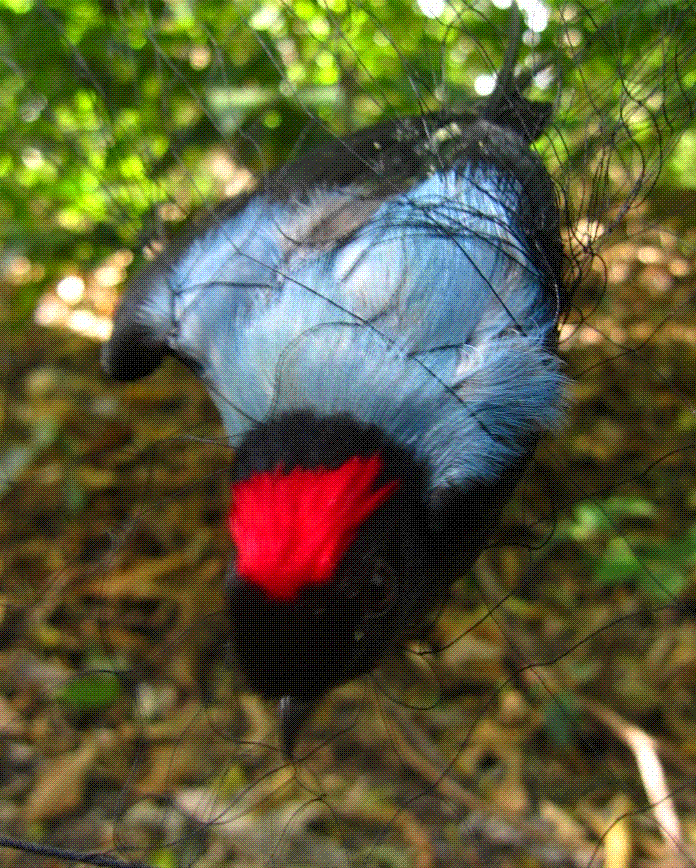
Showing posts with label mist netting. Show all posts

Tuesday, June 26, 2012

Hummingbirds I


hummingbirds Nicaragua
Blue-throated Goldentail (Hylocharis eliciae) in Laguna de Apoyo Nature Reserve, Nicaragua. Photo by Wendy van Kooten.
Identifying some birds in the forest on sight is relatively easy, especially when the birds are large. Among the most difficult birds to identify are the hummingbirds (Trochilidae). They are the smallest, of course. And, their feathers are iridescent. They glow brightly when the light is just so, but when the light is not just right, they may appear black. We love catching hummingbirds in our bird monitoring project, because we get to see the birds in brilliant splendor, which is immeasurable for the hummingbirds.
The Blue-throated Goldentail is quite local in Laguna de Apoyo Nature Reserve. They are absent from the forests close to Estacion Biologica, yet they are common in a couple of our monitoring sites, one of them where we monitor with mist nets. We think they appreciate the added humidity of the sites where they are common, because the added shade there holds moisture better than in the more open areas.
hummingbirds Nicaragua
This Blue-throated Goldentail (Hylocharis eliciae) is getting measured before getting released to resume his life in the wild. Photo by Wendy van Kooten.
The Blue-throated Goldentail males form leks, areas dense with males seeking breeding partners, in the dry season. These males don't look different from females, so their distinctive attributes are found in their voice and in their ability to defend a well-positioned perch near the center of the lek. The forest round them is filled with their calls as each competes with the others for the attention of female potential mates. 
hummingbirds Nicaragua
The Stripe-throated Hermit (Phaethornis striigularis) in Laguna de Apoyo Nature Reserve, Nicaragua. Photo by Wendy van Kooten.
Most hummingbirds are amply covered by shiny, metallic green plumage. The only hummingbird in Laguna de Apoyo Nature Reserve without any green feathers is the Stripe-throated Hermit (Phaethornis striigularis). This bird may suggest a moth in flight. It tends to be found in low areas such as canyons, dark and humid areas, avoiding the sun. Birdwatchers easily identify the Stripe-throated Hermit on site, in contrast to some of the other hummingbirds, thanks to its strongly decurved bill, as it is the only hummingbird in Laguna de Apoyo Nature Reserve with such a bill.
Little Hermit
The Stripe-throated Hermit shows off his tail feathers. His head has been moistened to facilitate age determination by examination of cranial ossification. Photo by Wendy van Kooten. 
The Stripe-headed Hermit was until recently, considered a subspecies of the Little Hermit (Phaethornis longuemareus), which will be the reported name for our species in older records. The range for what is now considered the Little Hermit is restricted to east and south of eastern Venezuela.
hummingbirds
The Stripe-headed Hermit (Phaethornis striigularis) is the only species in Laguna de Apoyo Nature Reserve sporting a strongly decurved bill. Photo by Wendy van Kooten.
Our interns and volunteers at Estacion Biologica catch a few hummingbirds in every mist-netting activity. The hummingbirds require a slightly different treatment from other birds, because they are extremely small and fragile. At the slightest sign of weakness, we give a hummingbird water, by dabbing a drop onto the bill or submerging the bill into a capful of water. The bird may suffer easily from dehydration because of its extremely rapid metabolism and small size, so we must be observing it at all times to ensure it is strong and capable of returning to its normal routine when we release it. Hummingbirds, unlike some other bird species, don't tend to struggle when held by our technicians, and when we release them, they may sit for a few seconds before deciding to fly away.
hummingbirds
The Steely-vented Hummingbird (Amazilia saucerrottei) is difficult to distinguish from the Blue-tailed Hummingbird (Amazilia cyanura) when observed at a distance. This bird was identified by the lack of rufous secondary feathers in the wing. Photo by Wendy van Kooten. 
Two nearly identical hummingbird species are found in Laguna de Apoyo Nature Reserve: The Steely-vented Hummingbird, Amazilia saucerrottei, and the Blue-tailed Hummingbird, Amazilia cyanura. The Steely-vented Hummingbird, furthermore, has a disjunct range, with part in southwestern Nicaragua and northwestern Costa Rica, and another part in northern South America. As a result, the disjunct populations may very well qualify as different species, but more taxonomic study will need to be done on the birds throughout the range to make a conclusion.
Amazilia cyanura
The Blue-tailed Hummingbird has somewhat  more rufous coloration than the Steely-vented Hummingbird. Both species are found in Laguna de Apoyo Nature Reserve. Here, our technicians comparing the bird with one of the field guides. Photo by Wendy van Kooten. 
 We are catching both species in our mist netting studies. Our technicians must scrutinize each bird carefully, especially the secondary wing feathers to determine species.
Amazilia cyanura
Blue-tailed Hummingbird (Amazilia cyanura) in Laguna de Apoyo Nature Reserve, Nicaragua. Photo by Wendy van Kooten.
 Holding these small, delicate creatures is an unforgettable experience. Their legs are much too short to hold in the traditional photographer's grip. The holder invariably feels a concern for harming the bird in the hand, but with experience, one can learn how to manipulate a hummingbird carefully and effectively, getting all the information we seek from it and then releasing it to return to its normal life without harm.
Amazilia cyanura Nicaragua
Hummingbird feathers have a unique iridescence which make the birds especially attractive. Photo by Wendy van Kooten.
Several of the hummingbird species found in Laguna de Apoyo Nature Reserve are members of the genus Amazilia. These birds are medium to large size, with plumages similar between males and females. These birds don't only drink nectar for their sustenance-they consume a large quantity of tiny arthropods which they catch on the wing: spiders, midges, mosquitoes, most of which escape our view, but not that of the hummingbird. The consumed animals provide protein not found in most nectars.

hummingbirds Nicaragua
The Blue-tailed Hummingbird glistens in sunlight. Photo by Wendy van Kooten.
Our bird studies are performed by students performing internships and volunteers. No prior experience is necessary, only a long-term commitment to undergo training and collaborate with our team for several months. The rewards of having the opportunity to hold and handle many hummingbirds and other species of birds, to gather information about them to promote the protection of these birds and their habitats, is a lifetime of golden memories of the experience.
Amazilia cyanura
Rusty coloration on the rump feathers is evident on the Blue-tailed Hummingbird (Amazilia cyanura). Photo by Wendy van Kooten.
We have learned a few things about the hummingbirds of Laguna de Apoyo Nature Reserve, but there is more to learn here. For instance, what are the most important associations between plants and each hummingbird species? How do different species share resources for feeding and nesting? Are any species restricted to certain parts of the Laguna de Apoyo Nature Reserve? 
hummingbird Nicaragua
Rufous secondary feathers can be seen on this Blue-tailed Hummingbird (Amazilia cyanura), captured in Laguna de Apoyo Nature Reserve. Photo by Wendy van Kooten. 
We never tire of seeing hummingbirds, so we are at the right place, because there are plenty of them here. Nonetheless, we are concerned for them, because Laguna de Apoyo Nature Reserve is facing constant threats to the habitats for wildlife such as hummingbirds. Firewood cutting, forest fires, and agriculture are all common activities. Foreigners have recently "found" Laguna de Apoyo as a great place to build a vacation home, too, and some people have cleared land to build more housing inside the Apoyo volcanic crater. How do these activities affect our hummingbirds?
Blue-tailed Hummingbird
From this angle, rufous secondary plumage can be seen in both wings on this Blue-tailed Hummingbird (Amazilia cyanura). Photo by Wendy van Kooten.
Canivet's Emerald
The male Canivet's Emerald (Chlorostilbon canivetti) is the greenest of the hummingbirds in Laguna de Apoyo Nature Reserve. 
A common hummingbird throughout Laguna de Apoyo Nature Reserve is Canivet's Emerald, Chlorostilbon canivetii. The male and female both tend to wag their tails forward and backward under their bodies while hovering around flowers or plucking tiny spiders from webs. The brilliant green especially of the male make its name seem so appropriate.
Canivet's Emerald
Male Canivet's Emerald is inspected after trapping during our mist net study in Laguna de Apoyo Nature Reserve, Nicaragua. Photo by Wendy van Kooten.
Canivet's Emerald is found in all the areas of the reserve, including in yards, as long as there are flowers and some shade nearby. One can often find them flying very close, as they apparently have less fear of people than other hummingbirds in the area. It is not uncommon to get a very close view of one moving close to inspect the colors of one's clothing.
hummingbird
A male Canivet's Emerald (Chlorostilbon canivetii) in the hand. Photo by Wendy van Kooten.
The Canivet's Emerald makes a cup nest, only a few centimeters in diameter, from spider webs and very small bits of vegetation, often close to the ground on a low bush. They are susceptible to domesticated cats, as a result, and their populations in Laguna de Apoyo Nature Reserve may be suppressed because of the large number of cats owned by foreigners inside the reserve boundaries.
Hummingbirds Nicaragua
The brilliant iridescence of the male Canivet's Emerald is especially strong in the hand. Photo by Wendy van Kooten.
Now that we at FUNDECI/GAIA have learned some things about the hummingbirds in Laguna de Apoyo Nature Reserve, we would like to pose some more subtle questions. How do we go about protecting the hummingbirds of our area? What are their needs and what can we do to make their populations in the wild more secure against the encroachment of man?
Amazilia rutila
The Cinnamon Hummingbird (Amazilia rutila) is very common in Laguna de Apoyo Nature Reserve, Nicaragua. Photo by Wendy van Kooten.
The most common hummingbird, particularly in fragmented areas such as around houses and agricultural plots, is the Cinnamon Hummingbird (Amazilia rutila). It is larger than the other hummingbirds seen in our area. Its rufous throat, breast and tail set it apart from all the others, making it easily identified. This species is also found in green spaces in Managua and other urban centers, and it occupies a wide range of habitats.
Amazilia rutila
The Cinnamon Hummingbird is larger than other hummingbirds in Laguna de Apoyo Nature Reserve.  Photo by Wendy van Kooten. 
The Cinnamon Hummingbird has a surprisingly wide bill, possibly an adaptation to increase its capacity to capture flying insects on the wing. This versatile bird is the hummingbird most people know from their own yards. 
Heliomaster constantii
The Plain-capped Starthroat (Heliomaster constantii) is nearly as large as the CInnamon Hummingbird, but its white breast ahd tail feathers, malar streak, and very long bill distinguish it easily. Photo by Wendy van Kooten.
Hummingbirds are obviously specialists for drinking flower nectar. Within the hummingbirds can be found several more refined specialist forms. The Plain-capped Starthroat (Heliomaster constantii), for instance, sports a much longer bill than any other hummingbird in Laguna de Apoyo Nature Reserve, obviously adapted for reaching nectar in certain flowers which would be unavailable for others. Its role in pollenation must be important for certain plants in our area, and we would like to make further investigations into this topic.
hummingbird Nicaragua
This young Plain-capped Starthroat already has several metallic reddish feathers on its gorget. Photo by Wendy van Kooten.
The Plain-capped Starthroat is the only resident bird of our area with a reddish throat, although the migratory Ruby-throated Hummingbird (Archilochus colubris) males also have brightly colored gorgets. Interestingly, most of the Ruby-throated Hummingbirds found in our area are not adult males.
Plain-capped Starthroat
The metallic colors on the gorget feathers of the Plain-capped Starthroat vary from gold to red. Photo by Wendy van Kooten.
The Plain-capped Starthroat is found in dry habitats from Arizona into western Costa Rica. They are found throughout the Pacific region of Nicaragua.
Heliomaster constantii Nicaragua
Bright colors show on the gorget of this young Plain-capped Starthroat. Photo by Wendy van Kooten.
Would you like to help us study the hummingbirds of Laguna de Apoyo Nature Reserve? If you would like to learn about hummingbirds, or if you would like to spend a day of "hummingbird tourism", we are happy to work with you. If you can not volunteer for a period, visit and make a day trip to see our bird studies in action, go birdwatching with us, or consider making a donation to our project. Please contact us! 
hummingbird
Click on the "escudo" to contact us.

Tuesday, July 19, 2011

The birds of Laguna de Apoyo Nature Reserve I: Resident birds


In this photography by our bird monitoring volunteer Joe Taylor, we see that the birds of Laguna de Apoyo Nature Reserve are truly esthetic beings. These photos were taken on mist netted birds while they were being processed by FUNDECI/GAIA staff, prior to returning to the wild. They show some of the wonderful details that we may never appreciate even as birdwatchers. Our technicians gather data on the bird populations by mist netting which is very important for conservation efforts, but we also enjoy the esthetic experience of admiring the birds from near. The birds were photographed in Laguna de Apoyo Nature Reserve, where all of them reproduce. We hope you enjoy them as much as we do.
birdwatching Nicaragua
Lesser Ground-Cuckoo (Morococcyx erythropygus) in Laguna de Apoyo Nature Reserve, Nicaragua. Photo by Joe Taylor.
Several cuckoo species are found in Laguna de Apoyo Nature Reserve, and they are not, at first sight, very similar birds. The Lesser Ground-Cuckoo (Morococcyx erythropygus) occupies degraded areas, and spends most of its time walking through low brush, on the ground. It is heard much more often than seen, giving a sound much like an insistent police whistle repeating. Folks here call it the "pajaro reloj" or the clock bird, because its call is reputed to be given on the hour, every hour. It nests on the ground, and its existence is threatened by domestic cats. Please don't bring cats into natural areas like this one! The Lesser Ground-Cuckoo is nothing short of spectacular when viewed up close.
birdwatching Nicaragua
Olive Sparrow (Arremonops rufivirgatus) in Laguna de Apoyo Nature Reserve, Nicaragua. Photo by Joe Taylor.
Dry tropical forest habitats usually have some grasses and other small-seeded annual plants in the many forest breaks, even when the forest is not heavily degraded by human use. Among the seed-eating birds in Laguna de Apoyo Nature Reserve is the Olive Sparrow (Arremonops rufivirgatus). The population here is not well-documented, its only reports to date being ours. We have recently spotted a nest with eggs, and two chicks hatched. This is another ground-nesting species, vulnerable to our beloved pet cats. Please keep your cats out of natural areas!

birdwatching Nicaragua
Female Long-tailed Manakin (Chiroxiphia linearis). Photo by Joe Taylor.

birdwatching Nicaragua
Immature male Long-tailed Manakin (Chiroxiphia linearis). Photo by Joe Taylor.
The Long-tailed Manakin (Chiroxiphia linearis) is the most commonly caught of all the bird species in our monitoring program. This is because we are located in prime habitat for them, in a sheltered area with lots of vegetation and food sources (they mostly eat fruit). The location is used for breeding, where males perform, quite literally, a song and dance to attract the females. Males perform the ritual in pairs, and the senior male gets the lady when she chooses the most attractive contestant. Males take up to four years to complete sexual maturity which is reflected in their plumage. We may catch as many as forty of this species in a single three-day period of mist netting.
birdwatching Nicaragua
Turquoise-browed Motmot (Eumomota superciliosa) and Blue-crowned Motmot (Momotus momota) in Laguna de Apoyo Nature Reserve, Nicaragua. Photo by Joe Taylor.
Among the emblematic birds of Nicaragua is the Turquoise-browed Motmot (Eumomota superciliosa), which is quite common throughout the Pacific region of the country. The Blue-crowned Motmot (Momotus momota) is considerably less common in most of the range. The subspecies found in Nicaragua has a black cap over the blue crown. Both motmot species nest in horizontal holes in dirt banks, and they catch flying insects on the wing as a principal component of their diet. They are both known as Guardabarrancos in Nicaragua, and the former is the national bird.
birdwatching Nicaragua
Dusky-capped Flycatcher (Myiarchus tuberculifer) in Laguna de Apoyo Nature Reserve, Nicaragua. Photo by Joe Taylor.
Lots of species of flycatchers are resident to Mesoamerica, and others migrate here from south or north. The flycatchers have bristly whiskers to help to guide their prey into the mouth. Shades of your aunt with the bristles on her chin, wanting to give you a kiss. It is not easy to distinguish them while birdwatching. Among the most common of flycatchers in Laguna de Apoyo Nature Reserve is the Dusky-capped Flycatcher (Myiarchus tuberculifer). This individual demands the last word, it appears.
birdwatching Nicaragua
Click on the "escudo" to contact us.

Monday, May 23, 2011

New bird records in Nicaragua


Most birdwatchers who visit Nicaragua complain of the lack of resources available for birdwatching and nature tourism in the country. In part, the issue is that relatively little has been done to document our wildlife here. Our bird research team at Estacion Biologica FUNDECI/GAIA is working on that: we have made the first records of some 25 bird species in Nicaragua (see the final paragraph of this entry for links to the articles). This country is obviously still under-researched, and many more species await the careful observer. Several of those first in-country records came from our observations in Laguna de Apoyo Nature Reserve. At Estacion Biologica, we are helping to fill the knowledge gaps through study of bird populations using two methodologies: point counts, and mist netting. The latter approach is far more labor intensive but among the benefits of its use is the opportunity to appreciate a bird "in the hand". Below are a few photos from a recent mist-netting expedition.

Chiroxiphia linearis Long-tailed Manakin birdwatching
The Long-tailed Manakin (Chiroxiphia linearis) male is stunningly beautiful. This male is still in the mist net, made of fine nylon threads which are stretchable to facilitate bird removal. More than fifty birds of this species were captured during the May 2011 mist netting activity. Photo by Lukas Betthauser.

bird mist netting research Nicaragua MOSI
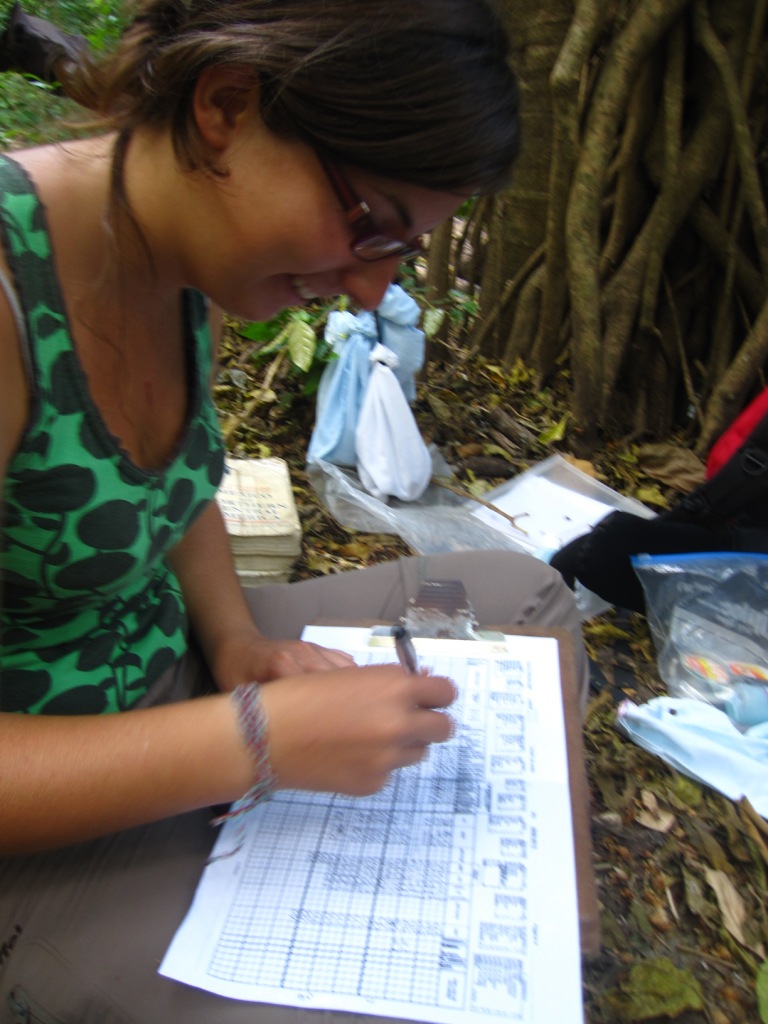
Marlene Kroner, a DED volunteer, performs the tedious task of data entry. Several observations and measurements are made on each bird before releasing it into the wild again. Photo by Lukas Betthausen.

birdwatching nature tours Nicaragua
Each mist netting activity involves three or four days in the field. During the dry season, hammocks are extremely comfortable for sleeping and for a midday nap. Photo by Lukas Betthausen.

Amazilia tzacatl Rufous-tailed Hummingbird Nicaragua
The head of a Rufous-tailed Hummingbird (Amazilia tzacatl) glimmers. Photo by Lukas Betthausen.

Long-tailed Manakin Chiroxiphia linearis Nicaragua birdwatching
A female Long-tailed Manakin (Chiroxiphia linearis) is quite drab in comparison to the adult male. Photo by Lukas Betthausen.

Elegant Trogon elegans birdwatching nature tours Nicaragua
Among the spectacular birds of the forests of Laguna de Apoyo Nature Reserve is the Elegant Trogon (Trogon elegans). The bird is quite docile in the hand in spite of its large size. Photo by Lukas Betthausen.

Passerina ciris Painted bunting birding Nicaragua
Female and immature birds are often drab and even camouflaged in comparison to their male counterparts. This Painted Bunting (Passerina ciris) female has a beautiful green color on its upperparts but it does not compare to the male. Photo by Lukas Betthausen.   

Painted bunting Passerina ciris mist netting Nicaragua MOSI
Red feathers can be seen among the yellow breast, suggesting this Painted Bunting (Passerina ciris) is not a female, but rather, an immature male. Photo by Lukas Betthausen.

Painted Bunting
This Painted Bunting (Passerina ciris) must be an immature male, as its red breast feathers have begun to come in. Photo by Lukas Betthausen.  
Some of the first records of bird species registered by our team are found in publications in the journal Cotinga, to find the articles click on Cotinga (2008), and Cotinga (2009). We are grateful for the support received in this work by DED, US Fish and Wildlife Service, and several other individuals and organizations mentioned in the articles.

Our research on birds is helping to protect the wildlife habitats of Nicaragua. Our research group is the most-published of any in the country, and we are leading the way among conservation professionals in identifying needs and presenting solutions. Our research and conservation activities are directly supported by the Laguna de Apoyo Spanish School. By studying Spanish with the school, you help support the wild nature of Nicaragua.

Would you like to help us with bird monitoring? We are seeking volunteers. Please let us know if you would like to participate. We have projects appropriate for volunteers without any specific qualification, as well as students and researchers in the biological and environmental sciences. We are happy to go birdwatching with you if you would like a skilled companion, too. Whether as a volunteer, donor, researcher, or birdwatcher, your participation helps us learn about and protect the birds of Nicaragua.

Laguna de Apoyo birdwatching
Click on the "escudo" to contact us.

Saturday, April 9, 2011

Bird population monitoring in Laguna de Apoyo Nature Reserve, Nicaragua


This week, our team of Marlene Kroner, Lucas Betthausen, Soren Kraack, and Lorenzo Lopez conducted bird population monitoring by mist netting in Laguna de Apoyo Nature Reserve. Every month, we use mist netting to capture birds for a population monitoring longitudinal study. Here is a selection of the birds they caught in photos, followed by a list of all species captured during this period.


Grey-headed Tanager
Grey-headed Tanager (Eucometes penicillata). Photo by Soren Kraack.
This gorgeous bird escaped our view for years in the reserve, particularly because it is only found in the southwestern section of the crater. We have never documented the Grey-headed Tanager on the northern side of the crater, where Estacion Biologica is situated. In spite of its bright yellow plumage, it is not easily seen, either! It is a resident species, present year-round.

Painted Bunting
Male Painted Bunting (Passerina ciris) having its plumage reviewed and noted in our data bank. Photo by Soren Kraack.
The Painted Bunting is among the most colorful birds in Nicaragua and also in North America, where it nests. The males are exuberantly colored, whereas the females are drab yellow. Our population will be heading northward before the next time we monitor birds by mist netting, next month. This species is of particular concern because of diminishing populations and is listed as Near Threatened on the IUCN Red List. Habitat loss by the intensification of agriculture in the southern and midwestern US is thought to be the principal cause of its recent population drop, but we know little of birds like this one in their southern habitat. Our captures may contribute to better conservation of this species. We have made another blog entry on this gorgeous bird, where you can read more about it.

Stripe-throated Hermit Hummingbird
Stripe-throated Hermit (Phaethornis striigularis). Photo by Soren Kraack.
There are at least ten species of hummingbirds found in the Tropical Dry Forest habitat of Laguna de Apoyo Nature Reserve. The Stripe-throated Hermit prefers more dense forest cover than others such as the Cinnamon Hummingbird which is more common at Estacion Biologica. This little bird may have co-evolved with specific flowers from which it feeds, hence the decurved bill. This species has recently been named as distinct from the Little Hermit (Phaethornis longuemareus) which now is limited to South America.

Yellow-olive Flycatcher
Lesser Greenlet (Hylophylus decurtatus). Photo by Soren Kraack.
The Tropical Dry Forest habitat abounds in flycatchers (Tyrannidae). Among the less flycatcher-like in behavior of this family is the smallish and retiring Yellow-olive Flycatcher (Tolmomyias sulphurescens). It makes a small pyriform nest with an entrance near the bottom. We often have nests in the yard at Estacion Biologica. The feathers at the top of this bird's head have been wettened by the handler to examine ossification of the cranium-a test for the bird's age.

Red-eyed Vireo
Red-eyed Vireo (Vireo olivaceus). Photo by Soren Kraack.
The Red-eyed Vireo migrates long distances between its nesting areas in the US and wintering ranges in Central and South America. Migratory birds are especially vulnerable to the many dangers of a long trip and need to re-establish territories in potentially crowded and hostile areas twice each year. This species is common in season throughout the Laguna de Apoyo Nature Reserve forests.

Here is a list of the birds captured during the April mist netting. Notice how different this list is from the birdwatching list of the same date. It gives you an idea, too, of what you can see when birdwatching in Laguna de Apoyo Nature Reserve.

Catharus ustulatus
Thryothorus rufalbus
Hylocharis eliciae
Chiroxiphia linearis
Eucometis penicillata
Passerina ciris
Xiphorhynchus flavigaster
Turdus grayi
Vireo olivaceus
Chlorostilbon canivetii
Seiurus noveboracensis
Arremonops rufivirgatus
Vermivora peregrina
Basileuterus rufifrons
Myiarchus crinitus
Seiurus aurocapillus
Tolmomyias sulphurescens
Hylocichla mustelina
Thryothorus pleurostictus
Hylophilus decurtatus
Phaethornis striigularis
Dendroica pennsylvanica
Amazilia cyanura

birdwatching Nicaragua
Click on the "escudo" to contact us.


Tuesday, March 22, 2011

Painted Bunting in Laguna de Apoyo Nature Reserve


Among the birds which inhabit Laguna de Apoyo Nature Reserve is the Painted Bunting (Passerina ciris). This migratory bird merits special mention because of the frequency of our observations of it here-it is a common bird in appropriate habitat and in season-and its conservation status. This bird is one of the many reasons Laguna de Apoyo Nature Reserve is great for birdwatching.

Our staff and volunteers (Lorenzo Lopez, Marlene Kroner, Lucas Betthausen, and Soren Kraak) conduct monthly mist netting for bird population monitoring in Laguna de Apoyo Nature Reserve. They captured two of this lovely bird in the most recent mist netting activity. Below are photos and some basic information about the species.

birdwatching Nicaragua
Male Painted bunting captured in mist netting Laguna de Apoyo Nature Reserve, Nicaragua, February 20, 2011

The Painted Bunting
(Extracted from A Guide to the Birds of Costa Rica, by Stiles and Skutch.) The Painted Bunting (Passerina siris) is a species of migratory bird in the Cardinal family. The population winters on the Nicaraguan Pacific Slope. In Costa Rica, it is found chiefly in Tempisque basin and around Golfo de Nicoya and in Térraba region. We present it here because it is commonly observed in season in Laguna de Apoyo Nature Reserve.

Painted Buntings are mostly monogamous and are solitary or in pairs during the breeding season, but sometimes exhibit polygamy. They are shy, secretive and often difficult to see. Males sing from exposed perches and tend to hop along on the ground. The Painted Bunting eats seeds, spiders, insects and caterpillars. It lays 3 or 4 gray-white, brown-spotted eggs, which are incubated by the female for 11–13 days. Two weeks after hatching, the young birds are ready to leave the nest.
Description
The size of the bird is five inch and it weighs 15 gram. Brilliant adult male unmistakable; female above more greenish, below more yellowish than other seedeaters or grassquits.
The male adult: top and sides of head and neck, to sides of breast, violet-blue; back yellow-green; rump and upper tail-coverts pinkish-red; shoulder violet; middle coverts purplish; greater coverts and tertials greenish; rectrices and remiges dusky-purplish; rest of underparts bright red; eye-ring rose-red.
The female adult: above bright olive-green to dull grass-green, often tinged with bluish on sides of crown or nape; below greenish-yellow, washed with green on breast and tinged with olive on sides and flanks; belly sometimes strongly tinged with buff. Upper mandible blackish, lower grayish; legs dusky.
Immatures: like adult female but duller, above more brownish; males below often brighter yellow, females duller and buffier.
Habits
Forages low amid dense cover of brushy second growth, overgrown pastures, high grass, or riverside stands of wild cane; often alone, or in small groups, as when visiting water holes in dry areas; by March a male may accompany a female as though already mated; eats seeds, some fruits and insects.
Voice
Call a sharp chirp or chip.
Range
Breeds in South USA and North Mexico; winters from North Mexico and Florida to West Panama and West Indies.
Red List
Since 1988 the Passerina Siris is on the red list. The IUCN Red List of Threatened Species (also known as the IUCN Red List or Red Data List), founded in 1963, is the world's most comprehensive inventory of the global conservation status of plant and animal species. The International Union for Conservation of Nature (IUCN) is the world's main authority on the conservation status of species. A series of Regional Red Lists are produced by countries or organizations, which assess the risk of extinction to species within a political management unit.
The IUCN Red List is set upon precise criteria to evaluate the extinction risk of thousands of species and subspecies. These criteria are relevant to all species and all regions of the world. The aim is to convey the urgency of conservation issues to the public and policy makers, as well as help the international community to try to reduce species extinction.
The IUCN aims to have the category of every species re-evaluated every 5 years if possible, or at least every ten years. This is done in a peer reviewed manner through IUCN Species Survival Commission (SSC) Specialist Groups, which are Red List Authorities responsible for a species, group of species or specific geographic area, or in the case of BirdLife International, an entire class (Aves).[1]
The Pain
Red List Category & Criteria:
Near Threatened     
Year Assessed:
2008
Assessor/s
BirdLife International
Reviewer/s:
Bird, J. & Butchart, S. (BirdLife International Red List Authority)
Justification:
This species has declined over the long term and apparently continues to do so at a moderately rapid rate. It is therefore considered to be Near Threatened. 
History:
2004
–
Near Threatened
2000
–
Lower Risk/least concern
1994
–
Lower Risk/least concern
1988
–
Lower Risk/least concern


Passerina ciris in Nicaragua
Male Painted Bunting, Laguna de Apoyo Nature Reserve, Nicaragua
FUNDECI/GAIA
http://www.gaianicaragua.org/
Painted Bunting
Click on the "escudo" to contact us.