Spanish school, Research Station, Sustainable tourism, Ecotourism, Fish studies, Bird and other nature studies, Reforestation and Conservation Activities and Hostel in Laguna de Apoyo Nature Reserve, Nicaragua. Birdwatching, SCUBA diving, swimming, hiking, nature and wildlife watching. Hostel, great meals, great friends. Saving the planet and enjoying every minute of it!
www.gaianicaragua.org.
www.twitter.com/lagunaapoyo
Showing posts with label Laguna de Apoyo Nature Reserve. Show all posts
Showing posts with label Laguna de Apoyo Nature Reserve. Show all posts
New friends are made easily, because we are small and we share with people who visit. People come and go, from Nicaragua and beyond. Some to learn, others to give. Everyone ends up doing a little of both.
Bella, our faithful canine, hangs with the gang in front of Estacion Biologica Laguna de Apoyo. Foto Jeffrey McCrary.
Estacion Biologica is not at all pretentious or upscale. We have a simple place, and we are doing simple things: planting trees, studying the environment, birdwatching, sharing our knowledge of the language and culture, and collaborating with the neighbors and the government of Nicaragua to make Laguna de Apoyo Nature Reserve a great place for nature, for decades to come. Our visitors are welcome to pitch in. Our prices are very low, but we are comfortable, and we eat very well! Special food options can always be arranged: gluten- or dairy-free, vegetarian, or vegan.
This is how Spanish homework ends some evenings. Photo Andras Dorgai.
We are perhaps best known in some circles for the Spanish courses we offer, at Apoyo Spanish School. Each year, we impart at least one hundred fifty course units of a week each, custom-designed to fit the abilities and needs of each person. Our students are often travels who want to engage with locals better. Many, however, are learning Spanish for professional reasons, using their language skills in Nicaragua or other nearby countries in their jobs.
Early morning in Lake Apoyo, while clouds cover Pacaya, above the rim of the crater. Photo Andras Dorgai.
Undoubtedly, the best part of spending time at Estacion Biologica Laguna de Apoyo is the lake. Mornings, the lake can be calm and smooth as glass, without a soul to be seen near the water. As the day progresses, however, locals and tourists may come for a dip. There is no water body anywhere that is as comfortable and naturally clean as Laguna de Apoyo, for a great swim. Visibility underwater during a scuba dive may be as much as 10 meters on a calm day.
All ages get involved when monkeys are to be seen. Everyone becomes a kid again! Photo Jeffrey McCrary.
Our property at Estacion Biologica is humble, but blessed with great trees and often with lovely wild animals. Golden-mantled howler monkeys, known locally as mono congo, are over our heads these days, perhaps two hundred days each year. We thank effective conservation policies enacted as part of the management plan that our director, Jeffrey McCrary, coordinated for the Ministry of the Environment and Natural Resources. Several years ago, there were fewer monkeys and they were found in more limited locations than currently.
Apoyo Spanish School students gather for some extra tutoring from Bela. Photo Andras Dorgai.
Volunteers come to Estacion Biologica to participate in specific projects, or in whatever is most needed. One example is the Murrieta family, who recently spent a couple of weeks engaged in all kinds of environmental conservation activities, including the planting of 56 new trees in a reforestation plot in the hillside behind Estacion Biologica. The evenings were filled with discussions ranging from poetry and literature, to politics and saving the environment, to our favorite places in the many cities each of us had lived or visited.
Visits to Estacion Biologica are often a family affair. Photo Jeffrey McCrary.
Each day at Estacion Biologica brings a new, unexpected blessing. The people in these photos are just a sampling of the blessings that have come our way in the most recent months. We are grateful for every hand lent and each voice raised. Please come by or write us!
The Apoyo Volcano exploded in what may have been the most powerful of all the volcanic blasts of the quaternary epoch in Central America, around 23,000 years ago. No humans were around to see it, however, as the first direct or indirect evidence of humans in the area seems to be less than 15,000 years old. We can imagine the awe of the first people to look down into the lake seated at the bottom of the crater. Although the name "Apoyo" matches a Spanish-language word, it actually is a precolombian toponym referring to clear water.
We know nothing of the message or messengers who inscribed on the rocks in Laguna de Apoyo. Photo Pablo Somarriba.
The precolombian people of the region around Apoyo, particularly on the sides of the Pueblos Blancos to the west, and Masaya to the north, did not die out or migrate away. Precolombian roots are seen in the faces and the traditions of the area. Furthermore, in Masaya and a few other areas, some people maintain official indigenous representation, according to registrations with the government from more than a century ago. The precolombian culture was largely erradicated by the Spanish conquest, but these relics give silent testimony to a society that still lives.
Indigenous people of the area left etchinngs in several rocks in Laguna de Apoyo Nature Reserve. Photo Pablo Somarriba.
Students at Apoyo Spanish School can visit the petroglyphs found in different locations near us. The messages have not been deciphered, so each person can imagine and hypothesize about the meanings behind each etching. Some are small, others are a few meters wide. The centuries have passed since these designs and messages were left behind, but thankfully, we are still able to enjoy them.
Possibly an Insect? Turtle? Photo Pablo Somarriba.
The hundreds of years of separation from their prior society has left the native Nicaraguans of this area disconnected from the reasons, language, and messages behind these treasures. Someday, hopefully, there could be a rescue of these petroglyphs for the benefit of the people who continue to live in the area. It is no surprise that many petroglyphs are found here, because of the abundance of rock and the marvelous place that is the interior of the Apoyo crater.
Students of Apoyo Spanish School sit above a large petroglyph in the Apoyo crater. Photo Andras Dorgai
There are a few nice walks on public-access trails in the crater that pass by petroglyphs. These walks can combine great views of landscapes, birds, monkeys, the incredible diversity of plants, and these relics from another era. Some of the trails lead to communities along the edge of the crater, so a walk could terminate with a nice beverage while looking across the lake.
This petroglyph has been carved on the top of a flat bedrock. Photo Andras Dorgai.
If you would like to make a hike to see petroglyphs, please contact us. We would love to take you for a hike that can combine birds, monkeys, useful plants, petroglyphs, and majestic views.
A petroglyph in Laguna de Apoyo Nature Reserve. Photo Andras Dorgai.
Chilling imagery left behind by the precolombian ancestors in Laguna de Apoyo Nature Reserve. Photo Andras Dorgai.
A spooky petroglyph with ann oddity behind. Photo Andras Dorgai.
Some wild animals can be cute, at least at a distance, under controlled conditions, or perhaps just when they are juveniles. Most wild animals, however, demonstrate at some moment that they are wild by acting aggressively, or by feeling depressed or stressed in conditions of confinement. The cuteness and uniqueness of an exotic animal can seduce the most logical of people into thinking that they can provide adequate conditions to a wild animal so that it will actually be happy and willing to act like a domesticated animal, by showing attachment, obeying commands, and generally acting in a safe manner.
An entire genre of movies has recently emerged, showing wild animals acting in human-like ways, sometimes in Happy Feet-style fantasies. A common theme among them is the connection between humans and the animals. The wildness of the animals is almost always conquered by the goodness of people.
The best term for this sentiment is hubris.
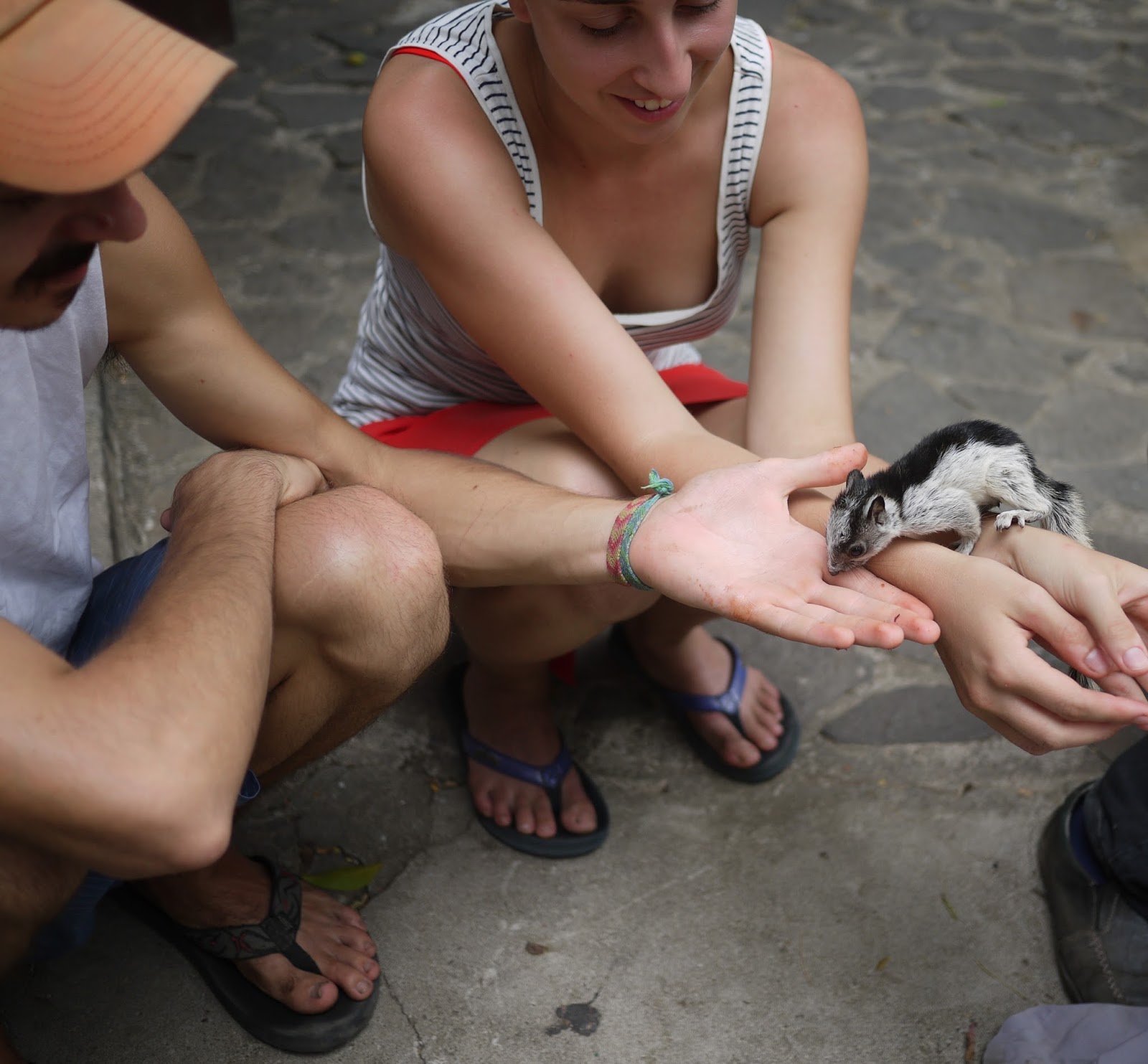
One of several variegated squirrels taken from the pet trade and brought to Estacion Biologica Laguna de Apoyo to transition back to the wild. Photo Andras Dorgai.
This hubris is multiplied when a poor animal is placed for sale at a street light in Managua. So often, we see wild animals such as parrots, toucans, monkeys and even an occasional feline for sale, all bidding to enchant someone enough to plop down a little money and take the animal home to convert it into a family pet.
Purchasing wild animals as pets presents a terrible threat to the populations of animals in the wild. Captures of wild animals for use as pets have decimated the populations of animals such as Scarlet Macaw and the white-faced capuchin monkey in almost all areas throughout the country.
Once wild animals have been made into pets, they may face a difficult transition back into the wild. Photo Jeffrey McCrary.
But the impacts humans have over wild animals because of the pet trade does not stop with the placement of animals who were once wild into cages and forcing them to live in captivity. The habitats where these animals lived is often ravaged to get the animals out. Fire is an effective hunting technique, driving animals from holes in the ground or in large trees. These sites as effective refugia for wild animals are lost, and often, the fires rage onward because the hunters rarely make special efforts to put out the fires they started.
Juvenile squirrels sleep as much as twenty hours per day, in confined spaces in nests, which can be imitated by a bundle of cloths. Photo Jeffrey McCrary.
We do get a particular pleasure from the rehabilitation of variegated squirrels (Sciurus variegatoides). Baby squirrels are often captured by animal traffickers by knocking down nests from the tops of trees, and picking up the baby squirrels that survive the fall. The adults, strong and hostile with sharp teeth, are much less interesting as potential pets than the docile and dependent babies. Once in our hands, they must be handled to give the animals the social interactions they need and to assure that they are feeding well and getting sufficient stimulation and exercise.
Squirrels adapted to humans may even prefer to climb on them over scaling trees. Photo Jeffrey McCrary.
Little by little, squirrels can be reacquainted with their natural habitats. This species of squirrel rarely comes to the ground, finding plenty of bark, small insects and other fauna, fruits and nuts, year-round, high in trees. By coming and going from the security of a well-equipped cage, with a door open, the squirrels can choose to sleep, play, feed, and so on, all through the day. Juvenile squirrels can develop their interest in these foods and habitats little by little, until they may lose their interest in humans entirely.
Whenever safe to do so, juvenile squirrels are allowed to enter and leave their cage at will, so they can get exercise, explore, and socialize with wild squirrels nearby. Photo Jeffrey McCrary.
Whenever squirrels or other wildlife have lost their fear of humans, the dangers they face are abundant. First, they may wander into the hands of people who will capture them all over again and carry them back into the pet trade. Second, they face dangers from domestic animals, cars, and even the risk of being stepped upon can be high. Third, pets may also carry viruses that can affect them.
Squirrels quickly learn whose hand does the feeding. Photo Jeffrey McCrary.
Once a squirrel has become accustomed to humans, it must learn to find food, socialize with wild squirrels, and stay away from danger. Perhaps the single most difficult barrier to returning to the wild, however, is to have a shelter in which to sleep. Young squirrels may make a shelter on their own, without the help of other squirrels, or they may be allowed to enter into the nests made by other squirrels.
Even though Laguna de Apoyo Nature Reserve is a protected area with priority given to native species, cats abound in properties controlled by foreigners. This squirrel, once free and living in the trees above us, was caught by a cat from The Peace Project, and did not survive its wounds. Photo Jeffrey McCrary.
Sometimes, a wild animal is successfully reintroduced into the wild. Squirrels will sometimes survive, and their wild character may return, and they may reintegrate into the community of squirrels in the area. When this happens we are always grateful for all the efforts of so many people who participated in bringing food, spending time to provide care, clean cages, and even provide logistics. Each successful reintroduction into the wild results as the culmination of the efforts of many people.
Socialization from humans may substitute for the relationships lost from the members of their species for social animals such as squirrels. Eventually, however, they must develop relationships with their own species in the wild setting, to prosper in the wild. Photo Jeffrey McCrary.
These squirrels are beginning to learn to spend their days foraging in trees. They are still returning each night to sleep in their cage. Photo Jeffrey McCrary.
Variegated squirrels may lose their fear of humans after being caught, so that they may actually prefer to be with people to spending their days in the trees. But little by little, with encouragement, they learn skills for feeding and socialization in their arboreal environment, eventually to never return. Photo Jeffrey McCrary.
When we receive a wild animal to rescue at Estacion Biologica Laguna de Apoyo, we can not always predict what will happen. Sometimes, the animals are injured so badly that little can be done, beyond securing a peaceful hospice for its last hours of life. But, sometimes, animals with injuries may recover, even when their injuries may have appeared gruesome or grave, initially. The owl brought to us last week is another surprise of this sort, with an unexpectedly happy ending.
Perhaps the most common of the owls in the inhabited portion of the Laguna de Apoyo Nature Reserve is the Pacific Screech-Owl (Megascops cooperi). Its range is limited to the dry tropical forest habitats, farmlands and even residential areas, near the Pacific coast from the Isthmus of Tihuantepec to northwestern Costa Rica.
This species is called corococa locally, in homage to its lively call, which is often answered in kind among the members of a social group. It consumes mostly arthropods, although it is thought to take small rodents, as well. A biological control over some potential nuisances may be managed by its presence, making it a beneficial species to have nearby. Nonetheless, local people often kill any wildlife within view, especially when associated with negative myths, as are owls in the Nicaraguan culture.
Although the Pacific Screech-Owl is not active during the daytime, it often roosts in plain view, on low branches of trees, where its camouflage may keep it unnoticed by humans and other fauna. Nonetheless, if seen, it is likely that Nicaraguans, full of myths about owls and generally hostile to any wild animals within view, will attack an owl with intent to harm. In fact, the Pacific Screech-Owl is among the more commonly received bird species by us at GAIA. The subject of this report, brought to us just a couple of weeks ago in Laguna de Apoyo Nature Reserve, was an injured fledgling.
Juvenile Pacific Screech-Owl, rescued in Laguna de Apoyo Nature Reserve, Nicaragua. Photo Jeffrey McCrary.
This young owl, surely having been flying only days of its life, was found by neighbors, Claudio Arnaudo and Jimmy, who work at a nearby hotel in Laguna de Apoyo. The poor bird was plagued with lesions of different kinds. One eye had swollen shut from trauma. Another lesion, possibly caused in a fall, was evident beneath the beak. A wing was bruised and missing about ten of its flight feathers. As owls tend to be, the little animal was hostile to all who approached. Its injuries impeded flying, however, so there was little it could do, beyond menacing looks and tight grips with the sharp talons, against those who bothered it.
The Pacific Screech-Owl perched on a wall at Estacion Biologica, Laguna de Apoyo, Photo Pablo Somarriba.
After several days, during which it refused all food offered, we thought that the poor owl would soon be dead. Yet, it maintained strength. Then, one evening, we noticed that the owl was communicating with the local, wild owls. Small peeps were emanating from the cage, in evident response to the characteristic calls from the trees.
The wing, still missing half its flight feathers, had nonetheless recovered mobility and some of its strength. We left the owl out of its cage to see what would happen. After a few false starts, the owl was gone.
The following dawn, however, the owl appeared once again, at the same place where it was left free. Its adventure over, it had returned to familiar, if confined, surroundings. This time, the owl was placed back into the cage, but with the cage door maintained open, in case it developed an urge to go back to the wild.
The next evening, owls were heard and spotted nearby. The fledgling owl was once again taken out and placed outside the cage, and this time, we watched as the other owls flew in. The injured owl had friends, this was clear, and this time, it took flight and left with them, not to return. One more wild bird in the forests of Nicaragua, mission accomplished.
In the following video, the fledgling owl is approached by another owl. Whether the owl was fed or simply visited, what is clear is that a firm association was developed.
The story of this fledgling owl, adopted by the local owl-family, was unexpected. Furthermore, we are left to wonder if, indeed, the owl had been getting fed by the local owls through the bars of the cage, all along. That possibility would explain why the health of the owl improved, even though it seemingly was not eating. Regardless, we are glad that the owl could enjoy another day as a free animal, to live and die in the forest instead of in a cage. One more animal that was a victim to the aggression of senseless people was saved and returned to the wild. This owl, given another chance at life in the wild, is free in its natural environment, thanks to the attentiveness and kindness of Claudio and Jimmy. Wild animal rescue, sometimes, can be very gratifying.
We at GAIA are working to make Laguna de Apoyo Nature Reserve, and other places in Nicaragua, friendly habitats for wild nature. You can help us to reduce human-wildlife conflicts, provide environmental education, and conduct scientific research on topics of importance to the environment in Nicaragua. Please join us by sending a contribution or volunteering.
Laguna de Apoyo is called a "laguna", but this term is neither the generally used term in English, nor in Spanish. It is a water-filled volcanic crater, resulting from a huge, volcanic explosion about 23,000 years ago. The lake that occupies the bottom of the crater has no open-water connection to any other body of water, although the water table flows into and out of the lake, and basically defines the lake level.
The lake and the terrestrial interior of the volcanic crater are designated a protected area by the Nicaraguan government, called Laguna de Apoyo Nature Reserve. There are several natural resource-related issues which justify and focus the conservation issues.
Among the issues that make the Laguna de Apoyo Nature Reserve a special place, are the views. The lake provides recreation for lots of people who benefit from seeing and interacting with the natural features, especially the lake itself. Being on the shore or in the lake gives one a view of water, forest and sky, a perfect combination.
Laguna de Apoyo at dawn, from the shore in front of Estacion Biologica. Photo Andras Dorgai.
Especially around holiday periods, the lakeshore becomes a festive gathering spot for locals. The beachfront before Estacion Biologica has always been managed as public-access beach for the benefit of all, in accordance with Nicaraguan law. Many hotels and private properties try to deny locals access to the lakeshore before their properties, in order to provide their clients, usually foreigners and sometimes wealthy Nicaraguans, an exclusive experience, even though laws clearly make all lakeshore public property.
During periods that are less touristic, the beach areas of Laguna de Apoyo may be visited by fewer people. On almost any day, the beach is very quiet at dawn. It's a great moment to see the lake, as light emerges over the edge of the crater, when there is little human activity to distract.
Dawn on Lake Apoyo, from a kayak. Photo Andras Dorgai.
There is something special to enjoy personally, alone, and quietly, at dawn on Laguna de Apoyo. The sounds of people, music, cars and the like, are much lower. The wind is usually much lower, too. Birds can be heard from long distances, even monkeys. The shapes of ripples in the water, and the clouds in the sky, help to make a peaceful start to the day.
The lake is often calm at dawn. Photo Wendy Van Kooten.
We at GAIA feel honored when people want to donate their time, money or materials to help us in our objectives to protect the wild natural resources of Nicaragua. Some people help with our activities as Eco-Warrior Environmental Volunteers, conducting lots of tasks that are important to nature such as reforestation, maintenance, and assistance with wild animal rescue. We love to share our time and efforts with people who share our opinions about the importance of protecting wild nature.
Not everyone can give a block of time to a project such as reforestation. Some people prefer to help by making a small financial donation, or provide some of the materials that are required for our operations, such as foods for animals and containers for planting trees. We want to express our gratitude to the many people who have given small, or sometimes, not so small, material or financial donations to help us do what we do. A few such donations received during the most recent days are mentioned below.
Seeds were donated by the owners of Apoyo Lodge-thank you!
The great folks at Apoyo Lodge dropped by to share with us and they shared their wealth by donating sunflower seeds. It is worth noting that Apoyo Lodge has changed hands, and the new proprietors are particularly kind and conscientious, as is evidenced by their donation of sunflower seeds for the benefit important nutrients. Our rescue macaw has a flexible diet but, like all parrots, requires certain components, among them, seeds which carry certain small-scale nutrients that this bird may not obtain from the other foods in its daily diet in captivity.
The kinds veterinarians at WorldVets donated a surgery for Juju the kinkajou, and some juicy fruits which were readily devoured.
Steve and the team from WorldVets donated a costly treatment of surgeries to Juju, a wild kinkajou that was found badly beaten in Laguna de Apoyo Nature Reserve. The animal was given a chance to live by these operations, which included the removal of a foot and an eye, and closure of an open wound on one cheek. The team dropped in a couple of times to see Juju, and they brought the animal some fruit. From all appearances, watermelon ranks highly in the list of preferred foods for a kinkajou. We often receive severely injured wildlife, and sometimes the success of seeing them heal is worth it all!
Juju the kinkajou likes watermelon. Photo Andras Dorgai.
There are lots of options for a visit to Laguna de Apoyo these days. The people who visit us often want to be involved in some way in doing something good for the environment. Part of keeping the environment safe for wild nature is patrolling to reduce vandalism, hunting, other bad things that harm the public good. We at Gaia support the local institutions in the ways we can. We had noticed the local patrol motorcycle for the police department was using a completely treadless tire, worn dangerously bald from overuse. Mark Connell, a student of Apoyo Spanish School, took note of our concern and provided a cash donation which covered most of the cost of the tire.
We compared prices and models and acquired the best fit for the job, and made an official delivery to the police representative. Now he can participate in hot pursuit safely!
Our local police representative in Laguna de Apoyo desperately needed a new front tire for his patrol motorcycle, which was donated by Mark Connell and funds from Gaia. Here, Juan Carlos presents the new tire along with Pablo and Mileidy from Gaia. Photo Jeffrey McCrary.
The next time we saw him pass by on the motorcycle, we stopped to ask about the tire, and sure enough, he had already had it mounted on the bike.
Our local police motorcycle now sports a fully new front tire! Photo Jeffrey McCrary.
We don't have any large bank accounts to fund projects without some sort of financing, which is a cruel reality for most not-for-profits that are really doing things of benefit to our society. We depend on contributions from our allies and friends. Sometimes, the contributions are small, but really, no contribution is ever to small. Every penny can be put to use in the protection of wild nature in Nicaragua. Missie and Stephen Lavergne recently gave us two (yes, two!) animal transporters-not exactly a small contribution. The transporters are in nearly-new condition and capable of handling animals of different sizes. Who said Christmas doesn't come in April? It will now be more feasible to transport animals-both wildlife and pets such as Lassie.
Lassie tries our our new large-animal transporter, donated by Missy and Stephen Lavergne. Photo Jeffrey McCrary.
The smaller animal transporter donated generously by Stephen and Missy Lavergne is just right for small and medium-sized animals. Thank you! Photo Andras Dorgai.
Lassie, our newest pet addition, was rescued from the street in Managua. For the next long trip, she now has some very comfortable conditions for traveling. Photo Andras Dorgai.
Andras Dorgai has been learning Spanish and helping as an Eco-Warrior Environmental Volunteer. Not only has he provided lots of great help, he also donated a bag of walnuts to the animals. Anyone who has been in Nicaragua knows that they can be very expensive and the cost can seem even more prohibitive when contrasting to the incomes found in Nicaragua. It is not easy for us to keep the animals fed with high-quality foods that meet their special, nutritional needs without donations. Midorna, our rescue Scarlet Macaw, needs nuts as part of her diet, so she is getting a small quantity daily.
Dorgai is passing a walnut to Midorna, part of their daily ritual. Photo Jeffrey McCrary.
Lots of others have donated items and cash recently, particularly in support of our studies of the wild natural resources in the area. The examples mentioned here are presented to demonstrate the diversity of ways to help available. We want to thank everyone who has made a donation. If you would like to donate to Gaia, please click on the "escudo" below or just come by Estacion Biologica Laguna de Apoyo any time!
Although birds are not always easily photographed in the wild, some people are up for the challenge. The following photos were taken by Lars Saenger, who spent two weeks studying at Apoyo Spanish School and watching nature inside the Laguna de Apoyo Nature Reserve. These photos demonstrate that the area is great for practicing nature photography.
Osprey (Pandion haliaetus)
Osprey (Pandion haliaetus) populations found in Nicaragua do not breed locally. The entire Osprey population of Nicaragua is regarded as migratory, nesting further north. Some birds pass through Nicaragua on migratory trips, but many choose the ample aquatic ecosystems to fish in Nicaragua until moving northward for another reproductive period. Ospreys feed almost entirely on fish plucked from the surface of water. Even though the Osprey does not nest in Nicaragua, there are always a few individuals present in Laguna de Apoyo, most likely immatures that remain behind in their southern range until ready for reproduction.
Hoffmann's Woodpecker (Melanerpes hoffmannii)
Most of the bird species found in Nicaragua have wide ranges, often spanning many countries. Some, however, are found in more restrictive ranges, within an ecosystem. One such bird species, Hoffmann's Woodpecker (Melanerpes hoffmannii), is located only in Honduras, Nicaragua, and Costa Rica. The species prospers in both open areas with plenty of trees and natural forest areas in the tropical dry forest region of Nicaragua. Laguna de Apoyo Nature Reserve is an ideal habitat for the bird, which is a close relative to and shares many superficial characteristics with the Red-Bellied Woodpecker (Melanerpes carolinus), a species common through much of the eastern United States. Hoffmann's Woodpecker is active in most areas of the reserve year-round, including both the deepest forest areas and built areas with houses.
Great-tailed Grackle (Quiscalus mexicanus)
Some birds prefer to inhabit areas without human influence, but others may be particularly attracted to humans. One bird that responds positively to human impacts on the forest is the Great-tailed Grackle (Quiscalus mexicanus). They tend to be active throughout the day, loud and ebullient, and many other species do not prosper in their presence. They are not found deep into the forest.
Cinnamon Hummingbird (Amazilia rutila), feeding on the nectar of Tabebuia rosea.
Hummingbirds are always loved by birdwatchers. Their precise movements and delicate forms inspire awe among anyone who sees them. Among the most common hummingbird species in Laguna de Apoyo Nature Reserve is the Cinnamon Hummingbird (Amazilia rutila). It and other hummingbirds consume nectar from flowers, as everyone knows; what fewer people appreciate, however, is that hummingbirds also consume very small arthropods, which they may glean from the air. One example of such prey is the juvenile spiders, that may actually be transported by the wind. The Cinnamon Hummingbird will feed on tiny spiders, often gleaning them from foliage and flowers. This bird species is common particularly near humans, and is even found in peri-urban areas of Managua.
Boat-billed Flycatcher (Megarhynchus pitangua)
Many species of tyrant flycatchers have been documented in Laguna de Apoyo Nature Reserve, among them, the Boat-billed Flycatcher (Megarhynchus pitangua). At first glance, it resembles the Great Kiskadee (Pitangus sulfuratus), but without cinnamon wing-feathers, and with a much more formidable peak and distinctive calls. It can be found in open areas as well as within a relatively closed canopy.
Turquoise-brlowed Motmot (Eumomota superciliosa)
The bird most adored by Nicaraguans is the Turquoise-browed Motmot (Eumomota superciliosa). This lovely species is very common in Laguna de Apoyo Nature Reserve, likely because of the abundant sites for nesting available. The species makes nests in tunnels carved horizontally into loose clay and ash deposits in the steep banks in ravines and road cuts. This site may be among the best to find the species in the entire country.
Dusky-capped Flycatcher (Myiarchus tuberculifer)
Among the numerous species of tyrant flycatchers in Laguna de Apoyo Nature Reserve, is the Dusky-capped Flycatcher (Myiarchus tuberculifer). Its genus consists of several species, some of which are quite difficult to distinguish at a distance. It is common throughout the reserve.
Montezuma Oropendola (Psarocolius montezuma)
Birdwatchers never tire of watching the Montezuma Oropendola (Psarocolius montezuma), especially around a nesting colony. Dozens of nests in the form of woven socks are constructed in a single tree, where the birds engage in highly social behavior among the nesting group. Nesting occurs during the dry season, sometimes starting as early as November, with as many as one hundred birds gathered into a single site! An oropendola colony is always a birdwatching paradise.