Showing posts with label research. Show all posts

Monday, July 3, 2017

Scientific Tourism in Estación Biológica Laguna de Apoyo

For the second time in a week, Estación Biológica Laguna de Apoyo has received reportage in the edition 3 July, 2017 of El Nuevo Diario. Our research station is a point of participation for the protection of Laguna de Apoyo Nature Reserve, through activities in scientific research, environmental education, and conservation activities. Click on the link above and take a look!

scuba dive Nicaragua
GAIA scientist Jeffrey McCrary conducts underwater monitoring in Laguna de Apoyo. Photo Garey Knop.

How to make a center for research, conservation, and education work, we have found, is not easy. We often are in debt, but we carry on. There are plenty of gratifying moments and activities for all of us, which is why we continue. We get to help in small ways to cure nature of the ills caused by humans, through rescue of wild animals, planting and caring for trees, recycling, organizing, educating, coordinating with communities and the government, studying the issues facing the continued protection of the area, and developing policy recommendations. One of the many examples of our success is found in the long list of publications in which we have been involved.

A few areas in which we have worked are mentioned in the cited article. We were involved in getting motorboats and jet skis off the lake permanently. This has been a great advance in the protection of the nature inside the lake, and also makes for a much more pleasant and safe experience for all. Boats have meant ugly noises and danger from constant encroachment onto the spaces of swimmers. Everyone, except the few boaters, are glad they are gone. There are plenty of places to take motorboats, such as Lake Nicaragua, so all people win by the elimination of motorboats from Laguna de Apoyo.

Laguna de Apoyo
The chancho cichlid, Amphilophus chancho, is one of five fish species from Laguna de Apoyo discovered in studies coordinated by GAIA. Photo Adrianus Konings.
Our group has discovered five species of fish that are only found in Laguna de Apoyo. All of these species are descendants of the parent fish of the so-called Midas cichlid (Amphilophus citrinellus). Research coordinated by GAIA demonstrated that the five species in Laguna de Apoyo are genetically distinct from forms in all the other natural areas inhabited by the Midas cichlid.

Scuba divers can join us in monitoring activities on the fish populations in the lake. We are the only approved dive center in Laguna de Apoyo Nature Reserve, and we conduct all our activities in cooperation with the local municipal authorities, MINSA, MARENA, and INTUR.

GAIA maintains the costs of operation of Estación Biológica Laguna de Apoyo through visits, donations, sales of lunch and coffee, hostel stay, and training activities such as intensive Spanish courses. We hope you visit us and get to know what we do. Please come by or write us.

Click on the "escudo" to contact us.

Monday, September 15, 2014

Revista Estudios Ambientales

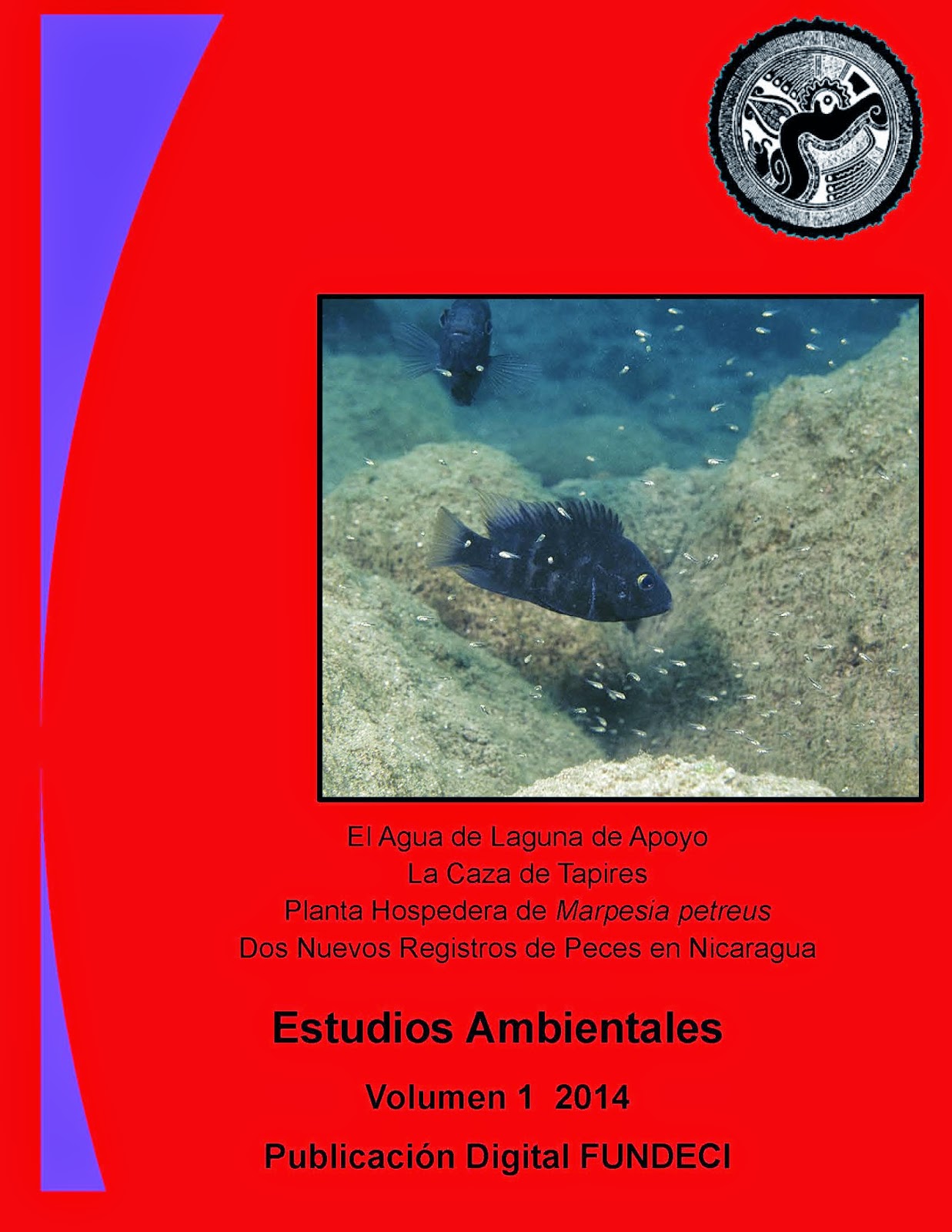
A pesar de las apariencias, las ciencias sí existen en Nicaragua y también inciden en el progreso del país. Hay docenas de científicos en Nicaragua, preparados para contribuir a estudios de varios tipos, incluyendo el campo ambiental. Para promover la comunicación científica entre científicos y los estudiosos del medio ambiente de Nicaragua, FUNDECI patrocina la revista científica Estudios Ambientales, donde aparecen contribuciones al debate cientifíco nacional. 


Estudios Ambientales
Haga clic en la portada para conectarse con Volumen I de Estudios Ambientales.


FUNDECI
Foto Pablo Somarriba.
La revista Estudios Ambientales ya cuenta con un número en publicación, y un equipo editorial de mucha distinción dentro y fuera del país. En el primer número, se documenta registros oficiales de la caza del danto Tapirus bairdii, de la presencia de dos especies de peces en las aguas continentales y de la asociación de una mariposa con una especie de arbol. También hay un informe especial sobre las aguas de la Laguna de Apoyo. Mas de quince diferentes autores de varias instituciones participaron. 

La revista se presenta en español para maximizar el acceso entre los miembros de la comunidad nacional, de forma totalmente gratis y en forma digital. 

La Revista Estudios Ambientales hace el llamado para la remisión de manuscritos para su segundo numero, para ser publicado durante el último cuatrimestre del 2014. Esperamos la inclusión de muchos científicos con aportes nuevos para este número.


estudios ambientales
Foto Salvador Montenegro.

Puedes contactarnos si quieres decirnos algo sobre nuestro blog, o puedes colgar un comentario abajo! 

Puedes ayudarnos a proteger la naturaleza en Nicaragua, haciendo un voluntariado o donando para nuestros proyectos para proteger la naturaleza.

Tropical Kingbird
Click on the "escudo" to contact us. 

Thursday, May 23, 2013

Conservation Science Internships in Nicaragua

Nicaragua is a poor country with lots of natural resources at risk in a rapidly changing socio-economic environment. Whole forests can disappear overnight, lakes can go from pristine to polluted before anyone notices, and species may go extinct without ever getting a name in the first place. FUNDECI/GAIA has developed Conservation Science Internships to promote the protection of Nicaragua's delicate and wonderful natural world. 
Conservation Research
Pier-Olivier Beaudrault, from Sherbrooke University in Quebec, studied the birds of Laguna de Apoyo Nature Reserve. During his internship, he established five monitoring sites for flora and fauna and began collecting data in a project that has now lasted five years. Photo by Catherine Bard-Descheneau.
The forests of the tropics face grave challenges in the twenty-first century. The worldwide construction wood business affects forests globally, as does urbanization locally. Furthermore, poverty drives many people to cut firewood from forests for sustenance and income. Our interns develop useful information to guide the community about what is important in the natural important and how to protect it.

Many of our conservation science interns are students of biology or environmental science, but not all of them. If you would like to participate as a conservation science intern, you don't need to be planning a career in biology. In fact, we can use people of many types of skills which can apply to our projects, ranging from science students to people dedicated to education, computers, construction, and even journalism. There are many ways in which someone can contribute.

Three of our Conservation Science Interns from Holland produced a video about their projects. We hope you like it. Please take a look!


Our focus is on protecting the natural resources of Laguna de Apoyo Nature Reserve. This means a lot more than just counting the monkeys and birds. It also means working with the people of the area. As a result, interns with diverse areas of professional development can be involved, all coinciding in a love of wild nature and a desire to help poor, rural people live more prosperous lives, sustainably. 
bird research
Mara McPartland is an ecologist from Bennington College in the United States. She is making a presentation on the variations in the bird communities in Laguna de Apoyo, according to human impacts on the forest in each site. Photo by Laura Ruysseveldt.
conservation science intern
Our Conservation Science Interns may study some aspect of the biodiversity in the lake or the terrestrial system of the Laguna de Apoyo Nature Reserve. 

conservation science internship
Data gathered in field work is later used for purposes of advancing scientific knowledge and protecting the wild ecosystems found in Laguna de Apoyo Nature Reserve and other natural areas.

bats and birds
Nicaraguans and foreigners will work closely on all projects.
Our current projects for interns include: care and promotion of rescue animals; organization and outreach for conservation and environmental education activities; and wildlife conservation and biodiversity research.
internship Nicaragua
Click on the "escudo" to contact us.

Tuesday, May 21, 2013

A new bat record for Laguna de Apoyo: Pteronotus personatus


We have been studying the bats of Laguna de Apoyo Nature Reserve a while. Three volunteers, Michael Persicke, Lukas Betthaeusen, and Florian Schmid, all have made great contributions to our knowledge of the bats of our area during their volunteer periods sponsored by GIZ. We have 27 bat species on our list, about a quarter of all the species documented in Nicaragua, among the more than 600 bats captured in our studies to date. Nonetheless, there is always something new and special out there. 

Our technician Elmer Nicaragua noticed a small bat hanging from the roof of our patio, and we quickly concluded it was not any of the species we know to be in Laguna de Apoyo Nature Reserve. Elmer captured it with a butterfly net, and we examined it. 

bats in Nicaragua
Wagner's Mustached Bat, Pteronotus personatus, has relatively long, thin wings. Photo by Elizabeth Loudon.
The tiny bat was quickly identified by its distinctive face, long wings, and lack of a wing-sac which some species have. The face was distinctive, with a large flap on the chin. And, of course, hair over the upper lip, hence the name Wagner's Mustached Bat.
bat Nicaragua
This little male Wagner's Mustached Bat is a fully grown male. Photo by Elizabeth Loudon.
Wagner's Mustached Bat consumes insects, and uses Doppler shifts in echolocation. This bat species is not well-known in Nicaragua, and this was our first record of it in Laguna de Apoyo Nature Reserve.
Wagner's Mustached Bat
This tiny bat (Pteronotus personatus) has several unique features on the face and head that may be aids in echolocation. Photo by Elizabeth Loudon. 
We are not surprised at this finding, because we are sure there are many more species of bats in Laguna de Apoyo Nature Reserve than the 27 documented species to date. Our presence here in the reserve, however, and the careful eye of Elmer Nicaragua, allowed us to make this new species record, thanks to his careful, trained eye.
bats in Nicaragua
Adult male Wagner's Mustached Bat (Pteronotus personatus), captured in Estacion Biologica, Laguna de Apoyo Nature Reserve,  Nicaragua, 20 May, 2013. Photo by Elizabeth Loudon.
This bat supposedly roosts in warm caves, but it is likely that this individual just got lost and chose our roof for his rest during the day. He is one more example of the importance of Laguna de Apoyo Nature Reserve to the wildlife of Nicaragua.
Pteronotus personatus
Our little bat takes a few minutes to rest on the clothesline before flying away. Photo by Elizabeth Loudon. 
At FUNDECI/GAIA, we conduct diverse activities to protect wild nature in Nicaragua. Volunteers and conservation science interns are always welcomed. Would you like to work as a conservation science intern? Contact us for more details.
Chiroptera
Click on the "escudo" to contact us.

Monday, February 4, 2013

Jaguar cichlid in Laguna de Apoyo, Nicaragua

-->
Many cichlid fish species evolved in the Nicaraguan Great Lakes system. Among the more popular of the fish of this region are the guapotes, fish of the genus Parachromis. Guapotes can make a very nice fish dinner. The most abundant of the guapotes in the San Juan River and the Nicaraguan Great Lakes is the Jaguar cichlid, Parachromis managuensis. In Nicaragua, it is known as the guapote barcino, in reference to its checkerboard spotted pattern. Along with several species from the Midas cichlid species complex, the Jaguar cichlid make nests in which parental care observations can be made easily during SCUBA diving.
All the mating cichlids native to Nicaragua protect their young for several weeks after hatching. The guapotes have some important structural advantages to parental care over the more common Midas cichlids found in their range. First of all, the guapotes are large, and therefore can sustain large egg loads. It is not uncommon to see over 2000 fry at Jaguar cichlid nest. Secondly, the guapotes all have large mouths adapted to capture fast-swimming fishes. A bite of the Jaguar cichlid could be fatal even to a medium-sized fish. Potential predators know this and tend to avoid the risk of a bad bite.
These hatchling Jaguar cichlids are less than a week old. They stay near the parental units within reach of a natural or dug cave, and they receive parental care up to about 60 days after hatching. Photo by Martin Cabrera. 
Along with several bird species, the Jaguar cichlid sits atop the food web in Lake Apoyo, Nicaragua. It is the only fish in the lake that can kill and consume up to medium-size fish. Adult Jaguar cichlids only eat fish and perhaps crabs.
Hatchling P. managuensis are prone to move toward the diver, a camera, a hand. Photo by Martin Cabrera.
Male Jaguar cichlids differ morphologically from females in its upturned mouth and other aspects of head shape. Like all the other cichlids native to Nicaragua, the males in breeding pairs always exceed the females in size.
This female Jaguar cichlid is never far from her free-swimming fry. Photo by Martin Cabrera.
All cichlid nests can be fascinating, and the Jaguar cichlids are not unique in this respect. Parents may move little in defense of their fry, but they usually don't have to do much, to get the point across to potential predators.
Most cichlids in Nicaragua utilize natural features such as caves and holes to defend their offspring. This Jaguar cichlid is watching her fry just outside of this crevice. Photo by Martin Cabrera.
Breeding seasonality of the Jaguar cichlid is not as strong as in the Midas cichlids in Lake Apoyo. Whereas the Midas cichlids may reproduce in only two to four months during the year, the Jaguar cichlid is found in reproduction most of the year.
A female Jaguar cichlid (P. managuensis) in her nesting site. Photo by Martin Cabrera.
All cichlid fishes in Nicaragua provide extensive parental care to their fry for the first several weeks after they hatch. There is fierce competition among the Jaguar cichlids for high-quality breeding sites such as this one in our photographs. This site is actually a cave under a large rock, with openings on both ends. The male parent of this nest has little or no continued relation with the nest, however. Big male P. managuensis are scarce, and the males tend to abandon nests earlier than the female, in contrast with many other Nicaraguan cichlids. Big males are easily harpooned when on nest, and unscrupulous SCUBA divers often harvest this fish, as a trophy and for a great meal.
This female is emaciated from the physical stress and reduced food intake associated with reproduction. Photo by Martin Cabrera.
Fry feed on detritus and phytoplankton/zooplankton. They stay close to their fellow fry at all times, depending on the maxim safety in numbers. Among the most dangerous predators of cichlid fry are the Bigmouth Sleepers (Gobiomorus dormitor), introduced into Lake Apoyo only 22 years ago. Both adults and juveniles can catch cichlid fry, especially when a single fish has separated from the group. Fry face a much greater risk of capture when separated from their siblings.
Mother P. managuensis and her fry in Lake Apoyo, Nicaragua. Photo by Martin Cabrera.
We at FUNDECI/GAIA are working to determine the population structure of the fishes, plants and other life in Lake Apoyo, Nicaragua. This delicate lake is under tremendous pressure from people who want to do things that affect the lake: fish unsustainably, cultivate agricultural products using agrochemicals, build houses and install grassy gardens which use copious quantities of water and leave pollution in the lake. With a population baseline, we can determine variations in populations of the different fishes and plants which may result from human-induced alterations in the lake.
Parachromis managuensis
This female guapote barcino tends to thousands of fry. Photo by Martin Cabrera.
Click on the "escudo" to contact us.

Friday, February 1, 2013

Bird Studies in Nicaragua

Anyone who has done some birdwatching in Nicaragua knows there are some great birds in this country. Observing birds by binoculars, however, still leaves many details unseen, as the photos below can demonstrate. We get a special opportunity to observe birds up close when mist netting. There are few tasks as gratifying as one involving the observation of a living, wild bird up close, especially our birds here.
birdwatching
Leslie patiently waits for this Blue-tailed Hummingbird (Amazilia cyanura) to fly away. Photo by Emily Williams.
By studying the birds in Laguna de Apoyo Nature Reserve, we are learning about bird communities in the Nicaraguan tropical dry forest habitat that dominates the terrestrial areas in this protected area. We are also learning, however, about land use, by determining which birds are found in different areas according to the human activities in each. Some birds can use only good forest habitats, and they may be getting forced out by forest degradation. We are hoping to demonstrate consistent patterns in bird populations according to land use and to the changing forest structure as a reforested area grows back into a relatively mature, natural forest.
A Yellow-throated Vireo (Vireo flavifrons) wants to make his disagreement known. Photo by Emily Williams.
At least 225 bird species have been documented in Laguna de Apoyo Nature Reserve, to date. Mist netting has helped us confirm several species which had been poorly documented by sightings. Many of the birds captured during mist netting, in appropriate season, are migratory birds, such as the Yellow-throated Vireo (Vireo flavifrons) and the Painted Bunting (Passerina ciris). Perhaps a quarter of the species found in Laguna de Apoyo Nature Reserve are migratory. Almost all migratory birds here nest further north and spend the non-breeding season here.
The male Painted Bunting (Passerina ciris) has dramatic coloration. Photo by Emily Williams.
Some migratory birds winter in mixed-sex flocks, and others segregate by sex and/or age in their southern, nonbreeding range. By counting the birds by sex and age in Laguna de Apoyo, we can help to determine migration patterns for these birds. Appropriate habitat is required for all migratory birds, especially the Red-Listed species such as the Painted Bunting (Near Threatened), and for all sexes and age classes.
Painted Bunting males are bright, whereas the females are drab. Photo by Emily Williams.
Even when the migratory birds have returned to their nesting ranges, the forests and shoreline of Laguna de Apoyo Nature Reserve continue to be conspicuously occupied with birds. The year-round resident birds, which will have become even more evident when the migratory birds have gone, may even reproduce during the stay of most migratory birds, during winter in the northern hemisphere.
The White-tipped Dove (Leptotila verreauxi) is among the larger species we catch commonly in mist netting activities in Laguna de Apoyo Nature Reserve. Photo by Emily Williams.
Not all birds use the same resources, of course. Many resident birds avoid areas with certain kinds of human impacts, such as the elimination of large, old trees, or the clearing of ground cover. The White-tipped Dove (Leptotila verreauxi) is an example. It is common in forest, but quite uncommon in yards, even where the yards have large, old trees. Another resident bird which is affected by human activity is the Northern Barred Woodcreeper (Lepidocolaptes sanctithomae). This species is common on the south side of Lake Apoyo, but absent from the north side, where greater human impacts are found on the vegetation structure. 
The Northern Barred Woodcreeper (Dendrocolaptes sanctithomae) is not well-documented west of Lake Nicaragua. Photo by Emily Williams.
Some of the local people brand us as tree-huggers, which is fine by us. We seem to get in the way of some people who have big plans for building inside the Laguna de Apoyo Nature Reserve, and they would rather that we go away. That gives us even more motivation to continue to work to save the forest and lake of this reserve. The greatest aspect of our bird studies is that of the people-those who are dedicated and even thrilled by the birds, and learn along the way. Our conservation science interns and volunteers bring life to our projects.
Nicaragua birdwatching
Work as a volunteer in wildlife monitoring is exhausting but worthwhile. Photo by Emily Williams.
The most thrilling of the birds we catch with mist nets must be the most demanding for our technicians, the hummingbirds. They are the smallest and, by far, the most delicate of the birds we catch. Hummingbirds keep very little "reserve" to fuel their activities, requiring that they feed and drink often. We give the hummingbirds water when they are captured, and we process them as quickly as possible to allow them to resume their activities with little interruption. Hummingbirds are usually docile in the hand, and sometimes won't fly away immediately when released.

Hummingbirds are not easy to see well when on the wing, so having one in the hand is particularly special. One can appreciate so many particular features of these birds when they are still and close.
With all the information we gather, we are trying to find which birds are segregated by land use and what can be done about it. We are looking for clear recommendations to promote the entire reserve as good forest and lakeshore for the birds.

birds Nicaragua
Click on the "escudo" to contact us.

Tuesday, September 20, 2011

Geckos of Laguna de Apoyo, Nicaragua


wildlife photography in Nicaragua
The Asian House Gecko, Hemidactylus frenatus, has expanded rapidly since its successful introduction a few decades ago. It is displacing native species? Photo by Rachel Lauwerijssen.
Geckos are special animals. They climb on walls and ceilings, inhabiting all houses in Nicaragua, but they are wild animals, not pets. And generally, they are tolerated and even enjoyed by us bipeds. Their chirping, hunting antics, and those eggs found in boxes, shoes, and other enclosures are always innocuous and most often charming. And they are in the forests, too. It's common to see pictures of geckos in trip reports by tourists!
Nonetheless, there is more to the story than that Nicaragua has geckos. In fact, there are several species here; in Laguna de Apoyo Nature Reserve, three species are present; two species are native, and one was recently introduced to Nicaragua. Two students from Holland, Rachel Lauwerijssen and Simone Blomenkamp, are studying these animals to determine what impacts, if any, the introduced species may produce on the native populations. Simone started her study a month ago, and Rachel has just finished in Spanish training, at Laguna de Apoyo Spanish School, and is now at full speed in the study, too.
One of the species native to the area is the yellow-headed gecko, Gonatodes albogularis. The head of the male of the subspecies found in Nicaragua is more brick red than yellow, however. Although all geckos are collectively called perrozompopo (ant-dog in Spanish!) locally, some people recognize that this form exists, as opposed to the more neutral form (see above). It is generally more reclusive than the exotic species.
geckos in Nicaragua
This mail Yellow-headed Gecko is undergoing molt. 
The female yellow-headed gecko can be confused with other geckos without a closer look, given their neutral colors. Most commonly seen by Nicaraguans is the Asian house gecko (Hemidactylus frenatus), which was introduced into Nicaragua a few decades ago. This picture was taken on the wall of Estacion Biologica. It is not clear just how the Asian house gecko first arrived in Nicaragua, although some blame the Panamians, others blame the Cubans coming from Angola in the 1980's! At any rate, it is prolific, and highly reproductive, as the photos in a previous blog entry attest.
Simone and Rachel are gathering data on the abundance of each species in a variety of habitats in Laguna de Apoyo Nature Reserve, to evaluate whether the introduced species has any impacts on the species native to here. They have study locations both in trees and in structures such as houses.
biodiversity intern studying geckos
Simone Blomenkamp taking notes during field work in Laguna de Apoyo Nature Reserve. Photo by Witold Lapinski.
wildlife photography in Nicaragua
Simone Blomenkamp photographing a gecko in Laguna de Apoyo Nature Reserve. Photo by Witold Lapinski.
gecko
Neutral colors on the female yellow-headed gecko (Gonatodes albogularis) combine with a cryptic pattern to aid in predator avoidance. Photo by Simone Blomenkamp.
A third gecko species is found in Laguna de Apoyo Nature Reserve, the yellow-belly gecko (Phyllodactylus tuberculosus). This species is much less abundant than the other two in all the habitats we have evaluated so far. In fact, about two weeks of intense study had passed before we sighted the first one.
Phyllodactylus tuberculosus
Yellow-bellied gecko, Phyllodactylus tuberculosus, at Estacion Biologica, Laguna de Apoyo Nature Reserve. Photo by Simone Blomenkamp.
Nature photographers enjoy watching the geckos and other lizards of Laguna de Apoyo Nature Reserve, because they often give great photography opportunities.
Phyllodactylus tuberculosus
The sticky pads on Phyllodactylus tuberculosus feet in ventral view. Photo by Witold Lapinski.
Finding the yellow-bellied gecko actually was not easy. Over one-hundred geckos had been sighted before the first one had appeared. The sticky foot pads, seen above, are distinctive for this species. The foot pad morphology will dictate the appropriate habitat for the species, and given that the pads are not as extensive as in the introduced species, we ask whether there are problems with aquiring appropriate habitat. We are focussing on how Hemidactylus frenatus may compete with this species for resources.
herpetology study Laguna de Apoyo Nature Reserve
Simone Blomenkamp photographs the first yellow-bellied gecko captured during the study in Laguna de Apoyo Nature Reserve, as Jeffrey McCrary holds the gecko. Photo by Rachel Lauwerijssen.
The geckos captured in some sites are marked for a quantitative population study. Below, the yellow-bellied gecko with markings has been released near its capture site. Each marked individual has a unique pattern, allowing us to identify the individual when observing it.
Phyllodactylus tuberculosus mark and recapture
Yellow-bellied gecko, Phyllodactylus tuberculosus, marked for a population estimate study. Photo by Simone Blomenkamp.
wildlife research in Nicaragua
Rachel Lauwerijssen with a gecko in hand, during field work in Laguna de Apoyo. Rachel has just finished his study at Laguna de Apoyo Spanish Language School, and now he will devote his efforts to study of the geckos. Photo by Witold Lapinski.
The Asian house gecko has often been blamed for the demise of native gecko species in other places, but in Nicaragua, no one has bothered to analyze the potential impacts provoked by the introduction of this species. We intend to generate specific information on habitats of each species, overlaps, fertility, competition, and potentially, predation for each species.
nature photography and wildlife resarch in Nicaragua
Click on the "escudo" to contact us.

Monday, August 15, 2011

Video: Endemic Fish Species in Laguna de Apoyo, Nicaragua, Threatened by Humans


The volcanic crater lakes of Nicaragua attract lots of tourists, both Nicaraguans and foreigners. The water-filled craters are all beautiful, each with its own special features. Eight of these lakes, however, have endemic fish species, daughter species of the ancestral form of the Midas cichlid (Amphilophus citrinellus), living in them. The water of most of these lakes is transparent, perfect for observing these fish while SCUBA diving.
During the nineteenth century, scientists and explorers admired the wide variations in color and shape among the Midas cichlid group, so much so that several species were described during the succeeding fifty years. Most of those species are today lumped back into A. citrinellus, given that this is the first described of the group from Lake Nicaragua. Its sister group, A. labiatus, has similar features but is generally longer and sleeker bodied with prominent lips and frenum. This fish became incorporated into the aquarium hobby trade in a brightly colored form, and is still known as the red-devil cichlid. Only these two species "survived" the scientific scrutiny of the first three-quarters of the twentieth century.

red devil cichlid
Amphilophus labiatus showing its prominent lips in Laguna de Xiloa, Nicaragua. Photo by Ad Konings.
People knew these fish populated not only the Nicaraguan Great Lakes, but also the volcanic crater lakes along their western shores. The late, visionary scientist George Barlow applied for the first time, multivariate analysis to the morphological characters of fish populations in this group to demonstrate convincingly that A. labiatus and A. citrinellus were different species, and that in Lake Apoyo, a unique species exists as well, which he called the arrow cichlid (Amphilophus zaliosus). This species, more elongate than A. citrinellus and lacking the fat lips of A. labiatus, was found in Lake Apoyo. 
Amphilophus zaliosus SCUBA diving
A pair of Amphilophus zaliosus on nest, in breeding coloration. Photo by Ad Konings.
The sacred trinity of A. citrinellus, A. labiatus, and A. zaliosus stood through the remainder of the twentieth century. During the current century, we incorporated the talents of Jay R. Stauffer, Jr. in the taxonomic descriptions of fishes in this group. To date, he has led the descriptions of eight additional species-three from Lake Xiloa, and five from Lake Apoyo, Nicaragua. They will be discussed in a coming blog entry. Most of the species from Lake Apoyo can be appreciated in the video below.
Video by Balasz Lerner.

This second video, produced by Fabio Buitrago, shows underwater footage of endemic fish species in Lake Apoyo, facing a crisis of man-made dimensions-garbage. Everywhere. Why must we pollute their home? These fish-six species known and others not yet discovered-only live here in this lake.

The most common of the fish in this video, and in just about any part of the lake where we have looked, is the little Apoyo cichlid, A. astorquii. It was named in honor of Father Ignacio Astorqui, a Jesuit priest from Spain who devoted much of his life to the study of freshwater fishes of Nicaragua, and wrote the first comprehensive guide to them. A breeding pair with their fry are shown below:

Scuba dive Nicaragua
Amphilophus astorquii pair caring for fry, Laguna de Apoyo, Nicaragua. Photos taken during scuba diving by Adrianus Konings.
Would you like to help us protect and study the endemic cichlid species of Laguna de Apoyo? One of these species is already on the endangered list (Arrow cichlid, Amphilophus zaliosus, Critically Endangered-IUCN). Nicaragua needs your help, because the threats are many, and resources are few. We are seeking divers, biologists, people with experience in excel, and volunteers without any specialized skills to help us in this project. Please contact us if you would like to participate. The Laguna de Apoyo Spanish School also supports this project by providing a portion of its proceeds to fund our studies and conservation efforts. Would you like to learn Spanish? Think about attending our program, and go diving with us, too!

Dive Laguna de Apoyo endemic