Showing posts with label Artibeus jamaicensis. Show all posts

Sunday, April 2, 2017

Animal Rescue XXI: Jamaican Fruit Bat

Bats give most people a creepy feeling when they intrude into a certain safe-space that people have just for animals that could cause irreparable harm. Seeing bats up in the sky is generally acceptable, because most people have come to terms with bats being "up there" and doing the things bats do, for as long as anyone can remember. But bats in the house, for instance, provoke a concern that comes from the subconscious, that is not easily controlled. Not even great admiration for Batman can dissolve the uneasiness they provoke.

Seeing a bat up close in a safe, controlled situation, however, usually works to endear people to them. Bats, after all, have faces, and they are small, and most of them, we know consciously, don't drink the blood of unfortunate humans. Most bats fall into one or another of three categories of diet: fruit, insects, and nectar. All of those bats provide tremendous environmental services that make our natural world work better. They keep down pesky insects, disperse seeds, and fertilize flowers.

We were recently blessed with a project - a juvenile Jamaican Fruit Bat (Artibeus jamaicensis), not fully grown, that was found on the ground and would not fly. It would, however, drink and chew fruits. We at Gaia decided we would take on the project to rescue and try to bring the bat back to a healthy animal, if there was something we could do.

Artibeus jamaicensis
This little guy did not want to fly, but readily drank milk. Photo Jeffrey McCrary

The bat was still not nearly fully grown. As a mammal, it thoroughly enjoyed drinking milk, and it would suck on watermelon and other juicy fruits. We gave it plenty of food, at intervals of less than two hours over a ten-day period.
Artibeus jamaicensis
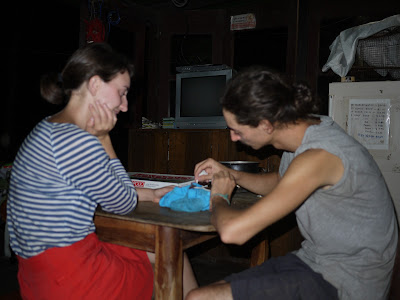
Eco-Warrior Volunteers diligently cared for the baby bat, feeding and cleaning the animal at frequent intervals. Photo Jeffrey McCrary. 

Our Eco-Warrior Enviromental Volunteers were enthusiastic about the animal. The baby bat had all the expected basic, biological functions, but did not grow or get stronger, and eventually succumbed. Meanwhile, we learned a few things.

animal rescue
The bat readily sucked milk out of a cloth, but paper was more easily extracted from his mouth after a feeding. Photo Jeffrey McCrary.

The first thing we learned, is that a bat is capable of responding positively to human attention and comfort. This little animal evidently enjoyed the attention and drank surprisingly large quantities at times. This all made us feel that the effort was not in vain. The bat did not live long, but it was not suffering and it even seemed to enjoy its life at moments.

Eco-Warrior Enviromental Volunteers
Another feeding session with the baby bat. Photo Jeffrey McCrary.
We also learned that we can try to do things that may not always succeed. Success is to often defined by the absence of failure. Even though we did not see the bat grow to an independent creature and fly away to live in the wild, we learned and gave, and this one bat also gained a benefit, by living comfortably a few more days. So, we are happy.

The attempted rescue of this little animal also gave us the opportunity to share with others the story of bats as beneficial creatures. Not all animals we rescue survive to return to the wild, but we try to give them all a chance to live and, if it happens, to die with dignity, especially those animals affected by humans. Some, but not all the stories of wild animal rescue are positive, and some are downright tragic. All of us know, sadly, that the antagonistic relationship that humans sustain with wildlife requires new ways to engage people. We hope that this story reaches people who have not considered what happens to wildlife in the vicinity of humans. This little bat has gone on, but here, the story of this animal continues to reach people who may begin to consider that much of the harsh treatment toward wildlife is unnecessary and even counterproductive. Our staff, visitors, local neighbors and volunteers, and now, our readers can consider that even animals such as this little bat deserve both life and death with dignity.

A bat adorns the wall in Laguna de Apoyo. Photo Pablo Somarriba.

We are engaged in different types of activities at Gaia, not only wild animal rescue. Please read through our blog and visit us, to discuss with us the ways we can protect wild natural resources in Nicaragua. We hope you are engaged, too. If you would like to help us with cages, food, time, or money, to provide care for wild animals in distress, we would be grateful. Please contact us or drop by at Estación Biológica in Laguna de Apoyo Nature Reserve, any time.


Artibeus jamaicensis
Click on the "escudo" to contact us.

Friday, January 13, 2012

Bat monitoring in Laguna de Apoyo Nature Reserve, Nicaragua

We are learning a lot about the forests of Laguna de Apoyo Nature Reserve. At night, when other things are quiet, bats are busy and we are monitoring the bat populations in different areas in the forest. The past couple of years, we have counted on volunteers Lukas Betthauser and Florian Schmid to manage the bat study, among the more ambitious nature studies in Nicaragua. Here are some images from the bats we have seen in our monitoring program.
Albino short-tailed fruit bat, Carollia perspicillata. Photo by Florian Schmid. 
An albino bat seems quite unlikely, given that most bats rely on stealth to catch their victim, or so we have been led to think. In fact, many bats enjoy the good life, consuming fruits and nectar and other things that don't run away when forewarned. The short-tailed fruit bat (also known as Seba's short-tailed bat) is one of those, and it only makes sense that an albino could survive in this species. The light color of this albino would alert predators to his presence, but would not affect his own prey, as the name suggests. Perhaps this albino guy was a little less lucky with the insects, but the 50-100 species of fruit, pollen and nectar would not have avoided him.

The roles in nature filled by bats may be quite diverse. They may disperse fruit, pollenate plants, and control populations of small animals. Some bats eat fish, others eat birds and other bats. There are dozens of species in Laguna de Apoyo Nature Reserve and they help sustain the populations of many other species groups. It's not easy to batwatch, but if you accompany our monitoring team, you will see the bats up close and personal. They are some of the more enignmatic animals of the forest, and suprisingly charismatic when seen from near.
By mist netting in different parts of the reserve, we are gathering information on the habitat use by the bats. We can see strong distinctions in the bat communities according to the way humans impact the forest. Bat communities in the deep forest, far from houses and deforestation, are considerably different than in other places. 
Short-tailed fruit bat is being held by Florian. Photo by Jayne Richards.
Florian and a volunteer measure several parts of a bat. Photo by Jayne Richards. 
Florian extracts a bat from the mist net. Photo by Jayne Richards. 
Each bat in the study is measured before being released into the wild again. Photo by Jeffrey McCrary.

This is the first orange-throated bat (Lampronycteris brachyotis) captured in our studies in Laguna de Apoyo Nature Reserve. Photo by Jayne Richards.

In our research on bats, we are hoping to determine how bats and humans interact. For instance, we want to know whether the bat populations differ according to the land use patterns in different parts of the Laguna de Apoyo Nature Reserve. For instance, some bats, such at the orange-throated bat, have only been found in the deepest forest. The bats we have recorded here are in the following list.

Saccopteryx bilineata (Greater Sac-winged Bat)

Noctilio leporinus (Greater Bulldog bat)

Pteronotus parnellii (Parnell's Mustached Bat)

Micronycteris minuta (White-bellied Big-eared Bat)

Lampronycteris brachyotis (Yellow-throated Big-eared Bat)

Phyllostomus discolor (Pale Spear-nosed Bat)

Phyllostomus hastatus (Greater Spear-nosed Bat)

Glossophaga soricina (Pallas's Long-tongued Bat)

Glossophaga leachii (Gray Long-tongued Bat)

Glossophaga commissarisi (Commissaris's Long-tongued Bat)

Carollia subrufa (Gray Short-tailed bat)

Carollia sowelli (Sowell's Short-tailed bat)

Carollia perspicillata (Seba's Short-tailed Bat)

Sturnira lilium (Little Yellow-shouldered Bat)

Artibeus lituratus (Great Fruit-eating Bat)

Artibeus intermedius (Leaf-nosed bat)

Artibeus jamaicensis (Jamaican fruit bat)

Artibeus inopinatus (Honduran Fruit-eating Bat)

Artibeus phaeotis (Pygmy Fruit-eating bat)

Uroderma bilobatum (Tent-making Bat)

Uroderma magnirostrum (Brown Tent-making Bat)

Platyrrhinus helleri (Heller's Broad-nosed Bat)

Centurio senex (Wrinkle-faced Bat)

Desmodus rotundus (Common Vampire Bat)

Myotis elegans (Elegant Myotis)

Rhogeessa tumida (Black-winged Little Yellow Bat)

Click on the ¨escudo¨ to contact us. 

Saturday, March 5, 2011

Bats!!!

Who would have ever thought bats could be interesting in some way? Once we caught a few, we were fascinated, and we also were sure there was much to learn about Laguna de Apoyo Nature Reserve through them. We conduct a monitoring program on the wildlife in which one segment deals with bat diversity. Our volunteers Lukas and Soren have been very busy with this study.
wildlife
Lukas and Pablo catching bats in Laguna de Apoyo Nature Reserve. Photo by Soren Kraack.

Bat monitoring in Laguna de Apoyo Nature Reserve, Nicaragua. Video produced by David McKnight.


This study is being conducted by the staff of FUNDECI/GAIA with support from the German cooperation organization DED, and coordination with the Ministry of Natural Resources and the Environment in Nicaragua. Researchers, thesis students, and volunteers are all welcome to work with us. We accept volunteers to help us perform wildlife monitoring. If you would like to be involved, please let us know!
bats
Click on the "escudo" to contact us.