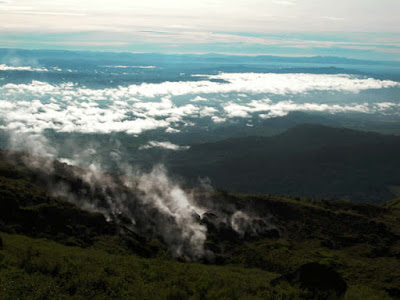
The volcanic crater lakes of Nicaragua were once again the subject of a news article in El Nuevo Diario this week. Anyone who has visited the volcanic crater lakes of Nicaragua would agree that they are quite unique. As a group, they are isolated lakes, without any open water channel connecting any of them to any other water body. Their connection through the water table, with slow filtering of water through the sediments and rocks which eliminates the passage of animals and even microorganisms to and from each lake.
It is precisely this isolation that makes the volcanic crater lakes of particular importance to the study of biodiversity and evolution, and consequently, gives them priority as objects of protection for the conservation of the unique fauna in each lake. The majority of the volcanic crater lakes in Nicaragua have been studied to determine what fish species are found in them. The principal study which documented these lakes was conducted by our group in eight of the volcanic crater lakes, resulting in twenty new distributional records for fish in the country. Prior work had been performed by Jaime Villa, Padre Ignacio Astorqui, and George Barlow, all of whom had conducted some amount of fish studies in one or more volcanic crater lakes.
Each of these eight lakes that have been studied contain unique fauna. Laguna de Apoyo, for instance, is the only wild habitat in the world for six species of fish; Laguna de Xiloa, for another five species. The other, less well-studied lakes on this list, definitely contain unique fish species, as well.
A former employee of our group has more recently sounded the call to name the volcanic crater lakes, collectively, a World Heritage Site, through UNESCO. This idea is not new; in fact, it has been floated repeatedly for the past twenty or so years. While some people host press conferences to hijack ideas for their personal aggrandizement, we are busy doing the things that protect the natural areas of Nicaragua and the biodiversity at risk found in them. For years, GAIA has been on the front lines of defense of the lakes from senseless destruction of the natural resource base in these fragile ecosystems. Although many of the actions go unnoticed by the public, a few have had a larger profile. For instance, GAIA director Jeffrey McCrary served as the coordinator for the development and approval of the official management plan for the Laguna de Apoyo Nature Reserve. The majority of the entries in this blog deal with the activities of GAIA inside that protected area, although several entries deal with other volcanic crater lakes, as well. In summary, we have been there, advocating for the protection of each of these jewels, with real actions resulting in new knowledge and better policy and protection.
In places like Nicaragua, it is easy to find people who want to be in the spotlight, especially foreigners who jet around from country to country, who talk about peace, or saving children from poverty, or the environment. Sometimes, such as in this example, there is not much behind their grandstanding. The real struggle is not about press conferences with grand proposals, but rather, in the trenches, building schools for poor people, spending countless hours dedicated to community involvement in the decision-making processes for natural resource use and protection, and sleepless nights in the thankless job of making a few hours in the forest or under the water turn into peer-reviewed, accepted research publications that provide meaningful justification to protect special places such as the volcanic crater lakes of Nicaragua.
It was not lost on us that someone would discuss the volcanic crater lakes of Nicaragua in the press as if there were no current and historic initiatives to protect them, and even less surprising that it would come from a foreigner who feels the need to plant himself as protagonist in an effort that needs him to accomplish something that no one in Nicaragua could accomplish without his grandeur. It is absurd to think that someone would propose research stations in these natural areas, as if no research had ever been conducted and published already. We have come accustomed to this type of attitude, and we continue to do what we do, as small as it may seem at times. Our organization, unlike other supposed organizations, is real, solvent, and active. We are in constant communication with the communities where we have alliances and with the relevant institutions of government to assure that what we do is appropriate on all levels.
We invite you to visit us at Estacion Biologica Laguna de Apoyo or write us and get to know us. We seek alliances of all kinds, to work hand in hand wherever possible, to keep nature wild and free in Nicaragua. Please contact us!
 |
| GAIA has been active in studying and protecting the fauna and flora of Laguna de Apoyo Nature Reserve. |
Each of these eight lakes that have been studied contain unique fauna. Laguna de Apoyo, for instance, is the only wild habitat in the world for six species of fish; Laguna de Xiloa, for another five species. The other, less well-studied lakes on this list, definitely contain unique fish species, as well.
A former employee of our group has more recently sounded the call to name the volcanic crater lakes, collectively, a World Heritage Site, through UNESCO. This idea is not new; in fact, it has been floated repeatedly for the past twenty or so years. While some people host press conferences to hijack ideas for their personal aggrandizement, we are busy doing the things that protect the natural areas of Nicaragua and the biodiversity at risk found in them. For years, GAIA has been on the front lines of defense of the lakes from senseless destruction of the natural resource base in these fragile ecosystems. Although many of the actions go unnoticed by the public, a few have had a larger profile. For instance, GAIA director Jeffrey McCrary served as the coordinator for the development and approval of the official management plan for the Laguna de Apoyo Nature Reserve. The majority of the entries in this blog deal with the activities of GAIA inside that protected area, although several entries deal with other volcanic crater lakes, as well. In summary, we have been there, advocating for the protection of each of these jewels, with real actions resulting in new knowledge and better policy and protection.
In places like Nicaragua, it is easy to find people who want to be in the spotlight, especially foreigners who jet around from country to country, who talk about peace, or saving children from poverty, or the environment. Sometimes, such as in this example, there is not much behind their grandstanding. The real struggle is not about press conferences with grand proposals, but rather, in the trenches, building schools for poor people, spending countless hours dedicated to community involvement in the decision-making processes for natural resource use and protection, and sleepless nights in the thankless job of making a few hours in the forest or under the water turn into peer-reviewed, accepted research publications that provide meaningful justification to protect special places such as the volcanic crater lakes of Nicaragua.
 |
| GAIA is present and active in Laguna de Apoyo Nature Reserve. |
It was not lost on us that someone would discuss the volcanic crater lakes of Nicaragua in the press as if there were no current and historic initiatives to protect them, and even less surprising that it would come from a foreigner who feels the need to plant himself as protagonist in an effort that needs him to accomplish something that no one in Nicaragua could accomplish without his grandeur. It is absurd to think that someone would propose research stations in these natural areas, as if no research had ever been conducted and published already. We have come accustomed to this type of attitude, and we continue to do what we do, as small as it may seem at times. Our organization, unlike other supposed organizations, is real, solvent, and active. We are in constant communication with the communities where we have alliances and with the relevant institutions of government to assure that what we do is appropriate on all levels.
We invite you to visit us at Estacion Biologica Laguna de Apoyo or write us and get to know us. We seek alliances of all kinds, to work hand in hand wherever possible, to keep nature wild and free in Nicaragua. Please contact us!
 |
| Click on the "escudo" to contact us. |