Showing posts with label Masaya. Show all posts

Sunday, February 28, 2016

Volcano Craziness

Nicaragua has been called the land of lakes and volcanoes. Both dominate the views throughout the Pacific region of the country. Lately, volcanic activity has dominated the national news and the minds of all who live near them. The authorities have evacuated employees from some locations and some residents from a few locations, while intense monitoring of the situation continues. Here is a video of the dramatic volcanic activity in the Santiago Crater of Volcano Masaya.


There are, currently, five volcanoes in Nicaragua that are declared "active", which means something far beyond just heat on the surface or active fumaroles. These are Masaya, Momotombo, Cerro Negro, San Cristobal, and Telica. All are worth a view. The Volcano Masaya National Park is closed until further notice. In this area, the volcanic activity far exceeds anything that has happened there in more than 200 years. Views are best during the evening, particularly during a new moon, either from the Masaya-Managua highway or along the Malecon in the city of Masaya.

Volcano Masaya
The INETER Volcano Cam from 4 March 2016, shows an intense glow on the smoke emitted from the volcano. 


The Masaya Volcano is the main attraction of the Volcano Masaya National Park, located just north of the city of Masaya. The top portion of the crater is devoid of vegetation, hot and arid, and much of its flanks are covered only in annual plants which burn during the occasional dry season forest fires. Trees can not grow in these areas because of the intense heat which reaches to very near the surface of the soil. A volcanic crater lake, one of eleven found in the country, also can be seen in the park.

Make a trip to see them, but remember to be safe and obey the laws and current prohibitions!

Masaya Volcano
The smoke emerging from the mouth of the Santiago crater at Volcano Masaya National Park. Photo Jeffrey McCrary.

Volcano Masaya
Even on a good day, Volcano Masaya emits enormous quantities of smoke and noxious, corrosive gases. It is the largest source of mercury emission in the western hemisphere. On the flanks of the crater interior, a parakeets roost and reproduce in holes, some of which can be seen in the photo. Photo Jeffrey McCrary.

Momotombo
Momotombo Volcano rises from the north edge of Lake Managua. Its sister volcano, Momotombito, can be seen in the distance, an island in the lake. Photo Brenda McCrary.


Casitas Nicaragua
Casitas Volcano has active fumaroles near the summit.

Nicaragua Volcano
The smoking crater of El Hoyo Volcano, as seen from the summit of Casitas. 
Nicaragua
Click on the escudo to contact us.

Thursday, July 16, 2015

Laguna de Apoyo in view


As the largest volcanic crater lake in Nicaragua, Laguna de Apoyo has a lot to see. There are lots of angles and facets, and the perspective changes from hour to hour. Here are a few photos shared by our friends to give you an idea of the different ways people see the lake.
Laguna de Apoyo
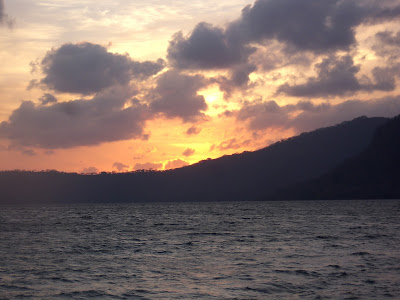
Sunrise is a great moment to be on the lake. Vera Neumann
Usually at dawn, the lake is relatively quiet. During the rainy season, that may mean the volcanic crater lake is so smooth as to reflect the mountains on the opposite side. During the dry season, when winds blow constantly, the lake is just less choppy at dawn, whereas real waves may kick up during the day, as strong gusts build. Throughout the day, constantly changing, the water is never the same.
Laguna de Apoyo
Lake Apoyo may show patches of different colors, when viewed from above, as in this photo taken from Catarina. Ad Konings.
Because Laguna de Apoyo is extremely deep, reaching 178 meters depth, masses of water with different flow patterns may occur. And, of course, there are fish down there, interesting ones. At all times, the lake is a beautiful blue, but the shades of blue may vary in the patches and may also be muted by whitecaps during the strong winds of the dry season, from December through April.

laguna de apoyo
Sometimes views of the lake are sharp and clear, and other times there may be clouds or haze, but the view is always worth a smile. Jessica Lopez.
The forests surrounding the lake serve some very important environmental functions. The first is that the trees sustain the loose, volcanic ash-laden soils on the steep slopes surrounding the lake. Apoyo is a volcanic crater some 23,000 years old, with the water table emerging through the bottom of the crater. The interior sides of the crater are rapidly eroding. in areas where houses have been built or the land has been deforested for whatever reason. In some places where the trees have been cut, the land has given way in dramatic landslides.

Another important function of the forest is to retain the water in the ground. When the sun and wind reach the soils, as in deforested areas, the ground dries and compacts, drawing water out of the water table below and reducing the capacity of the soils to recharge water into the water table during precipitation. 

The forests of  Laguna de Apoyo Nature Reserve are also very important habitat for a wide variety of terrestrial mammals, most notably two species of monkeys and over 225 species of birds. Although the forests of Apoyo are not extensive, they are contiguous with forests of Mombacho and Volcano Masaya, linking a corridor which together makes an important contribution to the biodiversity of the region. 

swimming
Any visit to Laguna de Apoyo must include swimming. Photo Lucy Lia Real.
The best part of the lake for us bipeds is that the water is warm, clean, and inviting. We get into the lake to feel what only being in a natural water body can bring, a sense of renewal. It is no surprise that religions often use water in spiritual renewal rites. Laguna de Apoyo will inspire the most spiritual aspects of anyone, particularly when one gets away from the handful of tourist traps near the entrance.
Nicaragua
Stormy weather can be dramatic in Laguna de Apoyo, worth seeing at a safe distance. Photo Jen Moran.
GAIA is dedicated to keeping Laguna de Apoyo pristine, through working with scientists, tourists and locals to make the best choices for development in the area of the lake. We coordinated with another NGO, CLUSA to develop the management plan now in place in Laguna de Apoyo Nature Reserve, in which our personnel were deeply involved in the community involvement in all the negotiations.

GAIA scientists have discovered five species of fish in Laguna de Apoyo, all of which are only found in this lake.
Laguna de Apoyo
A serene moment at Laguna de Apoyo calls for yoga. Photo Jen Moran.
Laguna de Apoyo deserves your involvement and needs you to help ensure the lake is never destroyed, so that humans and wild nature can find harmony. Please contact us if you would like to join us. We want to year from you.
Laguna de Apoyo
Loving Laguna de Apoyo means leaving only a shadow behind. Catherine Bard-Dechesnau

Laguna de Apoyo
Click on the "escudo" to contact us at Gaia.

Tuesday, February 8, 2011

Flowers of Laguna de Apoyo Nature Reserve


Here we present the flowers of just a few of the more than 500 species of plants documented in Laguna de Apoyo Nature Reserve.

Anoda cristata (Malvaceae). Range from Mexico through Central America. This species is an important weed in some places but is sometimes harvested as a food and medicinal plant. Known in English as spurred anoda or crested anoda.

Cascabela ovata (Apocynaceae). Range from Mexico through Central America. Most of the petals have fallen from this flower, and two fruits are also present.

Achimenes longiflora (Gesneriadeae). A trailing vine with large, beautiful flowers. Over its large range (southern US into South America), several varieties are found.


Rytidostylis gracilis (Cucurbitaceae). Called "chanchito" locally, this annual species is common throughout most of Nicaragua and the neotropics.


Gonolobus barbatus (Apocynaceae). Common in open areas in Nicaragua's Racific region. Flowers in June-October (rainy season), annual.

Tecoma stans (Boraginaceae). Yellow trumpet-flower. Found from southern US through South America. Whereas it is little more than a bush in the northern limits of its range, it is a common and fast-growing tree in Nicaragua. This tree is very important for the ecological recovery of deforested natural areas in the Pacific region of Nicaragua, and is among the most common trees in Laguna de Apoyo Nature Reserve.

Click on the "escudo" to contact us.