Showing posts with label Morpho. Show all posts

Wednesday, July 31, 2013

Brushfoot Butterlies (Nymphalidae): Mariposa!

Although we all enjoy watching butterflies in passing, not many people give them much attention. We all know that they pass from caterpillars to flying beauties via a dramatic physical transformation we call metamorphosis. But of the thousands of butterflies and moths (Order Lepidoptera) found in Nicaragua, much is not known. Only a fraction of the species found in Nicaragua of the moths-those which fly at night-are even documented in Nicaragua, and many species of the butterflies-those that are active in the daytime-have not been documented in the country.
mariposa
Several species of Hamadryas genus butterflies are found in Laguna de Apoyo Nature Reserve. Photo Max Schellekens.
There are hundreds of butterfly species in Laguna de Apoyo Nature Reserve. Researchers at FUNDECI/GAIA have documented well over 200 diurnal butterfly species so far (see this link for a publication). One group of butterflies, called the brushfoots (family Nymphalidae), is notable for its tendency to feed on fermented fruit on the forest floor. This ample group is represented in this area by dozens of species. Some of these species are quite numerous during appropriate seasons. 
butterfly
Una mariposa grande! Photo Max Schellekens.
The great species richness of this group in Laguna de Apoyo Nature Reserve depends on diversity of vegetation. The larval forms of butterflies are usually limited to only a few species of plants for each species. Many species are very particular about the host plants for their larval forms.  Wherever a butterfly species is found, one or more of a small number of potential host plants for the caterpillars of that species must also be found. 
butterfly
The eyespots on the underside of the wing of Morpho helenor. Photo Max Schellekens
This means, quite simply, that butterflies can be important indicators of the conservation status of a natural area. Activities such as selective cutting, forest fires, and clearing vegetation from the forest floor may impact some butterfly species by altering the number of potential host plants available. We have been studying the butterflies of the Nymphalidae family with quantitative methods for a few years, with the intention to compare the communities of this group in different areas of the forests with different land use patterns. 
butterfly
The Malachite (Siproeta stelenes) is quite common in Laguna de Apoyo Nature Reserve. Muy bonita mariposa! Photo Max Schellekens.
Two interns from Holland, Max Schellekens and Hessel van der Weide, reviewed the accumulated data on Nymphalidae butterfly communities and reported on their findings in a presentation in July, 2013. As we expected, the butterfly communities were altered dramatically by more intense land uses such as housing and in secondary forest formed after deforestation. 
la mariposa
The underside of the Malachite (Siproeta stelenes) is far less colorful and dramatic than the upperside, aiding in avoiding predators while perched on the forest floor. Photo Max Schellekens.
Meanwhile, these interns developed some interesting information on when the populations peaked for each species of the group, and where they were most common. This information can be used to determine what environmental factors can be most important for each species, to develop conservation strategies to protect the forests and the animals in them. 
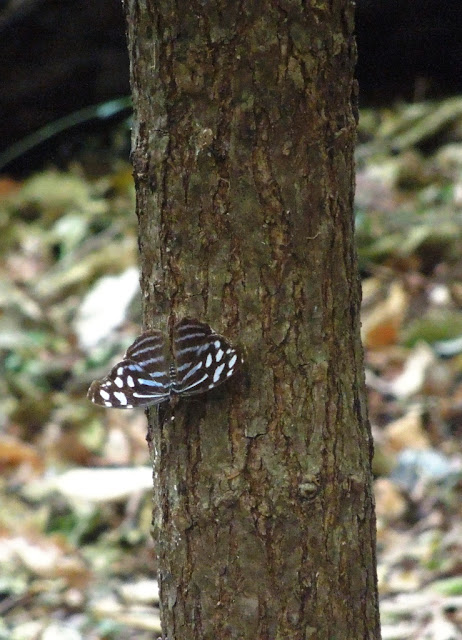
butterfly
Although well-camouflaged when the wings are vertical, many butterflies of Nymphalidae family are conspicuous when viewed along the dorsal side. Photo Max Schellekens.
As consumers of the juices of fruit on the forest floor, these species require strategies against potential predators in trees as well as on the ground. Most Nymphalidae are well-camouflaged when sitting on the forest floor, where checkered patterns of dark and light, neutral colors dominate among leaf litter. When these butterflies as perched on the forest floor, they maintain their wings erect, showing complex patterns of neutral colors on the ventral sides of the wings, which blend with the surroundings.  
butterflies
Some Nymphalidae butterflies are particularly subtle, with cryptic patterns on both sides of the wing. These butterflies tend to inhabit altered areas more, where greater need for hiding is necessary. Photo Max Schellekens.
When dropping their wings, other patterns and colors appear, more vibrant and spectacular. Most brushfoots show dramatic coloration above. Perhaps the most popular of the butterflies of the forests in Nicaragua is the Morpho butterfly (Morpho helenor montezuma), whose dorsal side glows with metallic blue, whereas the underside of the wings are dark with eyespots. One particularly large eyespot near the rear of the hindwing may aid the butterfly by giving the impression of an owl. Many potential predators of a Morpho butterfly would not want to run up against an owl, so this spot may reduce the pressure of predation.
mariposa
Even when butterflies are practically invisible from a distance, the wing patterns upon close examination may be very attractive. Photo Max Schellekens.
As the photographs show in this essay, studying the brushfoot butterflies does not require harming them. The butterflies are trapped passively when they come to the fermented fruit bait, and there they are held a few hours without harm until they are removed, identified, and then released. These butterflies have colors and design patterns that are much better appreciated up close, too, as the photos show. They are all beautiful!
mariposa
Hamadryas butterflies are especially abundant in altered areas in Laguna de Apoyo Nature Reserve. Photo Max Schellekens.
 By making careful observations, the interns were able to make commentaries on the abundance of the butterflies during different seasons and in different locations in Laguna de Apoyo Nature Reserve. Furthermore, they gathered information regarding the sex on the butterflies. Males and females of many species act very differently. Often, females are not very active. Many aspects of the basic biology of the Nymphalidae butterflies is simply not known, and we hope to make a small contribution to the knowledge base, while learning about the butterfly diversity in the different areas of the reserve.
butterfly
La Mariposa Aliazul, or the Bluewing, is far more conspicuous on the dorsal side than the ventral side. Photo Max Schellekens.
By learning when and where each butterfly species is most common, we can build patterns of the web of diversity in the forests of this reserve. Seasonality of butterfly abundance depends on environmental factors such as appropriate conditions for feeding caterpillars in the host plants. 
butterfly
Hamadryas butterflies show dramatic colors and patterns on the dorsal side of the wings. Photo Max Schellekens.
The interns Max and Hessel built on a substantial database developed over five years. During this time, we counted on the labor of several interns and volunteers, and the volunteer support of the students of Apoyo Spanish School as well. Their final presentation was attended by a standing-room-only crowd of conservation professionals, tourism operators, biologists and students. More work is to be done, so potential interns and volunteers are invited to apply!
Nymphalidae
Wing underside patterns of the Nymphalidae butterflies are subtle but, on close observation, filled with fascinating detail. Photo Max Schellekens.
All visitors are welcome to visit us and discuss the butterflies, or to volunteer to participate in our studies. Please contact us for any information you request.
mariposa
Click on the "escudo" to contact us.

Thursday, July 25, 2013

Wildlife Monitoring in Laguna de Apoyo

It is no secret to us who frequent Laguna de Apoyo Nature Reserve that it is under siege from several types of human activities. Forests disappear without anyone taking note and speaking out. Usually, this happens not in fell swoops of forest, but rather, one branch, or a small stem, at a time. Areas get cleared by surreptitious actions of hired workers, a little at a time. Trash and concrete slowly creep across what was jungle.
colibri

How this process, of conversion of land from wild jungle to farmland and summer homes and gardens, affeds wildlife on the scale it is conducted in Laguna de Apoyo, has not been tested much. Common sense would tell us that small alterations to the forest make big changes in the animals that live in it. But we live in a society where lies and misconstructions are stated and accepted as facts, so we set out to compare the fauna of different parts of the forests in Laguna de Apoyo.

mariposa
The title page of the presentation by three interns from Holland. Photo Pablo Somarriba.
 At FUNDECI/GAIA, we have been studying the impacts of human activity in the forests of Laguna de Apoyo Nature Reserve for some five years. The results are now being prepared for publication. A presentation of the results of the impacts on fruit-eating butterflies (family Nymphalidae) and hummingbirds (family Trochilidae) was made at Volcano Masaya National Park, Tuesday 23 July, 2013. Bart Verdicjk, Hessel van der Heide, and Max Schellekens, biology interns from Holland, produced the following videos on the process, which were presented along with results of the studies on butterfly and hummingbird communities in Laguna de Apoyo Nature Reserve.
Intern Max Schellekens presenting the results of butterfly studies while dozens of participants observe. Photo Pablo Somarriba.
These three interns collected data and then they analyzed data on hummingbirds and butterflies during the past five years in different locations in Laguna de Apoyo Nature Reserve. Their presentation was well-attended, not a single seat was found in the house!
Volcano Masaya National Park Director, Liliana Diaz, during an animated discussion after the presentations by the interns. Photo Pablo Somarriba.
A rising consciousness and concern for wild nature is seen in Nicaragua today. The young people of the area of Laguna de Apoyo, many of whom attend Instituto Augusto Flores Silva, made an important representation of the audience, which pleased us infinitely to see.
A standing-room-only crowd in the auditorium of Volcano Masaya National Park! Photo Pablo Somarriba.
The risks that wildlife face in Laguna de Apoyo Nature Reserve are enormous, and as many people recognized in the discussion, tourism provides important elements to a strategy to protect this beautiful natural site. Several professional tour guides were present as well, some of whom added important comments.
Las mariposas de la Laguna de Apoyo. Video Max Schellekens.

Los colibries de la Laguna de Apoyo. Video Max Schellekens.

butterflies
Click on the "escudo" to contact us.

Sunday, September 26, 2010

Lepidoptera!

Morpho helenor montezumae
Yes, butterflies can really look like that! It is Morpho helenor montezuma, a common butterfly in Laguna de Apoyo Nature Reserve. We completed the first phase of our studies on the butterflies and moths (members of the order Lepidoptera) earlier this year (2010), concluding with the publication of a listing of 220 species of butterflies and moths, of which 116 are new reports for the reserve, and 25 are new reports for Nicaragua. We are continuing with special effort placed on the monitoring of moths. Little is known about most groups of tropical moths.

Lepidoptera

The above moth is a typical example of the moths we are encountering in our present phase of study. We can not yet identify it or most of the moths we are capturing, but we are developing a database and slowly identifying the species in collaboration with experts in the field. Below are photos of another "unknown" and our light trap in action.

LepidopteraLepidoptera

Lepidoptera

We have a reference collection of butterflies and moths on display for the public in Estacion Biologica: Our current lines of Lepidoptera study involve light traps for the moths, and fruit traps for butterflies of the family Nymphalidae (brushfoots). Would you like to work with us on butterfly and moth field studies? Please contact us! We have needs for volunteers, students, interns and collaborating scientists.
Lepidoptera
Working collection of Lepidoptera in Estacion Biologica FUNDECI/GAIA, Laguna de Apoyo Nature Reserve, Nicaragua.
Achalarus toxeus
Achalarus jalapus
Cogia cajeta eluina
Typhedanus ampyx
Astraptes anaphus annetta
Astraptes fulgerator azul
Pachyneuria licisca licisca
Pellicia arina
Myrinia raymundo
Bolla eusebius
Bollacupreiceps
Phocides belus
Epargyreus exadeus cruza
Epargyreus spina spina
Elbella scylla
Gorgythion begga pyralina
Gorgythion vox
Hylephila phyleus
Pyrgus oileus
Quasimellana eulogius
Antigonus erosus
Staphylus azteca
Staphylus mazans ascalaphus
Autochton zarex
Autochton bipunctatus
Cycloglypha thrasibulus thrasibulus
Quadrus contubernalis anicius
Quadrus cerialis
Mylon pelopidas
Sostrata bifasciata nordica
Atarnes sallei
Ouleus salvina
Xenophanes tryxus
Polyctor polyctor
Carrhenes calidius
Carrhenes fuscescens
Carrhenes meridensis
Heliopetes alana
Heliopetes laviana
Lerema liris
Polites vibex praeceps
Polites subreticulata
Cabares potrillo
Urbanus dorantes dorantes
Urbanus belli
Urbanus procne
Urbanus simplicius
Urbanus pronta
Urbanus doryssus doryssus
Urbanus evona
Polythrix asine
Polygonus savigny savigny
Codatractus cyda
Codatratcus bryaxis
Codatractus alcaeus alcaeus
Niconiades merenda
Perichares deceptus deceptus
Anatrytone mella
Saliana triangularis
Saliana longirostris
Battus ingenuus
Battus lydicas
Battus polydamas polydamas
Parides montezuma
Parides erithalion sadyattes
Parides iphidamas iphidamas
Parides photinus
Mimoides ilus branchus
Eurytides epidaus epidaus
Eurytides philolaus philolaus
Papilio anchisiades idaeus
Papilio thoas autocles
Papilio polyxenes asterius
Papilio victorinus
Ascia monuste monuste
Ganyra josephina josepha
Itaballia demophile
Leptophobia aripa aripa
Melete lycimnia isandra
Appias drusilla
Pieriballia viardi viardi
Anteos maerula
Anteos clorinde
Eurema arbela boisduvaliana
Eurema daira eugenia
Eurema proterpia
Eurema xanthochlora xanthochlora
Phoebis agarithe agarithe
Phoebis argante argante
Phoebis neocypris virgo
Phoebis philea philea
Phoebis statira jada
Phoebis sennae marcellina
Colia (Zerene) cesonia cesonia
Anaea troglodyta aidea
Archaeoprepona demophon centralis
Archaeoprepona camilla camilla
Consul fabius cecrops
Memphis morvus boisduvalii
Prepona omphale octavia
Siderone marthesia marthesia
Zaretis isidora
Zaretis ellops
Zaretis itys
Asterocampa idyja argus
Doxocopa callianira
Doxocopa laure laure
Doxocopa pavon
Libytheana carinenta mexicana
Adelpha basiloides basiloides
Adelpha fessonia
Adelpha iphiclus iphicleola
Adelpha lycorias melanthe
Colobura dirce dirce
Dynamie postverta mexicana
Historis acheronta acheronta
Historis odius dious
Marpesia chiron marius
Marpesia petreus tethys
Smyrna blomfildia datis
Biblis hyperia hyperia
Callicore pitheas
Eunica sydonia caresa
Eunica mygdonia mygdonia
Eunica monima modesta
Hamadryas amphinome mexicana
Hamadryas februa ferentina
Hamadryas glauconome glauconome
Hamadryas guatemalena guatemalena
Mestra dorcas amymone
Myscelia ethusa pattenia
Myscelia cyaniris cyaniris
Nica flavilla canthara
Temenis laothoe hondurensis
Anartia fatima fatima
Anartia jatrophae luteipicta
Anthanassa drusilla lelex
Anthanassa frisia tulcis
Chlosyne hippodrome hippodrome
Chlosyne theona
Chlosyne lacinia
Chlosyne melanarge
Eresia ithomioides alsina
Junonia evarete
Microtia elva
Siproeta epaphus epaphus
Siproeta stelenes biplagiata
Actinote thalia anteas
Agraulis vanillae incarnata
Altinote ozomene nox
Dione juno juno
Dione moneta poeyii
Dryadula phaetus
Dryas iulia moderata
Euptoieta hegesia hoffmanni
Eueides isabella eva
Heliconius charitonius charitonius
Heliconius erato
Heliconius hecale zuleika
Heliconius ismenius telchinia
Greta morgane oto
Mechanitis polymnia isthmia
Tighorea tarricina pinthas
Mechanitis lysimnia utemaia
Danaus plexippus nigrippus
Danaus eresimus montezuma
Eutresis hypereia theope
Lycorea cleobaea atergatis
Morpho helenor montezuma
Caligo telamonius memnon
Dynastor darius stygianus
Narope cyllastros testacea
Opsiphanes boisduvalii
Opsiphanes cassina fabricii
Opsiphanes tamarindi tamarindi
Magneuptychia libye
Yphthimoides renata
Cissia themis
Cissia similis
Cissia pompilia
Hermeuptychia hermes
Hermeuptychia sosybius
Pierella luna pallida
Taygetic laches laches
Taygetis mermeria excavata
Taygetis rufomarginata
Juditha caucana
Thisbe lycorias lycorias
Synargis mycone
Emesis tegula
Anteros carausius
Caria rhacotis
Lasaia sula sula
Mesosemia telegone telegone
Melanis cephise cephise
Calephelis sp.
Leptotes marina
Everes comyntas texanus
Hemiargus hanno zachaeina
Parrhasius polibetes
Panthyiades bathildis
Panthiades bitias
Panthiades phaleros
Ministrymon clytie
Calycopis isobeon
Evenus regalis
Tmolus echion
Pseudolycaena marsyas damo
Ascalapha odorata
Arsenura armida armida
Dysdaemonia boreas
Automeris hamata
Rothschildia lebeau
Eumorpha fasciatus fasciatus
Eumorpha satelitia licaon
Eumorpha vitis vitis
Protambulyx strigilis

Lepidoptera
Click on the "escudo" to contact us.