Showing posts with label biodiversity. Show all posts

Friday, July 17, 2015

Taller de Biodiversidad con Instituto Juan José Díaz

Nosotros como equipo de personal de Gaia nos preocupamos por lo que piensa la gente en Nicaragua sobre la naturaleza. Desafortunadamente, mucha gente en Nicaragua piensa en serpientes con veneno mortal cuando piensan en el bosque. Invitamos a la comunidad siempre en nuestras actividades de investigación sobre los animales y la naturaleza en la Reserva Natural Laguna de Apoyo. AquÍ, presentamos unas fotos de un pequeño taller de biodiversidad de aves con jóvenes estudiantes de quinto año en el Instituto Juan José Díaz, que es el colegio para nuestros vecinos en la zona de la entrada principal a y dentro de la Reserva Natural Laguna de Apoyo.

aves
Una joven examina una ave capturada en nuestro estudio. Foto Bart Verdick.
Los estudiantes acompañaron al campo a uno de los sitios de estudio donde una captura de aves con redes de neblina. Los estudiantes podían observar la operación de las redes y cuando se capturaba un ave, también podían observar cada individuo de cerca y aprender a manipularlos y anotar datos sobre cada uno.
Nicaragua
Se retira de la red de neblina una ave para el estudio. Foto Bart Verdick.
En este taller, los jóvenes valoraban el trabajo técnico de campo en nuestro estudio de aves con redes de neblina, y luego consideraron las aves capturadas en las redes durante el curso de la mañana del taller.

Nicaragua necesita igualmente de científicos dedicados a estudiar y defender a la vida silvestre del país, y una sociedad conocedora y amante de las maravillas naturales del país. Cuando conocemos con la Reserva Natural Laguna de Apoyo, ya vemos que las maravillas son diversas, y no terminan con lasque se encuentran dentro del agua. Las aves de estos bosques son diversas y especiales.

aves
El senzontle (Turdus grayi). Photo Bart Verdick.
Los participantes del taller, conducido en la Reserva Natural Laguna de Apoyo, vieron al proceso de captura, extracción de las redes, toma de datos, y inspección de las aves, y finalmente, su liberación para volver a sus actividades normales. Cuando se capturó un senzontle (Turdus grayi), los participantes apoyaron en la toma de datos y liberaron al animal a la conclusión de su observación.

aves
Una mano joven libera al senzontle. Foto Bart Verdick.
Es doblemente importante desarrollar un afecto hacia el bosque cuando uno vive en la mera orilla de un gran monumento a la biodiversidad como la Laguna de Apoyo. Nos gusta participar en actividades con el Instituto porque lo vemos como una inversión en el futuro de esta laguna y sus bosques.

aves
Los estudiantes preguntan a nuestro equipo de trabajo de campo sobre los estudios de aves. Foto Bart Verdick. 
Contáctanos si deseas participar en un curso de especialización o una pasantía en el Programa Gaia
Haga "clic" en el escudo para contactarnos


Sunday, June 14, 2015

Rescate Animal XVII: El Milano Chico

Cuando pensamos en la gente de raíces humildes en Nicaragua, tenemos una tendencia de pensar que sea gente sin capacidad de actuar por si misma. En realidad, los nicaragüenses pobres hacen y dicen, escuchan y deciden. El ejemplo de Francisco Aburto, un obrero que vive en el barrio Villa Americas, demuestra como somos los nicaragüenses. 


milano chico
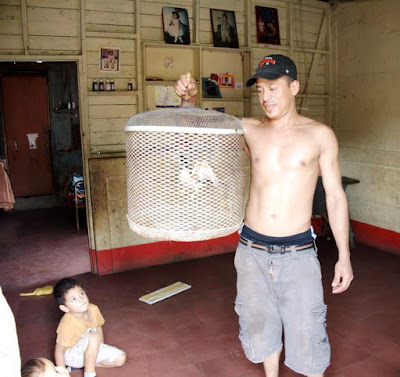
Francisco demuestra el Milano Chico rescatado en la zona oriental de Managua. Foto Jeffrey McCrary.
Francisco escuchó una bulla en un predio al lado de su sitio de trabajo en la parte oriental de Managua. Varios zanates pegaban a un animal, otro ave, y Francisco decidió salvar al animal afectado. Al tenerlo al animal golpeado en la mano, se dio cuenta que es algún tipo de ave rapaz. Se encariño con el pequeño animal y decidió buscar ayuda para que se componga y vuelva a tener su vida normal. 


Gampsonyx swainsonii
El deseo de ayudar al animal fue compartido entre toda la familia. Foto Jeffrey McCrary.
Francisco lo llevó a su casa y con una jaula prestada, le dio refugio. Probaba comidas, pero vio que el ave prefería ratones vivos! El instinto de cazar dominaba en el pequeño animal! Entre los miembros de su familia surgió un debate sobre qué tipo de animal es. Todos estaban de acuerdo que es un ave rapaz, pero no parece a ninguna especie que ellos conocen. Francisco mismo lanzó la hipótesis de que se trata de un Halcón Peregrino, solo que sea muy pequeño. 


gavilan
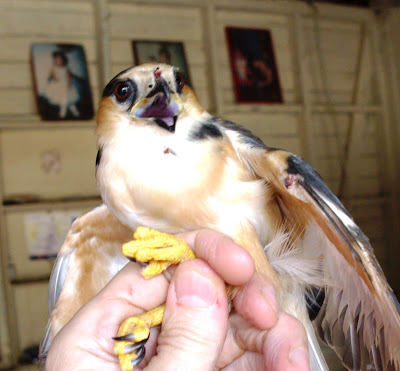
El Milano Chico se ve en excelente estado de salud. Por juvenil, tiene mucho color en el pecho. Foto Jeffrey McCrary.
Francisco y su familia mantuvo saludable al animal con muchos ratones, pero sabían que no se trataba de una mascota. El pequeño gavilán es un animal silvestre, y no quiere vivir en una jaula al anotojo de alguna persona. Por esto, buscaban ayuda para que el Milano Chico pudiera volver a vivir en su estado natural. Francisco y su familia desean que ese animalito viva y muera en el bosque, no en una jaula!

ave
El Milano Chico es arisco, pero bello! Foto Jeffrey McCrary
Francisco y su familia no tienen mucho. Viven en un barrio obrero, sin ningún lujo, pero tienen interés en los animales y en su entorno y quieren aprender, hacer, contribuir. Gracias a ellos, este animalito tiene otra oportunidad de vivir y volar libre


animal silvestre
Pronto vas a estar libre! Foto Jeffrey McCrary
El Milano Chico (Gampsonyx swainsonii) es un gavilán muy poco documentado en Nicaragua. Se ven parados sobre los postes al lado del camino sobre la Carretera a León.


Pearl Kite
Por ahora, este animalito tiene una nueva casa. Y luego,  a volar y no regresar. Hasta pronto! Foto Jeffrey McCrary.
Milano Chico
Click on the "escudo" to contact us.

Saturday, August 30, 2014

Abusador de animales violento agrede a hombre y a tigrillo (PRECAUCION IMAGEN VIOLENTA)

Cuando la gente ve a un animal en venta como mascota en plena calle, muchas veces no piensa nada malo esté pasando. Hay vendedores de perros de raza en las cunetas de diferentes puntos de Managua, por ejemplo detrás de MetroCentro. Hay que cuestionar las condiciones de vida de estos pobres animales que pasan el día en la calle y quién sabe qué condiciones en la noche. 


trafico ilegal
Esta persona repugnante vende una lapa pintada. No basta que este animal se encuentre en peligro de extinción, sino que hay que pintarle de varios colores para que parezca algo distinto. El hombre es el mismo que abusa violentamente del tigrillo en el video presentado abajo. Foto Matthias Geiger.
Peor aún es el caso del vendedor ambulante de animales silvestres. El punto más reconocido de la venta en la calle dentro de la capital se ubica entre los semáforos del Hospital Militar y PriceSmart. Mientras uno puede quejarse de la venta de perros en la calle, esa gente se ampara en la ley, pero los hombres que laboran en la venta de loras y otros animales silvestres en este punto saben bien que lo que hacen es prohibido.

Otro punto es del km 67 en la Carretera Panamericana Norte. Justo al norte de la jurisdicción de municipio Managua, los residentes de este punto conocido como Playitas-Moyua se amparan en implicancias y disinterés entre los oficiales de Ciudad Darío. A lo largo de más de dos décadas, esta gente se dedica a vender animales del bosque como loras, lapas, monos, tucanes, cusucos, y tigrillos. Diario se encuentran varias personas de un caserío pegado a la carretera con sus animales en palos o colgando de sus brazos, mientras pasa el tráfico entre el norte en Managua. Obviamente las personas con dinero que andan en vehículos privados son los motores del tráfico ilícito de estos pobres animales, o bien los vendedores hubieran buscado otro oficio hace años.


mono cara blanca
Esta misma persona vende un mono cara blanca, con loras y chocoyos. Cuándo van a actuar para frenar a esta actividad en contra del patrimonio natural de los nicas? Foto Maggie Folkesson. 
Aunque en muchos respetos la situación ambiental es mejor en Costa Rica que en Nicaragua, los mismos ticos y los extranjeros que dominan las escenas de las periferias y las playas del país semi-permanente refugios consideran igualmente que la vida es mejor acompañado por un mono en una cadena, o un par de loras o una lapa en una jaula. La vida silvestre de ambos países sufre por la casa furtiva para suplir a la demanda de mascotas coloridas que se convierten en símbolos de poder. 

Pero como se aprecia en el vídeo abajo, esta persona que vive y ejerce el oficio de pirata de animales silvestres en el km 67 de la Carretera Norte se pasa de toda expectativa entre los seres humanos. Entendemos que él puede no estar de acuerdo con la venta de animales, pero no podemos aceptar aguantar ni un día más el actuar de esta persona ni la falta de coacción en su contra de parte de las autoridades municipales y del gobierno central. Este hombre, cuyo nombre y apellido son conocidos, abusa a un tigrillo (Felix wiedii) delante de varias personas como se demuestra en la foto abajo y el vídeo publicado en La Prensa


trafico ilegal
Parece ser un objeto ocupado como látigo, pero es un ser vivo. Esta persona repugnante golpea a Ernesto López con un tigrillo (Feliz wiedii), en la Carretera Norte, km 67. Apelamos a las autoridades a rescatar a este animal y castigar a esta persona que ha reincidido en la venta y abuso de animales silvestres sobre muchos años.
Sabemos que las autoridades en MARENA conocen a esta persona y sabemos que ellos tienen una historia dedicándose en buscar alternativas de vida para él y para otros que también viven en ese mismo caserío en la Carretera Norte. Pero no aguantamos más los abusos de esta persona. Insistimos en un acción inmediata y precisa a favor del pobre gato, que es una especie en peligro de extinción y merece un trato totalmente diferente a lo visto aquí. Gracias a La Prensa por compartir sus sentimientos en dos reportajes. 


En FUNDECI/GAIA, pensamos que los animales silvestres deben vivir y morir en el bosque, no en una jaula. Obviamente, muchas personas piensan diferente, pero contamos en que nuestros lectores se sumen a las voces que reclaman los derechos para los animales silvestres. Estos animales se deben de considerarse como patrimonio nacional para crear un mecanismo especial de protección de ellos y de su hábitat.
trafico ilegal
Haga clic en el escudo para contactarnos.

Wednesday, July 31, 2013

Brushfoot Butterlies (Nymphalidae): Mariposa!

Although we all enjoy watching butterflies in passing, not many people give them much attention. We all know that they pass from caterpillars to flying beauties via a dramatic physical transformation we call metamorphosis. But of the thousands of butterflies and moths (Order Lepidoptera) found in Nicaragua, much is not known. Only a fraction of the species found in Nicaragua of the moths-those which fly at night-are even documented in Nicaragua, and many species of the butterflies-those that are active in the daytime-have not been documented in the country.
mariposa
Several species of Hamadryas genus butterflies are found in Laguna de Apoyo Nature Reserve. Photo Max Schellekens.
There are hundreds of butterfly species in Laguna de Apoyo Nature Reserve. Researchers at FUNDECI/GAIA have documented well over 200 diurnal butterfly species so far (see this link for a publication). One group of butterflies, called the brushfoots (family Nymphalidae), is notable for its tendency to feed on fermented fruit on the forest floor. This ample group is represented in this area by dozens of species. Some of these species are quite numerous during appropriate seasons. 
butterfly
Una mariposa grande! Photo Max Schellekens.
The great species richness of this group in Laguna de Apoyo Nature Reserve depends on diversity of vegetation. The larval forms of butterflies are usually limited to only a few species of plants for each species. Many species are very particular about the host plants for their larval forms.  Wherever a butterfly species is found, one or more of a small number of potential host plants for the caterpillars of that species must also be found. 
butterfly
The eyespots on the underside of the wing of Morpho helenor. Photo Max Schellekens
This means, quite simply, that butterflies can be important indicators of the conservation status of a natural area. Activities such as selective cutting, forest fires, and clearing vegetation from the forest floor may impact some butterfly species by altering the number of potential host plants available. We have been studying the butterflies of the Nymphalidae family with quantitative methods for a few years, with the intention to compare the communities of this group in different areas of the forests with different land use patterns. 
butterfly
The Malachite (Siproeta stelenes) is quite common in Laguna de Apoyo Nature Reserve. Muy bonita mariposa! Photo Max Schellekens.
Two interns from Holland, Max Schellekens and Hessel van der Weide, reviewed the accumulated data on Nymphalidae butterfly communities and reported on their findings in a presentation in July, 2013. As we expected, the butterfly communities were altered dramatically by more intense land uses such as housing and in secondary forest formed after deforestation. 
la mariposa
The underside of the Malachite (Siproeta stelenes) is far less colorful and dramatic than the upperside, aiding in avoiding predators while perched on the forest floor. Photo Max Schellekens.
Meanwhile, these interns developed some interesting information on when the populations peaked for each species of the group, and where they were most common. This information can be used to determine what environmental factors can be most important for each species, to develop conservation strategies to protect the forests and the animals in them. 
butterfly
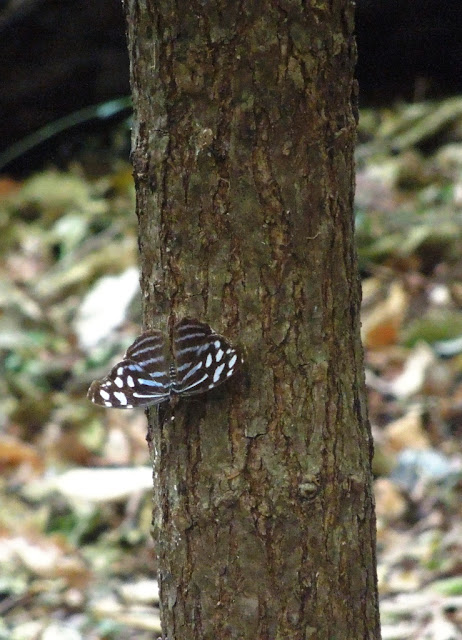
Although well-camouflaged when the wings are vertical, many butterflies of Nymphalidae family are conspicuous when viewed along the dorsal side. Photo Max Schellekens.
As consumers of the juices of fruit on the forest floor, these species require strategies against potential predators in trees as well as on the ground. Most Nymphalidae are well-camouflaged when sitting on the forest floor, where checkered patterns of dark and light, neutral colors dominate among leaf litter. When these butterflies as perched on the forest floor, they maintain their wings erect, showing complex patterns of neutral colors on the ventral sides of the wings, which blend with the surroundings.  
butterflies
Some Nymphalidae butterflies are particularly subtle, with cryptic patterns on both sides of the wing. These butterflies tend to inhabit altered areas more, where greater need for hiding is necessary. Photo Max Schellekens.
When dropping their wings, other patterns and colors appear, more vibrant and spectacular. Most brushfoots show dramatic coloration above. Perhaps the most popular of the butterflies of the forests in Nicaragua is the Morpho butterfly (Morpho helenor montezuma), whose dorsal side glows with metallic blue, whereas the underside of the wings are dark with eyespots. One particularly large eyespot near the rear of the hindwing may aid the butterfly by giving the impression of an owl. Many potential predators of a Morpho butterfly would not want to run up against an owl, so this spot may reduce the pressure of predation.
mariposa
Even when butterflies are practically invisible from a distance, the wing patterns upon close examination may be very attractive. Photo Max Schellekens.
As the photographs show in this essay, studying the brushfoot butterflies does not require harming them. The butterflies are trapped passively when they come to the fermented fruit bait, and there they are held a few hours without harm until they are removed, identified, and then released. These butterflies have colors and design patterns that are much better appreciated up close, too, as the photos show. They are all beautiful!
mariposa
Hamadryas butterflies are especially abundant in altered areas in Laguna de Apoyo Nature Reserve. Photo Max Schellekens.
 By making careful observations, the interns were able to make commentaries on the abundance of the butterflies during different seasons and in different locations in Laguna de Apoyo Nature Reserve. Furthermore, they gathered information regarding the sex on the butterflies. Males and females of many species act very differently. Often, females are not very active. Many aspects of the basic biology of the Nymphalidae butterflies is simply not known, and we hope to make a small contribution to the knowledge base, while learning about the butterfly diversity in the different areas of the reserve.
butterfly
La Mariposa Aliazul, or the Bluewing, is far more conspicuous on the dorsal side than the ventral side. Photo Max Schellekens.
By learning when and where each butterfly species is most common, we can build patterns of the web of diversity in the forests of this reserve. Seasonality of butterfly abundance depends on environmental factors such as appropriate conditions for feeding caterpillars in the host plants. 
butterfly
Hamadryas butterflies show dramatic colors and patterns on the dorsal side of the wings. Photo Max Schellekens.
The interns Max and Hessel built on a substantial database developed over five years. During this time, we counted on the labor of several interns and volunteers, and the volunteer support of the students of Apoyo Spanish School as well. Their final presentation was attended by a standing-room-only crowd of conservation professionals, tourism operators, biologists and students. More work is to be done, so potential interns and volunteers are invited to apply!
Nymphalidae
Wing underside patterns of the Nymphalidae butterflies are subtle but, on close observation, filled with fascinating detail. Photo Max Schellekens.
All visitors are welcome to visit us and discuss the butterflies, or to volunteer to participate in our studies. Please contact us for any information you request.
mariposa
Click on the "escudo" to contact us.

Thursday, July 25, 2013

Wildlife Monitoring in Laguna de Apoyo

It is no secret to us who frequent Laguna de Apoyo Nature Reserve that it is under siege from several types of human activities. Forests disappear without anyone taking note and speaking out. Usually, this happens not in fell swoops of forest, but rather, one branch, or a small stem, at a time. Areas get cleared by surreptitious actions of hired workers, a little at a time. Trash and concrete slowly creep across what was jungle.
colibri

How this process, of conversion of land from wild jungle to farmland and summer homes and gardens, affeds wildlife on the scale it is conducted in Laguna de Apoyo, has not been tested much. Common sense would tell us that small alterations to the forest make big changes in the animals that live in it. But we live in a society where lies and misconstructions are stated and accepted as facts, so we set out to compare the fauna of different parts of the forests in Laguna de Apoyo.

mariposa
The title page of the presentation by three interns from Holland. Photo Pablo Somarriba.
 At FUNDECI/GAIA, we have been studying the impacts of human activity in the forests of Laguna de Apoyo Nature Reserve for some five years. The results are now being prepared for publication. A presentation of the results of the impacts on fruit-eating butterflies (family Nymphalidae) and hummingbirds (family Trochilidae) was made at Volcano Masaya National Park, Tuesday 23 July, 2013. Bart Verdicjk, Hessel van der Heide, and Max Schellekens, biology interns from Holland, produced the following videos on the process, which were presented along with results of the studies on butterfly and hummingbird communities in Laguna de Apoyo Nature Reserve.
Intern Max Schellekens presenting the results of butterfly studies while dozens of participants observe. Photo Pablo Somarriba.
These three interns collected data and then they analyzed data on hummingbirds and butterflies during the past five years in different locations in Laguna de Apoyo Nature Reserve. Their presentation was well-attended, not a single seat was found in the house!
Volcano Masaya National Park Director, Liliana Diaz, during an animated discussion after the presentations by the interns. Photo Pablo Somarriba.
A rising consciousness and concern for wild nature is seen in Nicaragua today. The young people of the area of Laguna de Apoyo, many of whom attend Instituto Augusto Flores Silva, made an important representation of the audience, which pleased us infinitely to see.
A standing-room-only crowd in the auditorium of Volcano Masaya National Park! Photo Pablo Somarriba.
The risks that wildlife face in Laguna de Apoyo Nature Reserve are enormous, and as many people recognized in the discussion, tourism provides important elements to a strategy to protect this beautiful natural site. Several professional tour guides were present as well, some of whom added important comments.
Las mariposas de la Laguna de Apoyo. Video Max Schellekens.

Los colibries de la Laguna de Apoyo. Video Max Schellekens.

butterflies
Click on the "escudo" to contact us.

Wednesday, July 10, 2013

Hummingbirds II: Amazilia cyanura/saucerrottei species complex

There are lots of interesting and important bird studies to be performed in Nicaragua, among them, issues regarding hummingbirds. What habitats hummingbirds prefer, and how human land use impacts each hummingbird species can be an important issue for Nicaragua, especially now that Nicaragua is developing rapidly. To make such analyses, however, identification of the hummingbirds is vital, but not always straightforward. Both the Blue-tailed hummingbird, Amazilia cyanura, and the Steely-vented Hummingbird, Amazilia saucerrottei, are reported for Nicaragua, although they are so similar that we don't trust any distinctions made in reports about them. Conservation science intern Bart Verdijck has been examining the populations of the species in Laguna de Apoyo Nature Reserve, to determine which is here and whether any distinctions can be made in the field, where supposedly, the two species occur together.
Blue tailed hummingbird
This hummingbird is lending us a few minutes of his time to further the knowledge about his species. Is he a Blue-tailed Hummingird (Amazilia cyanura) or a Steely-vented Hummingbird (Amazilia saucerrottei)? Photo Bart Verdijck.
Ten hummingbird species have been recorded in Laguna de Apoyo Nature Reserve to date. Some species are quite rare or even accidental, whereas others are very common. These two species, however, intrigue one in a special way, because little information exists on the two species in the same place.
Steely vented Hummingbird
FUNDECI/GAIA technician Elmer Nicaragua holds a hummingbird. Photo Bart Verdijck.
The intense urbanization all through the region means that hummingbird habitats are being altered rapidly. Without knowing what resources are required for year-round sustenance and reproduction of each species, we are gambling against the hummingbirds with every new forest cleared, building constructed, and parking lot paved. Which hummingbirds among the great diversity of the region will be lost?
Amazilia cyanura
Hummingbirds are easily captured by mist nets for study. Photo Bart Verdijck.
The overlapping ranges of A. cyanura and A. saucerrottei mean that resources upon which the two species depend must be divided somehow. Our first goal is to compare the abundances of these and other hummingbirds in each of several sites in Laguna de Apoyo Nature Reserve, to look for trends according to forest structures and land use patterns.
Amazilia saucerrottei
Elmer examines the tail and wing colors on this hummingbird. Photo Bart Verdijck.
In addition to comparing A. cyanura and A. saucerrottei habitat preferences and abundances in Laguna de Apoyo Nature Reserve through analysis of mist netting data, Bart is examining the populations of all the hummingbirds, using both mist netting and point count results.
Amazilia cyanura
Undertail coverts showing the characteristic pattern of the Steely-vented Hummingbird. Photo Bart Verdijck.
Among the trends hopefully found in the analysis are patterns of reproductive activity. When birds are captured through mist netting, nesting can be inferred from examination of the brood patch which many bird species have-a bare section on the belly, which is highly vascularized and swollen to transfer warmth to eggs, when the birds are sitting.
hummingbird
Examination of the brood patch can demonstrate whether a bird is nesting. Photo Bart Verdijck.

Blue-tailed Hummingbird
This hummingbird shows a wet head after our technicians examined the ossification on its cranium. Photo Bart Verdijck.

Blue-throated Hummingbird
Now that this bird has been examined and measured, it is ready to return to the wild. Photo Bart Verdijck.
Some hummingbirds migrate, most notably the Ruby-throated Hummingbird which nests in North America and can be found in Nicaragua during the cold months in its nesting range. Other hummingbirds also migrate, particularly the Blue-tailed Hummingbird, as folks learned in a study in northern Nicaragua. Elevational migrations toward the end of the dry season may be necessary for many birds in tropical dry forest to survive the last weeks of the period, when food items may disappear.
Steely-vented Hummingbird
The vent of this bird has the characteristic pattern of the Steely-vented Hummingbird. Photo Bart Verdijck.
Laguna de Apoyo Nature Reserve is very small-only 4300 hectares, of which almost half is water. Knowledge of migratory patterns is vital to protecting the species found in this reserve.
hummingbird
The red coloration on the lower mandible terminates before the tip. Photo Bart Verdijck.

hummingbirds
Lacking evident rusty secondary covert feathers (these are bronzy green) demonstrates that this bird is a Steely-vented Hummingbird (Amazilia saucerrottei). Photo Barth Verdijck.

Helping Nicaragua protect its native fauna in the face of rapid development is our challenge. FUNDECI/GAIA is dedicated to protecting wild nature in Nicaragua in harmony with its people. If you would like to work alongside Nicaraguans and visitors from other countries as a volunteer or intern, you are welcome to participate. Hummingbirds and many other species of animals are waiting for your help! 

Steely-vented Hummingbird
Click on the "escudo" to contact us.