Showing posts with label conservation. Show all posts

Thursday, November 13, 2014

Birdwatching in Laguna de Apoyo Nature Reserve III-Land birds

As camera technologies advance, photography continues to become a more interesting option for birdwatching activities. Today, one does not have to be a professional or invest thousands into a hobby to take good pictures of birds. Many of our visitors at Estacion Biologica Laguna de Apoyo come especially for the birds, and some of them even take great photographs. Here, we present the second blog entry highlighting the photography of birdwatchers Jesse Bickley and Anna James.

kiskadee
Great Kiskadee (Pitangus sulfuratus) is very common in the Laguna de Apoyo Nature Reserve and throughout wooded areas in the Pacific region of Nicaragua. Photo Jesse Bickley and Anna James.

Ramphastos
The Keel-billed Toucan (Ramphastos sulfuratus) are always pleasant discoveries here, where they are easier heard than seen. Great photo shots of this species may be difficult, because they prefer forest canopy. Photo Jesse Bickley and Anna James.

birding
Long-tailed Manakins (Chiroxiphia linearis) males dance and sing to attract a mate. The senior male dances in tandem with a junior male who requires up to four years to reach sexual maturity. Photo Jesse Bickley and Anna James.

elegant trogon
The male Elegant Trogon (Trogon elegans) makes an unattractive growl but is quite a beauty to see. Photo Jesse Bickley and Anna James.
trogon
The Black-headed Trogon (Trogon melanocephalus) is quite common on the north side of Lake Apoyo, where Estacion Biologica is located. Photo Jesse Bickley and Anna James.

motmot
Our national bird is the Turquoise-browed Motmot (Eumomota superciliosa). The abundance of steep banks with loose, volcanic soils make Laguna de Apoyo Nature Reserve ideal habitat for this bird. Photo Jesse Bickley and Anna James.

eumomota superciliosa
The pendulum-like swing of the tail of the Turquoise-browed Motmot (Eumomota superciliosa) is thought to discourage predators. Photo Jesse Bickley and Anna James.


clay-colored thrush
The Clay-colored Thrush (Turdus grayi) acts and even sounds similarly to the American Robin of North America. Photo Jesse Bickley and Anna James.
Summer Tanager
Male Summer Tanager (Piranga rubra) make fill our forest with bright color about seven months per year. It accompanies hundreds of other birds in yearly migration, reproducing in North America. Photo Jesse Bickley and Anna James.
Amazilia
The red bill and rusty tail distinguish this bird as the Rufous-tailed Hummingbird (Amazilia tzacatl), much more common in Eastern Nicaragua than in the forests of Laguna de Apoyo Nature Reserve. Photo Jesse Bickley and Anna James.
Birdwatching
The Great Kiskadee is very common in forest edge throughout the Pacific region of Nicaragua. Photo Jesse Bickley and Anna James.
Chestnut-capped Warbler
The Chestnut-capped Warbler (Basileuterus delattrii) is the only year-round resident warbler of the reserve. Photo Jesse Bickley and Anna James.
Groove-billed Ani
Cuckoos such as the Groove-billed Ani (Crotophaga sulcirostris) have a distinctive smell which may serve to protect them from predation. Photo Jesse Bickley and Anna James.

Birding
The Montezuma Oropendola (Psarocolius montezuma) nest communally. Males and females divide the work around the nesting site. Photo Jesse Bickley and Anna James. 
birdwatching
No photo essay on birds in Nicaragua would be complete without the Black Vulture (Coragyps atratus), among the most visible of any bird in the country. Photo Jesse Bickley and Anna James.
Jesse and Anna also took some great photos of birds associated with Lake Apoyo, too. If you would like to schedule a birdwatching tour with one of our specialized birdwatching guides, please contact us!
Please contact us and let us know what you think of our blog, or post a comment below! 

You can help us keep nature wild in Nicaragua, by volunteering your time with us or making a small donation to support our projects in wild nature conservation.

Tropical Kingbird
Click on the "escudo" to contact us. 

Monday, September 15, 2014

Revista Estudios Ambientales

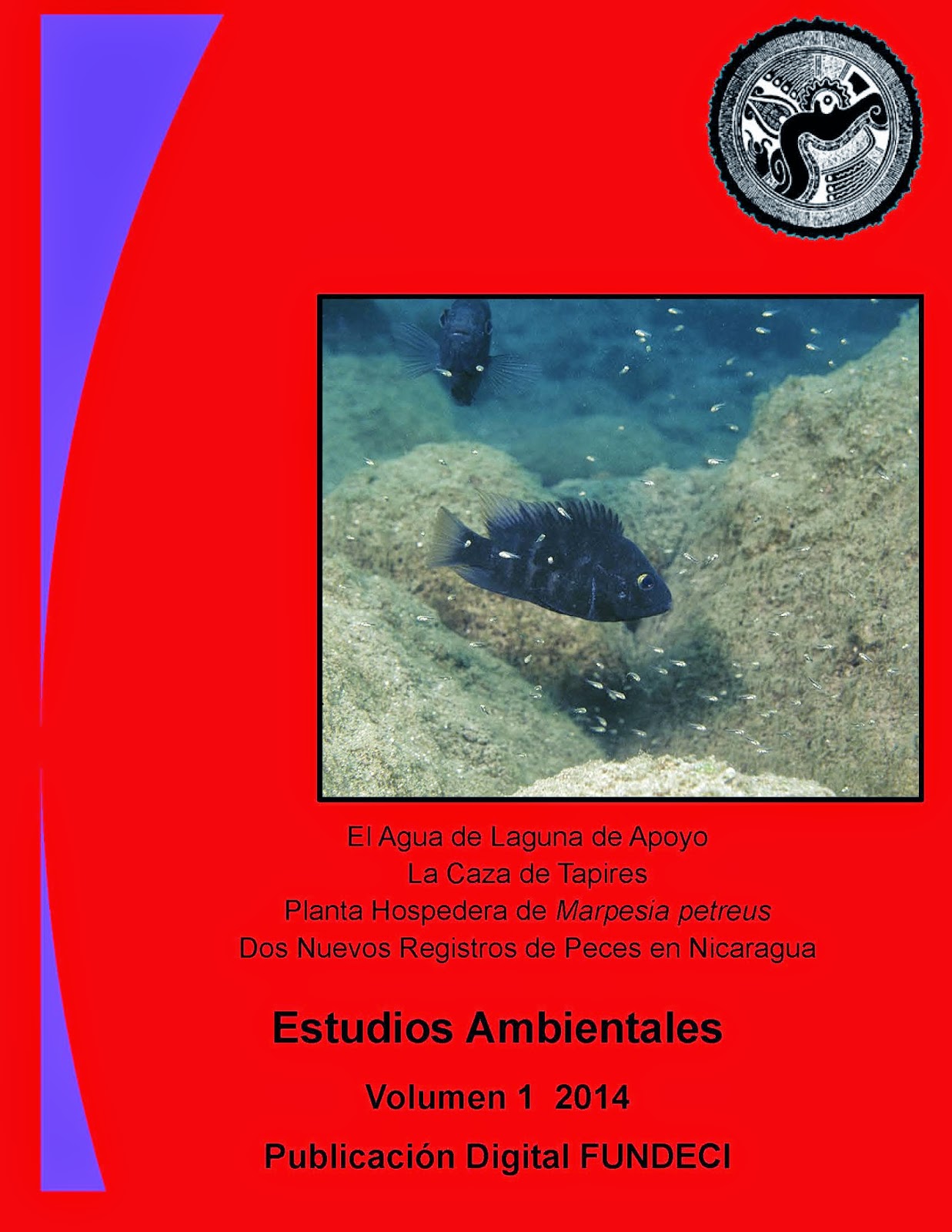
A pesar de las apariencias, las ciencias sí existen en Nicaragua y también inciden en el progreso del país. Hay docenas de científicos en Nicaragua, preparados para contribuir a estudios de varios tipos, incluyendo el campo ambiental. Para promover la comunicación científica entre científicos y los estudiosos del medio ambiente de Nicaragua, FUNDECI patrocina la revista científica Estudios Ambientales, donde aparecen contribuciones al debate cientifíco nacional. 


Estudios Ambientales
Haga clic en la portada para conectarse con Volumen I de Estudios Ambientales.


FUNDECI
Foto Pablo Somarriba.
La revista Estudios Ambientales ya cuenta con un número en publicación, y un equipo editorial de mucha distinción dentro y fuera del país. En el primer número, se documenta registros oficiales de la caza del danto Tapirus bairdii, de la presencia de dos especies de peces en las aguas continentales y de la asociación de una mariposa con una especie de arbol. También hay un informe especial sobre las aguas de la Laguna de Apoyo. Mas de quince diferentes autores de varias instituciones participaron. 

La revista se presenta en español para maximizar el acceso entre los miembros de la comunidad nacional, de forma totalmente gratis y en forma digital. 

La Revista Estudios Ambientales hace el llamado para la remisión de manuscritos para su segundo numero, para ser publicado durante el último cuatrimestre del 2014. Esperamos la inclusión de muchos científicos con aportes nuevos para este número.


estudios ambientales
Foto Salvador Montenegro.

Puedes contactarnos si quieres decirnos algo sobre nuestro blog, o puedes colgar un comentario abajo! 

Puedes ayudarnos a proteger la naturaleza en Nicaragua, haciendo un voluntariado o donando para nuestros proyectos para proteger la naturaleza.

Tropical Kingbird
Click on the "escudo" to contact us. 

Saturday, August 9, 2014

Conservation Science Interns and Volunteers at Laguna de Apoyo Nature Reserve, Nicaragua

There are 78 protected areas in the SINAP system, managed by the Ministry of the Environment and Natural Resources (MARENA) in Nicaragua. Among the most conflictive of these areas is Laguna de Apoyo Nature Reserve, because of the beautiful views and warm, clear water. This protected area faces many challenges but none is as grave as that of real estate development.
FUNDECI/GAIA maintains a permanent presence in Laguna de Apoyo Nature Reserve, through the operation of the biological research station "Estacion Biologica". We conduct a number of environmental studies and conservation actions through our research station there, and we share our knowledge about Nicaragua, its language, culture and great natural heritage through courses and internships offered there.

internship
FUNDECI/GAIA Conservation Science Intern Ruben Pelckmanns participates in bird population monitoring in Laguna de Apoyo Nature Reserve. Photo Pablo Somarriba.
Conservation science interns and volunteers are essential to our work in Laguna de Apoyo Nature Reserve. We are conducting studies of birds, monkeys, plants and fish during 2014 at this location, in coordination with some universities and MARENA. We are comparing animal and plant surveys to previous years to determine how the forests improve or degrade. Frankly, our initial results have suggested some important loss of habitat in some of the most important areas for biodiversity in this location.
conservation science internship
Conservation Science Interns at FUNDECI/GAIA can work on our wildlife monitoring project in the Laguna de Apoyo Nature Reserve. Photo Pablo Somarriba. 
We at FUNDECI/GAIA are committed to seeing Laguna de Apoyo Nature Reserve prosper as a natural area. Obviously, not everyone feels the same, and we have had to deal with some very negative forces in the area, especially coming from people who want to gain riches from investing in property inside the protected area for real estate development. Some of these people really do not like us, and we have recently won an important civil judgment against some of them. There is great opposition to protecting the forest and lake from their greatest enemies, the real estate offices!
internships in Nicaragua
These volunteers left us with a poignant and environmental message.  Photo Pablo Somarriba.
The GAIA Program in Laguna de Apoyo Nature Reserve also promotes environmental conservation projects, particularly reforestation in some of the affected areas in the reserve. Our group was instrumental in the production of the first-ever official management plan for the Laguna de Apoyo Nature Reserve, with GAIA director Jeffrey McCrary as the coordinator of the project, which involved dozens of work meetings with the community and government officials, reviews of biodiversity, geography, land use, sociological factors, and lots of maps and other information for use in the plan.
conservation science
The finding of a freshly dead bird led to a skin preparation. Photo Pablo Somarriba.
Our interns can be involved in ongoing studies on the environment in Laguna de Apoyo Nature Reserve. We have been conducting studies of bird, bat and butterfly populations in the reserve for several years. We are looking for historical trends in populations which may demonstrate differences in land use in five different sites inside the reserve.
conservation science
FUNDECI/GAIA volunteers at Laguna de Apoyo Nature Reserve painted realistic images of some of the wildlife found in the area, along the wall of the entrance to Estacion Biologica. Photo Pablo Somarriba.
Interns may also take on conservation projects. One of our oldest environmental volunteering projects is reforestation. We harvest seeds, plant and grow native trees in our tree nursery, and plant them in deforested areas in the forest. But the most important aspect of our project means the difference between success and failure-it is the continued care of the planted trees for years after planting. Many reforestation projects exist in natural areas, but few of them succeed in recreating natural forest, because tree survival is typically zero for those projects. 

We also rescue wild animals. Interns can work on animal care with our animals, which include two macaws. They can also participate in fundraising for the care and re-introduction of rescued wild animals. 


internships
FUNDECI/GAIA volunteers participate in discussions on the environment and social issues in Nicaragua with guests at Estacion Biologica. Photo Pablo Somarriba.

Nicaragua
Click on the "escudo" to contact us.

Thursday, May 23, 2013

Conservation Science Internships in Nicaragua

Nicaragua is a poor country with lots of natural resources at risk in a rapidly changing socio-economic environment. Whole forests can disappear overnight, lakes can go from pristine to polluted before anyone notices, and species may go extinct without ever getting a name in the first place. FUNDECI/GAIA has developed Conservation Science Internships to promote the protection of Nicaragua's delicate and wonderful natural world. 
Conservation Research
Pier-Olivier Beaudrault, from Sherbrooke University in Quebec, studied the birds of Laguna de Apoyo Nature Reserve. During his internship, he established five monitoring sites for flora and fauna and began collecting data in a project that has now lasted five years. Photo by Catherine Bard-Descheneau.
The forests of the tropics face grave challenges in the twenty-first century. The worldwide construction wood business affects forests globally, as does urbanization locally. Furthermore, poverty drives many people to cut firewood from forests for sustenance and income. Our interns develop useful information to guide the community about what is important in the natural important and how to protect it.

Many of our conservation science interns are students of biology or environmental science, but not all of them. If you would like to participate as a conservation science intern, you don't need to be planning a career in biology. In fact, we can use people of many types of skills which can apply to our projects, ranging from science students to people dedicated to education, computers, construction, and even journalism. There are many ways in which someone can contribute.

Three of our Conservation Science Interns from Holland produced a video about their projects. We hope you like it. Please take a look!


Our focus is on protecting the natural resources of Laguna de Apoyo Nature Reserve. This means a lot more than just counting the monkeys and birds. It also means working with the people of the area. As a result, interns with diverse areas of professional development can be involved, all coinciding in a love of wild nature and a desire to help poor, rural people live more prosperous lives, sustainably. 
bird research
Mara McPartland is an ecologist from Bennington College in the United States. She is making a presentation on the variations in the bird communities in Laguna de Apoyo, according to human impacts on the forest in each site. Photo by Laura Ruysseveldt.
conservation science intern
Our Conservation Science Interns may study some aspect of the biodiversity in the lake or the terrestrial system of the Laguna de Apoyo Nature Reserve. 

conservation science internship
Data gathered in field work is later used for purposes of advancing scientific knowledge and protecting the wild ecosystems found in Laguna de Apoyo Nature Reserve and other natural areas.

bats and birds
Nicaraguans and foreigners will work closely on all projects.
Our current projects for interns include: care and promotion of rescue animals; organization and outreach for conservation and environmental education activities; and wildlife conservation and biodiversity research.
internship Nicaragua
Click on the "escudo" to contact us.

Tuesday, May 21, 2013

A new bat record for Laguna de Apoyo: Pteronotus personatus


We have been studying the bats of Laguna de Apoyo Nature Reserve a while. Three volunteers, Michael Persicke, Lukas Betthaeusen, and Florian Schmid, all have made great contributions to our knowledge of the bats of our area during their volunteer periods sponsored by GIZ. We have 27 bat species on our list, about a quarter of all the species documented in Nicaragua, among the more than 600 bats captured in our studies to date. Nonetheless, there is always something new and special out there. 

Our technician Elmer Nicaragua noticed a small bat hanging from the roof of our patio, and we quickly concluded it was not any of the species we know to be in Laguna de Apoyo Nature Reserve. Elmer captured it with a butterfly net, and we examined it. 

bats in Nicaragua
Wagner's Mustached Bat, Pteronotus personatus, has relatively long, thin wings. Photo by Elizabeth Loudon.
The tiny bat was quickly identified by its distinctive face, long wings, and lack of a wing-sac which some species have. The face was distinctive, with a large flap on the chin. And, of course, hair over the upper lip, hence the name Wagner's Mustached Bat.
bat Nicaragua
This little male Wagner's Mustached Bat is a fully grown male. Photo by Elizabeth Loudon.
Wagner's Mustached Bat consumes insects, and uses Doppler shifts in echolocation. This bat species is not well-known in Nicaragua, and this was our first record of it in Laguna de Apoyo Nature Reserve.
Wagner's Mustached Bat
This tiny bat (Pteronotus personatus) has several unique features on the face and head that may be aids in echolocation. Photo by Elizabeth Loudon. 
We are not surprised at this finding, because we are sure there are many more species of bats in Laguna de Apoyo Nature Reserve than the 27 documented species to date. Our presence here in the reserve, however, and the careful eye of Elmer Nicaragua, allowed us to make this new species record, thanks to his careful, trained eye.
bats in Nicaragua
Adult male Wagner's Mustached Bat (Pteronotus personatus), captured in Estacion Biologica, Laguna de Apoyo Nature Reserve,  Nicaragua, 20 May, 2013. Photo by Elizabeth Loudon.
This bat supposedly roosts in warm caves, but it is likely that this individual just got lost and chose our roof for his rest during the day. He is one more example of the importance of Laguna de Apoyo Nature Reserve to the wildlife of Nicaragua.
Pteronotus personatus
Our little bat takes a few minutes to rest on the clothesline before flying away. Photo by Elizabeth Loudon. 
At FUNDECI/GAIA, we conduct diverse activities to protect wild nature in Nicaragua. Volunteers and conservation science interns are always welcomed. Would you like to work as a conservation science intern? Contact us for more details.
Chiroptera
Click on the "escudo" to contact us.

Sunday, May 19, 2013

Lizards of Laguna de Apoyo I: Conservation Science Interns at Work

gecko
The Central American Banded Gecko is very attractive, but its intricate pattern hides it well among leaf litter during the dry season. Photo by Laura Ruysseveldt.  
The tropical dry forest habitat of Laguna de Apoyo Nature Reserve dictates the kinds of animals found here. Both plants and animals must tolerate long months without rain, and in many areas, steeply inclined soils stripped of nutrients. Several species of lizards adapt well to the habitats found here, as conservation science interns Bryan Minne and Laura Ruysseveldt from Ghent University in Belgium found during their studies here.

Coleonyx mitratus
The Central American Banded Gecko, Coleonyx mitratus, is uncommon in Laguna de Apoyo Nature Reserve. Photo by Laura Ruysseveldt. 
Bryan and Laura spent a few months in Nicaragua, studying the geckos and other reptiles and amphibians of Laguna de Apoyo Nature Reserve. They turned up some solid information on gecko habitats, particularly regarding the recently introduced Asian house gecko, Hemidactylus frenatusand its impact on native gecko species.
herpetology
Field research on lizards and other herps usually includes a difficult process of identification. Photo by Laura Ruysseveldt.
Laura and Bryan also surveyed several habitats in the Laguna de Apoyo Nature Reserve, in search of each of the reptile and amphibian species that could be found here. They were the first to find the Central American Banded Gecko (Coleonyx mitratus), a charismatic little animal that tends to stay on the ground, rather than in trees. 

Asian house gecko
Asian house geckos (Hemidactylus frenatus) doing what they do best, which is among the reasons why they are now so abundant in Nicaragua, only a few decades after the first individuals arrived. Photo by Laura Ruysseveldt.
Bryan and Jeffrey review trees for study plots for gecko habitats in Laguna de Apoyo Nature Reserve, Nicaragua. Photo by Laura Ruysseveldt.
Field work included systematic reviews of habitats for geckos to determine how native species, particularly the Yellow-headed Gecko (Gonatodes albogularis) and the Yellow-bellied Gecko (Phyllodactylus tuberculosus) are responding to the invasion of the Asian House Gecko (Hemidactylus frenatus). Their project yielded some rigorous results, and they sweated a lot on long walks, but we are sure they are happy they came!
lizard Nicaragua
The Black-bellied Racerunner, Cnemidophorus deppei, is elusive and difficult  to photograph in the wild. Photo by Laura Ruysseveldt.

The Black Iguana, Ctenosaura similis, is an effective symbol for forest destruction in Nicaragua, as poachers often set forest fires to hunt them during the dry season. Photo by Laura Ruysseveldt.
We often ask ourselves how can we assure the protection of lizards and other wildlife in Nicaragua. By sponsoring conservation science internships for students such as Laura and Bryan, we are learning more about our herpetofauna, including what problems each species may be facing. For instance, while surveying the reptiles in our area, the staff at Estacion Biologica, along with Laura and Bryan, witnessed an attempt to capture a large Black Iguana (Ctenosaura similis). We stopped the hunters as they chased the animal through a ravine, and then reported the activity of these people to the park rangers, who responded within minutes to warn the people that hunting is illegal inside the Laguna de Apoyo Nature Reserve.
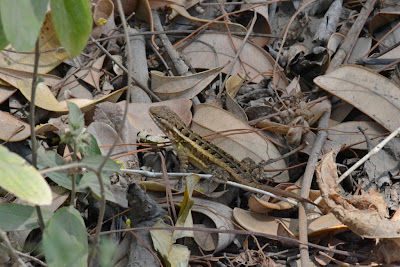
Sceloporus variabilis
The Rose-bellied Lizard, Sceloporus variabilis, is a close relative to several fence lizards found in the US and  Mesoamerica, and is abundant in rocky and dry areas. Photo by Laura Ruysseveldt.
Forest fires are often set to hunt iguanas and mammals. The fires destroy the habitat of and kill many smaller reptiles and other mammals, too. Laura and Bryan participated in extinguishing a forest fire that burned several hectares, just behind Estacion Biologica. Many animals live precariously in the forests where humans may abuse them in numerous ways.

Bryan examines a captured specimen before making a presentation on the reptiles of our area to the students of a local school. Photo by Laura Ruysseveldt.
Bryan and Laura returned to their studies in Belgium after completing a detailed, quantitative project as well as lots of time in the jungle, in search of lizards and other reptiles, and hopefully, we can utilize their knowledge to promote better stewardship of wild nature in Nicaragua.

lizards
Click on the "escudo" to contact us.