Showing posts with label Masaya Volcano. Show all posts

Sunday, February 28, 2016

Volcano Craziness

Nicaragua has been called the land of lakes and volcanoes. Both dominate the views throughout the Pacific region of the country. Lately, volcanic activity has dominated the national news and the minds of all who live near them. The authorities have evacuated employees from some locations and some residents from a few locations, while intense monitoring of the situation continues. Here is a video of the dramatic volcanic activity in the Santiago Crater of Volcano Masaya.


There are, currently, five volcanoes in Nicaragua that are declared "active", which means something far beyond just heat on the surface or active fumaroles. These are Masaya, Momotombo, Cerro Negro, San Cristobal, and Telica. All are worth a view. The Volcano Masaya National Park is closed until further notice. In this area, the volcanic activity far exceeds anything that has happened there in more than 200 years. Views are best during the evening, particularly during a new moon, either from the Masaya-Managua highway or along the Malecon in the city of Masaya.

Volcano Masaya
The INETER Volcano Cam from 4 March 2016, shows an intense glow on the smoke emitted from the volcano. 


The Masaya Volcano is the main attraction of the Volcano Masaya National Park, located just north of the city of Masaya. The top portion of the crater is devoid of vegetation, hot and arid, and much of its flanks are covered only in annual plants which burn during the occasional dry season forest fires. Trees can not grow in these areas because of the intense heat which reaches to very near the surface of the soil. A volcanic crater lake, one of eleven found in the country, also can be seen in the park.

Make a trip to see them, but remember to be safe and obey the laws and current prohibitions!

Masaya Volcano
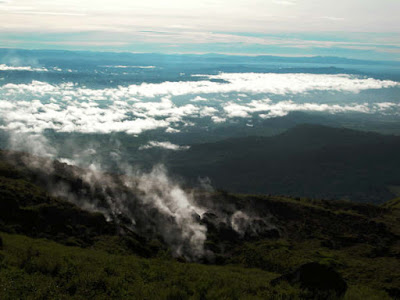
The smoke emerging from the mouth of the Santiago crater at Volcano Masaya National Park. Photo Jeffrey McCrary.

Volcano Masaya
Even on a good day, Volcano Masaya emits enormous quantities of smoke and noxious, corrosive gases. It is the largest source of mercury emission in the western hemisphere. On the flanks of the crater interior, a parakeets roost and reproduce in holes, some of which can be seen in the photo. Photo Jeffrey McCrary.

Momotombo
Momotombo Volcano rises from the north edge of Lake Managua. Its sister volcano, Momotombito, can be seen in the distance, an island in the lake. Photo Brenda McCrary.


Casitas Nicaragua
Casitas Volcano has active fumaroles near the summit.

Nicaragua Volcano
The smoking crater of El Hoyo Volcano, as seen from the summit of Casitas. 
Nicaragua
Click on the escudo to contact us.

Tuesday, May 1, 2012

World Water Day

Some folks think the twenty-first century will be the century of concern for water. We very well may run out of useful water before other resources are exhausted, especially given our predisposition to destroy the quality of many water resources. The Nicaraguan government has declared that access to water is a priority for all people.

We at FUNDECI/GAIA celebrated World Water Day March 22 with the Nicaraguan government and civil society at the Masaya Volcano National Park. The people present represented the Ministry of Natural Resources and the Environment (MARENA), the Ministry of Health (MINSA), the Nicaraguan Water Company (ENACAL), members of the municipal governments of Masaya, Nandasmo, Nindiri, and Masatepe, and many people from non-governmental organizations, including FUNDECI and the Indigenous community of Monimbo. Our focus for this day was Lake Masaya, a marvelous but tragically contaminated volcanic crater lake inside the Volcano Masaya caldera. We spent the morning with local schoolchildren, observing the fish and water of the lake, and in the afternoon, we participated in a forum discussing the situation of this lake.

World Water Day
Solid waste from surrounding communities collects along the waterline in Lake Masaya. Photo by Wendy van Kooten.

Lake Masaya receives inconceivable quantities of liquid and solid waste. Hundreds of gallons of polluted wastewater from Masaya pour into Lake Masaya each hour, and trash enters from communities in several directions. The lake is filling in from sediments and solid waste, and the fish are dying in large numbers. The incredible scenery of this lake from a distance is ruined by the shoreline littered with plastic and the putrid water.

Nicaragua has so many great sources of water, and so many of them have been destroyed. Lake Managua, also known as Xolotlan, is terribly polluted, but once was a source of drinking water for Managua. Tiscapa, like Lake Masaya, receives overwhelming quantities of municipal runoff and garbage with each rain. Nejapa went completely dry recently. Lake Apoyo is still beautiful but facing enormous quantities of trash from visitors.

World Water Day
Volcano Masaya National Park Director Liliana Diaz and a local youth admire a fish from Lake Masaya. Photo by Wendy van Kooten.
In spite of horrendous quantities of trash in and along the shore of Laguna de Masaya, the lake is teeming with life. Local children and park rangers admired the fishes dredged from the lake with seine nets. The local children knew all the names, because they eat the fish!
water
Members of MARENA, the local community, and staff from FUNDECI/GAIA debated the dilemma facing Laguna de Masaya. Photo by Wendy van Kooten.
Presentations on water issues in the lake and vicinity were made throughout the afternoon. The presentations were attended by members of the municipal governments throughout the region, along with the ministries of health, agriculture, and the environment, and members of communities including Masaya, Masatepe, Nindiri, and Nandasmo.

World Water Day Nicaragua
Jeffrey McCrary demonstrates the varieties of fish inhabiting Lake Masaya to members of the government and civil society on World Water Day. 

Nicaragua World Water Day
Lilian Diaz, the Director of Volcano Masaya National Park, shares with the public on World Water Day. 
Masaya Nicaragua
Lake Masaya as seen from the Santiago Crater of Volcano Masaya.
Would you like to help protect the water bodies of Nicaragua? FUNDECI/GAIA can arrange volunteer projects and internships in Lake Apoyo and other locations. You can make a difference and save the most precious single resource for future generations. Please contact us if you would like to volunteer.
World Water Day Masaya
Click on the "escudo" to contact us.

Monday, December 26, 2011

Volcano Masaya National Park


Any nature-loving tourist in Nicaragua must visit Volcano Masaya National Park. It lies west and north of Masaya, practically adjacent to the Laguna de Apoyo Nature Reserve. 
volcano masaya lava
Lava flows over two hundred years old still have not been overtaken by vegetation. The process of ecological succession can be noted according to the ages of the earth surface layer. Photo by Henyrk Madsen.
The Masaya volcano is composed of three craters. One of them erupted twice during the past five hundred years of recorded history. Lava flows are stark, with only islands of vegetation, mostly grasses which burn every few years during the dry season. Two lava flows-one of which destroyed Nindiri-have occurred since the Europeans arrived in the area, and they both cross the main access road to the craters.
laguna masaya
Lake Masaya, seen in the distance, lies inside the caldera of  Volcano Masaya, which is several kilometers wide. Our staff at Estacion Biologica is conducting a study of potentially new fish species in the lake. Photo by Henryk Madsen.
One of the larger well-protected patches of tropical dry forest in Nicaragua lies in the Masaya volcano caldera. Soils over the volcanic scree are thin and water drains from them easily. so that in some areas, where grasses take hold, trees may not be able to withstand the periodic fires which burn through the vegetation.
Volcano Nicaragua
Laguna Masaya and the Masaya Volcano, as seen from Coyotepe. Photo by Hans Rademaker.
At the foot of the Masaya volcano is Lake Masaya, which from a distance is beautiful, but it is contaminated from municipal runoff from the city of Masaya. Several species of fish inhabit the lake, including likely undescribed species. A couple of alligators are found there, having escaped from a private zoo nearby. The fish of this lake are the subject of a continuing study conducted  by Gaia scientists.
Masaya Volcano National Park
Two volunteers at Estacion Biologica, Helen and Simone, prepare their cameras for some spectacular views. Photo by Henryk Madsen. 
Masaya volcano ecotour
The Santiago crater emits large quantities of smoke. The glow of red-hot lava is usually visible  during the night tour of the volcano. Photo by Henryk Madsen. 
The three craters of the Masaya volcano complex are all different. The earthtones are very rich in the volcanic atmosphere, with purple, white, red and brown seen, One of the craters holds a forest in the crater which is impenetrably deep.
Masaya volcano crater
Along the steep banks of this crater, parakeets nest. How they survive the acrid smoke is not understood. Photo by Henryk Madsen. 
Masaya volcano
The stark Santiago crater of Volcano Masaya presents a variety of colors. Photo by Henryk Madsen. 
Santiago crater
A cross was placed on the edge of the crater because the first Spanish colonists considered the Masaya Volcano to be the mouth into hell. Photo by Hans Rademaker.

Nicaragua volcano
Volcano Masaya is very active, with lots of smoke emanating from one of its craters. Photo by Hans Rademaker.

ecotour masaya nicaragua
The interior walls of the Masaya Volcano show dramatic colors. Photo by Hans Rademaker.

ecotour volcano
The interior of the Santiago crater is stark, due to large quantities of acrid smoke. Photo by Hans Rademaker.

National Park Nicaragua
Visitors can approach the Santiago crater easily. Photo by Hans Rademaker.

Nicaragua ecotour
A lava tunnel at the bottom of the Santiago crater can be seen through dense smoke. Photo by Hans Rademaker.
Masaya volcano volunteer
The eastern edge of the Santiago crater is tourist-friendly, given the prevailing westward winds in Nicaragua. Photo by Henryk Madsen. 
Skink Nicaragua
Skinks are among the commonly seen fauna in the dry tropical forest habitats of Volcano Masaya National Park. Photo by Henryk Madsen. 
The stark differences between the different parts of the Volcano Masaya National Park-lake, tropical dry forest, lava flows, caves, and three very different volcanic craters-make an excellent ecotour.
Masaya volcan crater
The San Fernando crater contains a remote forest beneath steep crater walls. Photo by Henryk Madsen.  
Hiking trails at the top of the craters provide great views both of the craters and the park, and also of Managua, the Great Lakes, and Masaya. Night visits to the park are possible, in which visitors penetrate a cave, as the bats are departing for their evening activities.
Masaya Volcano National Park
Smoke emanates from the Santiago crater at Volcano Masaya National Park, Nicaragua. Photo by Henryk Masden. 

Masaya volcano volunteer
This strangling fig (Ficus sp.) near the entrance of the park awaits your visit. Photo by Henryk Madsen. 
cave tour
An evening excursion to Volcano Masaya includes a lava tunnel visit. Photo by Tammy Cameron.

volcano
A mural in the interpretive center depicts the confrontation of religions with the lava-filled crater. Photo by Tammy Cameron.
For a day trip, plan about three hours while there for a day trip, and spend at least one-half hour in the interpretive center. Take sunscreen, a hat, and something to drink.
Masaya volcan parque nacional
Click on the  ¨escudo¨ to contact us. 

Tuesday, September 28, 2010

Fish Research in Laguna de Masaya


The Masaya volcanic complex, lying just north of Apoyo, also contains a lake full of fish-and very interesting fish! The FUNDECI/GAIA research team are executing a study of the Midas cichlid species complex in Lake Masaya, in search of evidence that sympatric speciation has also occurred in this lake, as has been demonstrated in Lake Apoyo.
Lake Masaya cichlids
Maarten fishing for new species. Photo by Jeffrey McCrary.
Here is Maarten Hogenkamp, fishing in Laguna de Masaya. And take another look at the foreground!!!! Yes, that is trash. This lake is severely damaged by solid waste and liquid waste from the municipalities of Masaya and Masatepe. Nonetheless, the lake has fish, and very interesting ones!

Midas cichlid research in Nicaragua
Lorenzo and Jeffrey examine the catch. Photo by Marlene Kroner.
Here, Lorenzo hauls in a juvenile Midas cichlid by harpoon, and passes it off to Jeffrey McCrary of FUNDECI/GAIA while Erico from the Masaya Volcano National Park looks on.

A new species from Lake Masaya. Photo by Jeffrey McCrary.
Some of the catch: a probable new species! FUNDECI/GAIA is working with Jay Stauffer from Penn State to describe new species in Lake Masaya.


fish research Nicaragua
Lorenzo and Maarten discuss the color details of the fish. Photo by Jeffrey McCrary.

Amphilophus fish Nicaragua
Maarten and Elmer at work. Photo by Jeffrey McCrary.
And yes, fishing also means.... repairing nets, and getting ready for the next round. 
Fish studies Nicaragua
Click on the "escudo" to contact us.