Showing posts with label butterflies. Show all posts

Wednesday, July 31, 2013

Brushfoot Butterlies (Nymphalidae): Mariposa!

Although we all enjoy watching butterflies in passing, not many people give them much attention. We all know that they pass from caterpillars to flying beauties via a dramatic physical transformation we call metamorphosis. But of the thousands of butterflies and moths (Order Lepidoptera) found in Nicaragua, much is not known. Only a fraction of the species found in Nicaragua of the moths-those which fly at night-are even documented in Nicaragua, and many species of the butterflies-those that are active in the daytime-have not been documented in the country.
mariposa
Several species of Hamadryas genus butterflies are found in Laguna de Apoyo Nature Reserve. Photo Max Schellekens.
There are hundreds of butterfly species in Laguna de Apoyo Nature Reserve. Researchers at FUNDECI/GAIA have documented well over 200 diurnal butterfly species so far (see this link for a publication). One group of butterflies, called the brushfoots (family Nymphalidae), is notable for its tendency to feed on fermented fruit on the forest floor. This ample group is represented in this area by dozens of species. Some of these species are quite numerous during appropriate seasons. 
butterfly
Una mariposa grande! Photo Max Schellekens.
The great species richness of this group in Laguna de Apoyo Nature Reserve depends on diversity of vegetation. The larval forms of butterflies are usually limited to only a few species of plants for each species. Many species are very particular about the host plants for their larval forms.  Wherever a butterfly species is found, one or more of a small number of potential host plants for the caterpillars of that species must also be found. 
butterfly
The eyespots on the underside of the wing of Morpho helenor. Photo Max Schellekens
This means, quite simply, that butterflies can be important indicators of the conservation status of a natural area. Activities such as selective cutting, forest fires, and clearing vegetation from the forest floor may impact some butterfly species by altering the number of potential host plants available. We have been studying the butterflies of the Nymphalidae family with quantitative methods for a few years, with the intention to compare the communities of this group in different areas of the forests with different land use patterns. 
butterfly
The Malachite (Siproeta stelenes) is quite common in Laguna de Apoyo Nature Reserve. Muy bonita mariposa! Photo Max Schellekens.
Two interns from Holland, Max Schellekens and Hessel van der Weide, reviewed the accumulated data on Nymphalidae butterfly communities and reported on their findings in a presentation in July, 2013. As we expected, the butterfly communities were altered dramatically by more intense land uses such as housing and in secondary forest formed after deforestation. 
la mariposa
The underside of the Malachite (Siproeta stelenes) is far less colorful and dramatic than the upperside, aiding in avoiding predators while perched on the forest floor. Photo Max Schellekens.
Meanwhile, these interns developed some interesting information on when the populations peaked for each species of the group, and where they were most common. This information can be used to determine what environmental factors can be most important for each species, to develop conservation strategies to protect the forests and the animals in them. 
butterfly
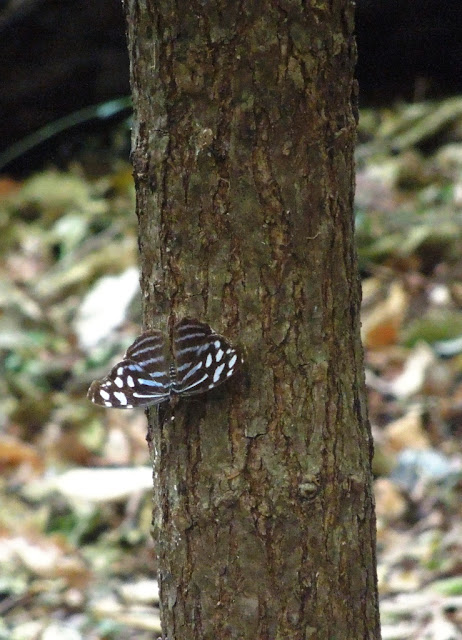
Although well-camouflaged when the wings are vertical, many butterflies of Nymphalidae family are conspicuous when viewed along the dorsal side. Photo Max Schellekens.
As consumers of the juices of fruit on the forest floor, these species require strategies against potential predators in trees as well as on the ground. Most Nymphalidae are well-camouflaged when sitting on the forest floor, where checkered patterns of dark and light, neutral colors dominate among leaf litter. When these butterflies as perched on the forest floor, they maintain their wings erect, showing complex patterns of neutral colors on the ventral sides of the wings, which blend with the surroundings.  
butterflies
Some Nymphalidae butterflies are particularly subtle, with cryptic patterns on both sides of the wing. These butterflies tend to inhabit altered areas more, where greater need for hiding is necessary. Photo Max Schellekens.
When dropping their wings, other patterns and colors appear, more vibrant and spectacular. Most brushfoots show dramatic coloration above. Perhaps the most popular of the butterflies of the forests in Nicaragua is the Morpho butterfly (Morpho helenor montezuma), whose dorsal side glows with metallic blue, whereas the underside of the wings are dark with eyespots. One particularly large eyespot near the rear of the hindwing may aid the butterfly by giving the impression of an owl. Many potential predators of a Morpho butterfly would not want to run up against an owl, so this spot may reduce the pressure of predation.
mariposa
Even when butterflies are practically invisible from a distance, the wing patterns upon close examination may be very attractive. Photo Max Schellekens.
As the photographs show in this essay, studying the brushfoot butterflies does not require harming them. The butterflies are trapped passively when they come to the fermented fruit bait, and there they are held a few hours without harm until they are removed, identified, and then released. These butterflies have colors and design patterns that are much better appreciated up close, too, as the photos show. They are all beautiful!
mariposa
Hamadryas butterflies are especially abundant in altered areas in Laguna de Apoyo Nature Reserve. Photo Max Schellekens.
 By making careful observations, the interns were able to make commentaries on the abundance of the butterflies during different seasons and in different locations in Laguna de Apoyo Nature Reserve. Furthermore, they gathered information regarding the sex on the butterflies. Males and females of many species act very differently. Often, females are not very active. Many aspects of the basic biology of the Nymphalidae butterflies is simply not known, and we hope to make a small contribution to the knowledge base, while learning about the butterfly diversity in the different areas of the reserve.
butterfly
La Mariposa Aliazul, or the Bluewing, is far more conspicuous on the dorsal side than the ventral side. Photo Max Schellekens.
By learning when and where each butterfly species is most common, we can build patterns of the web of diversity in the forests of this reserve. Seasonality of butterfly abundance depends on environmental factors such as appropriate conditions for feeding caterpillars in the host plants. 
butterfly
Hamadryas butterflies show dramatic colors and patterns on the dorsal side of the wings. Photo Max Schellekens.
The interns Max and Hessel built on a substantial database developed over five years. During this time, we counted on the labor of several interns and volunteers, and the volunteer support of the students of Apoyo Spanish School as well. Their final presentation was attended by a standing-room-only crowd of conservation professionals, tourism operators, biologists and students. More work is to be done, so potential interns and volunteers are invited to apply!
Nymphalidae
Wing underside patterns of the Nymphalidae butterflies are subtle but, on close observation, filled with fascinating detail. Photo Max Schellekens.
All visitors are welcome to visit us and discuss the butterflies, or to volunteer to participate in our studies. Please contact us for any information you request.
mariposa
Click on the "escudo" to contact us.

Thursday, July 25, 2013

Wildlife Monitoring in Laguna de Apoyo

It is no secret to us who frequent Laguna de Apoyo Nature Reserve that it is under siege from several types of human activities. Forests disappear without anyone taking note and speaking out. Usually, this happens not in fell swoops of forest, but rather, one branch, or a small stem, at a time. Areas get cleared by surreptitious actions of hired workers, a little at a time. Trash and concrete slowly creep across what was jungle.
colibri

How this process, of conversion of land from wild jungle to farmland and summer homes and gardens, affeds wildlife on the scale it is conducted in Laguna de Apoyo, has not been tested much. Common sense would tell us that small alterations to the forest make big changes in the animals that live in it. But we live in a society where lies and misconstructions are stated and accepted as facts, so we set out to compare the fauna of different parts of the forests in Laguna de Apoyo.

mariposa
The title page of the presentation by three interns from Holland. Photo Pablo Somarriba.
 At FUNDECI/GAIA, we have been studying the impacts of human activity in the forests of Laguna de Apoyo Nature Reserve for some five years. The results are now being prepared for publication. A presentation of the results of the impacts on fruit-eating butterflies (family Nymphalidae) and hummingbirds (family Trochilidae) was made at Volcano Masaya National Park, Tuesday 23 July, 2013. Bart Verdicjk, Hessel van der Heide, and Max Schellekens, biology interns from Holland, produced the following videos on the process, which were presented along with results of the studies on butterfly and hummingbird communities in Laguna de Apoyo Nature Reserve.
Intern Max Schellekens presenting the results of butterfly studies while dozens of participants observe. Photo Pablo Somarriba.
These three interns collected data and then they analyzed data on hummingbirds and butterflies during the past five years in different locations in Laguna de Apoyo Nature Reserve. Their presentation was well-attended, not a single seat was found in the house!
Volcano Masaya National Park Director, Liliana Diaz, during an animated discussion after the presentations by the interns. Photo Pablo Somarriba.
A rising consciousness and concern for wild nature is seen in Nicaragua today. The young people of the area of Laguna de Apoyo, many of whom attend Instituto Augusto Flores Silva, made an important representation of the audience, which pleased us infinitely to see.
A standing-room-only crowd in the auditorium of Volcano Masaya National Park! Photo Pablo Somarriba.
The risks that wildlife face in Laguna de Apoyo Nature Reserve are enormous, and as many people recognized in the discussion, tourism provides important elements to a strategy to protect this beautiful natural site. Several professional tour guides were present as well, some of whom added important comments.
Las mariposas de la Laguna de Apoyo. Video Max Schellekens.

Los colibries de la Laguna de Apoyo. Video Max Schellekens.

butterflies
Click on the "escudo" to contact us.

Sunday, December 16, 2012

Butterfly monitoring in Laguna de Apoyo Nature Reserve

We do not have a precise count of the number of butterfly species in Nicaragua. Although some scientists specializing in butterflies and moths have come to study the butterflies of Nicaragua, and a notable effort to study the butterflies occurs among scientists inside the country, publications detailing the species common to Nicaragua are not found in all families. The butterfly and moth (family Lepidoptera) species record in Nicaragua is partial and is mostly limited to certain, more commonly studies families. As a result, a dedicated study of the butterflies is likely to turn up something not yet documented in Nicaragua-a new species or subspecies, or perhaps an association with a plant not yet known to science. Butterflies (Lepidoptera) all have intimate associations with particular plant species, especially during the caterpillar stage of life.
butterflies in Nicaragua
The One-spotted Prepona (Archaeoprepona demophon) is a common capture in our butterfly monitoring program. Photo by Hans Rademaker.
We are engaged in a long-term monitoring project of certain faunal groups, among them, the butterflies which are attracted to rotten fruit. Almost all the butterflies which come to our rotten fruit traps are in the family Nymphalidae. This group is known as the brushfoots, and another common name for them is the four-footed butterflies, because their forelegs are reduced in size.
Some butterflies are brilliantly colored, others with subtle colors and patterns. Photo by Hans Rademaker.
The upper side or dorsal side of the brushfoot wings is often brightly colored. However, butterflies tend to maintain their wings erect when perched, exposing the underside or ventral aspect of the wings, which in this family are often dull or cryptically patterned, to prevent their detection when perched on the forest floor.
Smyrna blomfildia
Blomfild's Beauty is an appropriate common name for this butterfly (Smyrna blomfildia). Photo by Hans Rademaker.
In our study, butterflies are attracted by rotten fruit left on the forest floor, into a barrel-shaped trap only a few inches above the fruit. Once butterflies come to the fruit, they tend to fly into the trap when attempting to depart. We note the number of each species captured in each trap, then leave them to resume their natural lives.
Smyrna blomfildia
The dorsal view of Blomfild's Beauty (Smyrna blomfildia) differs from the ventral view. Photo by Hans Rademaker.
Of the over two hundred butterfly species that have been documented in Laguna de Apoyo Nature Reserve, some two dozen will come to the rotten fruit traps. We have learned that the butterfly communities in the reserve are dramatically affected by the houses found along the edge of Lake Apoyo on the north and west sides of the lake. Deeper in forest less affected by man, we find butterflies which do not come to traps in the inhabited areas. 
The Gray Cracker, Hamadryas februa, snaps its wings during courtship. Four species of this genus are found in Laguna de Apoyo Nature Reserve. Photo by Hans Rademaker.
Our study of the butterflies of Laguna de Apoyo Nature Reserve provides a visceral satisfaction to all who participate. Seeing a butterfly at close range reveals many secrets to its beauty.
Lepidoptera
Butterflies in repose inside a baited trap are awaiting their identification and liberation. Photo by Hans Rademaker.
Interns and volunteers are being accepted to study the butterflies. If you would like to participate in our studies, please contact us!

butterflies
Click on the "escudo" to contact us.

Sunday, July 29, 2012

Laguna de Apoyo is the most beautiful place in Nicaragua


wildlife Nicaragua
A black iguana (Ctenosaura similis) is sometimes green, requiring characters other than color to distinguish it from the green iguana (Iguana iguana), such as the rings of enlarged scales in the tail, the presence of a single large, smooth scale beneath the eye, and the absence of an enlarged scale beneath the tympano. The black iguana is far more common in Laguna de Apoyo Nature Reserve. Photo by Tessa Janga.
Laguna de Apoyo Nature Reserve is such a beautiful place precisely because so much nature is still in and surrounding it. We noticed, many years ago, how the forests were teeming with wildlife and a rich diversity in tropical plants, and that the beautiful clear, blue waters of Lake Apoyo depend on the presence of intact forest along the interior slops of this lake. Although many people visit this special place, it can still count as one of the secrets of Nicaragua.

Catarina
Laguna de Apoyo viewed from Catarina. Photo by Sienna Potts. 
Mankind is the worst enemy of natural areas such as Laguna de Apoyo. Trash dumping, hunting, illegal construction, and deforestation with pesticide use are rampant wherever there are people, and Nicaragua is not different. Just below the Catarina overlook, for instance, a group of "investors" with the blessing of the then-president of Nicaragua built 65 bungalows, a hotel and convention center, all of which add up to a serious ecological disaster, as well as a financial nightmare for the non-Nicaraguans who joined the project as co-investors. But not just like in all countries, many conscious, caring people are found in Nicaragua. For instance, dozens of members of the local community came to Laguna de Apoyo Nature Reserve to participate in a tree planting activity earlier this year. Thanks to all for volunteering your time!
Masaya
Young people from Masaya and neighboring towns came to plant trees in a reforestation activity in Laguna de Apoyo Nature Reserve. Photo by Frank Lindt.
The lake is usually very quiet, especiallly at dawn, with trees along much of its shore attracting birds and other wildlife. Weekends, however, attract visitors from Masaya and other communities, and the lake shore can be festive with families enjoying a day out in nature. The lake stretches four kilometers across and is 180 meters deep, with slightly salty water filled with volcanic minerals. Water clarity varies from five to fifteen meters, making the lake ideal for SCUBA divers to enjoy. 
Granada
Dawn on Lake Apoyo can be serene. Photo by Christine Bruxer. 
Lake Apoyo is known for its water, but more is going on than may meet the eye. This lake is located inside a volcanic crater which exploded 23,000 years ago, leaving a gaping hole hundreds of meters deep in the earth. Hot spots still abound around and inside the lake, too. SCUBA divers can easily find volcanic vents in the lake, and a few are also found on the lake edge. Many water wells are useless, because the water they produce is hot, salty and corrosive.


Most people think of the water in the lake when they think of Laguna de Apoyo Nature Reserve, because it is simply spectacular. Our team of wildlife specialist and volunteers, however, have taken the opportunity to learn many of the secrets of the jungle around the lake, inside the volcanic crater. Over four hundred species of plants are found in this forest, along with dozens of species of mammals, reptiles, and hundreds of birds.

wildlife in Nicaragua
This photo makes the first documented gray four-eyed opossum (Philander opossum) in Laguna de Apoyo Nature Reserve. Many secrets of nature await the intrepid observer. Photo by Lucas Betthauser.
Professional wildlife guides can arrange guided tours of the nature in Laguna de Apoyo Nature Reserve. A typical birdwatching walk of only one hour at dawn, for instance, yields around 25 species.
wildlife Nicaragua
The simple checkerspot, Chlosyne hippodrome, is one of more than two hundred butterfly species one can appreciate in Laguna de Apoyo Nature Reserve. Photo by Helen Croll.
Estacion Biologica provides lodging, meals, and services such as birdwatching SCUBA diving, and kayaking the lake. We also provide courses in Spanish and in natural resources management. Our site is operated by FUNDECI/GAIA. Visitors and tourists are always welcome.
Click on the "escudo" to contact us.


Sunday, January 29, 2012

Brushfoot Butterflies (Nymphalidae) in Laguna de Apoyo Nature Reserve, Nicaragua

Chlosyne hippodrome
Simple checkerspot, Chlosyne hippodrome, dorsal view. Photo by Aura Cruz.
Chlosyne hippodrome Nicaragua
Simple checkerspot, Chlosyne hippodrome, ventral view. Photo by Aura Cruz. 
The brushfoots, as the butterflies of the family Nymphalidae are called, are easily studied, because many of them are attracted to traps with rotten bait as fruit. We have been studying this group in several locations in the Laguna de Apoyo Nature Reserve, in Nicaragua with several objectives:

1. To determine which butterflies in this group are present in the area.
2. To determine the seasonal characteristics of each member of the group present.
3. To compare the communities in different parts of the reserve according to the forest structure and land use patterns.

We are using the brushfoot butterflies as a model system to evaluate the environmental impact of constructions and of deforestation on the local fauna diversity. We have a simple, quantitative method for field work which involves traps with rotten fruit bait. We count and classify butterflies which enter the traps, and then release them without harm. Would you like to help us monitor butterfly populations? Please contact us for more information. We are seeking volunteers and interns to perform the field work and analyze the data.

Pictured are some of the species which commonly enter our traps in Laguna de Apoyo Nature Reserve.

Caligo memnon Nicaragua
Giant owl butterfly, Caligo memnon, dorsal view. . Photo by Aura Cruz. 
Caligo memnon
Giant owl butterfly, Caligo memnon, ventral view. Photo by Aura Cruz. 

Hamadryas guatemalena Nicaragua
Guatemalan cracker, Hamadryas guatemalena, dorsal view. Photo by Aura Cruz.

Guatemalan cracker
Guatemalan cracker, Hamadryas guatemalena, ventral view. Photo by Aura Cruz. 

Juniona evarete
Mangrove buckeye, Junonia evarete, dorsal view. Photo by Aura Cruz. 

Juniona evarete Nicaragua
Mangrove buckeye, Junonia evarete, ventral view. Photo by Aura Cruz. 
Nymphalidae
Click on the "escudo" to contact us. 

Monday, October 3, 2011

Wildlife in Laguna de Apoyo Nature Reserve, Nicaragua


We are actively engaged in learning about, teaching about, and protecting wild nature in Nicaragua. Our princpal focus is Laguna de Apoyo Nature Reserve, where we have executed years of careful study of the birds, fish, and more recently, other creatures of the forests, lake and streams. Although this place is close-too close-to Granada and Masaya, which facilitates inappropriate and excessive human activity, there is still an abundance of nature here. Here we will show you some aspects of the wildlife of this area which you might not have contemplated before.

The first animal we share with you here is the White-necked Puffbird (Notharchus hyperrhynchus). It was previously considered to range from Mexico into the Amazon, but the South American birds have a smaller bill, and recently, "our" birds have been reclassified into another species, leaving the older names for the southern forms (Pied Puffbird, Notharchus tectus). It's a crazy looking bird! And a real prize for a birdwatching experience. This individual was caught by our field study group by mist nets. This species is much more common in the south-western part of the reserve, than in the northern part, reflecting that it prefers somewhat better forest quality, as the northern part is more heavily degraded.

birding Nicaragua

There is a little-known crab common to Lake Apoyo, known locally as jaiba, but without an English common name: Potamocarcinus nicaraguensis. We don't know much about it, except that it tastes good! We have begun to keep counts of crabs in our transects in the long-term flora and fauna monitoring project we conduct in Laguna de Apoyo Nature Reserve. We see one or two crabs on most of our SCUBA dives in the lake. Locals eat it and it appears to survive the low levels of harvesting pressure well enough. We have recently found it in one of the small streams that flows year round into Lake Apoyo. These crabs are important to consider in aquatic conservation in Laguna de Apoyo and its tributary streams.
birdwatching Nicaragua
A lacustrine crab, Potamocarcinus nicaraguensis. Photo by Balasz Lerner.
Butterflies abound here. We have been observing the butterflies a few years, and already have one scientific publication in which a few dozen new species for Nicaragua were documented. Today, we are focussing on the butterflies that feed on fruits, in a quantitative study of the effects of land use by man on the butterfly communities. Most of the butterflies we observe in this study are from a single family, Nymphalidae. However, we continue to watch and admire all the other ones. The next two pictures were taken of a freshly emerged individual from its coccoon. The wings were beautiful but had not yet taken flight.  
Birding Nicaragua
Photo by Rachel Lauwerijssen.

nature tours Nicaragua
Photo by Rachel Lauwerijssen
As a generality which holds quite well taxonomically in this region, we call those of the order (Lepidoptera) which fly in the daytime, butterflies, and those which fly at night, moths. Among the several distinctive features of moths is the antenna which are not clubbed, as in the butterflies, but a variety of other structures such as feathered or segmented. Moths are usually less distinctly colored and patterned than the diurnal butterflies, but there are some beautiful features to them, and in some cases, they can be surprisingly beautiful.

birding Nicaragua
Photo by Pablo Somarriba.


birdwatching tour Nicaragua
Photo by Pablo Somarriba.
White-faced capuchins (Cebus capucinus) occupy only a few sites in the reserve. There are few, because of poaching for the pet trade, and those still here are wary. Monkeys are not pets! Please do not support the trafficking of wild animals.
We have recently noticed the capuchins in new places in Laguna de Apoyo Nature Reserve. The populations here, like in other parts of Nicaragua, have been decimated by the pet trade. But, it appears that our monkeys in Apoyo are making a small comeback. Here, one looks down on us as we are catching birds by mist netting.
Nicaragua nature tours
Photo by Lukas Betthausen.

The Mantled Howler Monkey (Alouatta palliata) is more abundant than in past years in Laguna de Apoyo Nature Reserve, thanks to the increased vigilance of park guards against tree cutting, forest fires, and hunting. We are monitoring monkey populations in the reserve, and we need volunteers and interns to help us. Please contact us if you would like to do some monkey-watching.
volunteering Nicaragua
Photo by Mark de Graaf.

These photos were all taken in the Laguna de Apoyo Nature Reserve, by amateur photographers. They demonstrate how beatiful the area is, why we think is one of the leading sites for wildlife photography and nature tourism in Nicaragua, and hopefully, contribute to convincing the leaders here to protect it. We need your help. Our studies of the wildlife and projects in repairing the broken forest require money and volunteers. Can you help us at Estacion Biologica? Please write us.

nature tours Nicaragua
Click on the "escudo" to contact us.