|
 |
| Leslie is a biology student at a university in Nicaragua and one of our teachers in Apoyo Spanish School. |
Studying Spanish at
Apoyo Spanish School is not only about learning the grammar and vocabulary. Our teachers provide precise and demanding instruction with vigorous methods to engages the students, but they also teach about Nicaragua, the area, the forest and people, and other cultural issues. One of the best parts of a time at Apoyo Spanish School is the time spent in the forest, or in the lake.
 |
| Students of Apoyo Spanish School on an afternoon excursion with their teachers. |
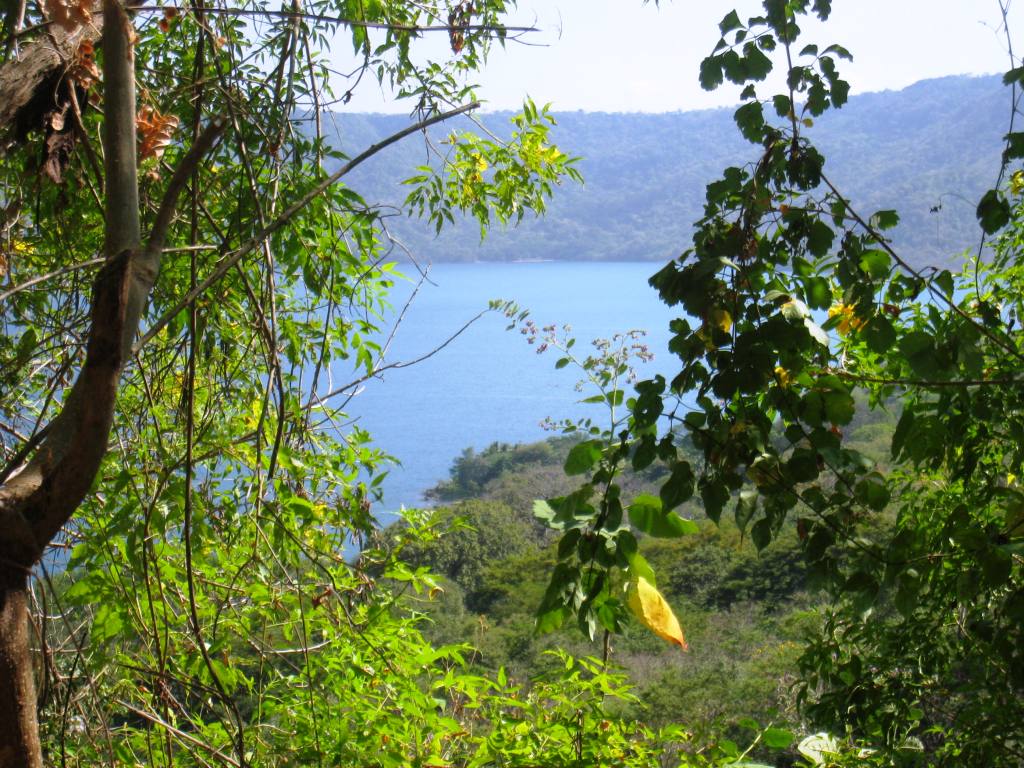
Most lakes around the world are already polluted and buildings have destroyed the natural environment around them. Building in this area is prohibited, and many other restrictions on activities are in place, which means the views can be excellent in almost any direction through a clearing.
 |
| Lake Apoyo is beautiful from a distance, too! |
 |
| The sun rises from Granada over Lake Apoyo at dawn. |
 |
| Ficus trees can take root even on tops of large rocks. |
Basalt rocks are everywhere, and layers of pumice are also found in the crater. During the dry season, leaf litter covers the ground and protects the life in it, holding in precious water until the first rains in May.
 |
| Leigh joins a local family on washing day in Lake Apoyo. |
 |
| Binoculars are recommended equipment for a visit to Apoyo Spanish School. |
 |
| The red, peeling bark of a Bursera simaruba tree suggests the local name, Indio Desnudo. |
 |
| The water of Lake Apoyo is transparent. |
 |
| The project behind these signs, supposedly for "ecotourism", were fined for serious environmental violations. Not everyone has the same ideas about ecotourism and real estate. |
Lake Apoyo and the
Apoyo Spanish School are located inside the Apoyo volcanic crater, which is actually a gaping hole in the earth, six kilometers across and several hundred meters deep. The lake is surrounded by the slopes of the crater interior on all sides, along which several houses have been built over the years. There are small patches of agriculture along the slopes, as well, and lots of natural forest. The most well-preserved of the natural forest is on the south-west side of the lake. One can enjoy the forest by hiking or sitting and meditating, swimming, or birdwatching. Monkeys are easy to find in the trees in most parts of the reserve.
Studying Spanish at
Apoyo Spanish School is about Spanish, but it is also about more: nature, local people, water, and causes. And plenty of natural beauty around. What do you see when you visit
Laguna de Apoyo Nature Reserve? Let us know, we are interested.