Showing posts with label cichlids. Show all posts

Monday, February 4, 2013

Jaguar cichlid in Laguna de Apoyo, Nicaragua

-->
Many cichlid fish species evolved in the Nicaraguan Great Lakes system. Among the more popular of the fish of this region are the guapotes, fish of the genus Parachromis. Guapotes can make a very nice fish dinner. The most abundant of the guapotes in the San Juan River and the Nicaraguan Great Lakes is the Jaguar cichlid, Parachromis managuensis. In Nicaragua, it is known as the guapote barcino, in reference to its checkerboard spotted pattern. Along with several species from the Midas cichlid species complex, the Jaguar cichlid make nests in which parental care observations can be made easily during SCUBA diving.
All the mating cichlids native to Nicaragua protect their young for several weeks after hatching. The guapotes have some important structural advantages to parental care over the more common Midas cichlids found in their range. First of all, the guapotes are large, and therefore can sustain large egg loads. It is not uncommon to see over 2000 fry at Jaguar cichlid nest. Secondly, the guapotes all have large mouths adapted to capture fast-swimming fishes. A bite of the Jaguar cichlid could be fatal even to a medium-sized fish. Potential predators know this and tend to avoid the risk of a bad bite.
These hatchling Jaguar cichlids are less than a week old. They stay near the parental units within reach of a natural or dug cave, and they receive parental care up to about 60 days after hatching. Photo by Martin Cabrera. 
Along with several bird species, the Jaguar cichlid sits atop the food web in Lake Apoyo, Nicaragua. It is the only fish in the lake that can kill and consume up to medium-size fish. Adult Jaguar cichlids only eat fish and perhaps crabs.
Hatchling P. managuensis are prone to move toward the diver, a camera, a hand. Photo by Martin Cabrera.
Male Jaguar cichlids differ morphologically from females in its upturned mouth and other aspects of head shape. Like all the other cichlids native to Nicaragua, the males in breeding pairs always exceed the females in size.
This female Jaguar cichlid is never far from her free-swimming fry. Photo by Martin Cabrera.
All cichlid nests can be fascinating, and the Jaguar cichlids are not unique in this respect. Parents may move little in defense of their fry, but they usually don't have to do much, to get the point across to potential predators.
Most cichlids in Nicaragua utilize natural features such as caves and holes to defend their offspring. This Jaguar cichlid is watching her fry just outside of this crevice. Photo by Martin Cabrera.
Breeding seasonality of the Jaguar cichlid is not as strong as in the Midas cichlids in Lake Apoyo. Whereas the Midas cichlids may reproduce in only two to four months during the year, the Jaguar cichlid is found in reproduction most of the year.
A female Jaguar cichlid (P. managuensis) in her nesting site. Photo by Martin Cabrera.
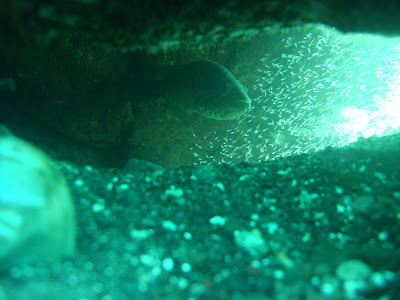
All cichlid fishes in Nicaragua provide extensive parental care to their fry for the first several weeks after they hatch. There is fierce competition among the Jaguar cichlids for high-quality breeding sites such as this one in our photographs. This site is actually a cave under a large rock, with openings on both ends. The male parent of this nest has little or no continued relation with the nest, however. Big male P. managuensis are scarce, and the males tend to abandon nests earlier than the female, in contrast with many other Nicaraguan cichlids. Big males are easily harpooned when on nest, and unscrupulous SCUBA divers often harvest this fish, as a trophy and for a great meal.
This female is emaciated from the physical stress and reduced food intake associated with reproduction. Photo by Martin Cabrera.
Fry feed on detritus and phytoplankton/zooplankton. They stay close to their fellow fry at all times, depending on the maxim safety in numbers. Among the most dangerous predators of cichlid fry are the Bigmouth Sleepers (Gobiomorus dormitor), introduced into Lake Apoyo only 22 years ago. Both adults and juveniles can catch cichlid fry, especially when a single fish has separated from the group. Fry face a much greater risk of capture when separated from their siblings.
Mother P. managuensis and her fry in Lake Apoyo, Nicaragua. Photo by Martin Cabrera.
We at FUNDECI/GAIA are working to determine the population structure of the fishes, plants and other life in Lake Apoyo, Nicaragua. This delicate lake is under tremendous pressure from people who want to do things that affect the lake: fish unsustainably, cultivate agricultural products using agrochemicals, build houses and install grassy gardens which use copious quantities of water and leave pollution in the lake. With a population baseline, we can determine variations in populations of the different fishes and plants which may result from human-induced alterations in the lake.
Parachromis managuensis
This female guapote barcino tends to thousands of fry. Photo by Martin Cabrera.
Click on the "escudo" to contact us.

Tuesday, January 10, 2012

Amphilophus chancho

The Midas cichlid (Amphilophus) species flock is composed of several species, and the research group at Estacion Biologica has been working on describing new species in the group. The largest of the Midas cichlid complex found in Laguna de Apoyo is the mojarra chancho, Amphilophus chancho Stauffer, McCrary & Black 2008. It is named after the Nicaraguan local name for pig, for its corpulent appearance.
Midas cichlid
Mojarra chancho in breeding coloration. Photo by Adrianus Konings.
Like other Midas cichlids in Nicaragua, the mojarra chancho find mates near breeding areas, then establish a breeding site with a natural or dug hole. They usually make nests at between 12 and 25 meters depth, in areas of massive nesting. The parents are sequentially monogamous, with both male and female staying on nest to care for the fry around forty days after free-swimming.

Amphilophus chancho
Juvenile mojarra chancho. Photo by Adrianus Konings.
 The mojarra chancho can be as large as the large-mouthed predator in the lake, the jaguar cichlid (Parachromis managuensis). Its only habitat is Lake Apoyo, Nicaragua, where it evolved sympatrically with a least five other members of the Midas cichlid species complex. This species is distinctive among the crater lake cichlids for its size and behavior: notice two of the fishes in the photo below, looking at the photographer with both eyes!
schooling Amphilophus chancho
Schooling mojarra chancho maraud in search of prey. Photo by Adrianus Konings.
Breeding is common from November through March. When not breeding, the fish may form monospecific schools and maraud the lake for prey. One of their most notable prey is the eyes of fish that have become blind by cataracts.
The conservation status of Amphilophus chancho has not been evaluated, but we expect it to receive status as an endangered species, given that its range and population are similar to those of the arrow cichlid, Amphilophus zaliosus, which has recently been declared Critically Endangered.
Midas cichlid Lake Apoyo
Mojarra chancho female with fry. Photo by Adrianus Konings.
Our SCUBA diving program has helped us determine that this is indeed a distinct species and to develop information about its ecology. We see several individuals each time we dive, and nests are not uncommon during the height of nesting season. By diving with us, you get to see some of the most interesting of animals in Nicaragua, in the water! If you are a certified open water diver, you can participate in a dive with us and help us learn more about the endemic fish species in Lake Apoyo. For more information on how to help us study this fascinating fish, please contact us.
Amphilophus citrinellus
Click on the "escudo" to contact us. 

Monday, December 12, 2011

The little Apoyo cichlid, Amphilophus astorquii


The most common cichlid fish in Lake Apoyo is the little Apoyo cichlid, Amphilophus astorquii. It was officially discovered as the culmination of years of study in Estacion Biologica, in a publication in 2008. About three-quarters of the cichlid fishes seen in Lake Apoyo are this species. They breed from December through February, as is shown in the photograph below.

SCUBA dive Amphilophus astorquii Midas cichlid Nicaragua

When breeding, thin, light bars appear over a bluish-black background. The dark coloration emerges from dark dorsolateral spots which remain when the fish is not breeding. The males are always noticeably large than the females in any given breeding pair. The breeding pairs form over a hole and utilize a hard surface such as a rock to attach eggs, which are cared as they hatch to form wigglers which later detach to swim freely. The parental units stay actively care for the fry until they are free-swimming approximately forty days. If parental protection is lost, the fry will be eaten by predators within minutes. 
SCUBA dive Amphilophus astorquii Pyrgophorus coronatus Midas cichlid Nicaragua

An important component of the diet of the little Apoyo cichlid is snails (Pyrgophorus coronatus). During 2011, two volunteers collected data on the snails of the lake, in an effort to understand better the food webs which must be protected for these fish. These volunteers studied Spanish while working with our staff to collect field data. SCUBA divers collected samples of snails in different habitats and then analyzed them.  

SCUBA dive Amphilophus astorquii Midas cichlid Nicaragua

Males often develop nuchal humps as the one in this photo, as a secondary sex characteristic. This fish is in nonbreeding coloration, showing a light, neutral background color, and dark dorsolateral spots. Vestigial dark vertical bars can be seen faintly above and below the spots. When the fish begins its transformation to breeding coloration, these bars will darken and thicken, including the head, leaving the light coloring on the fish limited to thin regions between the bars.
SCUBA dive Amphilophus astorquii Midas cichlid Nicaragua

The little Apoyo cichlid is only found in Lake Apoyo, as is confirmed by a recent phylogenetic study conducted by Matthias Geiger, Jeffrey McCrary and Uli Schliewen, in coordination with Estacion Biologica. They are easy to observe, and our monitoring project gives us lots of opportunities to watch them year-round. Other members of the Midas cichlid species complex in Laguna de Apoyo are: Amphilophus chancho, Amphilophus flaveolus, Amphilophus globosus, Amphilophus supercilius, Amphilophus zaliosus. In addition, the jaguar cichlid, Parachromis managuensis is found in the lake; the molly, Poecilia sphenops; and the silversides, Atherinella sardina. Recent introductions of Gobiomorus dormitor and the Nile tilapia, Oreochromis niloticus, can be found as well.

You are welcome to join us in a SCUBA dive to see these fish in their natural environment.
All of the above pictures were taken by Ad Konings, and copyrights are preserved. Ad is a great colleague and friend, and we are grateful that he has taken interest in the cichlid fishes of Nicaragua. Please do not use these photographs without permission.
Apoyo Spanish School Nicaragua
Click on the ¨escudo¨ to contact us.

Monday, August 15, 2011

Video: Endemic Fish Species in Laguna de Apoyo, Nicaragua, Threatened by Humans


The volcanic crater lakes of Nicaragua attract lots of tourists, both Nicaraguans and foreigners. The water-filled craters are all beautiful, each with its own special features. Eight of these lakes, however, have endemic fish species, daughter species of the ancestral form of the Midas cichlid (Amphilophus citrinellus), living in them. The water of most of these lakes is transparent, perfect for observing these fish while SCUBA diving.
During the nineteenth century, scientists and explorers admired the wide variations in color and shape among the Midas cichlid group, so much so that several species were described during the succeeding fifty years. Most of those species are today lumped back into A. citrinellus, given that this is the first described of the group from Lake Nicaragua. Its sister group, A. labiatus, has similar features but is generally longer and sleeker bodied with prominent lips and frenum. This fish became incorporated into the aquarium hobby trade in a brightly colored form, and is still known as the red-devil cichlid. Only these two species "survived" the scientific scrutiny of the first three-quarters of the twentieth century.

red devil cichlid
Amphilophus labiatus showing its prominent lips in Laguna de Xiloa, Nicaragua. Photo by Ad Konings.
People knew these fish populated not only the Nicaraguan Great Lakes, but also the volcanic crater lakes along their western shores. The late, visionary scientist George Barlow applied for the first time, multivariate analysis to the morphological characters of fish populations in this group to demonstrate convincingly that A. labiatus and A. citrinellus were different species, and that in Lake Apoyo, a unique species exists as well, which he called the arrow cichlid (Amphilophus zaliosus). This species, more elongate than A. citrinellus and lacking the fat lips of A. labiatus, was found in Lake Apoyo. 
Amphilophus zaliosus SCUBA diving
A pair of Amphilophus zaliosus on nest, in breeding coloration. Photo by Ad Konings.
The sacred trinity of A. citrinellus, A. labiatus, and A. zaliosus stood through the remainder of the twentieth century. During the current century, we incorporated the talents of Jay R. Stauffer, Jr. in the taxonomic descriptions of fishes in this group. To date, he has led the descriptions of eight additional species-three from Lake Xiloa, and five from Lake Apoyo, Nicaragua. They will be discussed in a coming blog entry. Most of the species from Lake Apoyo can be appreciated in the video below.
Video by Balasz Lerner.

This second video, produced by Fabio Buitrago, shows underwater footage of endemic fish species in Lake Apoyo, facing a crisis of man-made dimensions-garbage. Everywhere. Why must we pollute their home? These fish-six species known and others not yet discovered-only live here in this lake.

The most common of the fish in this video, and in just about any part of the lake where we have looked, is the little Apoyo cichlid, A. astorquii. It was named in honor of Father Ignacio Astorqui, a Jesuit priest from Spain who devoted much of his life to the study of freshwater fishes of Nicaragua, and wrote the first comprehensive guide to them. A breeding pair with their fry are shown below:

Scuba dive Nicaragua
Amphilophus astorquii pair caring for fry, Laguna de Apoyo, Nicaragua. Photos taken during scuba diving by Adrianus Konings.
Would you like to help us protect and study the endemic cichlid species of Laguna de Apoyo? One of these species is already on the endangered list (Arrow cichlid, Amphilophus zaliosus, Critically Endangered-IUCN). Nicaragua needs your help, because the threats are many, and resources are few. We are seeking divers, biologists, people with experience in excel, and volunteers without any specialized skills to help us in this project. Please contact us if you would like to participate. The Laguna de Apoyo Spanish School also supports this project by providing a portion of its proceeds to fund our studies and conservation efforts. Would you like to learn Spanish? Think about attending our program, and go diving with us, too!

Dive Laguna de Apoyo endemic

Tuesday, September 28, 2010

Fish Research in Laguna de Masaya


The Masaya volcanic complex, lying just north of Apoyo, also contains a lake full of fish-and very interesting fish! The FUNDECI/GAIA research team are executing a study of the Midas cichlid species complex in Lake Masaya, in search of evidence that sympatric speciation has also occurred in this lake, as has been demonstrated in Lake Apoyo.
Lake Masaya cichlids
Maarten fishing for new species. Photo by Jeffrey McCrary.
Here is Maarten Hogenkamp, fishing in Laguna de Masaya. And take another look at the foreground!!!! Yes, that is trash. This lake is severely damaged by solid waste and liquid waste from the municipalities of Masaya and Masatepe. Nonetheless, the lake has fish, and very interesting ones!

Midas cichlid research in Nicaragua
Lorenzo and Jeffrey examine the catch. Photo by Marlene Kroner.
Here, Lorenzo hauls in a juvenile Midas cichlid by harpoon, and passes it off to Jeffrey McCrary of FUNDECI/GAIA while Erico from the Masaya Volcano National Park looks on.

A new species from Lake Masaya. Photo by Jeffrey McCrary.
Some of the catch: a probable new species! FUNDECI/GAIA is working with Jay Stauffer from Penn State to describe new species in Lake Masaya.


fish research Nicaragua
Lorenzo and Maarten discuss the color details of the fish. Photo by Jeffrey McCrary.

Amphilophus fish Nicaragua
Maarten and Elmer at work. Photo by Jeffrey McCrary.
And yes, fishing also means.... repairing nets, and getting ready for the next round. 
Fish studies Nicaragua
Click on the "escudo" to contact us.