Showing posts with label Lake Apoyo. Show all posts

Saturday, March 26, 2016

Nuestras Aguas Contaminadas en Nicaragua

agua
Captura de peces en la Laguna de Masaya realizada por Gaia y el equipo del Parque Nacional Volcan Masaya. Foto Marten Hogencamp.
Nicaragua es un país bendecido por sus recursos acuáticos como casi ningún otro. Sin embargo, el manejo de estos recursos ha sido fenomenalmente malo, desde hace muchas décadas atrás. Xolotlán (también conocido como Lago Managua) ahora se clasifica como hipertrófico, es decir la población bacteriana figura muy fuerte en la ecología del lago. Está con enormes cantidades de sedimentos de todas las cuencas que se dirigen al lago, donde el manejo de tierras no ha prevenido la erosión de suelo ni la retención de agua en los acuíferos subacuáticos para el uso humano. No obstante, un siglo atrás, este lago abastecía a los Managuas y muchas otras comunidades con agua potable. Notables cantidades de residuos sólidos municipales entran sin ningún impedimento durante cad alluvia mediante grandes cauces que atraviesan la capital. Los sedimentos en el fondo del lago se encuentran contaminados con químicos industriales y agroquímicos.

Nicaragua
Estarán claras las aguas de la Laguna de Apoyo siempre? 
El Lago Cocibolca (también llamado Lago Nicaragua) sufre el mismo proceso de contaminación que el Xolotlán, aunque sus cambios han sido más lentos, debido al gran tamaño del lago, una salida caudalosa, y la dicha de no estar en la orilla de Managua, donde volúmenes desmedidos de desechos se generan. Los cultivos de arroz ocupan fumigación aérea, las ciudades en la cuenca tienen poca capacidad de gestión de aguas servidas. 

Las lagunas cratéricas, ubicadas en los conos de numerosos volcanes en Nicaragua, también se encuentran en crises, hasta los ríos que sufren por el mal manejo de los bosques en su orilla, y la introducción de suelos en el río desde fincas, minas y ciudades.
Aquí se presenta en dos partes un video elaborado por nuestros amigos  sobre el manejo de las aguas naturales en Nicaragua. Entre las lagunas en riesgo se encuentra la Laguna de Apoyo, ahora un foco de turismo muy fuerte; Laguna de Nejapa, que se encuentra casi seca; Laguna Masaya, afectada por desechos sólidos y aguas residuales de la ciudad de Masaya. 

Algunos aspectos de los problemas de agua se encuentran en el siguiente video, dividido en dos partes, elaborado por Fundación Luciérniga. Les invitamos a considerarlo. 


Un factor que hace tan difícil la contaminación de las aguas naturales, es que no se encuentra un individuo o grupo pequeño como culpable. Los responsables de la contaminación de las aguas son muchos, o más bien somos todos. La falta de existencia de políticas públicas que pueden proteger a las aguas trasciende generaciones y gobiernos desde la extrema izquierda hasta la extrema derecha. Una conversación largo para planificar las acciones necesarias para proteger a nuestras aguas es necesario. Quieres participar en el cuido de nuestras aguas? 
agua en Nicaragua
Haz clic en el escudo para contactarnos.

Friday, February 7, 2014

Bird Monitoring Laguna de Apoyo 2014

Our intern Pauline Pearse took some photos of the latest round of bird monitoring in Laguna de Apoyo Nature Reserve. We are now in our fifth year of MARENA-sponsored research on birds in this protected area. Here we share a few of them with you, to give you an idea of the esthetic value of the forest of this protected area. We hope you enjoy them. 

Summer Tanager
Summer Tanager, Piranga rubra, male. Photo Pauline Pearse.

Birds Nicaragua
Grey-headed Tanager, Eucometes penecillata. Photo Pauline Pearse.

Grey-headed Tanager
Grey-headed Tanager, Eucometes penecillata. Photo Pauline Pearse.

birds in Nicaragua
Banded Wren, Thryothorus pleurostictus. Photo Pauline Pearse.

Swainson's Thrush
Swainson's Thrush, Catharus ustulatus. Photo Pauline Pearse.

birds in Nicaragua
Immature Long-tailed Manakin, Chiroxiphia linearis. Photo Pauline Pearse.
Here are represented both migratory and resident birds which are all typical of the Tropical Dry Forest habitats of the Pacific region of Nicaragua.
birds
Click on the "escudo" to contact us.


Tuesday, April 30, 2013

SCUBA diving in Lake Apoyo, Nicaragua


Amphilophus zaliosus
Hundreds of young arrow cichlids (Amphilophus zaliosus) are only perhaps sixty days from hatching. Although they have been abandoned by their parents, they continue to school at a nesting site. Photo by Martin Cabrera.
We often get asked what can be seen while SCUBA diving in Laguna de Apoyo. Nicaragua has lots of lakes and rives, but most tropical freshwater sites here and elsewhere have low visibility. Lake Apoyo visibility is almost always 5-12 meters at the locations where we dive.

The fish of Lake Apoyo are special, too. The most commonly seen fish are members of the Midas cichlid species complex. Six species in this group have been discovered  in Lake Apoyo, all of which evolved in the lake and inhabit only this lake. The first to be discovered was the arrow cichlid (Amphilophus zaliosus) in 1976 by a professor at University of California-Berkeley, George W. Barlow. Most of these six endemic species can be seen while scuba diving.

Arrow cichlids, like all the other members of the Midas cichlid species complex in Lake Apoyo, nest in rocky reefs, but they also nest often over sandy bottoms in water from 4 to 8 m depth. All the fish in this species complex, which is found throughout the San Juan River watershed and a few rivers to the north and south, provide parental care to their fry for several weeks after hatching. Here is a photo of the arrow cichlid fry after the parents have abandoned them. These fish are no longer defended from predation by the parental units. 

Amphilophus zaliosus
These arrow cichlids have not yet dispersed but are no longer receiving parental care. Photo by Martin Cabrera. 
The parental units expend a lot of energy during the seven weeks of care of the fry. Predators constantly attempt to capture the small fish and they are fended off by the parental units. It's a long seven weeks, not including the courtship and egg-incubation. Parental units often look battered and even emaciated at the end of the period of parental care. However, the great majority of nests never make it to seven weeks fry age, because predation and disease will have killed of the entirety of their nests.
Dive Lake Apoyo
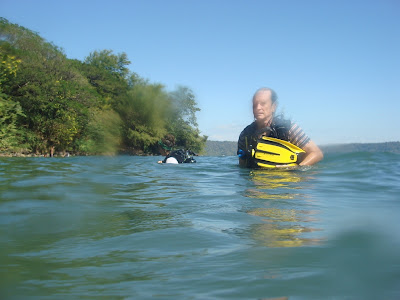
After a scuba dive in Laguna de Apoyo, the clearest lake in Nicaragua. Photo by Martin Cabrera.
Lake Apoyo is the easiest of all locations for scuba diving in Nicaragua. We are located only one hour from downtown Managua. Estacion Biologica collects data at four sites in Laguna de Apoyo, all have easy reach from the shore, and great views below. We enter our study areas from the shore, along property managed by Estacion Biologica.
Life is good after a dive. Photo by Martin Cabrera.
One vital reason for our monitoring program is the bigmouth sleeper, Gobiomorus dormitor. This fish looks a lot like a goby, only much larger as an adult. This voracious predator sits quietly on the lake bottom, where it awaits an injudicious move by any appropriately sized fish, when it strikes with lightning speed. The fish of Lake Apoyo spent thousands of years without the threat of bigmouth sleepers or anything similar, so they are now evolutionarily naive to the grave threats this fish presents.
The Bigmouth Sleeper (Gobiomorus dormitor) is a dangerous predator. It was introduced into Lake Apoyo in 1991. Photo by Martin Cabrera. 
Bright blotches, usually randomly placed, are not exactly uncommon among fish. These colors are usually caused by a specific mutation, such as in the goldfish, which is simply a selectively bred variant of a wild carp. Midas cichlids have a similarly brightly colored variation in the wild, although the "golds" are much more common in some locations than in others. Lake Apoyo, for instance, is considered to have no gold forms. Nonetheless, as the photo below demonstrates, gold forms may also be found in Lake Apoyo.
Gold form Midas cichlids are relatively common in some lakes, but not in Lake Apoyo. Fish such as the one in this photo are exceedingly rare. Photo by Martin Cabrera. 
Which gene(s) control the gold color form in the Midas cichlids is not known. Nor does anyone understand why Lake Apoyo has so few golds. In comparison to most other natural habitats of the Midas cichlids, Lake Apoyo has far fewer golds.
Some Midas cichlids show 
This clownish coloration is quite common among Midas cichlids in Lake Managua, some parts of Lake Nicaragua, and other volcanic crater lakes such as Lake Masaya and Lake Xiloa. Why is it so rare in Lake Apoyo? We don't know.
Amphilophus in Lake Apoyo, Nicaragua
This breeding, gold form Midas cichlid stays near the nesting hole. Photo by Martin Cabrera.
Midas cichlids are territorial when nesting. A breeding pair will occupy a natural or constructed hole, often at the base of rocks, in which a hard, flat, usually vertical surface can be utilized to adhere eggs. The pair will defend the site vigorously against predators and usurpers.
The gold-normal breeding pair linger near the nesting cavity. Photo by Martin Cabrera. 
The great majority of Midas cichlid nests do not result in the eventual creation of new adults. Hundreds of eggs are produced in each spawning, but very few fry will reach the age to swim away from the parental units and begin life independently of them.
The Bigmouth Sleeper has occupied Lake Apoyo only two decades, but is now very common. Photo by Martin Cabrera.
The newest reason for the demise of nests in Lake Apoyo, the bigmouth sleeper, has become very common in the lake. Some of the Midas cichlid species of Lake Apoyo are so rare that the bigmouth sleeper could even make the species disappear. Who would even know if a fish species in Lake Apoyo went extinct?
Filamentous algae forms a carpet on the lake bottom where Chara macroalgae was once abundant, placing much of the life in the lake at risk. Photo by Martin Cabrera. 
The bigmouth sleeper has a neutrally colored, mottled pattern along its sides and back, making its detection difficult. It sits on the bottom, awaiting a false move by some other fish. It strikes rapidly, with the intention to sink its long, fine teeth into the prey and then gradually move the prey into the mouth to swallow it.
bigmouth sleeper
A Bigmouth Sleeper (Gobiomorus dormitor) pair in courtship in Laguna de Apoyo. Photo by Martin Cabrera. 
The success of bigmouth sleeper (Gobiomorus dormitor) during the two decades of its time in Lake Apoyo is startling. They are extremely common. Recent research conducted by Topi Lehtonen and the research team at FUNDECI/GAIA demonstrated that the Midas cichlids of Lake Apoyo do not recognize the threat these fish present to their fry.
Amphilophus fry
These Midas cichlid fry must share their nest space with garbage left by humans. Photo by Martin Cabrera.
Lake Apoyo's fish species are facing several threats from humans. Soil introduction into the lake is higher than ever, coming from constructions in the watershed. Predation and loss of habitat by introduced species have done lots of damage to the species found here. And of course, garbage follows humans everywhere we go. The fish of Lake Apoyo have no choice but to utilize garbage-filled areas of the lake to feed and reproduce.
dive Nicaragua
Juvenile Amphilophus cichlids in Lake Apoyo, Nicaragua. Photo by Martin Cabrera. 
Lots of juvenile Midas cichlids are present year-round in Lake Apoyo. By diving during the different seasons, one can see the smaller fish grow and, by the end of about a year, start their first anniversary as members of the next breeding stock. The intense uses (and misuses) of Lake Apoyo by human beings requires that we assure adequate habitat for these fishes in all their life stages.
blind Amphilophus
A blind Amphilophus astorquii in Lake Apoyo, Nicaragua. Photo by Martin Cabrera.
To date, six species of the Midas cichlid species complex have been described in Lake Apoyo. All of them are only found in this lake. There are eight volcanic crater lakes such as Lake Apoyo, near the Nicaraguan Great Lakes, which have multiple species of Midas cichlids in them. What was once thought to be only one or a few species is now considered to be dozens of species, with very small ranges, and in some cases, populations of only a few thousands of adults. One of those species with a very small population is the chancho cichlid, Amphilophus chancho. It is the largest of the Midas cichlid species complex found in Lake Apoyo, with males sometimes reaching well over a kilogram weight.
Amphilophus chancho nest
Amphilophus chancho defending fry in a nesting hole in Lake Apoyo. Photo by Martin Cabrera. 
Child-rearing is an expensive venture for most species. It is especially so for the Midas cichlid species of Lake Apoyo, too. Providing care for the fry means eating less and lower quality food. It also means getting in harm's way. The parental units must confront potential predators and utilize displays, threats, and if nothing else works, direct attacks to drive away the fish and crabs that would want to eat the fry. Adults often look emaciated and battered at the end of the breeding season.
Amphilophus fishes near a hole beneath a rock in Lake Apoyo, Nicaragua. Photo by Martin Cabrera.
A scuba dive with the staff at FUNDECI/GAIA usually means seeing most of the six species of the Midas cichlid species complex, perhaps about five hundred individuals in total. Occasionally, we get to see jaguar cichlids (Parachromis managuensis) up close, while nesting. It also means seeing the ubiquitous bigmouth sleeper, lots of them, perhaps upward of a hundred individuals in a single dive. Other fish, crabs, and the dramatic undwater views round out most dives. Some of the dives take you to thermal vents, where clear, warm water flows from between rocks into the lake. And especially during the appropriate season (November through February), lots of fry in nests!
An adult bigmouth sleeper uses a hole beneath a rock as a hiding spot, from which to hunt. Photo by Martin Cabrera.
Diving in Lake Apoyo is different than in the ocean and generally much easier. No currents, waves, poisonous animals produce dangers here. The dives are rewarding and especially so when contemplating the rarity of some of the fishes, to which our divers contribute to study and protect them. Please contact us if you would like to dive with us in Lake Apoyo.
Parachromis managuensis
Jaguar cichlid (Parachromis managuensis) fry are feeding in open water outside their nest cavity in Lake Apoyo, Nicaragua. A small clump of Chara vegetation can be seen in the lower left. 
dive Lake Apoyo
Click on the "escudo" to contact us.

Thursday, July 12, 2012

Laguna de Apoyo t-shirt is now available

We invite you to help FUNDECI/GAIA and wear a trendy clothing item at the same time. Laguna de Apoyo t-shirts are now available at Estacion Biologica in two colors-red and blue. The t-shirts are high quality, TricoTextil fabric and stitching, and serigraphed with the Laguna de Apoyo logo on the front. 

nature conservation

Two full-sized designs adorn the back. One is of a toucan, a squirrel and a Midas cichlid-all emblematic wildlife found in Laguna de Apoyo Nature Reserve. 

wildlife conservation

The other back design shows the six endemic fish species of Laguna de Apoyo. These six species, all members of the Midas cichlid species complex, are facing threats of extinction due to human activity. Our work to learn about them and their needs helps the civil society and the government of Nicaragua to determine what measures are most important to protect these species. 

wildlife conservation

The back designs are available in either color. Prices ten dollars for small or medium, eleven dollars for large or extra large. 


The designs on these t-shirts were provided generously by volunteer Silvia Machgeels. By purchasing a t-shirt, you contribute to our program in wildlife monitoring in Laguna de Apoyo Nature Reserve. 


Please come by Estacion Biologica Laguna de Apoyo to pick up your t-shirt or write us at apoyo@gaianicaragua.org. We will gladly send you one!

Click on the "escudo" to contact us.

Thursday, February 16, 2012

Two days hike around Laguna de Apoyo

hiking Laguna de Apoyo
Laguna de Apoyo as seen from the Catarina mirador. Photo by Sandra Wallace.
Story by Xaver Schenk, a student of Apoyo Spanish School.
Some people would wonder why I would do a two days hike around the lake which would also be possible to manage in one day. I actually did the hike in one day, two weeks ago with a friendly American I met here. It took us 8 hours to get around the lake and we literally marched through the forest. So there wasn’t any time to really take a close look at the fantastic nature of this forest. That’s why I decided to do it again in two days which has given me the possibility to really enjoy all its facilities.
backpacking hiking swimming Nicaragua
Simba and Xaver. Photo by Xaver Schenk.
I started right after dinner with my fully packed backpack and Simba, one of the dogs of the station who is tied up too much of his day, so he would love to have a little trip to the forest. So I headed north east on the road, passed a cute little church and several houses. I think I went a little early to the shore because when I continued I had to cross several
laguna de apoyo hiking
Laguna de Apoyo hiking. Photo by Xaver Schenk.
properties which is actually no problem but with Simba I had a lot of fun with the guarding dogs of those properties. We had to make our way over several barbed wire fences but Simba seemed to know the parts where there were holes in it so that it was no big problem. As I continued I passed some ruins of stone terraces. Walking on I, recognized the forest getting cleaner and it was really good to feel the absence of human beings. That’s where I started to see toucans and other tropical birds.

I recognized that I might have a little too much stuff in my backpack because I was sweating and my legs felt kind of weird. At midday I looked for a good place for me to have lunch. I probably should have looked a little better. Because when I took off my shoes and started to get ready for lunch I recognized hundreds of small ants raping my food, so I had to look for another place which was actually pretty easy.
laguna de apoyo nature tour swimming
Wild areas along the shore of Lake Apoyo. Photo by Xaver Schenk.
Around four o'clock, I came to a place where the beach was broad enough to build up a tent and it actually was a really beautiful place. So, I decided to set up my camp and try to get a few fishes out of the lake for dinner. I tried to catch some cichlids with what they here call “pescado falso” a plastic fish with hooks. I saw a local the other day catching a lot of fishes with one of those but I had no luck this day.

laguna de apoyo camping
Photo by Xaver Schenk.
But actually I really enjoyed fishing with my improvised fishing root which was a plastic bottle I wrapped the fishing line on. I was glad that I had some rice with beans in my backpack so I wouldn’t had to go to bed hungry. After dinner I lit a fire and played some songs on my blues harp and just enjoyed being in nature.
Laguna de Apoyo at night. Photo by Xaver Schenk.

tent camping Nicaragua
Simba guards the tent at Laguna de Apoyo. Photo by Xaver Schenk.
I had Simba tied to my tent and he woke me up once or twice just to show me a rabbit or a goody he had spotted. I went in at dusk and had a nice swim in the lake which is at this time totally calm. After eating some more rice and beans I went back on the track. Now the forest changed because huge rocks from a prehistoric eruption where all over the place. A lot of geckos where hiding beneath the rocks when Simba and I climbed over the rocks.
nature tours Nicaragua
Gonatodes albogularis in Laguna de Apoyo. Photo by Xaver Schenk.

It was actually pretty hard to get over those rocks with my backpack but it was actually worth it because when I sat down for a break on one of those rocks some howler monkeys started a party over my head shouting at each other. When I finally hit the road one of my shoes lost its soles and I arrived kind of funny walking at the station and fell into a hammock. It really was a great hike. I would recommend it to everyone who is looking for some outdoor trip in Nicaragua.


Laguna de Apoyo
Click on the "escudo" to contact us.

Tuesday, October 4, 2011

Underwater Lake Cleanup 15 and 16 October, 2011


Laguna de Apoyo Spanish School and Volunteer Program
Laguna de Apoyo is among the most beautiful places I have ever visited. Although most of us respect and care for this magical lake and the land around it as a reflection of our concern and care, some people do not. Trash is an unavoidable part of the underwater scenery, which is the habitat for the lake's very special animals.

We will be conducting a lake cleanup activity with volunteer divers 15 and 16 October, 2011. Certified divers are welcome to join us for either or both days. You will need to bring your own gear and your proof of SCUBA diving certification, and we will have compressors handy for tank refills. Non-divers can help with lots of above-water logistics and management of the waste that will be retrieved, and photodocumentation. This is a great opportunity to provide a small volunteer contribution to give back to the lake which we all love most. Please join us-write for reservations for participation and for rooms if you wish to stay overnight. Our "core group" of active military force divers has already signed on.

For those who can not participate in person, please consider making a donation to offset the costs of this activity. We will be spending hundreds of dollars in fuel consumption, logistics and planning. Your help in any way is greatly appreciated.

Watch Channel 13 VIVA LA VIDA Wednesday, October 5, at 8:30 am when we will be discussing the event.
Nicaragua Volunteering
Click on the "escudo" to contact us.

Friday, December 10, 2010

Video-endemic fish species in Laguna de Apoyo


Six fish species are known to inhabit only Laguna de Apoyo. Our research group at FUNDECI/GAIA in collaboration with scientists from US and Europe discovered five of those six, and we have a few other taxa targeted for species recognition from this lake. We are conducting a long-term fish population monitoring project in Lake Apoyo, in part to provide information about the populations of each species in order to assure their continued existence. We gather this date while SCUBA diving. See the film of one of those dives, below.


Volunteer divers participate in monthly monitoring of fish transects in Laguna de Apoyo.

The fish species found in Lake Apoyo are:

Amphilophus astorquii^
Amphilophus chancho^
Amphilophus flaveolus^
Amphilophus globosus^
Amphilophus supercilius^
Amphilophus zaliosus^
Parachromis managuensis
Poecilia sphenops
Atherinella sardina
Gobiomorus dormitor*
Oreochromis aureus*
Oreochromis niloticus*
^-endemic to Laguna de Apoyo
*-recently introduced by human activity
The volunteers and staff at Estacion Biologica FUNDECI/GAIA are conducting long-term fish population monitoring in a program that encourages "citizen participation". Certified divers can join us in the dives and help us collect data. 

Our work has led to more than a dozen scientific publications on the fishes of Laguna de Apoyo, and five species of fish have been discovered by our staff in this lake. Furthermore, one of these species, the arrow cichlid (Amphilophus zaliosus), has recently been listed as Critically Endangered on the IUCN Red List.
Would you like to help us monitor and protect the endangered fishes of Lake Apoyo? Certified Open Water divers are welcome to join us in this vital work to protect the natural heritage of this beautiful lake. Please contact us for more details.

Dive Nicaragua
Click on the "escudo" to contact us.

Wednesday, August 19, 2009

Children of Laguna de Apoyo Read Books!

The children of Laguna de Apoyo Nature Reserve live without the benefits of our children in the First World. Their parents don't have cars, most don't even have refrigerators to store cold foods. They live simply, and without opportunities to know distant places, or expensive toys. Books are not even found in their houses. Our friend Christine decided to add a new dimension to the lives of our children here, by coordinating a campaign to donate books to the Escuela Luis Alfonso Velasquez. She brought with her from Canada, more than forty books appropriate for primary school-age children in Spanish, on a wide variety of educational topics. Our study center supports the local children to promote the best education possible. 
Apoyo Cultural Center
Christine McGregor demonstrates the fine art of bubble-blowing to children at  Escuela Luis Alfonso Velasquez  in Laguna de Apoyo. Photo by Christine McGregor.
Reading is a gateway to other countries, continents, and planets. Yet, the children of Laguna de Apoyo come from families with little income, parents without education, and the school is without resources. Thanks to the kindness and generosity of Christine McGregor, the children of Avon Maitland School in London, Ontario, Canada, and several publishers who made discounts and donations, the children of Laguna de Apoyo can feed their imaginations and develop their reading skills in the process.
Apoyo Cultural Center
Not all the children at Escuela Luis Alfonso Velasquez can purchase a school  uniform. Photo by Christine McGregor.

Apoyo Cultural Center
Where the Wild Things Are is a favorite of many North American children, and now, the children of Laguna de Apoyo can read this wonderful story, too. Photo by Christine McGregor.
Nicaragua schools
Children devour the books donated to them! Photo by Christine McGregor.
children Nicaragua
The children at Escuela Luis Alfonso Velasquez intently read the books donated to them. Photo by Christine McGregor.
Apoyo Cultural Center
Now, even in Laguna de Apoyo, children can read the environmentalist message of The Lorax, a favorite Dr. Seuss book. Photo by Christine McGregor.
Apoyo Culture Center
Christine and the teachers of Escuela Luis Alfonso Velasquez watch children reading the books donated from our Canadian friends. Photo by Christine McGregor.
Apoyo Cultural Center
The books donated from Christine McGregor to the children of Laguna de Apoyo. They included science and cultural themes. Photo by Christine McGregor.

schools Nicaragua
The teachers of Escuela Luis Alfonso Velasquez tag each donate book. Photo by Christine McGregor.

education Nicaragua
Tagged books for the children of Laguna de Apoyo now have their place in the shelves at Escuela Luis Alfonso Velasquez. Photo by Christine McGregor. 
Every year, FUNDECI/GAIA makes a donation to the Escuela Luis Alfonso Velasquez. Often, we organize cultural presentations for the children there. If you would like to donate to the Escuela Luis Alfonso Velasquez, or if you would like to volunteer as a teacher's assistant, please let us know.
education Nicaragua
Click on the "escudo" to contact us.