Spanish school, Research Station, Sustainable tourism, Ecotourism, Fish studies, Bird and other nature studies, Reforestation and Conservation Activities and Hostel in Laguna de Apoyo Nature Reserve, Nicaragua. Birdwatching, SCUBA diving, swimming, hiking, nature and wildlife watching. Hostel, great meals, great friends. Saving the planet and enjoying every minute of it!
www.gaianicaragua.org.
www.twitter.com/lagunaapoyo
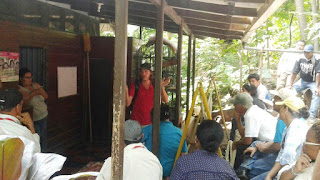
Recently, the participants in a course organized by the International Center for Tropical Agriculture (CIAT, its initials in Spanish) visited Estación Biológica Laguna de Apoyo to learn about land management in a protected area.
CIAT course members tour the native tree nursery managed by GAIA. Hundreds of trees are grown in the nursery and transplanted into reforestation plots to re-created natural forest in the Laguna de Apoyo Nature Reserve. Photo Patricia Gómez.
Although most of their course dealt with the traditional problems facing poor farmers in the country, such as weather insecurity, labor, credit, and technical assistance, here the issues are shaped by the special aspects of the protected area. GAIA Director Jeffrey McCrary discussed with them the legal and technical issues facing land management in the area. Masaya Department, where the northern half of the reserve is located, is highly populated, but is historically a very productive agricultural area, with yuca, beans, sesame, and even coffee in the area near the Laguna de Apoyo Nature Reserve, in addition to the standard slate of smallholder crops which are often destined for personal use with excess production directed to the market, such as corn, plantains, and tree fruits.
The classification of the lands inside Laguna de Apoyo Nature Reserve as part of the SINAP protected area system regulated by the Nicaraguan government, however, imposes overriding restrictions and prohibitions on several activities, among them agriculture. The area is dictated by a number of laws, regulations, and policies, which specifically prohibit agriculture, cutting plants, killing or capturing animals, and even building structures. Enforcing the policies has its own set of challenges, particularly because much of the land is in the hands of private landowners who wish to put houses on subdivided plots and sell them for profit. Even subdividing land is forbidden, as part of the Law 559.
The management plan in effect in Laguna de Apoyo Nature Reserve, approved by decree in 2010, was produced by a team coordinated by GAIA director Jeffrey McCrary, who provided a brief review of the successes and failures of the plan since its implementation. Different interest groups were considered, such as mostly-foreign tourism business owners and vacation home owners, Nicaraguan renters on public land, the local community, and the community at large which includes all Nicaraguans, who have a voice in the way all natural areas are managed.
Course members contemplate wild animal rescue and rehabilitation, another activity conducted by GAIA at Estación Biológica Laguna de Apoyo. Photo Pablo Somarriba.
The most important single element of Laguna de Apoyo Nature Reserve is the lake at the bottom of its crater. In it, several fish species have evolved; six currently recognized species are only found in this lake. The lake provides unequaled views from near and far, and watersports opportunities, as well as serving as the only habitat in nature for these six species of fish. Strict policies are necessary to ensure that the lake remain pristine and uncontaminated. Issues discussed included the constant introduction of garbage from visitors and from a set of bars managed by Nicaraguans on municipal property, and the scandalous introduction of hundreds of tires into the lake by a group of non-Nicaraguan scuba divers puporting to represent a non-profit organization. Although the introduction of tires is regarded as patently illegal, the Nicaraguan government has found the challenges behind stopping this practice greater than their technical capacity to enforce the law.
CIAT course participants enjoy views of Laguna de Apoyo and take selfies. Photo Jeffrey McCrary.
We can make presentations for your group at Estación Biológica or elsewhere on environmental and development issues. GAIA works in Laguna de Apoyo Nature Reserve and throughout the country. We have worked in every department in the country, and most of the 78 nationally recognized protected areas. Contact us by clicking on the "escudo" below to let us know how we can help you.
New friends are made easily, because we are small and we share with people who visit. People come and go, from Nicaragua and beyond. Some to learn, others to give. Everyone ends up doing a little of both.
Bella, our faithful canine, hangs with the gang in front of Estacion Biologica Laguna de Apoyo. Foto Jeffrey McCrary.
Estacion Biologica is not at all pretentious or upscale. We have a simple place, and we are doing simple things: planting trees, studying the environment, birdwatching, sharing our knowledge of the language and culture, and collaborating with the neighbors and the government of Nicaragua to make Laguna de Apoyo Nature Reserve a great place for nature, for decades to come. Our visitors are welcome to pitch in. Our prices are very low, but we are comfortable, and we eat very well! Special food options can always be arranged: gluten- or dairy-free, vegetarian, or vegan.
This is how Spanish homework ends some evenings. Photo Andras Dorgai.
We are perhaps best known in some circles for the Spanish courses we offer, at Apoyo Spanish School. Each year, we impart at least one hundred fifty course units of a week each, custom-designed to fit the abilities and needs of each person. Our students are often travels who want to engage with locals better. Many, however, are learning Spanish for professional reasons, using their language skills in Nicaragua or other nearby countries in their jobs.
Early morning in Lake Apoyo, while clouds cover Pacaya, above the rim of the crater. Photo Andras Dorgai.
Undoubtedly, the best part of spending time at Estacion Biologica Laguna de Apoyo is the lake. Mornings, the lake can be calm and smooth as glass, without a soul to be seen near the water. As the day progresses, however, locals and tourists may come for a dip. There is no water body anywhere that is as comfortable and naturally clean as Laguna de Apoyo, for a great swim. Visibility underwater during a scuba dive may be as much as 10 meters on a calm day.
All ages get involved when monkeys are to be seen. Everyone becomes a kid again! Photo Jeffrey McCrary.
Our property at Estacion Biologica is humble, but blessed with great trees and often with lovely wild animals. Golden-mantled howler monkeys, known locally as mono congo, are over our heads these days, perhaps two hundred days each year. We thank effective conservation policies enacted as part of the management plan that our director, Jeffrey McCrary, coordinated for the Ministry of the Environment and Natural Resources. Several years ago, there were fewer monkeys and they were found in more limited locations than currently.
Apoyo Spanish School students gather for some extra tutoring from Bela. Photo Andras Dorgai.
Volunteers come to Estacion Biologica to participate in specific projects, or in whatever is most needed. One example is the Murrieta family, who recently spent a couple of weeks engaged in all kinds of environmental conservation activities, including the planting of 56 new trees in a reforestation plot in the hillside behind Estacion Biologica. The evenings were filled with discussions ranging from poetry and literature, to politics and saving the environment, to our favorite places in the many cities each of us had lived or visited.
Visits to Estacion Biologica are often a family affair. Photo Jeffrey McCrary.
Each day at Estacion Biologica brings a new, unexpected blessing. The people in these photos are just a sampling of the blessings that have come our way in the most recent months. We are grateful for every hand lent and each voice raised. Please come by or write us!
Laguna de Apoyo is called a "laguna", but this term is neither the generally used term in English, nor in Spanish. It is a water-filled volcanic crater, resulting from a huge, volcanic explosion about 23,000 years ago. The lake that occupies the bottom of the crater has no open-water connection to any other body of water, although the water table flows into and out of the lake, and basically defines the lake level.
The lake and the terrestrial interior of the volcanic crater are designated a protected area by the Nicaraguan government, called Laguna de Apoyo Nature Reserve. There are several natural resource-related issues which justify and focus the conservation issues.
Among the issues that make the Laguna de Apoyo Nature Reserve a special place, are the views. The lake provides recreation for lots of people who benefit from seeing and interacting with the natural features, especially the lake itself. Being on the shore or in the lake gives one a view of water, forest and sky, a perfect combination.
Laguna de Apoyo at dawn, from the shore in front of Estacion Biologica. Photo Andras Dorgai.
Especially around holiday periods, the lakeshore becomes a festive gathering spot for locals. The beachfront before Estacion Biologica has always been managed as public-access beach for the benefit of all, in accordance with Nicaraguan law. Many hotels and private properties try to deny locals access to the lakeshore before their properties, in order to provide their clients, usually foreigners and sometimes wealthy Nicaraguans, an exclusive experience, even though laws clearly make all lakeshore public property.
During periods that are less touristic, the beach areas of Laguna de Apoyo may be visited by fewer people. On almost any day, the beach is very quiet at dawn. It's a great moment to see the lake, as light emerges over the edge of the crater, when there is little human activity to distract.
Dawn on Lake Apoyo, from a kayak. Photo Andras Dorgai.
There is something special to enjoy personally, alone, and quietly, at dawn on Laguna de Apoyo. The sounds of people, music, cars and the like, are much lower. The wind is usually much lower, too. Birds can be heard from long distances, even monkeys. The shapes of ripples in the water, and the clouds in the sky, help to make a peaceful start to the day.
The lake is often calm at dawn. Photo Wendy Van Kooten.
This article recently appeared in the New York Times April 4, 2016. In it, Gaia scientist Jeffrey McCrary discusses some of the environmental implications of the canal.
Lost in Nicaragua, a Chinese Tycoon’s Canal Project
BRITO, Nicaragua — A Spanish explorer conducted the first survey to connect the Atlantic and Pacific Oceans here in the 16th century. Napoleon III of France dreamed about it. The railroad magnate Cornelius Vanderbilt briefly had rights to do it. Nicaragua’s history is littered with dozens of failed canal schemes.
But when a Chinese billionaire, Wang Jing, officially broke ground in a field outside this sleepy Pacific Coast village about a year ago, many Nicaraguans believed that this time, finally, they would get their canal.
And not a small one, either. Three times as long and twice as deep as the Panama Canal, it would slice 170 miles across the southern part of the country — bulldozing through fragile ecosystems, virgin forests and scenes of incredible beauty. It would allow for the passage of the world’s largest ships, vessels the length of skyscrapers that are too big for the Panama Canal.
Yet 16 months later, Mr. Wang’s project — it would be the largest movement of earth in the planet’s history — is shrouded in mystery and producing angry protests here. President Daniel Ortega has not talked about the canal in public for months. And there are no visible signs of progress. Cows graze in the field where Mr. Wang officially began the project.
Experts say they are baffled by Mr. Wang’s canal. It may be backed by the Chinese government, part of its growing interest in Latin America, or may simply be a private investment cast adrift by the convulsions of China’s stock markets and its slowing economy.
At the time of the groundbreaking in December 2014, the Chinese government said it was not involved with the project. This and Mr. Wang’s recent setbacks — he has reportedly lost about 80 percent of his $10 billion fortune — make some experts say the deal is probably dead.
Others, however, say Chinese business practices are so opaque that it is hard to tell. Facilitating the movement of goods from the Pacific to the Atlantic aligns with Chinese interests, and the cost of the project is hardly an obstacle if the Chinese government wants to go forward — if it is involved.
Officials of Mr. Wang’s company say they are simply taking more time to do precon
“It’s a project that has been notoriously nontransparent,” said Margaret Myers, the director of the China and Latin America program at Inter-American Dialogue, a policy institute in Washington. She says she believes the project is probably dead for lack of funds, but like most experts is not sure.
What does seem clear is that the project’s critics — environmentalists, human rights advocates and economists — have grown more outspoken and organized. In this part of the country, many homeowners have stenciled “Go Away Chinese” on the sides of their houses, and virtually all the re-election posters for Mr. Ortega have been hit with black paint balls.
When he announced the deal in 2013, Mr. Ortega, a left-wing guerrilla turned pro-business politician, promised that the canal would transformNicaragua and create hundreds of thousands of jobs, eventually doubling the country’s gross domestic product. Many Nicaraguans, eager for a better future, embraced the idea, and many still do.
But a growing number say the benefits of the deal are not so clear.
Some question whether the canal would even be commercially viable. Few supertankers and massive container ships now afloat will not be able to pass through the expanded Panama Canal set to open soon. And few ports are big enough to welcome those megaships. In the short term, some experts say, the combination of the Panama and Nicaragua canals would lead to overcapacity and price wars.
There are also concerns about the seismic activity in the area, or the many volcanos. Some analysts point to China’s poor record on environmental matters and Mr. Wang’s inexperience in building anything, let alone a $50 billion (some say $80 billion) canal carving through miles of protected areas that are home to many endangered species, including the jaguar, and legally recognized indigenous lands. The little-known Mr. Wang made his fortune in telecommunications, not in construction.
And then there is the 50-mile trench to be dug on the floor of Lake Nicaragua, the largest body of fresh water in Central America — which many fear could end up contaminating, even killing, the lake.
Economists and human rights activists also object to the powers Mr. Wang has to expropriate land at far less than market rates, saying the terms of Mr. Wang’s concession could discourage anyone else from investing in Nicaragua.
HONDURAS
NICARAGUA
Route of
proposed canal
Managua
Lake
Nicaragua
Brito
Caribbean
Sea
Pacific Ocean
COSTA
RICA
100 MILES
That aspect has prompted protests from farmers, some of which have turned violent. Experts say Mr. Wang will have to pay only the assessed value, or about 5 percent of the market value, for any lands he takes. But many farmers would not be entitled to even that. In a country that is short of adequate roads and government offices, many do not have formal title to the fields they have cultivated for generations.
Juan Sebastián Chamorro, the general director of theFunides research institute, who has come out against the canal, said the agreement with Mr. Wang, rushed through Parliament and enshrined in the Constitution, effectively made no landowner safe anywhere in the country.
“In theory, if Mr. Wang wanted to take this building we are sitting in right now for his project, he could,” Mr. Chamorro said, his hand sweeping across his office in downtown Managua, the capital. “Who would want to buy or build here with that possibility hanging over their heads?”
Mr. Chamorro said that the majority of the construction jobs would not go to Nicaraguans and that Panama did not become prosperous until it won control of its canal. That is unlikely to happen here for 100 years, according to the agreement with Mr. Wang, which he can sell to a third party.
Under the current plan, the canal would begin along a stretch of pristine beach in Brito, then cut through Lake Nicaragua, which, with two volcanoes rising out of it, is one of the country’s major tourist destinations. It would reach the Caribbean coast by cutting through the land of the Rama and Kriol people, in areas that are not accessible by road right now.
But the plan is much broader than just a canal. Mr. Wang’s vision includes new airports, new ports on both ends of the canal, new lakes in the mountains to make sure the canal has enough water, and new islands in Lake Nicaragua to dispose of excavated sediment and rock.
A 1,100-page study of the project, conducted by the British consulting firm ERM and issued five months ago, reinforced the notion of how much is at stake. It recommended further studies in many areas before going forward and noted that a wide range of mitigation efforts would be needed, like reforestation and job training.
Some see hope in those efforts. Jeffrey McCrary, an American fish biologist who lives in Nicaragua and worked on the study, supports the project, saying Mr. Wang’s company will have to provide money to clean up environmental damage already caused by deforestation, poor land management, crop fumigation and general dumping into Lake Nicaragua.
“I’ve seen that lake, and it is in miserable shape,” he said. “Are we going to kill a lot of fish to build the canal? Yeah, we are. But without the canal, I think we are doomed.”
Kamilo Lara, a member of the Nicaragua Canal Commission, a group appointed by the government to oversee the project, said many critics of the project were political opportunists. Mr. Lara said the canal plan had been adjusted to deal with problem issues, like potential earthquakes, tsunamis and environmental concerns. And people who might be displaced by it, he said, could be moved to small cities with new schools and services they never had before.
“I have been to China,” he said. “I saw the incredible capital they have to invest.”
In answers to written questions, Pang Kwok Wai, the executive vice president of Mr. Wang’s company, the Hong Kong Nicaragua Canal Development Investment Company, said Mr. Wang was in talks with potential investors and would announce progress “in due form.” He said Mr. Wang had already invested about $500 million of his own money.
Mr. Pang also said the company, though not obligated to do so, would pay market rates for the land it wanted. “We are in Nicaragua to bring progress and play a fair game,” he said.
In the meantime, speculating about the canal has become a national pastime, though polls show that Nicaraguans grow less inclined to believe that it will be built.
“We used to talk about it every day,” said Carlos Fernando Chamorro, the editor of Confidencial, an investigative magazine. “Now we only talk about it every two days.”
Some still hope it will lift this country out of poverty.
But in Brito and the nearby city of Rivas, those who expect to be displaced are angry. Teresa de Jesus Henriquez Delgado, 31, is one of the residents who used a stencil to paint “Go Away Chinese!” on the outside of her house.
“I will resist with all of my strength when the bulldozers come to tear down my house,” she said. “I will fight until I die. I have to for my children. They can’t take this land from my family.”
Captura de peces en la Laguna de Masaya realizada por Gaia y el equipo del Parque Nacional Volcan Masaya. Foto Marten Hogencamp.
Nicaragua es un país bendecido por sus recursos acuáticos como casi ningún otro.
Sin embargo, el manejo de estos recursos ha sido fenomenalmente malo, desde
hace muchas décadas atrás. Xolotlán (también conocido como Lago Managua) ahora
se clasifica como hipertrófico, es decir la población bacteriana figura muy
fuerte en la ecología del lago. Está con enormes cantidades de sedimentos de
todas las cuencas que se dirigen al lago, donde el manejo de tierras no ha
prevenido la erosión de suelo ni la retención de agua en los acuíferos
subacuáticos para el uso humano. No obstante, un siglo atrás, este lago
abastecía a los Managuas y muchas otras comunidades con agua potable. Notables
cantidades de residuos sólidos municipales entran sin ningún impedimento durante
cad alluvia mediante grandes cauces que atraviesan la capital. Los sedimentos
en el fondo del lago se encuentran contaminados con químicos industriales y
agroquímicos.
Estarán claras las aguas de la Laguna de Apoyo siempre?
El Lago Cocibolca (también llamado Lago Nicaragua) sufre el mismo proceso de contaminación que el Xolotlán,
aunque sus cambios han sido más lentos, debido al gran tamaño del lago, una salida caudalosa, y la dicha de no estar en la orilla de
Managua, donde volúmenes desmedidos de
desechos se generan. Los cultivos de arroz ocupan fumigación aérea, las ciudades en la cuenca tienen poca capacidad de gestión de aguas servidas.
Las lagunas
cratéricas, ubicadas en los conos de numerosos volcanes en Nicaragua, también
se encuentran en crises, hasta los ríos que sufren por el mal manejo de los
bosques en su orilla, y la introducción de suelos en el río desde fincas, minas
y ciudades.
Aquí se
presenta en dos partes un video elaborado por nuestros amigos sobre el manejo de las aguas naturales en
Nicaragua. Entre las lagunas en riesgo se encuentra la Laguna de Apoyo, ahora un foco de turismo muy fuerte; Laguna de Nejapa, que se encuentra casi seca; Laguna Masaya, afectada por desechos sólidos y aguas residuales de la ciudad de Masaya. Algunos aspectos de los problemas de agua se encuentran en el siguiente video, dividido en dos partes, elaborado por Fundación Luciérniga. Les invitamos a considerarlo.
Un factor que hace tan difícil la contaminación de las aguas naturales, es que no se encuentra un individuo o grupo pequeño como culpable. Los responsables de la contaminación de las aguas son muchos, o más bien somos todos. La falta de existencia de políticas públicas que pueden proteger a las aguas trasciende generaciones y gobiernos desde la extrema izquierda hasta la extrema derecha. Una conversación largo para planificar las acciones necesarias para proteger a nuestras aguas es necesario. Quieres participar en el cuido de nuestras aguas?
Among the most powerful images that come to mind when one thinks of Nicaragua are those of Laguna de Apoyo. Both foreign travelers and Nicaraguans are stunned by the views. The lake occupies a deep, wide volcanic crater, with relatively steep interior sides, making the lake essentially occupy a hole in the ground. Its clear water is warm, inviting and clean.
Although most references to Apoyo characterize it as a lake, it is a true volcano. The lake is often called a crater lake, in which its water has no open flows outward. In fact, its volcanic origins are demonstrated, as there are warm water vents in the lake at several points. Its shape is considerably different from other, more typical volcanoes, such as Masaya and Mombacho, between which Apoyo lies. There is no overground flow of water out of the lake, and its water is slightly salty.
Especially on the weekends, Nicaraguans from the neighboring towns love to visit Laguna de Apoyo, where they can picnic and relax in a natural setting, and the few who can swim my get into the water. The entire shoreline is public, making access to the lake wide, although many property owners along the shoreline may not cooperate with access to the water easily.
Photo Jeffrey McCrary.
There really is nothing better than being on the lake, in the water. But that is not the only way to enjoy the lake. The view from Catarina, for instance, is spectacular, and one is often serenaded by folk musicians. There, one can enjoy an ice cream or even a full dinner while marveling at the constantly changing hues in patchwork style across the water, with Volcano Mombacho to the right, Granada and Lake Nicaragua beyond, and Volcano Masaya to the left.
Photo Belen Camino.
The lake can produce whitecaps during the dry season, but when still, especially in the mornings of the rainy season (May through November), the lake can reflect the profiles on the opposite side. Mombacho, often capped by lenticular clouds, faces the viewer when observing from behind Estacion Biologica.
Photo Anne Sutton.
Tourism to Laguna de Apoyo can be massive during certain periods, especially around Easter week. Other times, such as in October, can be relatively quiet. Not only the traffic varies with the season, but also the water and the surrounding forests. Winds are constant during the dry season, making the lake more choppy, whereas the surface may be smooth and reflective as a mirror during the rainy season.
Photo Regina Bernheim Delgadillo.
Some of the beaches, such as in front of Estacion Biologica, are made of black, volcanic sand. Others are rocky and steep. The lake varies from place to place. The water is warm (28 degrees C) year-round.
Photo Lucy Lia Real.
The sirens of Ulysees may appear along the shore of Lake Apoyo. Photo Jen Moran.
Although the black sand is characterized by eroded, volcanic obsidian, but other rocks are prominent along the water's edge, particularly pumice which floats and accumulates along the water's edge. Beaches may also contain patches of clay in some locations, and large, composite boulders are found alongside obsidian.
Clouds tend to set in during the rainy season, from May through November. Photo Jeffrey McCrary.
The water of Laguna de Apoyo is slightly salty with volcanic minerals. There are no currents and the waves are very small. The lakefront in most places has a steeply inclined shoreline, but in front of Estacion Biologica, the shoreline is gently sloped, providing a large area in which one can stand and relax, while swimming in deeper water is possible just a few meters further inward.
Photo Heyling Aviles.
Photo Lucy Lia Real.
Would you like to visit us for a swim and lunch? Or stay a few days? Please contact us to enjoy our wonderful Lake Apoyo.
Colombus and other early explorers to the Americas came in search of a passage to the Pacific Ocean which would permit water access to east Asia. This link counted among the inspirations of diverse adventurers in the Central American isthmus, from Cortes to Humboldt. In fact, Lake Nicaragua, also known as Lake Cocibolca, was repeatedly investigated for the possibilities of a direct water link to the Pacific coast.
The shifts in global economies did not lay the issue to rest. Humans had great interest in moving by water from the Atlantic Ocean to the Pacific, and vice versa. The Spanish empire, obliged to trek gold eastward by mule from Peru, dedicated many resources to transoceanic route possibilities, followed in the postcolonial period by other powerful European and US efforts to open a canal. Nicaragua became the principal focus of these efforts, given the natural advantages its topography offered.
Even without a canal, interoceanic travel in Nicaragua spiked during the middle of the nineteenth century, fueled by the massive human movement toward California during the Gold Rush. Cornelius Vanderbilt developed a system of transport along the San Juan River, across Lake Nicaragua, and then by land to San Juan del Sur on the Pacific coast, which benefited thousands of travelers who wished to circumvent the conflicts between whites and indigenous people along the Great Plains. Mark Twain documented the reverse journal with ample detail on Nicaragua in his Travels with Mr. Brown.
History was written with the production of a canal across the Central American isthmus, but in Panama rather than in Nicaragua. But this did not end the ambitions of some to create another canal in Nicaragua. Analyses continued through the twentieth century, as pressure continually rose on the already existing Panama Canal's limited capacity in terms of water to move ships and its limited size. As the Panama Canal widened, ever larger ships could pass, yet an entire class of cargo ship was still left isolated from easy movement between the oceans. A further widening of the Panama canal is simply not feasible.
Undoubtedly, the world would benefit from another, wider canal, built closer to the US, in which transportation costs for many products could be dramatically lowered and greenhouse gas emissions could be cut. For this reason, near the end of the twentieth century, the Nicaraguan government and civil society developed feasibility studies for potential canal routes in Nicaragua, ranging from a "dry canal" consisting essentially of two ports connected by a highway transited by hundreds or thousands of container trucks or a train, to a dug canal crossing Lake Nicaragua at some point.
The canal is now closer than ever a reality. A concession has been awarded to HKND, a venture capital firm located in Hong Kong. Although official canal construction has not begun, an Environmental and Social Impact Study, produced by ERM, has been reviewed and accepted in Nicaragua, which has provided a conceptual approval but many additional studies are pending.
GAIA scientists Jeffrey McCrary and Pablo Somarriba participated in the field studies and analyses for this study, moving throughout the route. Dr. McCrary composed several sections of the extensive Environmental and Social Impact Assessment. As the study progressed, several points of discussion emerged among the public, as well. Although some aspects of the pending canal have been defined, many important aspects must be resolved. GAIA scientists continue to participate in discussions regarding the canal with HKND, the Nicaraguan government, and the civil society, to assure that each anticipated impact and risk be resolved. This is a gargantuan task, for a project which promises to be the largest of its kind in the world, in a country as poor and marginalized as Nicaragua, and crossing such precious natural resources as Lake Nicaragua.
Lake Nicaragua with storms on the horizon. Photo Jeffrey McCrary.
Numerous arguments have been made to question the viability of a canal in Nicaragua, particularly the concession given to HKND. Some of the issues have been of an environmental nature, such as the emminent, total destruction of hundreds of thousands of hectares of tropical forests and wetlands, as was alleged by Jorge Huete and Axel Meyer in Nature. GAIA scientist Jeffrey McCrary participated with other Nicaraguan scientists to rebut this position in separate communication in Nature. The differences in opinion between different members of the scientific community in Nicaragua and a few people such as Jorge Huete was later revealed in further detail in an interview in Global Construction Review, another in a Swedish journal, and finally, an investigative report in Science.
Richard Condit from the Smithsonian Institution in Panama wrote a article in PLoS Biology, in which he discusses the possibilities that a canal in Nicaragua can mean, given the century of experience in the Panama Canal.
While everyone is concerned about the effects of the Nicaragua Canal on water pollution and effects on nature, others see these problems as technical, with solutions within the grasp of those pretending to undertake such a large project. Differences of opinion about the canal abound, but a few things are certain. The Nicaragua Grand Oceanic Canal could be made wrong, and the economy and environment could suffer by water pollution and various other possible calamities. Another scenario is also looming, however, where things are done right and Nicaragua gains, along with the entire planet. It is a big project, and demands a great deal of attention, but it also holds great promise.