The public is invited to this presentation on the human impacts on fauna in Laguna de Apoyo Nature Reserve, Nicaragua. The presentation by Mara McPartland and Jeffrey McCrary, is held at the Escuela Luis Alfonso Velazquez in Laguna de Apoyo 23 July, 2013.
Spanish school, Research Station, Sustainable tourism, Ecotourism, Fish studies, Bird and other nature studies, Reforestation and Conservation Activities and Hostel in Laguna de Apoyo Nature Reserve, Nicaragua. Birdwatching, SCUBA diving, swimming, hiking, nature and wildlife watching. Hostel, great meals, great friends. Saving the planet and enjoying every minute of it! www.gaianicaragua.org. www.twitter.com/lagunaapoyo
Showing posts with label Amazilia rutila. Show all posts
Monday, July 22, 2013
Invitation: Human impacts on the fauna of Laguna de Apoyo
Etiquetas:
Amazilia rutila,
biodiversity,
bird monitoring,
butterflies,
ecotourism,
FUNDECI/GAIA,
hummingbirds,
Jeffrey McCrary,
Laguna de Apoyo Nature Reserve,
Morpho,
Volcano Masaya National Park
Wednesday, July 10, 2013
Hummingbirds II: Amazilia cyanura/saucerrottei species complex
There are lots of interesting and important bird studies to be performed in Nicaragua, among them, issues regarding hummingbirds. What habitats hummingbirds prefer, and how human land use impacts each hummingbird species can be an important issue for Nicaragua, especially now that Nicaragua is developing rapidly. To make such analyses, however, identification of the hummingbirds is vital, but not always straightforward. Both the Blue-tailed hummingbird, Amazilia cyanura, and the Steely-vented Hummingbird, Amazilia saucerrottei, are reported for Nicaragua, although they are so similar that we don't trust any distinctions made in reports about them. Conservation science intern Bart Verdijck has been examining the populations of the species in Laguna de Apoyo Nature Reserve, to determine which is here and whether any distinctions can be made in the field, where supposedly, the two species occur together.
Laguna de Apoyo Nature Reserve to date. Some species are quite rare or even accidental, whereas others are very common. These two species, however, intrigue one in a special way, because little information exists on the two species in the same place.
The intense urbanization all through the region means that hummingbird habitats are being altered rapidly. Without knowing what resources are required for year-round sustenance and reproduction of each species, we are gambling against the hummingbirds with every new forest cleared, building constructed, and parking lot paved. Which hummingbirds among the great diversity of the region will be lost?
The overlapping ranges of A. cyanura and A. saucerrottei mean that resources upon which the two species depend must be divided somehow. Our first goal is to compare the abundances of these and other hummingbirds in each of several sites in Laguna de Apoyo Nature Reserve, to look for trends according to forest structures and land use patterns.
In addition to comparing A. cyanura and A. saucerrottei habitat preferences and abundances in Laguna de Apoyo Nature Reserve through analysis of mist netting data, Bart is examining the populations of all the hummingbirds, using both mist netting and point count results.
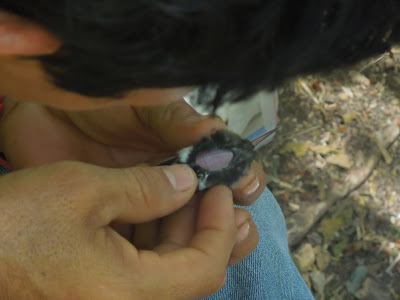
Among the trends hopefully found in the analysis are patterns of reproductive activity. When birds are captured through mist netting, nesting can be inferred from examination of the brood patch which many bird species have-a bare section on the belly, which is highly vascularized and swollen to transfer warmth to eggs, when the birds are sitting.
Some hummingbirds migrate, most notably the Ruby-throated Hummingbird which nests in North America and can be found in Nicaragua during the cold months in its nesting range. Other hummingbirds also migrate, particularly the Blue-tailed Hummingbird, as folks learned in a study in northern Nicaragua. Elevational migrations toward the end of the dry season may be necessary for many birds in tropical dry forest to survive the last weeks of the period, when food items may disappear.
Laguna de Apoyo Nature Reserve is very small-only 4300 hectares, of which almost half is water. Knowledge of migratory patterns is vital to protecting the species found in this reserve.
Laguna de Apoyo Nature Reserve to date. Some species are quite rare or even accidental, whereas others are very common. These two species, however, intrigue one in a special way, because little information exists on the two species in the same place.
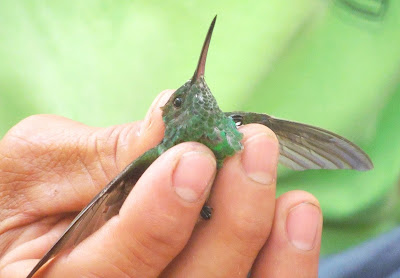
| FUNDECI/GAIA technician Elmer Nicaragua holds a hummingbird. Photo Bart Verdijck. |
| Hummingbirds are easily captured by mist nets for study. Photo Bart Verdijck. |
| Elmer examines the tail and wing colors on this hummingbird. Photo Bart Verdijck. |
| Undertail coverts showing the characteristic pattern of the Steely-vented Hummingbird. Photo Bart Verdijck. |
| Examination of the brood patch can demonstrate whether a bird is nesting. Photo Bart Verdijck. |
| This hummingbird shows a wet head after our technicians examined the ossification on its cranium. Photo Bart Verdijck. |
| Now that this bird has been examined and measured, it is ready to return to the wild. Photo Bart Verdijck. |
| The vent of this bird has the characteristic pattern of the Steely-vented Hummingbird. Photo Bart Verdijck. |
| The red coloration on the lower mandible terminates before the tip. Photo Bart Verdijck. |
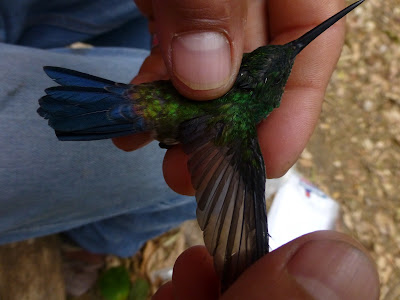
| Lacking evident rusty secondary covert feathers (these are bronzy green) demonstrates that this bird is a Steely-vented Hummingbird (Amazilia saucerrottei). Photo Barth Verdijck.
Helping Nicaragua protect its native fauna in the face of rapid development is our challenge. FUNDECI/GAIA is dedicated to protecting wild nature in Nicaragua in harmony with its people. If you would like to work alongside Nicaraguans and visitors from other countries as a volunteer or intern, you are welcome to participate. Hummingbirds and many other species of animals are waiting for your help!
|
Tuesday, May 28, 2013
Birdwatching in Nicaragua-Video of El Porvenir Trip 2013
| Blue-crowned Motmot - known in Nicaragua as the Guardabarranco. Click on picture to see video! Photo by Max Schellekens. |
| Among the more common hummingbirds in the western region of Nicaragua is Salvin's Emerald, Chlorostilbon canivetii. Photo Max Schellekens. |
| A Salvin's Emerald doing what hummingbirds do best. Photo Max Schellekens. |
![]() |
| Click on the "escudo" to contact us. |
Friday, February 1, 2013
Bird Studies in Nicaragua
Anyone who has done some birdwatching in Nicaragua knows there are some great birds in this country. Observing birds by binoculars, however, still leaves many details unseen, as the photos below can demonstrate. We get a special opportunity to observe birds up close when mist netting. There are few tasks as gratifying as one involving the observation of a living, wild bird up close, especially our birds here.
By studying the birds in Laguna de Apoyo Nature Reserve, we are learning about bird communities in the Nicaraguan tropical dry forest habitat that dominates the terrestrial areas in this protected area. We are also learning, however, about land use, by determining which birds are found in different areas according to the human activities in each. Some birds can use only good forest habitats, and they may be getting forced out by forest degradation. We are hoping to demonstrate consistent patterns in bird populations according to land use and to the changing forest structure as a reforested area grows back into a relatively mature, natural forest.
At least 225 bird species have been documented in Laguna de Apoyo Nature Reserve, to date. Mist netting has helped us confirm several species which had been poorly documented by sightings. Many of the birds captured during mist netting, in appropriate season, are migratory birds, such as the Yellow-throated Vireo (Vireo flavifrons) and the Painted Bunting (Passerina ciris). Perhaps a quarter of the species found in Laguna de Apoyo Nature Reserve are migratory. Almost all migratory birds here nest further north and spend the non-breeding season here.
Some migratory birds winter in mixed-sex flocks, and others segregate by sex and/or age in their southern, nonbreeding range. By counting the birds by sex and age in Laguna de Apoyo, we can help to determine migration patterns for these birds. Appropriate habitat is required for all migratory birds, especially the Red-Listed species such as the Painted Bunting (Near Threatened), and for all sexes and age classes.
Even when the migratory birds have returned to their nesting ranges, the forests and shoreline of Laguna de Apoyo Nature Reserve continue to be conspicuously occupied with birds. The year-round resident birds, which will have become even more evident when the migratory birds have gone, may even reproduce during the stay of most migratory birds, during winter in the northern hemisphere.
The most thrilling of the birds we catch with mist nets must be the most demanding for our technicians, the hummingbirds. They are the smallest and, by far, the most delicate of the birds we catch. Hummingbirds keep very little "reserve" to fuel their activities, requiring that they feed and drink often. We give the hummingbirds water when they are captured, and we process them as quickly as possible to allow them to resume their activities with little interruption. Hummingbirds are usually docile in the hand, and sometimes won't fly away immediately when released.
Hummingbirds are not easy to see well when on the wing, so having one in the hand is particularly special. One can appreciate so many particular features of these birds when they are still and close.
With all the information we gather, we are trying to find which birds are segregated by land use and what can be done about it. We are looking for clear recommendations to promote the entire reserve as good forest and lakeshore for the birds.
![]() |
| Leslie patiently waits for this Blue-tailed Hummingbird (Amazilia cyanura) to fly away. Photo by Emily Williams. |
![]() |
| A Yellow-throated Vireo (Vireo flavifrons) wants to make his disagreement known. Photo by Emily Williams. |
![]() |
| The male Painted Bunting (Passerina ciris) has dramatic coloration. Photo by Emily Williams. |
![]() |
| Painted Bunting males are bright, whereas the females are drab. Photo by Emily Williams. |
![]() |
| The White-tipped Dove (Leptotila verreauxi) is among the larger species we catch commonly in mist netting activities in Laguna de Apoyo Nature Reserve. Photo by Emily Williams. |
Not all birds use the same resources, of course. Many resident birds avoid areas with certain kinds of human impacts, such as the elimination of large, old trees, or the clearing of ground cover. The White-tipped Dove (Leptotila verreauxi) is an example. It is common in forest, but quite uncommon in yards, even where the yards have large, old trees. Another resident bird which is affected by human activity is the Northern Barred Woodcreeper (Lepidocolaptes sanctithomae). This species is common on the south side of Lake Apoyo, but absent from the north side, where greater human impacts are found on the vegetation structure.
| The Northern Barred Woodcreeper (Dendrocolaptes sanctithomae) is not well-documented west of Lake Nicaragua. Photo by Emily Williams. |
Some of the local people brand us as tree-huggers, which is fine by us. We seem to get in the way of some people who have big plans for building inside the Laguna de Apoyo Nature Reserve, and they would rather that we go away. That gives us even more motivation to continue to work to save the forest and lake of this reserve. The greatest aspect of our bird studies is that of the people-those who are dedicated and even thrilled by the birds, and learn along the way. Our conservation science interns and volunteers bring life to our projects.
![]() |
| Work as a volunteer in wildlife monitoring is exhausting but worthwhile. Photo by Emily Williams. |
Hummingbirds are not easy to see well when on the wing, so having one in the hand is particularly special. One can appreciate so many particular features of these birds when they are still and close.
With all the information we gather, we are trying to find which birds are segregated by land use and what can be done about it. We are looking for clear recommendations to promote the entire reserve as good forest and lakeshore for the birds.
![]() |
| Click on the "escudo" to contact us. |
Saturday, April 9, 2011
Bird population monitoring in Laguna de Apoyo Nature Reserve, Nicaragua
This week, our team of Marlene Kroner, Lucas Betthausen, Soren Kraack, and Lorenzo Lopez conducted bird population monitoring by mist netting in Laguna de Apoyo Nature Reserve. Every month, we use mist netting to capture birds for a population monitoring longitudinal study. Here is a selection of the birds they caught in photos, followed by a list of all species captured during this period.
| Grey-headed Tanager (Eucometes penicillata). Photo by Soren Kraack. |
| Male Painted Bunting (Passerina ciris) having its plumage reviewed and noted in our data bank. Photo by Soren Kraack. |
| Stripe-throated Hermit (Phaethornis striigularis). Photo by Soren Kraack. |
There are at least ten species of hummingbirds found in the Tropical Dry Forest habitat of Laguna de Apoyo Nature Reserve. The Stripe-throated Hermit prefers more dense forest cover than others such as the Cinnamon Hummingbird which is more common at Estacion Biologica. This little bird may have co-evolved with specific flowers from which it feeds, hence the decurved bill. This species has recently been named as distinct from the Little Hermit (Phaethornis longuemareus) which now is limited to South America.
| Lesser Greenlet (Hylophylus decurtatus). Photo by Soren Kraack. |
The Tropical Dry Forest habitat abounds in flycatchers (Tyrannidae). Among the less flycatcher-like in behavior of this family is the smallish and retiring Yellow-olive Flycatcher (Tolmomyias sulphurescens). It makes a small pyriform nest with an entrance near the bottom. We often have nests in the yard at Estacion Biologica. The feathers at the top of this bird's head have been wettened by the handler to examine ossification of the cranium-a test for the bird's age.
| Red-eyed Vireo (Vireo olivaceus). Photo by Soren Kraack. |
Here is a list of the birds captured during the April mist netting. Notice how different this list is from the birdwatching list of the same date. It gives you an idea, too, of what you can see when birdwatching in Laguna de Apoyo Nature Reserve.
Catharus ustulatus
Thryothorus rufalbus
Hylocharis eliciae
Chiroxiphia linearis
Eucometis penicillata
Passerina ciris
Xiphorhynchus flavigaster
Turdus grayi
Vireo olivaceus
Chlorostilbon canivetii
Seiurus noveboracensis
Arremonops rufivirgatus
Vermivora peregrina
Basileuterus rufifrons
Myiarchus crinitus
Seiurus aurocapillus
Tolmomyias sulphurescens
Hylocichla mustelina
Thryothorus pleurostictus
Hylophilus decurtatus
Phaethornis striigularis
Dendroica pennsylvanica
Amazilia cyanura
Click on the "escudo" to contact us.
Etiquetas:
Amazilia rutila,
Arremonops rufivirgatus,
aviturismo,
biodiversity,
bird monitoring,
birds,
birdwatching,
Blue-crowned Motmot,
Laguna de Apoyo Nature Reserve,
mist netting
Friday, April 8, 2011
Birdwatching at Estacion Biologica I
The aquatic habitat of the lake combines with the tropical dry forest habitat of Laguna de Apoyo Nature Reserve to give a wide variety of birds to be seen in a birdwatching activity. Here is a list of birds we saw on a morning birdwatching walk around Estacion Biologica this week:
Osprey Pandion heliaetus
Turkey Vulture Cathartus aura
Black Vulture Coragyps atratrus
Orange-chinned Parakeet Brotogeris jugularis
Orange-fronted Parakeet Aratinga canicularis
Turquoise-browed Motmot Eumomota superciliosa
Northern Oriole Icterus galbula
Swainson's Thrush Turdus swainsonii
Clay-colored Thrush Turdus grayi
Hoffmann's Woodpecker Melanerpes hoffmannii
Yellow Warbler Dendroica petechia
Salvin's Emerald Chlorostylbon salvini
White-throated Magpie-Jay Calocitta formosa
Dusky-capped Flycatcher Myiarchus tuberculifer
Social Flycatcher Myiozetetes similis
Inca Dove Columbina inca
Red-billed Pigeon Patagioenas flavirostris
Tropical Kingbird Tyrannus melancholicus
Chestnut-capped Warbler Basileuterus delattrii
Melodious Blackbird Dives dives
Great-tailed Grackle Quiscalus mexicanus
Black-headed Trogon Trogon melanocephalus
Banded Wren Thryothorus pleurostictus
Montezuma Oropendola Psaracolius montezuma
Rufous-naped Wren Campylorhynchus rufinucha
Yellow-bellied Elenia Elenia flavogaster
Yellow-olive Flycatcher Tolmomyias sulphurescens
Blue-gray Tanager Thraupis episcopus
Scissor-tailed Flycatcher Tyrannus forficatus
Twenty-nine species in 90 minutes, all within 100 meters of Estacion Biologica. Not bad! And we didn't go into the forest, nor did we look near the water. Be watching for a coming posting on our mist netting results, for comparison.
We regularly make birdwatching walks at Estacion Biologica, in addition to the research studies, and we are able to see a similar number of birds without going far and returning in time for breakfast. This list was made with the participation of David Santillo who was studying Spanish with us.
Osprey Pandion heliaetus
Turkey Vulture Cathartus aura
Black Vulture Coragyps atratrus
Orange-chinned Parakeet Brotogeris jugularis
Orange-fronted Parakeet Aratinga canicularis
Turquoise-browed Motmot Eumomota superciliosa
Northern Oriole Icterus galbula
Swainson's Thrush Turdus swainsonii
Clay-colored Thrush Turdus grayi
Hoffmann's Woodpecker Melanerpes hoffmannii
Yellow Warbler Dendroica petechia
Salvin's Emerald Chlorostylbon salvini
White-throated Magpie-Jay Calocitta formosa
Dusky-capped Flycatcher Myiarchus tuberculifer
Social Flycatcher Myiozetetes similis
Inca Dove Columbina inca
Red-billed Pigeon Patagioenas flavirostris
Tropical Kingbird Tyrannus melancholicus
Chestnut-capped Warbler Basileuterus delattrii
Melodious Blackbird Dives dives
Great-tailed Grackle Quiscalus mexicanus
Black-headed Trogon Trogon melanocephalus
Banded Wren Thryothorus pleurostictus
Montezuma Oropendola Psaracolius montezuma
Rufous-naped Wren Campylorhynchus rufinucha
Yellow-bellied Elenia Elenia flavogaster
Yellow-olive Flycatcher Tolmomyias sulphurescens
Blue-gray Tanager Thraupis episcopus
Scissor-tailed Flycatcher Tyrannus forficatus
![]() |
| Photo by Jeffrey McCrary. |
We regularly make birdwatching walks at Estacion Biologica, in addition to the research studies, and we are able to see a similar number of birds without going far and returning in time for breakfast. This list was made with the participation of David Santillo who was studying Spanish with us.
![]() |
| Photo by Jeffrey McCrary. |
Nicaragua has plenty of great places for birdwatching, among them is our wonderful Laguna de Apoyo Nature Reserve. Come and bring your binoculars. Estacion Biologica can arrange a professional guide who knows his or her birds. Four members of our staff are published authors in the scientific literature about birds in Nicaragua.
![]() |
| Click on the "escudo" to contact us! |
Saturday, April 2, 2011
Bird monitoring in Laguna de Apoyo Nature Reserve
We study birds at Estacion Biologica. Would you like to be a volunteer bird monitoring participant? We need volunteers to work with us on monitoring bird populations in Laguna de Apoyo Nature Reserve. Over 225 species of birds have been identified to date in the area. We are conducting field work every month in several locations in the reserve, and we have a large body of data to process, so we can use computer-adept volunteers, too. There is plenty to do for the person who wants to gain experience with birds in Nicaragua. If you would like to participate, please contact us here. More information on the birds of Laguna de Apoyo Nature Reserve can also be found on our website.
![]() |
| The Turquoise-browed Motmot (Eumomota superciliosa) is frequently observed in our montoring in Laguna de Apoyo Nature Reserve. Photo by Romain De Jaegere. |
| Marlene Kroner inspecting a Blue-tailed Hummingbird (Amazilia cyanura). Photo by Stephan Beekhuis. |
![]() |
| Click on the "escudo" to contact us. |
Subscribe to:
Posts (Atom)


