Spanish school, Research Station, Sustainable tourism, Ecotourism, Fish studies, Bird and other nature studies, Reforestation and Conservation Activities and Hostel in Laguna de Apoyo Nature Reserve, Nicaragua. Birdwatching, SCUBA diving, swimming, hiking, nature and wildlife watching. Hostel, great meals, great friends. Saving the planet and enjoying every minute of it!
www.gaianicaragua.org.
www.twitter.com/lagunaapoyo
Showing posts with label wild animal rescue. Show all posts
Showing posts with label wild animal rescue. Show all posts
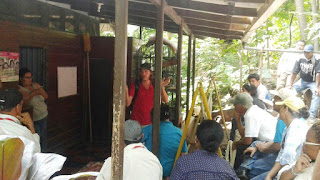
Recently, the participants in a course organized by the International Center for Tropical Agriculture (CIAT, its initials in Spanish) visited Estación Biológica Laguna de Apoyo to learn about land management in a protected area.
CIAT course members tour the native tree nursery managed by GAIA. Hundreds of trees are grown in the nursery and transplanted into reforestation plots to re-created natural forest in the Laguna de Apoyo Nature Reserve. Photo Patricia Gómez.
Although most of their course dealt with the traditional problems facing poor farmers in the country, such as weather insecurity, labor, credit, and technical assistance, here the issues are shaped by the special aspects of the protected area. GAIA Director Jeffrey McCrary discussed with them the legal and technical issues facing land management in the area. Masaya Department, where the northern half of the reserve is located, is highly populated, but is historically a very productive agricultural area, with yuca, beans, sesame, and even coffee in the area near the Laguna de Apoyo Nature Reserve, in addition to the standard slate of smallholder crops which are often destined for personal use with excess production directed to the market, such as corn, plantains, and tree fruits.
The classification of the lands inside Laguna de Apoyo Nature Reserve as part of the SINAP protected area system regulated by the Nicaraguan government, however, imposes overriding restrictions and prohibitions on several activities, among them agriculture. The area is dictated by a number of laws, regulations, and policies, which specifically prohibit agriculture, cutting plants, killing or capturing animals, and even building structures. Enforcing the policies has its own set of challenges, particularly because much of the land is in the hands of private landowners who wish to put houses on subdivided plots and sell them for profit. Even subdividing land is forbidden, as part of the Law 559.
The management plan in effect in Laguna de Apoyo Nature Reserve, approved by decree in 2010, was produced by a team coordinated by GAIA director Jeffrey McCrary, who provided a brief review of the successes and failures of the plan since its implementation. Different interest groups were considered, such as mostly-foreign tourism business owners and vacation home owners, Nicaraguan renters on public land, the local community, and the community at large which includes all Nicaraguans, who have a voice in the way all natural areas are managed.
Course members contemplate wild animal rescue and rehabilitation, another activity conducted by GAIA at Estación Biológica Laguna de Apoyo. Photo Pablo Somarriba.
The most important single element of Laguna de Apoyo Nature Reserve is the lake at the bottom of its crater. In it, several fish species have evolved; six currently recognized species are only found in this lake. The lake provides unequaled views from near and far, and watersports opportunities, as well as serving as the only habitat in nature for these six species of fish. Strict policies are necessary to ensure that the lake remain pristine and uncontaminated. Issues discussed included the constant introduction of garbage from visitors and from a set of bars managed by Nicaraguans on municipal property, and the scandalous introduction of hundreds of tires into the lake by a group of non-Nicaraguan scuba divers puporting to represent a non-profit organization. Although the introduction of tires is regarded as patently illegal, the Nicaraguan government has found the challenges behind stopping this practice greater than their technical capacity to enforce the law.
CIAT course participants enjoy views of Laguna de Apoyo and take selfies. Photo Jeffrey McCrary.
We can make presentations for your group at Estación Biológica or elsewhere on environmental and development issues. GAIA works in Laguna de Apoyo Nature Reserve and throughout the country. We have worked in every department in the country, and most of the 78 nationally recognized protected areas. Contact us by clicking on the "escudo" below to let us know how we can help you.
Many wild animals that have been captured and submitted to the pet trade can be given their fair opportunity to live and die in their natural habitat, instead of a cage. Over the last decade, we have participated in the return to the forest of parrots, toucans, squirrels, monkeys, owls, doves, among many other animals. We have also provided a kind of hospice for lots of wild animals that were mortally injured, almost always as a consequence of some kind of human-wildlife conflict. Many times, these conflicts have been non directly intentional. Other times, conscious intent to harm or at least use harmful force against some wild animal occurred. Wild animal rescue may be needed for any of several, different reasons.
Midorna, a Scarlet Macaw, is a long-term resident of Estacion Biologica Laguna de Apoyo. Photo Andras Dorgai.
One of the ways wildlife encounter conflict with humans is because of the pet trade. Almost any animal can be found for sale on the side of the road at likely locations, many of them offered as pets, others as meat. A few species of animals in Nicaragua, however, are overwhelmingly victimized by the pet trade. One of those species is the Scarlet Macaw (Ara macao).
New blood feathers, still covered in sheaths, are emerging along the neck of Midorna. Photo Andras Dorgai.
The Scarlet Macaw was first listed in Appendix III in the list of protected species of the Convention on International Trade in Endangered Species (CITES), in 1976. Its status was elevated to the more restrictive Appendix II in 1981, then to the most restrictive category for international trade, Appendix I, in 1985. In spite of this listing, the subspecies found in Mexico and Central America, Ara macao cyanoptera, has continued on a precipitous decline in wild populations. They had disappeared from El Salvador in the wild by 1987, and today in Nicaragua, fewer than 100 individuals are found in the wild, thanks principally to the pet trade.
For the few who earn her utmost trust, Midorna can be quite a playmate. Photo Andras Dorgai.
Midorna is a female Scarlet Macaw that has lived a fairly typical life for its species in Nicaragua. There has never existed a macaw hatchery in Nicaragua, so she, like all the others of her species in captivity, were once wild animals, flying free over forests and fields. Because Scarlet Macaws fly above the canopy, and make tremendous rackets while flying, they do not go unnoticed, making their presence-and their absence-conspicuous. Until 1983, several individuals that roosted in the Chiltepe Peninsula would routinely fly over Lake Managua to reach the capital, where they were easily observed. Likewise, the last corroborated accounts of the Scarlet Macaw in the villages around Laguna de Apoyo were from 1969, where they were regarded as potential sources of income for those who could catch them for the pet trade, and as pests by farmers whose corn could be decimated quickly by a flock. Although we don't know her age, Midorna is evidently decades old already.
Midorna craves attention and loves especially the company of males. Photo Andras Dorgai.
The pet trade has meant for Midorna, and for hundreds of other Scarlet Macaws in Nicaragua, a lot more than the tragedy of passing decades of her life in cages instead of the wild, where she belongs. During her capture and handling, or more bones in one of her wings was broken, leaving her absolutely incapable of flight. She knows perfectly well that nature gave her wings to fly, yet she cannot fly, or even make a soft landing if she falls from a height. She has been codemned to a flightless life in her conscious being, albeit she surely flies in her dreams. She loves to raise her wings and feel the wind in them, and to observe below from a high perch.
Midorna and her special friend. The majority of the red feathers that should provide a complete covering over her breast have been plucked by her. Photo Andras Dorgai.
Prisoners go mad when faced with extreme boredom in their incarceration. It should not be any surprise that a Scarlet Macaw would also react poorly to years in a cage. Boredom and isolation are guaranteed. Midorna has developed a behavioral disorder involving breaking and/or plucking her feathers. This disorder is chronic and recurrent: her feathers periodically regrow, only to be broken or plucked again. Even if she were to fly, this disorder would make her life in the wild impossible.
Midorna benefits from company, and becomes visibly happier with more interactions. Photo Andras Dorgai.
In these ways, not only has her life been robbed of years; her sentence for captivity is lifelong, and her own behavior is now plagued with pernicious actions that prejudice her own happiness. These issues are extremely common among macaws in captivity.
The Scarlet Macaw is no longer seen in the wild, almost anywhere in Nicaragua. Photo Andras Dorgai.
There are many issues at stake with what to do with Midorna. First and foremost, is the issue of the integrity of the wild populations that currently exist in Nicaragua and the region. If there is any way that Midorna's life can contribute to the healing and recovery of a stable, continuous, wild Scarlet Macaw population, then she should be at its service. There are many, many Scarlet Macaws in captivity throughout Nicaragua, and they could be placed into a captive reproduction program with the intention to create a new generation for release into the wild. Unfortunately, releasing Scarlet Macaws supposes a safe place for them to be released, which effectively does not yet exist. First, we need to create the conditions which discourage people from capturing them in the wild. At the moment, those conditions do not exist. So, Midorna is waiting.
Not just anyone would risk a kiss from Midorna. As a Scarlet Macaw, she has powerful mandibles that could rip flesh with ease. Photo Andras Dorgai.
Midorna can help to create the conditions for a future with Scarlet Macaws once again flying overhead in Laguna de Apoyo and similar areas. She is an ambassador for her species, for the tragedy of the pet trade. Nicaraguans and foreigners alike get to hear her story and contemplate the issues that are behind her condition. More is needed to change the tide, however.
The role of the Scarlet Macaw in wilderness policy in Nicaragua is the story that Midorna has to tell others. Photo Andras Dorgai.
Research, conservation policy advocacy, and education on the pet trade in wild animals are still needed in Nicaragua in a big way. You can help. First of all, don't buy wild animals as pets. Make your opinion heard among your friends. Second, get involved. Volunteer your time to care of wild animals, donate your spare change to help feed and care for them, or join us for a study of the issues behind the pet trade. Contact us at GAIA if you are interested!
Beards are a special attraction to Midorna. Our goal is that she is the happiest Scarlet Macaw in the country, because liberty is no longer an option. Photo Andras Dorgai.
Midorna loves attention, particularly from boys. Photo Jeffrey McCrary.
Midorna having an intense conversation. Photo Jeffrey McCrary.
Some wild animals can be cute, at least at a distance, under controlled conditions, or perhaps just when they are juveniles. Most wild animals, however, demonstrate at some moment that they are wild by acting aggressively, or by feeling depressed or stressed in conditions of confinement. The cuteness and uniqueness of an exotic animal can seduce the most logical of people into thinking that they can provide adequate conditions to a wild animal so that it will actually be happy and willing to act like a domesticated animal, by showing attachment, obeying commands, and generally acting in a safe manner.
An entire genre of movies has recently emerged, showing wild animals acting in human-like ways, sometimes in Happy Feet-style fantasies. A common theme among them is the connection between humans and the animals. The wildness of the animals is almost always conquered by the goodness of people.
The best term for this sentiment is hubris.
One of several variegated squirrels taken from the pet trade and brought to Estacion Biologica Laguna de Apoyo to transition back to the wild. Photo Andras Dorgai.
This hubris is multiplied when a poor animal is placed for sale at a street light in Managua. So often, we see wild animals such as parrots, toucans, monkeys and even an occasional feline for sale, all bidding to enchant someone enough to plop down a little money and take the animal home to convert it into a family pet.
Purchasing wild animals as pets presents a terrible threat to the populations of animals in the wild. Captures of wild animals for use as pets have decimated the populations of animals such as Scarlet Macaw and the white-faced capuchin monkey in almost all areas throughout the country.
Once wild animals have been made into pets, they may face a difficult transition back into the wild. Photo Jeffrey McCrary.
But the impacts humans have over wild animals because of the pet trade does not stop with the placement of animals who were once wild into cages and forcing them to live in captivity. The habitats where these animals lived is often ravaged to get the animals out. Fire is an effective hunting technique, driving animals from holes in the ground or in large trees. These sites as effective refugia for wild animals are lost, and often, the fires rage onward because the hunters rarely make special efforts to put out the fires they started.
Juvenile squirrels sleep as much as twenty hours per day, in confined spaces in nests, which can be imitated by a bundle of cloths. Photo Jeffrey McCrary.
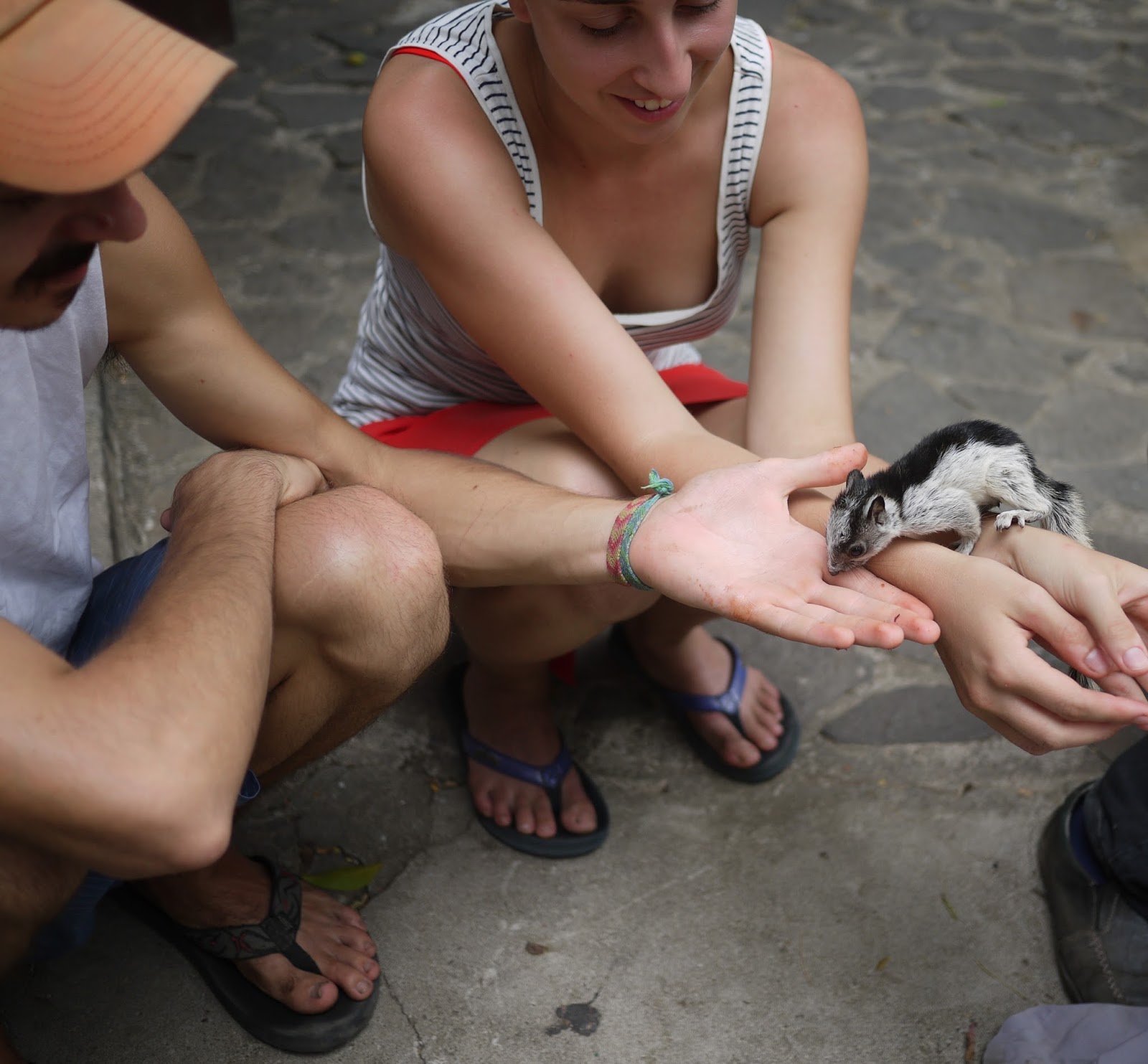
We do get a particular pleasure from the rehabilitation of variegated squirrels (Sciurus variegatoides). Baby squirrels are often captured by animal traffickers by knocking down nests from the tops of trees, and picking up the baby squirrels that survive the fall. The adults, strong and hostile with sharp teeth, are much less interesting as potential pets than the docile and dependent babies. Once in our hands, they must be handled to give the animals the social interactions they need and to assure that they are feeding well and getting sufficient stimulation and exercise.
Squirrels adapted to humans may even prefer to climb on them over scaling trees. Photo Jeffrey McCrary.
Little by little, squirrels can be reacquainted with their natural habitats. This species of squirrel rarely comes to the ground, finding plenty of bark, small insects and other fauna, fruits and nuts, year-round, high in trees. By coming and going from the security of a well-equipped cage, with a door open, the squirrels can choose to sleep, play, feed, and so on, all through the day. Juvenile squirrels can develop their interest in these foods and habitats little by little, until they may lose their interest in humans entirely.
Whenever safe to do so, juvenile squirrels are allowed to enter and leave their cage at will, so they can get exercise, explore, and socialize with wild squirrels nearby. Photo Jeffrey McCrary.
Whenever squirrels or other wildlife have lost their fear of humans, the dangers they face are abundant. First, they may wander into the hands of people who will capture them all over again and carry them back into the pet trade. Second, they face dangers from domestic animals, cars, and even the risk of being stepped upon can be high. Third, pets may also carry viruses that can affect them.
Squirrels quickly learn whose hand does the feeding. Photo Jeffrey McCrary.
Once a squirrel has become accustomed to humans, it must learn to find food, socialize with wild squirrels, and stay away from danger. Perhaps the single most difficult barrier to returning to the wild, however, is to have a shelter in which to sleep. Young squirrels may make a shelter on their own, without the help of other squirrels, or they may be allowed to enter into the nests made by other squirrels.
Even though Laguna de Apoyo Nature Reserve is a protected area with priority given to native species, cats abound in properties controlled by foreigners. This squirrel, once free and living in the trees above us, was caught by a cat from The Peace Project, and did not survive its wounds. Photo Jeffrey McCrary.
Sometimes, a wild animal is successfully reintroduced into the wild. Squirrels will sometimes survive, and their wild character may return, and they may reintegrate into the community of squirrels in the area. When this happens we are always grateful for all the efforts of so many people who participated in bringing food, spending time to provide care, clean cages, and even provide logistics. Each successful reintroduction into the wild results as the culmination of the efforts of many people.
Socialization from humans may substitute for the relationships lost from the members of their species for social animals such as squirrels. Eventually, however, they must develop relationships with their own species in the wild setting, to prosper in the wild. Photo Jeffrey McCrary.
These squirrels are beginning to learn to spend their days foraging in trees. They are still returning each night to sleep in their cage. Photo Jeffrey McCrary.
Variegated squirrels may lose their fear of humans after being caught, so that they may actually prefer to be with people to spending their days in the trees. But little by little, with encouragement, they learn skills for feeding and socialization in their arboreal environment, eventually to never return. Photo Jeffrey McCrary.
When we receive a wild animal to rescue at Estacion Biologica Laguna de Apoyo, we can not always predict what will happen. Sometimes, the animals are injured so badly that little can be done, beyond securing a peaceful hospice for its last hours of life. But, sometimes, animals with injuries may recover, even when their injuries may have appeared gruesome or grave, initially. The owl brought to us last week is another surprise of this sort, with an unexpectedly happy ending.
Perhaps the most common of the owls in the inhabited portion of the Laguna de Apoyo Nature Reserve is the Pacific Screech-Owl (Megascops cooperi). Its range is limited to the dry tropical forest habitats, farmlands and even residential areas, near the Pacific coast from the Isthmus of Tihuantepec to northwestern Costa Rica.
This species is called corococa locally, in homage to its lively call, which is often answered in kind among the members of a social group. It consumes mostly arthropods, although it is thought to take small rodents, as well. A biological control over some potential nuisances may be managed by its presence, making it a beneficial species to have nearby. Nonetheless, local people often kill any wildlife within view, especially when associated with negative myths, as are owls in the Nicaraguan culture.
Although the Pacific Screech-Owl is not active during the daytime, it often roosts in plain view, on low branches of trees, where its camouflage may keep it unnoticed by humans and other fauna. Nonetheless, if seen, it is likely that Nicaraguans, full of myths about owls and generally hostile to any wild animals within view, will attack an owl with intent to harm. In fact, the Pacific Screech-Owl is among the more commonly received bird species by us at GAIA. The subject of this report, brought to us just a couple of weeks ago in Laguna de Apoyo Nature Reserve, was an injured fledgling.
Juvenile Pacific Screech-Owl, rescued in Laguna de Apoyo Nature Reserve, Nicaragua. Photo Jeffrey McCrary.
This young owl, surely having been flying only days of its life, was found by neighbors, Claudio Arnaudo and Jimmy, who work at a nearby hotel in Laguna de Apoyo. The poor bird was plagued with lesions of different kinds. One eye had swollen shut from trauma. Another lesion, possibly caused in a fall, was evident beneath the beak. A wing was bruised and missing about ten of its flight feathers. As owls tend to be, the little animal was hostile to all who approached. Its injuries impeded flying, however, so there was little it could do, beyond menacing looks and tight grips with the sharp talons, against those who bothered it.
The Pacific Screech-Owl perched on a wall at Estacion Biologica, Laguna de Apoyo, Photo Pablo Somarriba.
After several days, during which it refused all food offered, we thought that the poor owl would soon be dead. Yet, it maintained strength. Then, one evening, we noticed that the owl was communicating with the local, wild owls. Small peeps were emanating from the cage, in evident response to the characteristic calls from the trees.
The wing, still missing half its flight feathers, had nonetheless recovered mobility and some of its strength. We left the owl out of its cage to see what would happen. After a few false starts, the owl was gone.
The following dawn, however, the owl appeared once again, at the same place where it was left free. Its adventure over, it had returned to familiar, if confined, surroundings. This time, the owl was placed back into the cage, but with the cage door maintained open, in case it developed an urge to go back to the wild.
The next evening, owls were heard and spotted nearby. The fledgling owl was once again taken out and placed outside the cage, and this time, we watched as the other owls flew in. The injured owl had friends, this was clear, and this time, it took flight and left with them, not to return. One more wild bird in the forests of Nicaragua, mission accomplished.
In the following video, the fledgling owl is approached by another owl. Whether the owl was fed or simply visited, what is clear is that a firm association was developed.
The story of this fledgling owl, adopted by the local owl-family, was unexpected. Furthermore, we are left to wonder if, indeed, the owl had been getting fed by the local owls through the bars of the cage, all along. That possibility would explain why the health of the owl improved, even though it seemingly was not eating. Regardless, we are glad that the owl could enjoy another day as a free animal, to live and die in the forest instead of in a cage. One more animal that was a victim to the aggression of senseless people was saved and returned to the wild. This owl, given another chance at life in the wild, is free in its natural environment, thanks to the attentiveness and kindness of Claudio and Jimmy. Wild animal rescue, sometimes, can be very gratifying.
We at GAIA are working to make Laguna de Apoyo Nature Reserve, and other places in Nicaragua, friendly habitats for wild nature. You can help us to reduce human-wildlife conflicts, provide environmental education, and conduct scientific research on topics of importance to the environment in Nicaragua. Please join us by sending a contribution or volunteering.