Showing posts with label Amphilophus astorquii. Show all posts

Thursday, August 31, 2017

Charles Darwin en Nicaragua

Durante aproximadamente un siglo, las ideas de Charles Darwin sobre la selección de pareja como un motor hacia el desarrollo de especies nuevas, fueron efectivamente desvaloradas dentro del Reino Animalia. Es difícil encontrar un caso donde es probable que dos especies se formaron dentro de una, en una sola población, con sus miembros en permanente contacto. Mientras siempre ha existido la idea que la selección de pareja puede ser un factor importante en el desarrollo de una especie nueva, en la gran mayoría de los casos, es poco probable que no hubiera otro factor, como una barrera geográfica, en la historia del desarrollo de las especies, en particular con animales vertebrados.

El tipo de formación de dos especies de una población de una sola especie, a través de la selección de pareja, es llamado especiación simpátrica. Sin embargo, el caso de la especiación entre un grupo de peces en las aguas de Lago Cocibolca (Lago Nicaragua) y las lagunas cratéricas alrededor, ha sido fundamental en el regreso de este concepto. El grupo de peces lleva el nombre "mojarra" en Nicaragua, y son varias especies, algunas descritas y otras no, del genero Amphilophus.

El tiempo de existencia de las lagunas cratéricas de Nicaragua varía entre unos diez mil y cien mil años, relativamente poco para los procesos de evolución típicos que forman especies nuevas. A pesar de su relativamente reducido tiempo de existencia en esas lagunas, se ha comprobado que procesos rápidos de evolución han sucedido en varias lagunas, a través de estudios morphológicos en Xiloá y Apoyo, y estudios genéticos en varias lagunas. Las aguas de cada laguna son aisladas de otros cuerpos de agua.

Las mojarras se hacen pareja y se anidan dentro de la planta que se llama Chara, en la Laguna de Apoyo. Foto Topi Lehtonen.
Un reportaje sobre los estudios ejecutados por GAIA en las lagunas fue publicado esta semana en El Nuevo Diario, en el cual se mencionan las especies endémicas de este grupo ya identificadas y descritas, de las lagunas de Apoyo, Xiloá y Asososca Managua, y también se menciona un estudio en curso en la Laguna de Masaya, sitio reconocido en desahucio por su nivel de contaminación por basura y aguas residuales que entran en la laguna desde las ciudades aledañas.

Del reportaje en El Nuevo Diario, 30 Agosto, 2017.

Para los científicos, además de que sean especies nuevas que en si tienen importancia, estas mojarras demuestran evidencia de haber sufrido procesos de especiación simpátrica durante el relativamente corto tiempo que habitan las lagunas cratéricas, por lo que sean de gran importancia como sujetos de estudio. Es una lástima que Charles Darwin nunca vino a Nicaragua, para que vea las mojarras que adornan a los lagos y las lagunas de Nicaragua. Si estuviera vivo hoy Charles Darwin, estaría en la Laguna de Apoyo, buceando con nosotros!

De Geiger, McCrary, y Schliewen, 2010.

Estudios de campo en la Laguna de Apoyo. Foto Jeffrey McCrary.

Los peces en la Laguna de Apoyo abundan entre estructuras rocosas. 


Oprime el escudo para contactarnos.

Saturday, November 22, 2014

Cichlids of Laguna de Apoyo by Willem Heijns

People are always asking what is to see in Laguna de Apoyo during a SCUBA dive. Lots of folks have Open Water certifications these days, but most of them have only dived in tropical oceans, over coral reefs where brightly colored fish dazzle. Tropical coral reefs are indeed among the best eye candy on the planet. But people are intrigued when they learn that we SCUBA dive in tropical lakes when the ocean is so close. It's obvious to them that something very attractive must be going on down there to keep our attention, with coral reefs just a couple of hours away.

We at FUNDECI/GAIA study the fish in this lake and in other freshwater locations in Nicaragua. Lake Apoyo has clear, warm water (28 degrees C) which makes it easy to view the fish underwater. Our divers have been collecting data on the fishes of Lake Apoyo for years, learning about the differences between very recently evolved species and even documenting the species themselves. Over the years, other research groups have also become interested in the cichlid fishes of Lake Apoyo and neighboring lakes, especially the group headed by Axel Meyer of the University of Konstanz.


The fish of the Midas cichlid group are definitely the main attraction in Laguna de Apoyo. Since the lake was formed some 23,000 years ago, the lake has been colonized by a few species of fish, but the dearth of species in the lake has left numerous, broad niches available for specialization in feeding, refuge behavior, and nesting activity. The Midas cichlids in the lake have undergone a remarkable evolution, dividing into numerous species. Six species from this group which are only found in Laguna de Apoyo are now accepted in the scientific community. Publications which present these six species can be found here, here, and here. These cichlids are terribly similar, but they do not interbreed, and they even use different timing and locations for nesting in the lake

The video presented above, produced by Willem Heijns, is among the best quality of videos showing some of these species in their natural habitat. We hope you enjoy seeing this video. Thank you, Willem!

Laguna de Apoyo

Please contact us and let us know what you think of our blog, or post a comment below!

You can help us keep nature wild in Nicaragua, by volunteering your time with us or making a small donation to support our projects in wild nature conservation.

Willem Heijns
Click on the "escudo" to contact us. 

Tuesday, April 30, 2013

SCUBA diving in Lake Apoyo, Nicaragua


Amphilophus zaliosus
Hundreds of young arrow cichlids (Amphilophus zaliosus) are only perhaps sixty days from hatching. Although they have been abandoned by their parents, they continue to school at a nesting site. Photo by Martin Cabrera.
We often get asked what can be seen while SCUBA diving in Laguna de Apoyo. Nicaragua has lots of lakes and rives, but most tropical freshwater sites here and elsewhere have low visibility. Lake Apoyo visibility is almost always 5-12 meters at the locations where we dive.

The fish of Lake Apoyo are special, too. The most commonly seen fish are members of the Midas cichlid species complex. Six species in this group have been discovered  in Lake Apoyo, all of which evolved in the lake and inhabit only this lake. The first to be discovered was the arrow cichlid (Amphilophus zaliosus) in 1976 by a professor at University of California-Berkeley, George W. Barlow. Most of these six endemic species can be seen while scuba diving.

Arrow cichlids, like all the other members of the Midas cichlid species complex in Lake Apoyo, nest in rocky reefs, but they also nest often over sandy bottoms in water from 4 to 8 m depth. All the fish in this species complex, which is found throughout the San Juan River watershed and a few rivers to the north and south, provide parental care to their fry for several weeks after hatching. Here is a photo of the arrow cichlid fry after the parents have abandoned them. These fish are no longer defended from predation by the parental units. 

Amphilophus zaliosus
These arrow cichlids have not yet dispersed but are no longer receiving parental care. Photo by Martin Cabrera. 
The parental units expend a lot of energy during the seven weeks of care of the fry. Predators constantly attempt to capture the small fish and they are fended off by the parental units. It's a long seven weeks, not including the courtship and egg-incubation. Parental units often look battered and even emaciated at the end of the period of parental care. However, the great majority of nests never make it to seven weeks fry age, because predation and disease will have killed of the entirety of their nests.
Dive Lake Apoyo
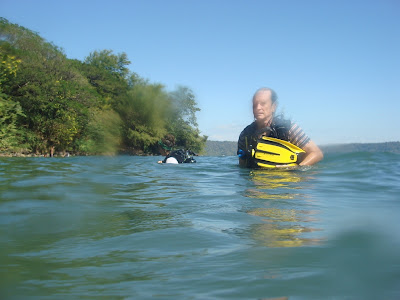
After a scuba dive in Laguna de Apoyo, the clearest lake in Nicaragua. Photo by Martin Cabrera.
Lake Apoyo is the easiest of all locations for scuba diving in Nicaragua. We are located only one hour from downtown Managua. Estacion Biologica collects data at four sites in Laguna de Apoyo, all have easy reach from the shore, and great views below. We enter our study areas from the shore, along property managed by Estacion Biologica.
Life is good after a dive. Photo by Martin Cabrera.
One vital reason for our monitoring program is the bigmouth sleeper, Gobiomorus dormitor. This fish looks a lot like a goby, only much larger as an adult. This voracious predator sits quietly on the lake bottom, where it awaits an injudicious move by any appropriately sized fish, when it strikes with lightning speed. The fish of Lake Apoyo spent thousands of years without the threat of bigmouth sleepers or anything similar, so they are now evolutionarily naive to the grave threats this fish presents.
The Bigmouth Sleeper (Gobiomorus dormitor) is a dangerous predator. It was introduced into Lake Apoyo in 1991. Photo by Martin Cabrera. 
Bright blotches, usually randomly placed, are not exactly uncommon among fish. These colors are usually caused by a specific mutation, such as in the goldfish, which is simply a selectively bred variant of a wild carp. Midas cichlids have a similarly brightly colored variation in the wild, although the "golds" are much more common in some locations than in others. Lake Apoyo, for instance, is considered to have no gold forms. Nonetheless, as the photo below demonstrates, gold forms may also be found in Lake Apoyo.
Gold form Midas cichlids are relatively common in some lakes, but not in Lake Apoyo. Fish such as the one in this photo are exceedingly rare. Photo by Martin Cabrera. 
Which gene(s) control the gold color form in the Midas cichlids is not known. Nor does anyone understand why Lake Apoyo has so few golds. In comparison to most other natural habitats of the Midas cichlids, Lake Apoyo has far fewer golds.
Some Midas cichlids show 
This clownish coloration is quite common among Midas cichlids in Lake Managua, some parts of Lake Nicaragua, and other volcanic crater lakes such as Lake Masaya and Lake Xiloa. Why is it so rare in Lake Apoyo? We don't know.
Amphilophus in Lake Apoyo, Nicaragua
This breeding, gold form Midas cichlid stays near the nesting hole. Photo by Martin Cabrera.
Midas cichlids are territorial when nesting. A breeding pair will occupy a natural or constructed hole, often at the base of rocks, in which a hard, flat, usually vertical surface can be utilized to adhere eggs. The pair will defend the site vigorously against predators and usurpers.
The gold-normal breeding pair linger near the nesting cavity. Photo by Martin Cabrera. 
The great majority of Midas cichlid nests do not result in the eventual creation of new adults. Hundreds of eggs are produced in each spawning, but very few fry will reach the age to swim away from the parental units and begin life independently of them.
The Bigmouth Sleeper has occupied Lake Apoyo only two decades, but is now very common. Photo by Martin Cabrera.
The newest reason for the demise of nests in Lake Apoyo, the bigmouth sleeper, has become very common in the lake. Some of the Midas cichlid species of Lake Apoyo are so rare that the bigmouth sleeper could even make the species disappear. Who would even know if a fish species in Lake Apoyo went extinct?
Filamentous algae forms a carpet on the lake bottom where Chara macroalgae was once abundant, placing much of the life in the lake at risk. Photo by Martin Cabrera. 
The bigmouth sleeper has a neutrally colored, mottled pattern along its sides and back, making its detection difficult. It sits on the bottom, awaiting a false move by some other fish. It strikes rapidly, with the intention to sink its long, fine teeth into the prey and then gradually move the prey into the mouth to swallow it.
bigmouth sleeper
A Bigmouth Sleeper (Gobiomorus dormitor) pair in courtship in Laguna de Apoyo. Photo by Martin Cabrera. 
The success of bigmouth sleeper (Gobiomorus dormitor) during the two decades of its time in Lake Apoyo is startling. They are extremely common. Recent research conducted by Topi Lehtonen and the research team at FUNDECI/GAIA demonstrated that the Midas cichlids of Lake Apoyo do not recognize the threat these fish present to their fry.
Amphilophus fry
These Midas cichlid fry must share their nest space with garbage left by humans. Photo by Martin Cabrera.
Lake Apoyo's fish species are facing several threats from humans. Soil introduction into the lake is higher than ever, coming from constructions in the watershed. Predation and loss of habitat by introduced species have done lots of damage to the species found here. And of course, garbage follows humans everywhere we go. The fish of Lake Apoyo have no choice but to utilize garbage-filled areas of the lake to feed and reproduce.
dive Nicaragua
Juvenile Amphilophus cichlids in Lake Apoyo, Nicaragua. Photo by Martin Cabrera. 
Lots of juvenile Midas cichlids are present year-round in Lake Apoyo. By diving during the different seasons, one can see the smaller fish grow and, by the end of about a year, start their first anniversary as members of the next breeding stock. The intense uses (and misuses) of Lake Apoyo by human beings requires that we assure adequate habitat for these fishes in all their life stages.
blind Amphilophus
A blind Amphilophus astorquii in Lake Apoyo, Nicaragua. Photo by Martin Cabrera.
To date, six species of the Midas cichlid species complex have been described in Lake Apoyo. All of them are only found in this lake. There are eight volcanic crater lakes such as Lake Apoyo, near the Nicaraguan Great Lakes, which have multiple species of Midas cichlids in them. What was once thought to be only one or a few species is now considered to be dozens of species, with very small ranges, and in some cases, populations of only a few thousands of adults. One of those species with a very small population is the chancho cichlid, Amphilophus chancho. It is the largest of the Midas cichlid species complex found in Lake Apoyo, with males sometimes reaching well over a kilogram weight.
Amphilophus chancho nest
Amphilophus chancho defending fry in a nesting hole in Lake Apoyo. Photo by Martin Cabrera. 
Child-rearing is an expensive venture for most species. It is especially so for the Midas cichlid species of Lake Apoyo, too. Providing care for the fry means eating less and lower quality food. It also means getting in harm's way. The parental units must confront potential predators and utilize displays, threats, and if nothing else works, direct attacks to drive away the fish and crabs that would want to eat the fry. Adults often look emaciated and battered at the end of the breeding season.
Amphilophus fishes near a hole beneath a rock in Lake Apoyo, Nicaragua. Photo by Martin Cabrera.
A scuba dive with the staff at FUNDECI/GAIA usually means seeing most of the six species of the Midas cichlid species complex, perhaps about five hundred individuals in total. Occasionally, we get to see jaguar cichlids (Parachromis managuensis) up close, while nesting. It also means seeing the ubiquitous bigmouth sleeper, lots of them, perhaps upward of a hundred individuals in a single dive. Other fish, crabs, and the dramatic undwater views round out most dives. Some of the dives take you to thermal vents, where clear, warm water flows from between rocks into the lake. And especially during the appropriate season (November through February), lots of fry in nests!
An adult bigmouth sleeper uses a hole beneath a rock as a hiding spot, from which to hunt. Photo by Martin Cabrera.
Diving in Lake Apoyo is different than in the ocean and generally much easier. No currents, waves, poisonous animals produce dangers here. The dives are rewarding and especially so when contemplating the rarity of some of the fishes, to which our divers contribute to study and protect them. Please contact us if you would like to dive with us in Lake Apoyo.
Parachromis managuensis
Jaguar cichlid (Parachromis managuensis) fry are feeding in open water outside their nest cavity in Lake Apoyo, Nicaragua. A small clump of Chara vegetation can be seen in the lower left. 
dive Lake Apoyo
Click on the "escudo" to contact us.

Monday, January 9, 2012

Sympatric Speciation Demonstrated Among the Midas Cichlid Species Complex

The Midas cichlid, Amphilophus citrinellus, was once thought to extend throughout the entirety of the San Juan River basin, including throughout both the Nicaraguan Great Lakes and many volcanic crater lakes along their western shores, habitat that only includes the southern half of Nicaragua and the northern half of Costa Rica. Thanks to work published by our research group in the past several years, two crater lakes are known to have multiple species, each endemic to its respective lake. More recently we have studied chromosomal and mitochondrial DNA profiles among the Midas cichlid forms found throughout much of its range, in which we found that each volcanic crater lake has its own group of species, suggesting dozens of species among this group yet to be discovered. Matthias Geiger, Jeffrey McCrary and Uli Schliewen demonstrated and interpreted the DNA profiles in "Not a simple case – A first comprehensive phylogenetic hypothesis for the Midas cichlid complex in Nicaragua (Teleostei: Cichlidae: Amphilophus)" in Molecular Phylogenetics and Evolution. This article confirms our suspicion, that the Midas cichlid species complex consists of dozens of species not yet discovered, in addition to the eleven currently recognized species.
Midas cichlid phylogenetics
Each isolated stock of Midas cichlids, particularly those in volcanic crater lakes, formed its own species flock by sympatric speciation. The inhabitants of each lake are evolutionarily closer to each other, than to any of the Midas cichlids in any of the other bodies of water.
Midas cichlids
Amphilophus astorquii pair with fry in Lake Apoyo, Nicaragua. Photo by Ad Konings.
The implications of the publication mentioned above include that each lake harbors its own set of species in the Midas cichlid complex, and that those species are likely not shared among lakes. The ranges of each fish species are very limited, meaning threats to their populations can be very high. One species from this group, the arrow cichlid (Amphilophus zaliosus), has been classified as Critically Endangered on the IUCN Red List. By extrapolation, we can expect many species to be ranked as Endangered or Critically Endangered when their conservation status is finally evaluated.
Midas cichlid
Click on the "escudo" to contact us. apoyo@gaianicaragua.org

Monday, December 12, 2011

The little Apoyo cichlid, Amphilophus astorquii


The most common cichlid fish in Lake Apoyo is the little Apoyo cichlid, Amphilophus astorquii. It was officially discovered as the culmination of years of study in Estacion Biologica, in a publication in 2008. About three-quarters of the cichlid fishes seen in Lake Apoyo are this species. They breed from December through February, as is shown in the photograph below.

SCUBA dive Amphilophus astorquii Midas cichlid Nicaragua

When breeding, thin, light bars appear over a bluish-black background. The dark coloration emerges from dark dorsolateral spots which remain when the fish is not breeding. The males are always noticeably large than the females in any given breeding pair. The breeding pairs form over a hole and utilize a hard surface such as a rock to attach eggs, which are cared as they hatch to form wigglers which later detach to swim freely. The parental units stay actively care for the fry until they are free-swimming approximately forty days. If parental protection is lost, the fry will be eaten by predators within minutes. 
SCUBA dive Amphilophus astorquii Pyrgophorus coronatus Midas cichlid Nicaragua

An important component of the diet of the little Apoyo cichlid is snails (Pyrgophorus coronatus). During 2011, two volunteers collected data on the snails of the lake, in an effort to understand better the food webs which must be protected for these fish. These volunteers studied Spanish while working with our staff to collect field data. SCUBA divers collected samples of snails in different habitats and then analyzed them.  

SCUBA dive Amphilophus astorquii Midas cichlid Nicaragua

Males often develop nuchal humps as the one in this photo, as a secondary sex characteristic. This fish is in nonbreeding coloration, showing a light, neutral background color, and dark dorsolateral spots. Vestigial dark vertical bars can be seen faintly above and below the spots. When the fish begins its transformation to breeding coloration, these bars will darken and thicken, including the head, leaving the light coloring on the fish limited to thin regions between the bars.
SCUBA dive Amphilophus astorquii Midas cichlid Nicaragua

The little Apoyo cichlid is only found in Lake Apoyo, as is confirmed by a recent phylogenetic study conducted by Matthias Geiger, Jeffrey McCrary and Uli Schliewen, in coordination with Estacion Biologica. They are easy to observe, and our monitoring project gives us lots of opportunities to watch them year-round. Other members of the Midas cichlid species complex in Laguna de Apoyo are: Amphilophus chancho, Amphilophus flaveolus, Amphilophus globosus, Amphilophus supercilius, Amphilophus zaliosus. In addition, the jaguar cichlid, Parachromis managuensis is found in the lake; the molly, Poecilia sphenops; and the silversides, Atherinella sardina. Recent introductions of Gobiomorus dormitor and the Nile tilapia, Oreochromis niloticus, can be found as well.

You are welcome to join us in a SCUBA dive to see these fish in their natural environment.
All of the above pictures were taken by Ad Konings, and copyrights are preserved. Ad is a great colleague and friend, and we are grateful that he has taken interest in the cichlid fishes of Nicaragua. Please do not use these photographs without permission.
Apoyo Spanish School Nicaragua
Click on the ¨escudo¨ to contact us.

Monday, August 15, 2011

Video: Endemic Fish Species in Laguna de Apoyo, Nicaragua, Threatened by Humans


The volcanic crater lakes of Nicaragua attract lots of tourists, both Nicaraguans and foreigners. The water-filled craters are all beautiful, each with its own special features. Eight of these lakes, however, have endemic fish species, daughter species of the ancestral form of the Midas cichlid (Amphilophus citrinellus), living in them. The water of most of these lakes is transparent, perfect for observing these fish while SCUBA diving.
During the nineteenth century, scientists and explorers admired the wide variations in color and shape among the Midas cichlid group, so much so that several species were described during the succeeding fifty years. Most of those species are today lumped back into A. citrinellus, given that this is the first described of the group from Lake Nicaragua. Its sister group, A. labiatus, has similar features but is generally longer and sleeker bodied with prominent lips and frenum. This fish became incorporated into the aquarium hobby trade in a brightly colored form, and is still known as the red-devil cichlid. Only these two species "survived" the scientific scrutiny of the first three-quarters of the twentieth century.

red devil cichlid
Amphilophus labiatus showing its prominent lips in Laguna de Xiloa, Nicaragua. Photo by Ad Konings.
People knew these fish populated not only the Nicaraguan Great Lakes, but also the volcanic crater lakes along their western shores. The late, visionary scientist George Barlow applied for the first time, multivariate analysis to the morphological characters of fish populations in this group to demonstrate convincingly that A. labiatus and A. citrinellus were different species, and that in Lake Apoyo, a unique species exists as well, which he called the arrow cichlid (Amphilophus zaliosus). This species, more elongate than A. citrinellus and lacking the fat lips of A. labiatus, was found in Lake Apoyo. 
Amphilophus zaliosus SCUBA diving
A pair of Amphilophus zaliosus on nest, in breeding coloration. Photo by Ad Konings.
The sacred trinity of A. citrinellus, A. labiatus, and A. zaliosus stood through the remainder of the twentieth century. During the current century, we incorporated the talents of Jay R. Stauffer, Jr. in the taxonomic descriptions of fishes in this group. To date, he has led the descriptions of eight additional species-three from Lake Xiloa, and five from Lake Apoyo, Nicaragua. They will be discussed in a coming blog entry. Most of the species from Lake Apoyo can be appreciated in the video below.
Video by Balasz Lerner.

This second video, produced by Fabio Buitrago, shows underwater footage of endemic fish species in Lake Apoyo, facing a crisis of man-made dimensions-garbage. Everywhere. Why must we pollute their home? These fish-six species known and others not yet discovered-only live here in this lake.

The most common of the fish in this video, and in just about any part of the lake where we have looked, is the little Apoyo cichlid, A. astorquii. It was named in honor of Father Ignacio Astorqui, a Jesuit priest from Spain who devoted much of his life to the study of freshwater fishes of Nicaragua, and wrote the first comprehensive guide to them. A breeding pair with their fry are shown below:

Scuba dive Nicaragua
Amphilophus astorquii pair caring for fry, Laguna de Apoyo, Nicaragua. Photos taken during scuba diving by Adrianus Konings.
Would you like to help us protect and study the endemic cichlid species of Laguna de Apoyo? One of these species is already on the endangered list (Arrow cichlid, Amphilophus zaliosus, Critically Endangered-IUCN). Nicaragua needs your help, because the threats are many, and resources are few. We are seeking divers, biologists, people with experience in excel, and volunteers without any specialized skills to help us in this project. Please contact us if you would like to participate. The Laguna de Apoyo Spanish School also supports this project by providing a portion of its proceeds to fund our studies and conservation efforts. Would you like to learn Spanish? Think about attending our program, and go diving with us, too!

Dive Laguna de Apoyo endemic

Wednesday, April 6, 2011

SCUBA diving in Laguna de Apoyo


We dive to study fish. We study fish to save them. Doubtless the fish of Laguna de Apoyo are facing a race against time as man continues to encroach on their habitat. Each day, the shores of the crater lake have fewer trees. Houses are built, forests are cut, pesticides are applied, all slowly drying and poisoning the only home for six known species of fish and countless others which have not been "discovered" officially. Dozens of fish species remain undiscovered in the waters of Nicaragua.


Here are the endemic species which have been named to date:
Amphilophus chancho
Amphilophus globosus
Amphilophus supercilius
Amphilophus flaveolus
Amphilophus astorquii
Amphilophus zaliosus

The last listed species, the arrow cichlid, was discovered by George Barlow in 1976, while the other five were discovered between 2008 and 2010 by a multinational research team in collaboration between FUNDECI/GAIA, Jay Stauffer's group at Pennsylvania State University and Matthias Geiger at Maximillian Ludwig University (Munich). They are all very closely related species, evolved since an introduction into the volcanic crater lake 10,000-20,000 years ago. All the fish are descendants of a parent Midas cichlid (Amphilophus citrinellus) stock.

In the photo below, taken while SCUBA diving on one of our monitoring sites in Laguna de Apoyo, several of the above-mentioned species are present.
Dive Nicaragua
A multispecies Amphilophus school in our monitoring site. Photo by Balasz Lerner.
We count fish numbers at fixed depths in specific locations monthly, as well as fish nests. The counting methods have permitted us to gain the extensive experience necessary to begin to decipher the differences between the fish species-distinctions that the fish themselves "see" but we do not nearly as easily.
Dive Lake Apoyo
Lorenzo Lopez is taking notes on fish populations in our fish monitoring activity in Laguna de Apoyo.
This study is important because it permits us to detect changes in the lake habitat and fish populations, hopefully giving us time to respond in the event of a potential fish kill or extinction event. We are still trying to understand just how many of each fish species are in the lake in order to interpret our results better. We have recently published a baseline of fish populations and breeding rates at three sites in Laguna de Apoyo, which you can find here.

Not only fish are observed in our monitoring work. We count the crabs seen as well:

SCUBA dive Laguna de Apoyo
Potamocarcinus nicaraguensis in Laguna de Apoyo.
Little is known about the crabs that inhabit the Nicaraguan Great Lakes system. We occasionally see them eating a dead fish, or more often, hiding in a hole or beneath an object. We usually see two or three each dive. We have begun counting them systematically, to look for trends in their population over time.

You can join us! Please let us know if you would like to dive with us in Laguna de Apoyo. If you are a certified diver, and you would like to accompany us, you can learn about the rare and threatened fishes of the lake, see them up close, and help us collect data that ultimately will contribute to scholarly publications about these fish and their habitat. We know far too little about these fish, and your participation helps us learn more about how to protect these species. We are saving Nicaraguan wild nature, and you can help.

Whether you are a field biologist or a tourist, we there are ways you can participate in our work. A few of the ways are:

1. Participate in our diving research program as a diver. Any certified diver can contribute by "buddying" on a research dive.
2. Visit us at Estacion Biologica in Laguna de Apoyo Nature Reserve and meet us personally.
3. Tell others about us and the nature conservation activities in Nicaragua.
4. Patronize businesses with responsible management practices such as permits, pesticide use, waste management, etc.
5. Volunteer some time with us-we have a constant need for volunteers outside the water as much as inside, from computer data management, conservation professional support, to physical activities without technical expertise.
6. Collaborate with us as a visiting scientist. We have numerous projects and topics that could benefit from the involvement of more researchers. Our group publishes more than any research group in Nicaragua, and we would like to work with more international and local collaborators.
7. Donate-whether in cash or used dive equipment in good condition. We can get material transported from the US if necessary. We can receive financial donations via paypal, and provide tax information (we are a Nicaraguan registered not-for-profit).

Please contact us if you want to help. This project depends on individual, small-scale contributions, so your can make a difference.

dive Laguna de Apoyo
Click on the "escudo" to contact us.

Friday, December 10, 2010

Video-endemic fish species in Laguna de Apoyo


Six fish species are known to inhabit only Laguna de Apoyo. Our research group at FUNDECI/GAIA in collaboration with scientists from US and Europe discovered five of those six, and we have a few other taxa targeted for species recognition from this lake. We are conducting a long-term fish population monitoring project in Lake Apoyo, in part to provide information about the populations of each species in order to assure their continued existence. We gather this date while SCUBA diving. See the film of one of those dives, below.


Volunteer divers participate in monthly monitoring of fish transects in Laguna de Apoyo.

The fish species found in Lake Apoyo are:

Amphilophus astorquii^
Amphilophus chancho^
Amphilophus flaveolus^
Amphilophus globosus^
Amphilophus supercilius^
Amphilophus zaliosus^
Parachromis managuensis
Poecilia sphenops
Atherinella sardina
Gobiomorus dormitor*
Oreochromis aureus*
Oreochromis niloticus*
^-endemic to Laguna de Apoyo
*-recently introduced by human activity
The volunteers and staff at Estacion Biologica FUNDECI/GAIA are conducting long-term fish population monitoring in a program that encourages "citizen participation". Certified divers can join us in the dives and help us collect data. 

Our work has led to more than a dozen scientific publications on the fishes of Laguna de Apoyo, and five species of fish have been discovered by our staff in this lake. Furthermore, one of these species, the arrow cichlid (Amphilophus zaliosus), has recently been listed as Critically Endangered on the IUCN Red List.
Would you like to help us monitor and protect the endangered fishes of Lake Apoyo? Certified Open Water divers are welcome to join us in this vital work to protect the natural heritage of this beautiful lake. Please contact us for more details.

Dive Nicaragua
Click on the "escudo" to contact us.

Monday, November 29, 2010

Amphilophus astorquii in a multispecies school


Lake Apoyo is populated by several endemic fish species. These fish species have all derived from the Midas cichlid (Amphilophus citrinellus) in Lake Nicaragua. Being a volcanic crater lake, it is isolated completely from other bodies of water. The first discovery of a fish endemic to Lake Apoyo occurred in 1976, while others have been discovered in 2008, and in 2010, and yet more are to be discovered. Estacion Biologica FUNDECI/GAIA conducts a monitoring program which keeps track of the fish populations and other environmental aspects of Lake Apoyo. Here is a photographic summary of the past week's monitoring, thanks to our SCUBA dive buddy Balazs Lerner, as he and our technician dive Laguna de Apoyo.
amphilophus astorquii

How many species do you see in this photo? All the fish in this photo are endemic species from the Midas cichlid species complex. It was taken at about 35 feet depth (11 meters), in Lake Apoyo, while SCUBA diving.  And yes, there are several species in this photo. This season's breeding is just beginning in Lake Apoyo, but most of the fish in this frame have not begun breeding behavior. We count fish and nests monthly in the lake.


Dive Nicaragua
This is an excellent example of Amphilophus astorquii, the Little Apoyo Cichlid. It was named after Father Ignacio Astorquii, a Spanish biologist and Jesuit priest who dedicated his scientific efforts to the fishes of the Nicaraguan Great Lakes watershed, which includes Lake Apoyo. This fish is in basic (i.e. nonbreeding) coloration.

dive Lake Apoyo
A mixed-species school of Amphilophus cichlids.

underwater photography

This fish suffers from cataracts, likely induced by parasite infection. We are monitoring the environmental health of the lake as well, as blindness is related the recent introduction of Nile tilapia (Oreochromis niloticus) into Lake Apoyo.

Midas cichlid species flock
Ascending at the end of another dive. Job well done!
You can help us continue to discover and protect rare species of fish in Nicaragua by participating in our monitoring program as a volunteer or by making a financial contribution. You can accompany us on a monitoring dive (certified SCUBA divers, of course), also. The fish of Lake Apoyo are in danger of extinction, and your contribution to our efforts helps us inform the Nicaraguan government and international scientific community regarding the conservation status of these species. Please give (via PayPal) to our program! Thank you!

Dive Laguna de Apoyo
Click on the "escudo" to contact us.