Showing posts with label birds. Show all posts

Thursday, August 10, 2017

The Turquoise-Browed Motmot

Nicaragua does not have an officially designated national bird. Nonetheless, the Turquoise-browed Motmot (Eumomota superciliosa) is widely regarded as the national bird. Its imagery permeates the symbology of the country, even appearing on the recently issued 200-cordoba note. All Nicaraguans love this bird, to be sure. Its name in Nicaraguan Spanish is Guardabarranco, or Bank Keeper.

Eumomota superciliosa
A Turquoise-browed Motmot brings a caterpillar to the chicks in a nest on the patio of Estacion Biologica Laguna de Apoyo. Photo Jeffrey McCrary.
This year marked a first. On our, not exactly expansive, patio, a pair of Turquoise-browed Motmots decided to nest. The nest conditions they require has spawned their Nicaraguan name: They choose a horizontal hole in a dirt bank, usually previously made by small reptiles, then expand and lengthen it. The nest is protected from some kinds of potential predators by its location that can be reached only with difficulty by small, clawed animals that can scale the wall, or by flying; by the length of the nest and usually a crook in the access tunnel, which makes any trip into the tunnel treacherous; and by extreme stealth on entering and leaving the nest. 

Laguna de Apoyo Nature Reserve
The 200-cordoba note, made of plastic, features none other than the Guardabarranco.
The nest site was a drainage hole, placed in a stone retaining wall. It is shielded from easy view by a mahogany tree, but is less than two meters from every person entering and leaving Estacion Biologica. There was just enough cover from the mahogany tree to permit the birds to enter and leave without being easily noticed. 

Turquoise-browed Motmot
A juicy caterpillar is on its way to chicks in the Turquoise-browed Motmot nest. Photo Jeffrey McCrary.
Once the eggs have hatched, the real work begins. Hungry chicks demand a lot of food, with particular nutrition profiles, particularly lots of protein. Both parents hurriedly made forays into the garden below and the jungle behind in search of fruits and especially small animals.

Eumomota superciliosa
The Turquoise-browed Motmot, caterillar in tow, is waiting for its mate to emerge from the nest, to ferry more food to them. Photo Jeffrey McCrary.
We were too busy to monitor the nest constantly. Furthermore, the parents noted whether someone was observing before entering or leaving the nest. We chose to act casually, let them do their thing, and hope for the best. This species is abundant in the Laguna de Apoyo Nature Reserve, some nests are found only 40 meters from our gate, but this first use of our own property made us proud.

eumomota superciliosa
The Turquoise-browed Motmot is uncharacteristically abundant in Laguna de Apoyo Nature Reserve. Photo Jeffrey McCrary.
We never saw the chicks depart, and the large numbers of nearby birds of this species makes it impossible to state which bird came from where. Whether they survived and fledged, we can only speculate. Hopefully, because we try to make our grounds more natural and friendly to wildlife, the nesting pair was able to use a new site successfully, and perhaps we will get another visit in the future. 

One does not have to be an expert to enjoy birdwatching. If you would like to see this gorgeous bird and lots of other forest birds, ask us to provide a field guide for a short excursion. Birdwatching is an inclusive, learning and enjoying activity, in which beginners can participate. Contact us if you would like to make a birdwatching excursion. 

guardabarranco
Click on the "escudo" to contact us.


Tuesday, March 7, 2017

Birdwatching Photography in Laguna de Apoyo

Although birds are not always easily photographed in the wild, some people are up for the challenge. The following photos were taken by Lars Saenger, who spent two weeks studying at Apoyo Spanish School and watching nature inside the Laguna de Apoyo Nature Reserve. These photos demonstrate that the area is great for practicing nature photography.
Osprey
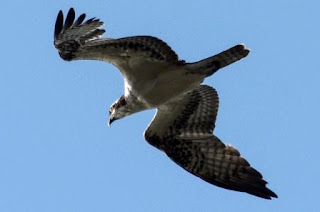
Osprey (Pandion haliaetus) 

Osprey (Pandion haliaetus) populations found in Nicaragua do not breed locally. The entire Osprey population of Nicaragua is regarded as migratory, nesting further north. Some birds pass through Nicaragua on migratory trips, but many choose the ample aquatic ecosystems to fish in Nicaragua until moving northward for another reproductive period. Ospreys feed almost entirely on fish plucked from the surface of water. Even though the Osprey does not nest in Nicaragua, there are always a few individuals present in Laguna de Apoyo, most likely immatures that remain behind in their southern range until ready for reproduction.

Hoffmann's Woodpecker
Hoffmann's Woodpecker (Melanerpes hoffmannii)
Most of the bird species found in Nicaragua have wide ranges, often spanning many countries. Some, however, are found in more restrictive ranges, within an ecosystem. One such bird species, Hoffmann's Woodpecker (Melanerpes hoffmannii), is located only in Honduras, Nicaragua, and Costa Rica. The species prospers in both open areas with plenty of trees and natural forest areas in the tropical dry forest region of Nicaragua. Laguna de Apoyo Nature Reserve is an ideal habitat for the bird, which is a close relative to and shares many superficial characteristics with the Red-Bellied Woodpecker (Melanerpes carolinus), a species common through much of the eastern United States. Hoffmann's Woodpecker is active in most areas of the reserve year-round, including both the deepest forest areas and built areas with houses.

birdwatching
Great-tailed Grackle (Quiscalus mexicanus)
Some birds prefer to inhabit areas without human influence, but others may be particularly attracted to humans. One bird that responds positively to human impacts on the forest is the Great-tailed Grackle (Quiscalus mexicanus). They tend to be active throughout the day, loud and ebullient, and many other species do not prosper in their presence. They are not found deep into the forest.

hummingbird
Cinnamon Hummingbird (Amazilia rutila), feeding on the nectar of Tabebuia rosea. 
Hummingbirds are always loved by birdwatchers. Their precise movements and delicate forms inspire awe among anyone who sees them. Among the most common hummingbird species in Laguna de Apoyo Nature Reserve is the Cinnamon Hummingbird (Amazilia rutila). It and other hummingbirds consume nectar from flowers, as everyone knows; what fewer people appreciate, however, is that hummingbirds also consume very small arthropods, which they may glean from the air. One example of such prey is the juvenile spiders, that may actually be transported by the wind. The Cinnamon Hummingbird will feed on tiny spiders, often gleaning them from foliage and flowers. This bird species is common particularly near humans, and is even found in peri-urban areas of Managua.

birdwatching in Nicaragua
Boat-billed Flycatcher (Megarhynchus pitangua)
Many species of tyrant flycatchers have been documented in Laguna de Apoyo Nature Reserve, among them, the Boat-billed Flycatcher (Megarhynchus pitangua). At first glance, it resembles the Great Kiskadee (Pitangus sulfuratus), but without cinnamon wing-feathers, and with a much more formidable peak and distinctive calls. It can be found in open areas as well as within a relatively closed canopy.

motmot
Turquoise-brlowed Motmot (Eumomota superciliosa)
The bird most adored by Nicaraguans is the Turquoise-browed Motmot (Eumomota superciliosa). This lovely species is very common in Laguna de Apoyo Nature Reserve, likely because of the abundant sites for nesting available. The species makes nests in tunnels carved horizontally into loose clay and ash deposits in the steep banks in ravines and road cuts. This site may be among the best to find the species in the entire country.

Dusky-capped Flycatcher
Dusky-capped Flycatcher (Myiarchus tuberculifer)
Among the numerous species of tyrant flycatchers in Laguna de Apoyo Nature Reserve, is the Dusky-capped Flycatcher (Myiarchus tuberculifer). Its genus consists of several species, some of which are quite difficult to distinguish at a distance. It is common throughout the reserve.

Montezuma Oropendola
Montezuma Oropendola (Psarocolius montezuma)
Birdwatchers never tire of watching the Montezuma Oropendola (Psarocolius montezuma), especially around a nesting colony. Dozens of nests in the form of woven socks are constructed in a single tree, where the birds engage in highly social behavior among the nesting group. Nesting occurs during the dry season, sometimes starting as early as November, with as many as one hundred birds gathered into a single site! An oropendola colony is always a birdwatching paradise.

Please contact us for a birdwatching tour in Laguna de Apoyo Nature Reserve or anywhere in Nicaragua. We organize expeditions in all locations of the country, and we would love to take you!

birdwatching
Click on the "escudo" to contact us at Gaia.


Wednesday, July 15, 2015

Migratory Birds II: Mist net studies in Laguna de Apoyo Nature Reserve, Nicaragua

Everyone is aware of how some bird species are quite evident and others are incredibly reclusive and difficult to note. This difference extends into most natural habitats that the birds use, especially forest habitats where birds can find lots of different places and ways to avoid detection. Birds are somewhat uniform anatomically, however, there are about ten thousand existing species, each with some distinguishing features, showing how feathers along with other features can make such a large number of distinctions which serve to fit ecological niches for feeding, defense and predator avoidance, migration, compatibility with the elements, and reproduction.

We have conducted several cycles of mist netting studies of the birds of Laguna de Apoyo Nature Reserve in Nicaragua, where there are tropical dry forest habitats facing several levels of human intervention. We have noted how several species of birds can be found commonly in one of our study sites but rare or almost not at all in another site of different vegetation structure and composition. The following are a sampling of the migratory birds that appear in our nets in our studies.

birds
Indigo Bunting (Passer cyaneus) males are not nearly so spectacular on the wintering grounds as they are during breeding season. Photo Pier-Oliver Boudreault.
This remarkable partitioning of the habitats of the reserve is also noted among migratory birds. About a quarter of all the bird species found in Nicaragua conduct well-defined, seasonal migrations, in which nesting occurs in a northward habitat during the North American summer, and leaves the area along with most or all the birds of the same species southward for several months, once the chicks have hatched, fledged and gained independence. The birds remain in a southern habitat until time to return to the nesting grounds again.

Laguna de Apoyo Nature Reserve offers winter habitats to many migratory bird species which nest further north. One example is the Indigo Bunting (Passerina cyanea), which nests as far south as extreme northern Mexico, but all the birds of this species disappear move southward into a range extending from central Mexico , the southern tip of Florida, throughout the Antilles and to Panama.

The male Indigo Bunting is appropriately named for its attractive, practically solid blue coloration exhibited during reproduction. A feather molt in the fall, however, leaves the males with mostly drab, brown color, with some deep blue highlights. Hence, the male Indigo Bunting only uses the bright colors during reproduction and maintains a muted appearance when in Nicaragua, which may be driven by predator avoidance and possibly direct physiological costs to produce and maintain the bright plumage.

The female Indigo Bunting is never brightly colored, and lacks the blue wash seen in the male when not in reproductive plumage. Many bird species use color dimorphism in which males demonstrate their reproductive fitness with bold colors and plumage as secondary sexual characteristics which the females use in mate selection. Presumably, a male which will sire offspring more successfully will also have a nice wardrobe.

indigo bunting
This male Indigo Bunting is an adult with well-developed flight feathers, with rounded tips. Photo Pier Boudreault. 

Passerina cyanea
This female Indigo Bunting insisted on a fight so she got one-with the stem of a leaf. Photo Pier Boudreault. 
As a seed-eating species, the Indigo Bunting is generally found in open areas, where grasses may be found around large trees for perching and refuge. This species is found less often in the deeper forest.

In contrast to the Indigo Bunting, the Black-and-White Warbler (Mniotilta varia) feeds on insects found on the bark of trees, especially on the trunk and vertical limbs. It prefers more closed forest canopy and tends to stay low in the forest, climbing along on the trunk, then flying to another, nearby tree to land on the trunk and continue foraging. Its plumage is by no means camouflage for the bird, and there are more bold patterns on the male than on the female, in obvious use in mate selection. 

Like the Indigo Bunting, the Black-and-White Warbler breeding range, in eastern US and Canada, does not overlap with its winter range, which encompasses the extreme southern US, Mexico and Central America, and the Antilles and extreme northern South America. 
Mniotilta varia
Female Black-and-White Warbler. Photo Vera Neumann.

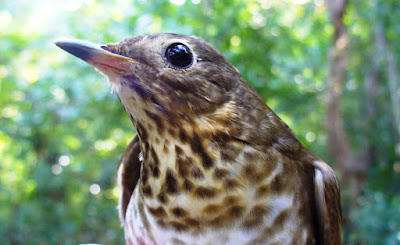
Another group of migratory birds which spend winter in Laguna de Apoyo Nature Reserve are found in the thrush family (Turdidae). In its breeding range, the Wood Thrush (Hylocichla mustelina) is known particularly for its haunting song, which is not given on its winter range. How fortunate are those who hear its song, for as Henry David Thoreau wrote, "wherever he hears it, it is a new world and a free country, and the gates of Heaven are not shut against him." Unlike the other two birds mentioned above, there are no significant differences in plumage between the sexes in this species. This species can be found foraging on the open ground beneath the shade of large trees, in similar actions to the common resident Clay-colored Thrush (Turdus grayi). 

Hylocichla mustelina
Wood Thrush. Photo Pier-Oliver Boudreault.
Less striking in appearance is another migratory thrush: the Swainson's Thrush (Catharus ustulatus), which is common in shaded areas in the Laguna de Apoyo Nature Reserve. Like the Wood Thrush, the sexes are similarly colored. Its muted color pattern may be of great advantage, especially when foraging on the ground, as it provides an even greater degree of camouflage than the Wood Thrush. The breeding range, across much of the US and Canada, is completely abandoned by this species during the winter. Birds from the western US and Canada pass the winter from Mexico into Costa Rica, whereas birds from the eastern US and Canada migrate across the Caribbean to Panama and South America for winter.


Swainson's Thrush
The Swainson's Thrush (Catharus ustulatus) is frequently captured by mist nets in appropriately shaded habitats in Laguna de Apoyo Nature Reserve. Photo Pier-Oliver Boudreault.

Another family of migratory landbirds consists of the tanagers, which are distributed into multiple families in spite of similar external characteristics. The Western Tanager (Piranga ludovicianus) has recently been placed in the cardinal family (Cardinalidae). It is less common than the Summer Tanager (Piranga rubra), and has a similar but less melodic, more raspy call on its winter habitat. The Western Tanager tends to stay close to the top of tall trees, coming down to lower levels only occasionally, for which we have relatively few capture records.

The mature male Western Tanager has a red head which fade to yellow neck and throat and olive-yellow body, over which bold black markings are found on the wings. The females lack red on the head and have fewer wing markings. As in many species, the males attain adult plumage after the first winter season, during which only vestiges of the adult male color pattern are noted. This species prefers more well-developed forest structure in Laguna de Apoyo Nature Reserve.

Piranga ludoviciana
Immature male Western Tanager. Photo Vera Neumann.
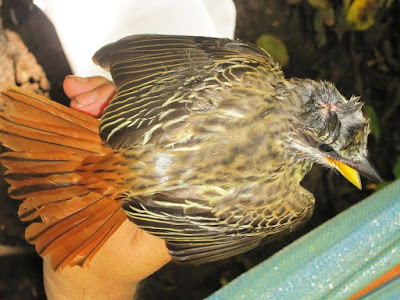
Not all migratory birds spend winter in Nicaragua and breed further north. One bird which breeds in Nicaragua during the US summer months and then migrates to South America in September is the Sulfur-bellied Flycatcher (Myiodynastes luteiventris). The forests in Laguna de Apoyo Nature Reserve will be punctuated by its squeaky call, which can be compared to a child's squeaky bathroom toy. As a tyrant flycatcher (Family Tyrannidae), it catches insects in flight in open areas, whether above trees in the canopy or over clearings, making sallies from perches at medium or high levels in trees.

Sulphur-bellied flycatcher
Sulphur-bellied Flycatcher (Myiodynastes luteiventris). Photo Marlene Krone.
The tyrant flycatchers are generally very aggressive birds, vigorously defending nesting territories from any bird or other animal it perceives to be a threat. Among the defense mechanisms is the use of its bright orange mouth, which it displays to frighten any threatening animal. A yellow flash can also be seen on the crest when excited.

Sulphur-bellied flycatcher
Sulfur-bellied Flycatcher. Photo Vera Neumann.
Migrating birds enjoy a special legal status internationally, thanks to the increasing recognition of the special needs involved in twice-yearly migrations. Among the oldest of legislation to protect wildlife is the Migratory Bird Treaty Act, signed by the US government in 1918. Although Nicaragua is not a co-signatory on this or other, similar legislation, foreign investment may require all the stipulations in this law to be applied, even when the investment is made in Nicaragua.

migratory birds
Click on the "escudo" to contact us.


Saturday, July 11, 2015

Bird Studies in Laguna de Apoyo Nature Reserve, Nicaragua: Long-tailed Manakin

Gaia has conducted studies of the birds of Laguna de Apoyo Nature Reserve now several years, during this period more than 225 bird species have been documented and some very interesting trends have been noted. One important finding is that the reserve is an important host for a very special bird, the Long-tailed Manakin (Chiroxiphia linearis). This small, reclusive bird is found in the canyons, at low and middle levels of the forest, beneath the cover of canopy.

Long-tailed Manakin
The adult male Long-taile Manakin is jet-black with a baby-blue back and crimson-red head. Two long tail-covert feathers stream behind the bird. Photo Pier-Oliver Beaudrault. 
 Although this species is uncommon in open areas, it is easily heard in its shaded habitat, with unique calls and songs that let one know where it can be found. Although the adult males are spectacular, with brilliant red head, baby blue back and bright orange legs, it can still be missed because it moves little, often remaining still for long periods, and prefers deep shade.

Juveniles and females are even more difficult to sight, because the base color is olive green. Once the bird is sighted, the legs are often the diagnostic feature, because of the angle of view and limited light where the bird is perched.
birdwatching
An immature male Long-tailed Manakin is just beginning to show blue on the back. Photo Joe Taylor.
We usually think of small birds reaching sexual maturity after one year and perhaps only living two or a few years. The long-tailed Manakin is distinctly long-lived. The males, in fact, only reach sexual maturity after four years, during which their changes in plumage occur in several stages. Two or three males work together to perform a song and dance to attract the females, and the females choose the group with the most accomplished performance. The senior male of the group mates and the others await their turn to move up in the hierarchy. Females build nests and raise young alone.

Chiroxiphia linearis
A male Long-tailed Manakin captured in a mist net. This is among the most commonly captured bird species in Laguna de Apoyo Nature Reserve. Photo Lukas Betthaueser.
The Gaia mist netting studies of birds in Laguna de Apoyo Nature Reserve is finally yielding some useful data, after several years of capturing thousands of birds. The Long-tailed Manakin counts among the most frequently captured bird species, in the most densely forested sites, although its capture numbers are considerably lower where the forest canopy is incomplete and undergrowth is removed. We are just learning which birds are the most important species in the reserve, and definitely, the Long-tailed Manakin ranks highly.

Long-tailed Manakin
A female Long-tailed Manakin. Photo Joe Taylor.
Laguna de Apoyo Nature Reserve is an interesting location to study this species, as it has a very high population density in some locations, where as many as 20 individuals have been captured in a three-day period. The high population found in our study area is also interesting because of its proximity to the southern range limit of the species, found in northwestern Costa Rica.

birds
An adult male Long-tailed Manakin has lent a few minutes of his time to our scientists for study. Photo Pier-Oliver Beaudrault.
In our next phase of study of this species, we hope to undertake population dynamics and nesting success. If you are interested in participating in bird studies in Laguna de Apoyo Nature Reserve, we would love to work with you. This is also a relatively easy bird to find, and we would love to take you on a birdwatching excursion. Please contact us if you would like to volunteer or undertake an internship in the study of this bird or other birds in the area or simply to go birdwatching with one of our expert guides.

Long-tailed Manakin
Two male Long-tailed Manakins in a courtship ritual. Photo Jesse Bickley and Anna James.
Chiroxiphia linearis


Sunday, June 14, 2015

Rescate Animal XVII: El Milano Chico

Cuando pensamos en la gente de raíces humildes en Nicaragua, tenemos una tendencia de pensar que sea gente sin capacidad de actuar por si misma. En realidad, los nicaragüenses pobres hacen y dicen, escuchan y deciden. El ejemplo de Francisco Aburto, un obrero que vive en el barrio Villa Americas, demuestra como somos los nicaragüenses. 


milano chico
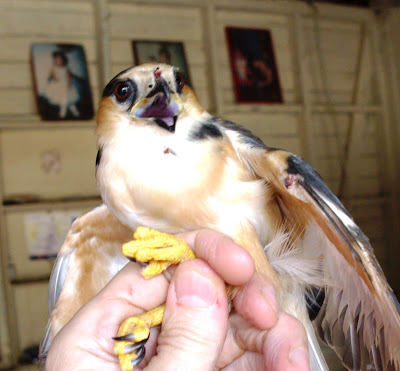
Francisco demuestra el Milano Chico rescatado en la zona oriental de Managua. Foto Jeffrey McCrary.
Francisco escuchó una bulla en un predio al lado de su sitio de trabajo en la parte oriental de Managua. Varios zanates pegaban a un animal, otro ave, y Francisco decidió salvar al animal afectado. Al tenerlo al animal golpeado en la mano, se dio cuenta que es algún tipo de ave rapaz. Se encariño con el pequeño animal y decidió buscar ayuda para que se componga y vuelva a tener su vida normal. 


Gampsonyx swainsonii
El deseo de ayudar al animal fue compartido entre toda la familia. Foto Jeffrey McCrary.
Francisco lo llevó a su casa y con una jaula prestada, le dio refugio. Probaba comidas, pero vio que el ave prefería ratones vivos! El instinto de cazar dominaba en el pequeño animal! Entre los miembros de su familia surgió un debate sobre qué tipo de animal es. Todos estaban de acuerdo que es un ave rapaz, pero no parece a ninguna especie que ellos conocen. Francisco mismo lanzó la hipótesis de que se trata de un Halcón Peregrino, solo que sea muy pequeño. 


gavilan
El Milano Chico se ve en excelente estado de salud. Por juvenil, tiene mucho color en el pecho. Foto Jeffrey McCrary.
Francisco y su familia mantuvo saludable al animal con muchos ratones, pero sabían que no se trataba de una mascota. El pequeño gavilán es un animal silvestre, y no quiere vivir en una jaula al anotojo de alguna persona. Por esto, buscaban ayuda para que el Milano Chico pudiera volver a vivir en su estado natural. Francisco y su familia desean que ese animalito viva y muera en el bosque, no en una jaula!

ave
El Milano Chico es arisco, pero bello! Foto Jeffrey McCrary
Francisco y su familia no tienen mucho. Viven en un barrio obrero, sin ningún lujo, pero tienen interés en los animales y en su entorno y quieren aprender, hacer, contribuir. Gracias a ellos, este animalito tiene otra oportunidad de vivir y volar libre. 


animal silvestre
Pronto vas a estar libre! Foto Jeffrey McCrary
El Milano Chico (Gampsonyx swainsonii) es un gavilán muy poco documentado en Nicaragua. Se ven parados sobre los postes al lado del camino sobre la Carretera a León.


Pearl Kite
Por ahora, este animalito tiene una nueva casa. Y luego,  a volar y no regresar. Hasta pronto! Foto Jeffrey McCrary.
Milano Chico
Click on the "escudo" to contact us.

Thursday, June 11, 2015

Animal Rescue XVI: Macaws in Estacion Biologica Laguna de Apoyo, Nicaragua

Life is good when you are caring for injured animals. Click on the photo to learn more about Bumbelina and Midorna, our most loved members of Estacion Biologica. Photo Jen Moran.
Everyone likes pet animals. Animals bring happiness to our life in a lot of ways, by showing affection, their physical attractiveness, and by humoring us with their actions. Animals like dogs and cats have evolved thousands of years in the presence of humans, to the point that they are incapable of living distant from us. It might even seem that we are co-dependent on them, too, sometimes we can't live without them. 

These two macaws have been rescued from the pet trade, and we care for them at Estacion Biologica in Laguna de Apoyo. Photo Jen Moran.
We humans have a disconcerting tendency to interfere with the other species with whom we share this planet, however. It isn't enough that we eat some, use others to make housing, clothing and utensils. We like the idea of having animals around us, doing our bidding. We see a beautiful animal such as a macaw in the forest, and we think, "I want one". Even the precolombian people were known to capture these majestic animals and keep them as pets. It is difficult for us to accept and appreciate animals in the wild without giving in to the urge to dominate them, by capturing or killing them. 
Feather-plucking is one of several responses to years of captivity for animals that were never meant to be in cages. This bird can never return to the wild, so we are giving her the best treatment we can. Photo Jen Moran. 
Our fascination with wild animals has some perverse consequences. We insist on demonstrating our strength and courage by dominating wild animals by riding wild bulls and roping calves in rodeos, for instance. Ernest Hemingway wrote long and eloquent of his fascination with hunting animals and with the bullfight, a continuing tradition in Spain and Latin America, in which the bullfighter is pitted in a life-and-death struggle with a large, angry animal, albeit armed with deadly lances. We all know this to be an unfair fight, but millions are thrilled when the animal is conquered violently. 

This bird's broken wing has doomed her to a long lifetime in captivity. The pet trade in wild animals is extremely cruel, and should never be supported. Please do not ever pay for a wild animal! Photo Jen Moran.
Among most of us today, bullfights and rodeos are not popular. But our fascination with wild animals is such that having a wild animal as a pet is common and few people criticize this practice. However, unlike dogs and cats, wild animals suffer greatly in captivity, in ways that we may ignore as pet owners. 

These two birds are best friends and inseparable. Both are severely psychologically and physically scarred by their handling in the pet trade. Photo Jen Moran.
The pet trade in wild animals has been devastating to wildlife in Nicaragua. Today, very few people have ever seen a macaw in the wild. Nicaragua has two species, the Scarlet Macaw (Ara macao) and the Great Green Macaw (Ara ambiguus). Until about 1983, a flock of Scarlet Macaws was easily spotted flying over urban Managua, during the day, returning to roost in the Chiltepe Peninsula before dark. The pet trade took that flock away. Along the Pacific region of Nicaragua, all of which is native habitat for this glorious animal, only perhaps ten or fifteen animals remain, in the northwest corner, in the Cosiguina Peninsula. It is sad that one can not enjoy these majestic animals by birdwatching, but rather, we have to watch them through the bars of cages in zoos and the homes of wealthy individuals. 

Although both these birds suffer dramatic psychological effects from captivity, they are dying for attention. Our Eco-Warrior Volunteers at Estacion Biologica Laguna de Apoyo help with their care. Photo Jen Moran.
Most of the wild animals we rescue at GAIA end up getting released into the wild, if all goes well, and they have their opportunity to live and die in the forest, not in a cage as subjects of the whims of humans. These two animals, however, will never return, thanks to the horrible abuse they have received in captivity. We are giving them the wildest experience possible, with cages that look to the forest, lots of space, and as diversified a set of experiences as we can manage. We hope that through our small efforts, Nicaragua is a better place for wild animals and humans, alike.

These macaws will love you!! But they still bite! Photo Jen Moran.
Would you like to help us care for rescued wild animals? Please consider volunteering with GAIA or making a donation. We need spare cages, money for food and veterinary costs, and volunteers to spend time serving them! Please contact us.

Click on the "escudo" to contact us.

Saturday, June 6, 2015

Animal Rescue XV: Life behind bars

We are amazed and saddened when we hear yet another story of "wild animal rescue" with an all-too common thread. The story begins with a person with a wild animal in a cage, accompanied by photography thanks to Jen Moran. Not just any type of person, however; this story begins with a person who pretends to be socially and environmentally concerned and conscious. That's the hook that makes the rest of this archetypal story so sad. 


Nicaragua
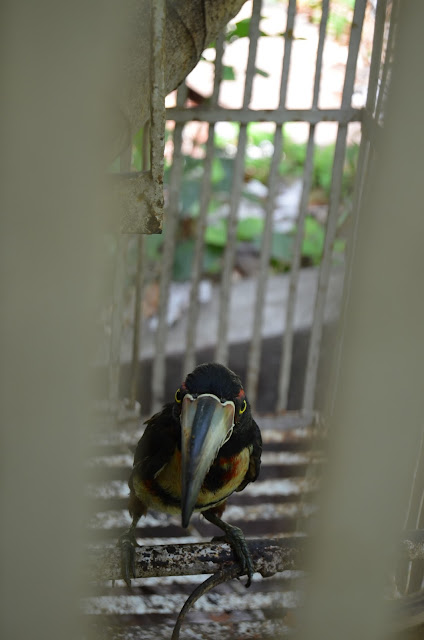
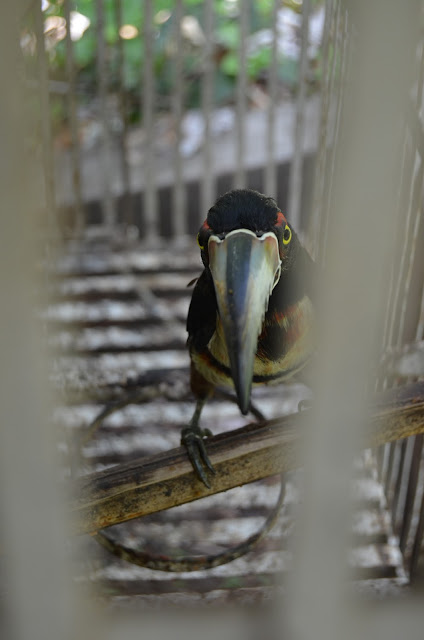
This Collared Aracari never asked to be put in a cage. Photo Jen Moran.
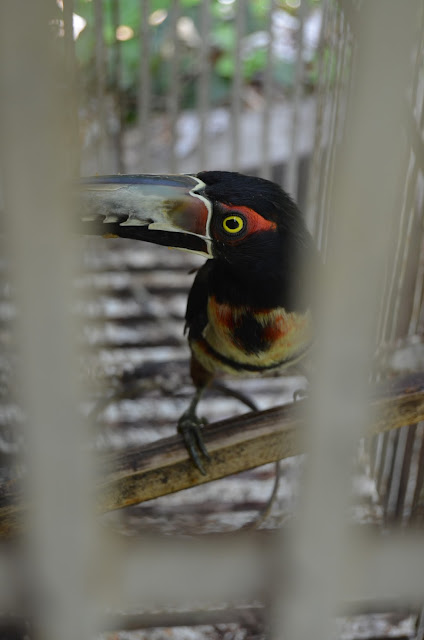
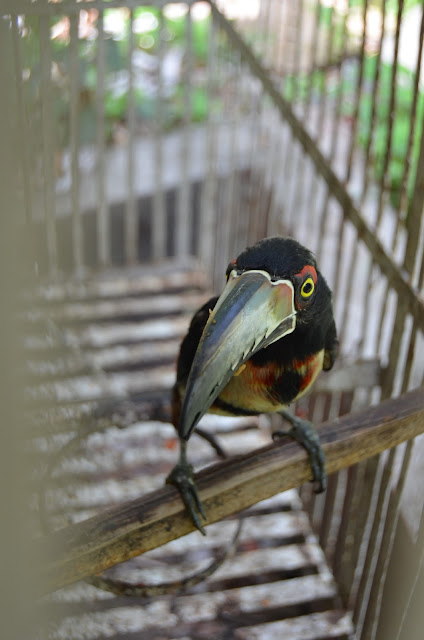
This bird is called a Collared Aracari (Pteroglossus torquatus). It is one of the two species of toucans found in Laguna de Apoyo Nature Reserve, and by far the most common. Collared Aracari tend to be seen in the forest canopy, flying about in family groups. Their diet is principally fruits, but their long bill with razor-edge sides provide toucans with an effective tool for predation. Small birds, especially chicks in the nest, can be consumed by the toucans. Their size, bright colors and substantial bill warn other birds, and they are generally feared by the smaller birds in the forest. 


Collared aracari
It is obvious that this Collared Aracari seeks freedom! Photo Jen Moran.
Those same bright colors and distinctive body that make the Collared Aracari a prominent member of the forests here, also bring its attention to its most dangerous predator: Homo sapiens. As if life in the forest is not complicated enough, toucans attract the attention of humans, who have learned that people will pay money for them. Although the Collared Aracari rarely descends to the lower levels of the forest, it is particularly vulnerable to capture, because it roosts and nests in tree cavities, where humans participating in the illegal trade in wild animals can spot them and reach them with relative ease. 


illegal pet trade
Such a majestic animal should never be forced to live in captivity. Photo Jen Moran.
Lots of birds live in accessible places, but when the birds are as spectacular as a Collared Aracari, someone is likely to follow them, learn their habits, capture them, and then sell them for money. That is where the supposedly well-meaning, well-educated and conscientious people of this world come in. Just seeing a toucan-any of the several species existing in Nicaragua-brings a state of awe to the observer. Its grace and beauty are elusive in nature, to be valued only by the hardiest and most disciplined and prepared birdwatchers. Suddenly The Discovery Channel is live and before us, when we see this bird up close. And as is often depicted on The Discovery Channel, our imagination is inspired to dream of becoming the toucan whisperer. We are all motivated by our consumer culture, to acquire what is attractive. We may go to perverse lengths to justify our desire to possess and control. Some people end up justifying the payment of money to a person engaging in illegal trafficking of wild animals, in spite of all their knowledge and perspective. It is sad to see birds like this little toucan in the pet trade, because they are obviously happier free and not in a cage.


Pteroglossus torquatus
The Collared Aracari is common and prominent in Laguna de Apoyo Nature Reserve. This rescue bird daily hears the calls of his free friends. Soon, when ready, this bird will meet them up close! Photo Jen Moran.
With astonishing frequency, we are contacted by people with animals such as this one. A few people are honest about their mistake: they bought an animal that really needed to be free and not in a cage. The majority, however, try to justify their purchase of a captured and caged animal, by claiming that by purchasing the animal, they can help to rescue it. It's as if these people had never taken a simple course in economics, on the law of supply and demand. Simply put, by investing money into the supply chain for the illegal pet trade in wild animals, these supposedly well-meaning individuals empower the people who destroy the natural resource base, guaranteeing doom for this toucan's relatives. 


animal rescue
This is not the way to live! Wild animals should live and die in the forest, not in a cage. Photo Jen Moran.
This is where we come in at GAIA: We receive, care for, rehabilitate, and release wild animals. This process has included lots of type of animals, from monkeys to wrens, over the years. We have made a small contribution to the process of educating people about the wild animal trade, as we go along. The animals receive the best humane treatment we can give, and when appropriate, they are released where they have the best opportunity to reintegrate themselves into the wild. 

Soon, this bird will return to the wild, to live and die as nature intended, free from its greatest menace. Meanwhile, we are learning from this bird, especially we are learning how misguided and destructive is the the illegal traffic in wild animals. Every day we find yet another well-educated person in Nicaragua with some monkey, parrot, or other animal that deserves to be away from the claws of humans. We tell them this practice needs to end and they need to be involved in ending it, although not everyone wants to hear such a message.

We at GAIA would like to do more, too. We have hungry mouths to feed and transport and infrastructure costs. We need your help. Your donation can provide a second chance for many animals, and help to put an end to the illegal trade in wild animals in Nicaragua. We want to build more cages and make a bigger impact. There are many animals that we can not take, because we do not have the resources to do so. You can volunteer to help us with wild animal rescue. Our animals need people to feed and clean cages, and perform repairs and maintenance on cages, and help to keep the animals happy and every day coming closer to returning to the wild. Not everyone can come and give their time, however. By making a ten-dollar donation, you can provide fresh fruit and other appropriate foods to this toucan for an entire month. By donating eighty dollars, you can provide the materials for another large enclosure which would aid in the preparation of animals for release. Please donate to GAIA for this worthy cause. 


toucan
Click on the "escudo" to contact us.