Showing posts with label migratory birds. Show all posts

Tuesday, March 7, 2017

Birdwatching Photography in Laguna de Apoyo

Although birds are not always easily photographed in the wild, some people are up for the challenge. The following photos were taken by Lars Saenger, who spent two weeks studying at Apoyo Spanish School and watching nature inside the Laguna de Apoyo Nature Reserve. These photos demonstrate that the area is great for practicing nature photography.
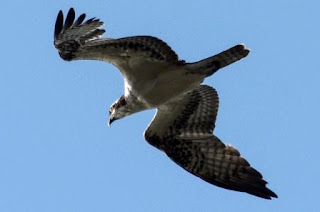
Osprey
Osprey (Pandion haliaetus

Osprey (Pandion haliaetus) populations found in Nicaragua do not breed locally. The entire Osprey population of Nicaragua is regarded as migratory, nesting further north. Some birds pass through Nicaragua on migratory trips, but many choose the ample aquatic ecosystems to fish in Nicaragua until moving northward for another reproductive period. Ospreys feed almost entirely on fish plucked from the surface of water. Even though the Osprey does not nest in Nicaragua, there are always a few individuals present in Laguna de Apoyo, most likely immatures that remain behind in their southern range until ready for reproduction.

Hoffmann's Woodpecker
Hoffmann's Woodpecker (Melanerpes hoffmannii)
Most of the bird species found in Nicaragua have wide ranges, often spanning many countries. Some, however, are found in more restrictive ranges, within an ecosystem. One such bird species, Hoffmann's Woodpecker (Melanerpes hoffmannii), is located only in Honduras, Nicaragua, and Costa Rica. The species prospers in both open areas with plenty of trees and natural forest areas in the tropical dry forest region of Nicaragua. Laguna de Apoyo Nature Reserve is an ideal habitat for the bird, which is a close relative to and shares many superficial characteristics with the Red-Bellied Woodpecker (Melanerpes carolinus), a species common through much of the eastern United States. Hoffmann's Woodpecker is active in most areas of the reserve year-round, including both the deepest forest areas and built areas with houses.

birdwatching
Great-tailed Grackle (Quiscalus mexicanus)
Some birds prefer to inhabit areas without human influence, but others may be particularly attracted to humans. One bird that responds positively to human impacts on the forest is the Great-tailed Grackle (Quiscalus mexicanus). They tend to be active throughout the day, loud and ebullient, and many other species do not prosper in their presence. They are not found deep into the forest.

hummingbird
Cinnamon Hummingbird (Amazilia rutila), feeding on the nectar of Tabebuia rosea
Hummingbirds are always loved by birdwatchers. Their precise movements and delicate forms inspire awe among anyone who sees them. Among the most common hummingbird species in Laguna de Apoyo Nature Reserve is the Cinnamon Hummingbird (Amazilia rutila). It and other hummingbirds consume nectar from flowers, as everyone knows; what fewer people appreciate, however, is that hummingbirds also consume very small arthropods, which they may glean from the air. One example of such prey is the juvenile spiders, that may actually be transported by the wind. The Cinnamon Hummingbird will feed on tiny spiders, often gleaning them from foliage and flowers. This bird species is common particularly near humans, and is even found in peri-urban areas of Managua.

birdwatching in Nicaragua
Boat-billed Flycatcher (Megarhynchus pitangua)
Many species of tyrant flycatchers have been documented in Laguna de Apoyo Nature Reserve, among them, the Boat-billed Flycatcher (Megarhynchus pitangua). At first glance, it resembles the Great Kiskadee (Pitangus sulfuratus), but without cinnamon wing-feathers, and with a much more formidable peak and distinctive calls. It can be found in open areas as well as within a relatively closed canopy.

motmot
Turquoise-brlowed Motmot (Eumomota superciliosa)
The bird most adored by Nicaraguans is the Turquoise-browed Motmot (Eumomota superciliosa). This lovely species is very common in Laguna de Apoyo Nature Reserve, likely because of the abundant sites for nesting available. The species makes nests in tunnels carved horizontally into loose clay and ash deposits in the steep banks in ravines and road cuts. This site may be among the best to find the species in the entire country.

Dusky-capped Flycatcher
Dusky-capped Flycatcher (Myiarchus tuberculifer)
Among the numerous species of tyrant flycatchers in Laguna de Apoyo Nature Reserve, is the Dusky-capped Flycatcher (Myiarchus tuberculifer). Its genus consists of several species, some of which are quite difficult to distinguish at a distance. It is common throughout the reserve.

Montezuma Oropendola
Montezuma Oropendola (Psarocolius montezuma)
Birdwatchers never tire of watching the Montezuma Oropendola (Psarocolius montezuma), especially around a nesting colony. Dozens of nests in the form of woven socks are constructed in a single tree, where the birds engage in highly social behavior among the nesting group. Nesting occurs during the dry season, sometimes starting as early as November, with as many as one hundred birds gathered into a single site! An oropendola colony is always a birdwatching paradise.

Please contact us for a birdwatching tour in Laguna de Apoyo Nature Reserve or anywhere in Nicaragua. We organize expeditions in all locations of the country, and we would love to take you!

birdwatching
Click on the "escudo" to contact us at Gaia.


Wednesday, July 15, 2015

Migratory Birds II: Mist net studies in Laguna de Apoyo Nature Reserve, Nicaragua

Everyone is aware of how some bird species are quite evident and others are incredibly reclusive and difficult to note. This difference extends into most natural habitats that the birds use, especially forest habitats where birds can find lots of different places and ways to avoid detection. Birds are somewhat uniform anatomically, however, there are about ten thousand existing species, each with some distinguishing features, showing how feathers along with other features can make such a large number of distinctions which serve to fit ecological niches for feeding, defense and predator avoidance, migration, compatibility with the elements, and reproduction.

We have conducted several cycles of mist netting studies of the birds of Laguna de Apoyo Nature Reserve in Nicaragua, where there are tropical dry forest habitats facing several levels of human intervention. We have noted how several species of birds can be found commonly in one of our study sites but rare or almost not at all in another site of different vegetation structure and composition. The following are a sampling of the migratory birds that appear in our nets in our studies.

birds
Indigo Bunting (Passer cyaneus) males are not nearly so spectacular on the wintering grounds as they are during breeding season. Photo Pier-Oliver Boudreault.
This remarkable partitioning of the habitats of the reserve is also noted among migratory birds. About a quarter of all the bird species found in Nicaragua conduct well-defined, seasonal migrations, in which nesting occurs in a northward habitat during the North American summer, and leaves the area along with most or all the birds of the same species southward for several months, once the chicks have hatched, fledged and gained independence. The birds remain in a southern habitat until time to return to the nesting grounds again.

Laguna de Apoyo Nature Reserve offers winter habitats to many migratory bird species which nest further north. One example is the Indigo Bunting (Passerina cyanea), which nests as far south as extreme northern Mexico, but all the birds of this species disappear move southward into a range extending from central Mexico , the southern tip of Florida, throughout the Antilles and to Panama.

The male Indigo Bunting is appropriately named for its attractive, practically solid blue coloration exhibited during reproduction. A feather molt in the fall, however, leaves the males with mostly drab, brown color, with some deep blue highlights. Hence, the male Indigo Bunting only uses the bright colors during reproduction and maintains a muted appearance when in Nicaragua, which may be driven by predator avoidance and possibly direct physiological costs to produce and maintain the bright plumage.

The female Indigo Bunting is never brightly colored, and lacks the blue wash seen in the male when not in reproductive plumage. Many bird species use color dimorphism in which males demonstrate their reproductive fitness with bold colors and plumage as secondary sexual characteristics which the females use in mate selection. Presumably, a male which will sire offspring more successfully will also have a nice wardrobe.

indigo bunting
This male Indigo Bunting is an adult with well-developed flight feathers, with rounded tips. Photo Pier Boudreault. 

Passerina cyanea
This female Indigo Bunting insisted on a fight so she got one-with the stem of a leaf. Photo Pier Boudreault. 
As a seed-eating species, the Indigo Bunting is generally found in open areas, where grasses may be found around large trees for perching and refuge. This species is found less often in the deeper forest.

In contrast to the Indigo Bunting, the Black-and-White Warbler (Mniotilta varia) feeds on insects found on the bark of trees, especially on the trunk and vertical limbs. It prefers more closed forest canopy and tends to stay low in the forest, climbing along on the trunk, then flying to another, nearby tree to land on the trunk and continue foraging. Its plumage is by no means camouflage for the bird, and there are more bold patterns on the male than on the female, in obvious use in mate selection. 

Like the Indigo Bunting, the Black-and-White Warbler breeding range, in eastern US and Canada, does not overlap with its winter range, which encompasses the extreme southern US, Mexico and Central America, and the Antilles and extreme northern South America. 
Mniotilta varia
Female Black-and-White Warbler. Photo Vera Neumann.

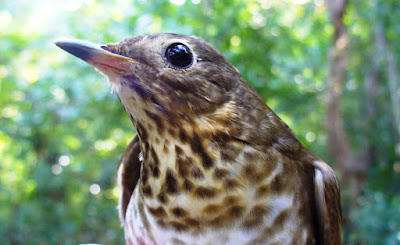
Another group of migratory birds which spend winter in Laguna de Apoyo Nature Reserve are found in the thrush family (Turdidae). In its breeding range, the Wood Thrush (Hylocichla mustelina) is known particularly for its haunting song, which is not given on its winter range. How fortunate are those who hear its song, for as Henry David Thoreau wrote, "wherever he hears it, it is a new world and a free country, and the gates of Heaven are not shut against him." Unlike the other two birds mentioned above, there are no significant differences in plumage between the sexes in this species. This species can be found foraging on the open ground beneath the shade of large trees, in similar actions to the common resident Clay-colored Thrush (Turdus grayi). 

Hylocichla mustelina
Wood Thrush. Photo Pier-Oliver Boudreault.
Less striking in appearance is another migratory thrush: the Swainson's Thrush (Catharus ustulatus), which is common in shaded areas in the Laguna de Apoyo Nature Reserve. Like the Wood Thrush, the sexes are similarly colored. Its muted color pattern may be of great advantage, especially when foraging on the ground, as it provides an even greater degree of camouflage than the Wood Thrush. The breeding range, across much of the US and Canada, is completely abandoned by this species during the winter. Birds from the western US and Canada pass the winter from Mexico into Costa Rica, whereas birds from the eastern US and Canada migrate across the Caribbean to Panama and South America for winter.


Swainson's Thrush
The Swainson's Thrush (Catharus ustulatus) is frequently captured by mist nets in appropriately shaded habitats in Laguna de Apoyo Nature Reserve. Photo Pier-Oliver Boudreault.

Another family of migratory landbirds consists of the tanagers, which are distributed into multiple families in spite of similar external characteristics. The Western Tanager (Piranga ludovicianus) has recently been placed in the cardinal family (Cardinalidae). It is less common than the Summer Tanager (Piranga rubra), and has a similar but less melodic, more raspy call on its winter habitat. The Western Tanager tends to stay close to the top of tall trees, coming down to lower levels only occasionally, for which we have relatively few capture records.

The mature male Western Tanager has a red head which fade to yellow neck and throat and olive-yellow body, over which bold black markings are found on the wings. The females lack red on the head and have fewer wing markings. As in many species, the males attain adult plumage after the first winter season, during which only vestiges of the adult male color pattern are noted. This species prefers more well-developed forest structure in Laguna de Apoyo Nature Reserve.

Piranga ludoviciana
Immature male Western Tanager. Photo Vera Neumann.
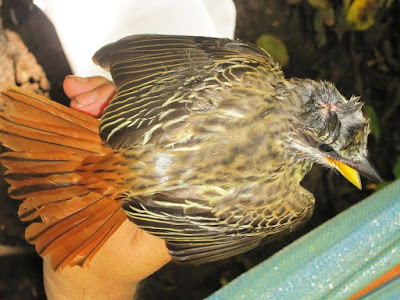
Not all migratory birds spend winter in Nicaragua and breed further north. One bird which breeds in Nicaragua during the US summer months and then migrates to South America in September is the Sulfur-bellied Flycatcher (Myiodynastes luteiventris). The forests in Laguna de Apoyo Nature Reserve will be punctuated by its squeaky call, which can be compared to a child's squeaky bathroom toy. As a tyrant flycatcher (Family Tyrannidae), it catches insects in flight in open areas, whether above trees in the canopy or over clearings, making sallies from perches at medium or high levels in trees.

Sulphur-bellied flycatcher
Sulphur-bellied Flycatcher (Myiodynastes luteiventris). Photo Marlene Krone.
The tyrant flycatchers are generally very aggressive birds, vigorously defending nesting territories from any bird or other animal it perceives to be a threat. Among the defense mechanisms is the use of its bright orange mouth, which it displays to frighten any threatening animal. A yellow flash can also be seen on the crest when excited.

Sulphur-bellied flycatcher
Sulfur-bellied Flycatcher. Photo Vera Neumann.
Migrating birds enjoy a special legal status internationally, thanks to the increasing recognition of the special needs involved in twice-yearly migrations. Among the oldest of legislation to protect wildlife is the Migratory Bird Treaty Act, signed by the US government in 1918. Although Nicaragua is not a co-signatory on this or other, similar legislation, foreign investment may require all the stipulations in this law to be applied, even when the investment is made in Nicaragua.

migratory birds
Click on the "escudo" to contact us.


Sunday, November 9, 2014

Birdwatching in Laguna de Apoyo Nature Reserve II-aquatic birds

Lake Apoyo is deep and clear with far less shallow water than a typical lake. Immense, deep areas provide ideal habitat for small, schooling fish in the open waters, and these fish are preyed upon by lots of fish and birds. Most of the shoreline is steeply graded; the water is more than a meter deep just a few steps inward. The shallow areas available for wading birds are somewhat more limited than in Lake Cocibolca, for instance, but several egrets and herons can always be found around the lake, always good for birdwatching.

Birdwatching
Lake Apoyo as seen from behind Estacion Biologica. Photo Jesse Bickley.
The wide expanse of water invites year-round populations of Osprey (Pandion haliaetus), Magnificent Frigatebird (Fregata magnificens), which feed on fish in the open waters. Black Terns (Chlidonias niger) are found year-round, as well, often swimming when not preying on schools of fish.
Diving birds such as the Pied-billed Grebe (Podilymbus podiceps), Least Grebe (Tachybaptus dominicus) and Olivaceous Cormorant (Phalacrocorax brasilianus) are found in regions of depths up to about 20 meters. They are usually seen swimming and diving.
Great Egret
Great Egret (Erdea alba) flies over Lake Apoyo. Photo Jesse Bickley. 
Wading birds include Great Blue Heron (Ardea herodias), Great Egret (Ardea alba), Snowy Egret (Egretta thula), Tricolor Heron (Egretta tricolor), Little Blue Heron (Egretta caerulea), and Little Green Heron (Butorides virescens) are found in shallow water along the shoreline. Nocturnal herons are also found, usually seen roosting, in small numbers: Boat-billed Heron (Cochlearis cochlearis), Black-crowned Night-Heron (Nycticorax nycticorax), and Yellow-crowned Night-Heron (Nyctanassa olivacea).
Birdwatching Nicaragua
Great Egret in flight. Photo Jesse Bickley.
Aerial fishing birds also include the Ringed Kingfisher (Megaceryle torquata), which find prey while perched on trees along the shoreline, usually small fishes (Atherinella sardina), then fly out and dive headlong to catch the prey, returning to their perch to consume the fish.
Ringed Kingfisher
Ringed Kingfisher (Megaceryle torquata) in flight over Lake Apoyo. Photo Jesse Bickley.
Along the shoreline, during the winter periods, Spotted Sandpiper (Actitis macularia) are common. This species exhibits a characteristic pumping action with the tail while foraging along the shoreline, just out of the water. Other sandpipers and plovers are rare in Lake Apoyo. It is a relatively easy bird for a birdwatcher to follow.
Pied-billed Grebe
Pied-billed Grebe (Podilymbus podiceps) is commonly seen swimming in the clear waters of Lake Apoyo. Photo Jesse Bickley.
All you need for birdwatching in Lake Apoyo is good field glasses, an experienced guide, a reference book, and patience. Birds are easily found in several habitats in all seasons. We would be happy to reserve a birdwatching tour for you, just contact us!

A Little Blue Heron (Egretta caerulea) accompanies a Great Egret (Ardea alba) in lakeside meditation. Photo Jesse Bickley and Anna James. 
Please contact us and let us know what you think of our blog, or post a comment below! 

You can help us keep nature wild in Nicaragua, by volunteering your time with us or making a small donation to support our projects in wild nature conservation.

Tropical Kingbird
Click on the "escudo" to contact us. 

Saturday, February 1, 2014

Conservation Science - Birds in Laguna de Apoyo Nature Reserve, Nicaragua

Although many people only think of Laguna de Apoyo as a place to swim or to build a house, fascinating wildlife can still be found in its forests. Our bird monitoring program, managed by the biologist Jeffrey McCrary in coordination with the Ministry of the Environment and Natural Resources (MARENA), is now in its fifth year, is intended to demonstrate what is important about this forest as a natural area. We have been very successful in identifying some of the more important places as bird habitat in the Laguna de Apoyo Nature Reserve. In one of the sites we study, a pair of Pale-billed Woodpeckers (Campephylus guatemalensis) is regularly seen. Here is a picture of the female, taken by the FUNDECI/GAIA intern Pauline Pearse.
Jeffrey McCrary
Female Pale-billed Woodpecker in Laguna de Apoyo Nature Reserve, Nicaragua. Photo Pauline Pearse.
Our list of birds documented inside Laguna de Apoyo Nature Reserve now reaches well over 225 species. Although we are surveying only a small fraction of the 2500 hectares of land, well over a quarter of all the birds documented in Nicaragua have appeared here. We continue to press upon the authorities at MARENA and community to enforce policies against hunting, wood extraction, building and other land uses which destroy the habitats for birds like the Pale-billed Woodpecker. For instance, this bird is not found in the less mature forests on the north side of the lake, but rather only where there is a greater amount of intact, mature forest, in the southwest corner of the reserve. There are not so many places in Nicaragua where this glorious bird can be seen easily, so we are always happy to get a glimpse.
Jeffrey McCrary
This juvenile Grey Hawk (Buteo nitidus) is a typical sighting in Laguna de Apoyo Nature Reserve. Photo Pauline Pearse.
The documentation of biodiversity and the environmental effects on it by human activity requires detailed work, much of which is performed by the conservation science interns at FUNDECI/GAIA. Their assistance in our long-term bird studies is essential to understanding how an area so heavily used by humans can retain its qualities as a natural area for wildlife.
Jeffrey McCrary
Laguna de Apoyo Nature Reserve is home for many birds, including the colonial nesting Montezuma Oropendola (Psaracolius montezuma). Photo Belen Camino.
We recognize that the threats are palpable to these wild animals. For instance, on two occasions, the Montezuma Oropendola (Psaracolius montezuma) colonies in the area have been affected by landowners destroying their nesting colonies. In many areas where houses are found, large trees that would attract the birds are downed, limiting the potential habitat for these and many other birds.
conservation science intern
FUNDECI/GAIA conservation science intern, Ruben Pelckmanns, at work on a study of the motmots. Photo Pablo Somarriba.
We are continuing to gather information on the wildlife of the area, with the aid of visiting scientists, interns and volunteers. Our studies have recently been widened to consider nest sites, in which two of our conservation science interns have participated. We invite interested people to contact us and participate in the study and protection of this special natural area.
Jeffrey McCrary
Migratory birds such at the Summer Tanager (Piranga rubra) are important components of the birdlife in Laguna de Apoyo Nature Reserve. Photo Onno Bierman.
conservation science internships
Click on the "escudo" to contact us.