Showing posts with label Arremonops rufivirgatus. Show all posts

Friday, February 1, 2013

Bird Studies in Nicaragua

Anyone who has done some birdwatching in Nicaragua knows there are some great birds in this country. Observing birds by binoculars, however, still leaves many details unseen, as the photos below can demonstrate. We get a special opportunity to observe birds up close when mist netting. There are few tasks as gratifying as one involving the observation of a living, wild bird up close, especially our birds here.
birdwatching
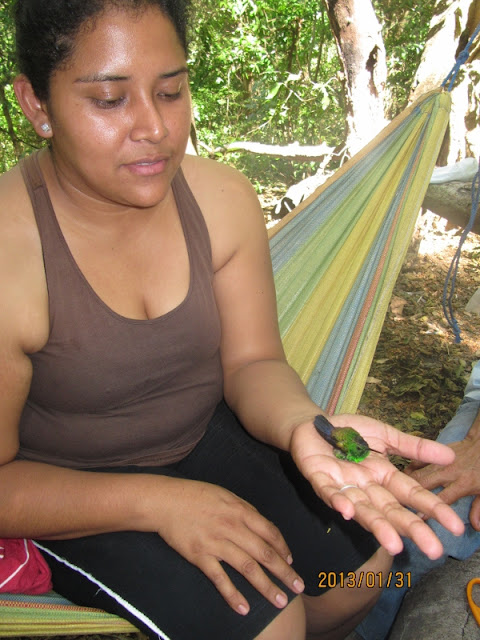
Leslie patiently waits for this Blue-tailed Hummingbird (Amazilia cyanura) to fly away. Photo by Emily Williams.
By studying the birds in Laguna de Apoyo Nature Reserve, we are learning about bird communities in the Nicaraguan tropical dry forest habitat that dominates the terrestrial areas in this protected area. We are also learning, however, about land use, by determining which birds are found in different areas according to the human activities in each. Some birds can use only good forest habitats, and they may be getting forced out by forest degradation. We are hoping to demonstrate consistent patterns in bird populations according to land use and to the changing forest structure as a reforested area grows back into a relatively mature, natural forest.
A Yellow-throated Vireo (Vireo flavifrons) wants to make his disagreement known. Photo by Emily Williams.
At least 225 bird species have been documented in Laguna de Apoyo Nature Reserve, to date. Mist netting has helped us confirm several species which had been poorly documented by sightings. Many of the birds captured during mist netting, in appropriate season, are migratory birds, such as the Yellow-throated Vireo (Vireo flavifrons) and the Painted Bunting (Passerina ciris). Perhaps a quarter of the species found in Laguna de Apoyo Nature Reserve are migratory. Almost all migratory birds here nest further north and spend the non-breeding season here.
The male Painted Bunting (Passerina ciris) has dramatic coloration. Photo by Emily Williams.
Some migratory birds winter in mixed-sex flocks, and others segregate by sex and/or age in their southern, nonbreeding range. By counting the birds by sex and age in Laguna de Apoyo, we can help to determine migration patterns for these birds. Appropriate habitat is required for all migratory birds, especially the Red-Listed species such as the Painted Bunting (Near Threatened), and for all sexes and age classes.
Painted Bunting males are bright, whereas the females are drab. Photo by Emily Williams.
Even when the migratory birds have returned to their nesting ranges, the forests and shoreline of Laguna de Apoyo Nature Reserve continue to be conspicuously occupied with birds. The year-round resident birds, which will have become even more evident when the migratory birds have gone, may even reproduce during the stay of most migratory birds, during winter in the northern hemisphere.
The White-tipped Dove (Leptotila verreauxi) is among the larger species we catch commonly in mist netting activities in Laguna de Apoyo Nature Reserve. Photo by Emily Williams.
Not all birds use the same resources, of course. Many resident birds avoid areas with certain kinds of human impacts, such as the elimination of large, old trees, or the clearing of ground cover. The White-tipped Dove (Leptotila verreauxi) is an example. It is common in forest, but quite uncommon in yards, even where the yards have large, old trees. Another resident bird which is affected by human activity is the Northern Barred Woodcreeper (Lepidocolaptes sanctithomae). This species is common on the south side of Lake Apoyo, but absent from the north side, where greater human impacts are found on the vegetation structure. 
The Northern Barred Woodcreeper (Dendrocolaptes sanctithomae) is not well-documented west of Lake Nicaragua. Photo by Emily Williams.
Some of the local people brand us as tree-huggers, which is fine by us. We seem to get in the way of some people who have big plans for building inside the Laguna de Apoyo Nature Reserve, and they would rather that we go away. That gives us even more motivation to continue to work to save the forest and lake of this reserve. The greatest aspect of our bird studies is that of the people-those who are dedicated and even thrilled by the birds, and learn along the way. Our conservation science interns and volunteers bring life to our projects.
Nicaragua birdwatching
Work as a volunteer in wildlife monitoring is exhausting but worthwhile. Photo by Emily Williams.
The most thrilling of the birds we catch with mist nets must be the most demanding for our technicians, the hummingbirds. They are the smallest and, by far, the most delicate of the birds we catch. Hummingbirds keep very little "reserve" to fuel their activities, requiring that they feed and drink often. We give the hummingbirds water when they are captured, and we process them as quickly as possible to allow them to resume their activities with little interruption. Hummingbirds are usually docile in the hand, and sometimes won't fly away immediately when released.

Hummingbirds are not easy to see well when on the wing, so having one in the hand is particularly special. One can appreciate so many particular features of these birds when they are still and close.
With all the information we gather, we are trying to find which birds are segregated by land use and what can be done about it. We are looking for clear recommendations to promote the entire reserve as good forest and lakeshore for the birds.

birds Nicaragua
Click on the "escudo" to contact us.

Saturday, March 17, 2012

Nicaragua Wildlife

Not all wildlife is easily seen by us when walking in a tropical forest. Most animals manage to avoid detection. Some wildlife are more active at night, others blend in with their surroundings. Many stay in secretive places most of their time. If we don't see them often, perhaps their prey won't see them, either. This green vine snake (Oxybelis fulgidus) is an example. Its color and shape make it difficult to see when among a mass of vines or small branches. In the pictures below, it emerged to bite an Olive Sparrow (Arremonops rufivirgatus) and devour it, while the latter was sleeping on its nest. Our volunteers caught the event in action, and Florian Schmid made the following set of photos and videos. 

Wildlife photography Nicaragua

green vine snake


wildlife in Nicaragua

Olive Sparrow

Arremonops rufivirgatus

Green vine snake

Olive Sparrow
FUNDECI/GAIA conducts many field activities in wildlife research and conservation which can use the assistance of volunteers, many of them coordinated from Estacion Biologica in Laguna de Apoyo Nature Reserve. Whether you are a biologist, a student or just a nature lover, if you would like to participate, we would like to work with you. You can contact us if you would like to be a wildlife monitoring volunteer. Help us study and protect the mammals, butterflies, birds, fish and other wildlife of Nicaragua. 
wildlife photography
Click on the "escudo" to contact us.

Tuesday, July 19, 2011

The birds of Laguna de Apoyo Nature Reserve I: Resident birds


In this photography by our bird monitoring volunteer Joe Taylor, we see that the birds of Laguna de Apoyo Nature Reserve are truly esthetic beings. These photos were taken on mist netted birds while they were being processed by FUNDECI/GAIA staff, prior to returning to the wild. They show some of the wonderful details that we may never appreciate even as birdwatchers. Our technicians gather data on the bird populations by mist netting which is very important for conservation efforts, but we also enjoy the esthetic experience of admiring the birds from near. The birds were photographed in Laguna de Apoyo Nature Reserve, where all of them reproduce. We hope you enjoy them as much as we do.
birdwatching Nicaragua
Lesser Ground-Cuckoo (Morococcyx erythropygus) in Laguna de Apoyo Nature Reserve, Nicaragua. Photo by Joe Taylor.
Several cuckoo species are found in Laguna de Apoyo Nature Reserve, and they are not, at first sight, very similar birds. The Lesser Ground-Cuckoo (Morococcyx erythropygus) occupies degraded areas, and spends most of its time walking through low brush, on the ground. It is heard much more often than seen, giving a sound much like an insistent police whistle repeating. Folks here call it the "pajaro reloj" or the clock bird, because its call is reputed to be given on the hour, every hour. It nests on the ground, and its existence is threatened by domestic cats. Please don't bring cats into natural areas like this one! The Lesser Ground-Cuckoo is nothing short of spectacular when viewed up close.
birdwatching Nicaragua
Olive Sparrow (Arremonops rufivirgatus) in Laguna de Apoyo Nature Reserve, Nicaragua. Photo by Joe Taylor.
Dry tropical forest habitats usually have some grasses and other small-seeded annual plants in the many forest breaks, even when the forest is not heavily degraded by human use. Among the seed-eating birds in Laguna de Apoyo Nature Reserve is the Olive Sparrow (Arremonops rufivirgatus). The population here is not well-documented, its only reports to date being ours. We have recently spotted a nest with eggs, and two chicks hatched. This is another ground-nesting species, vulnerable to our beloved pet cats. Please keep your cats out of natural areas!

birdwatching Nicaragua
Female Long-tailed Manakin (Chiroxiphia linearis). Photo by Joe Taylor.

birdwatching Nicaragua
Immature male Long-tailed Manakin (Chiroxiphia linearis). Photo by Joe Taylor.
The Long-tailed Manakin (Chiroxiphia linearis) is the most commonly caught of all the bird species in our monitoring program. This is because we are located in prime habitat for them, in a sheltered area with lots of vegetation and food sources (they mostly eat fruit). The location is used for breeding, where males perform, quite literally, a song and dance to attract the females. Males perform the ritual in pairs, and the senior male gets the lady when she chooses the most attractive contestant. Males take up to four years to complete sexual maturity which is reflected in their plumage. We may catch as many as forty of this species in a single three-day period of mist netting.
birdwatching Nicaragua
Turquoise-browed Motmot (Eumomota superciliosa) and Blue-crowned Motmot (Momotus momota) in Laguna de Apoyo Nature Reserve, Nicaragua. Photo by Joe Taylor.
Among the emblematic birds of Nicaragua is the Turquoise-browed Motmot (Eumomota superciliosa), which is quite common throughout the Pacific region of the country. The Blue-crowned Motmot (Momotus momota) is considerably less common in most of the range. The subspecies found in Nicaragua has a black cap over the blue crown. Both motmot species nest in horizontal holes in dirt banks, and they catch flying insects on the wing as a principal component of their diet. They are both known as Guardabarrancos in Nicaragua, and the former is the national bird.
birdwatching Nicaragua
Dusky-capped Flycatcher (Myiarchus tuberculifer) in Laguna de Apoyo Nature Reserve, Nicaragua. Photo by Joe Taylor.
Lots of species of flycatchers are resident to Mesoamerica, and others migrate here from south or north. The flycatchers have bristly whiskers to help to guide their prey into the mouth. Shades of your aunt with the bristles on her chin, wanting to give you a kiss. It is not easy to distinguish them while birdwatching. Among the most common of flycatchers in Laguna de Apoyo Nature Reserve is the Dusky-capped Flycatcher (Myiarchus tuberculifer). This individual demands the last word, it appears.
birdwatching Nicaragua
Click on the "escudo" to contact us.

Saturday, April 9, 2011

Bird population monitoring in Laguna de Apoyo Nature Reserve, Nicaragua


This week, our team of Marlene Kroner, Lucas Betthausen, Soren Kraack, and Lorenzo Lopez conducted bird population monitoring by mist netting in Laguna de Apoyo Nature Reserve. Every month, we use mist netting to capture birds for a population monitoring longitudinal study. Here is a selection of the birds they caught in photos, followed by a list of all species captured during this period.


Grey-headed Tanager
Grey-headed Tanager (Eucometes penicillata). Photo by Soren Kraack.
This gorgeous bird escaped our view for years in the reserve, particularly because it is only found in the southwestern section of the crater. We have never documented the Grey-headed Tanager on the northern side of the crater, where Estacion Biologica is situated. In spite of its bright yellow plumage, it is not easily seen, either! It is a resident species, present year-round.

Painted Bunting
Male Painted Bunting (Passerina ciris) having its plumage reviewed and noted in our data bank. Photo by Soren Kraack.
The Painted Bunting is among the most colorful birds in Nicaragua and also in North America, where it nests. The males are exuberantly colored, whereas the females are drab yellow. Our population will be heading northward before the next time we monitor birds by mist netting, next month. This species is of particular concern because of diminishing populations and is listed as Near Threatened on the IUCN Red List. Habitat loss by the intensification of agriculture in the southern and midwestern US is thought to be the principal cause of its recent population drop, but we know little of birds like this one in their southern habitat. Our captures may contribute to better conservation of this species. We have made another blog entry on this gorgeous bird, where you can read more about it.

Stripe-throated Hermit Hummingbird
Stripe-throated Hermit (Phaethornis striigularis). Photo by Soren Kraack.
There are at least ten species of hummingbirds found in the Tropical Dry Forest habitat of Laguna de Apoyo Nature Reserve. The Stripe-throated Hermit prefers more dense forest cover than others such as the Cinnamon Hummingbird which is more common at Estacion Biologica. This little bird may have co-evolved with specific flowers from which it feeds, hence the decurved bill. This species has recently been named as distinct from the Little Hermit (Phaethornis longuemareus) which now is limited to South America.

Yellow-olive Flycatcher
Lesser Greenlet (Hylophylus decurtatus). Photo by Soren Kraack.
The Tropical Dry Forest habitat abounds in flycatchers (Tyrannidae). Among the less flycatcher-like in behavior of this family is the smallish and retiring Yellow-olive Flycatcher (Tolmomyias sulphurescens). It makes a small pyriform nest with an entrance near the bottom. We often have nests in the yard at Estacion Biologica. The feathers at the top of this bird's head have been wettened by the handler to examine ossification of the cranium-a test for the bird's age.

Red-eyed Vireo
Red-eyed Vireo (Vireo olivaceus). Photo by Soren Kraack.
The Red-eyed Vireo migrates long distances between its nesting areas in the US and wintering ranges in Central and South America. Migratory birds are especially vulnerable to the many dangers of a long trip and need to re-establish territories in potentially crowded and hostile areas twice each year. This species is common in season throughout the Laguna de Apoyo Nature Reserve forests.

Here is a list of the birds captured during the April mist netting. Notice how different this list is from the birdwatching list of the same date. It gives you an idea, too, of what you can see when birdwatching in Laguna de Apoyo Nature Reserve.

Catharus ustulatus
Thryothorus rufalbus
Hylocharis eliciae
Chiroxiphia linearis
Eucometis penicillata
Passerina ciris
Xiphorhynchus flavigaster
Turdus grayi
Vireo olivaceus
Chlorostilbon canivetii
Seiurus noveboracensis
Arremonops rufivirgatus
Vermivora peregrina
Basileuterus rufifrons
Myiarchus crinitus
Seiurus aurocapillus
Tolmomyias sulphurescens
Hylocichla mustelina
Thryothorus pleurostictus
Hylophilus decurtatus
Phaethornis striigularis
Dendroica pennsylvanica
Amazilia cyanura

birdwatching Nicaragua
Click on the "escudo" to contact us.