Showing posts with label SCUBA diving. Show all posts

Thursday, August 31, 2017

Charles Darwin en Nicaragua

Durante aproximadamente un siglo, las ideas de Charles Darwin sobre la selección de pareja como un motor hacia el desarrollo de especies nuevas, fueron efectivamente desvaloradas dentro del Reino Animalia. Es difícil encontrar un caso donde es probable que dos especies se formaron dentro de una, en una sola población, con sus miembros en permanente contacto. Mientras siempre ha existido la idea que la selección de pareja puede ser un factor importante en el desarrollo de una especie nueva, en la gran mayoría de los casos, es poco probable que no hubiera otro factor, como una barrera geográfica, en la historia del desarrollo de las especies, en particular con animales vertebrados.

El tipo de formación de dos especies de una población de una sola especie, a través de la selección de pareja, es llamado especiación simpátrica. Sin embargo, el caso de la especiación entre un grupo de peces en las aguas de Lago Cocibolca (Lago Nicaragua) y las lagunas cratéricas alrededor, ha sido fundamental en el regreso de este concepto. El grupo de peces lleva el nombre "mojarra" en Nicaragua, y son varias especies, algunas descritas y otras no, del genero Amphilophus.

El tiempo de existencia de las lagunas cratéricas de Nicaragua varía entre unos diez mil y cien mil años, relativamente poco para los procesos de evolución típicos que forman especies nuevas. A pesar de su relativamente reducido tiempo de existencia en esas lagunas, se ha comprobado que procesos rápidos de evolución han sucedido en varias lagunas, a través de estudios morphológicos en Xiloá y Apoyo, y estudios genéticos en varias lagunas. Las aguas de cada laguna son aisladas de otros cuerpos de agua.

Las mojarras se hacen pareja y se anidan dentro de la planta que se llama Chara, en la Laguna de Apoyo. Foto Topi Lehtonen.
Un reportaje sobre los estudios ejecutados por GAIA en las lagunas fue publicado esta semana en El Nuevo Diario, en el cual se mencionan las especies endémicas de este grupo ya identificadas y descritas, de las lagunas de Apoyo, Xiloá y Asososca Managua, y también se menciona un estudio en curso en la Laguna de Masaya, sitio reconocido en desahucio por su nivel de contaminación por basura y aguas residuales que entran en la laguna desde las ciudades aledañas.

Del reportaje en El Nuevo Diario, 30 Agosto, 2017.

Para los científicos, además de que sean especies nuevas que en si tienen importancia, estas mojarras demuestran evidencia de haber sufrido procesos de especiación simpátrica durante el relativamente corto tiempo que habitan las lagunas cratéricas, por lo que sean de gran importancia como sujetos de estudio. Es una lástima que Charles Darwin nunca vino a Nicaragua, para que vea las mojarras que adornan a los lagos y las lagunas de Nicaragua. Si estuviera vivo hoy Charles Darwin, estaría en la Laguna de Apoyo, buceando con nosotros!

De Geiger, McCrary, y Schliewen, 2010.

Estudios de campo en la Laguna de Apoyo. Foto Jeffrey McCrary.

Los peces en la Laguna de Apoyo abundan entre estructuras rocosas. 


Oprime el escudo para contactarnos.

Sunday, August 27, 2017

Another day at Estacion Biologica Laguna de Apoyo

Every day brings something new to us at Estacion Biologica Laguna de Apoyo. Observations of flora and fauna, studies being conducted, scuba diving, cultural activities. People teaching, and others learning, Spanish, culture, biodiversity, the environment, volunteering.

New friends are made easily, because we are small and we share with people who visit. People come and go, from Nicaragua and beyond. Some to learn, others to give. Everyone ends up doing a little of both.

Laguna de Apoyo
Bella, our faithful canine, hangs with the gang in front of Estacion Biologica Laguna de Apoyo. Foto Jeffrey McCrary.
Estacion Biologica is not at all pretentious or upscale. We have a simple place, and we are doing simple things: planting trees, studying the environment, birdwatching, sharing our knowledge of the language and culture, and collaborating with the neighbors and the government of Nicaragua to make Laguna de Apoyo Nature Reserve a great place for nature, for decades to come. Our visitors are welcome to pitch in. Our prices are very low, but we are comfortable, and we eat very well! Special food options can always be arranged: gluten- or dairy-free, vegetarian, or vegan.
This is how Spanish homework ends some evenings. Photo Andras Dorgai.
We are perhaps best known in some circles for the Spanish courses we offer, at Apoyo Spanish School. Each year, we impart at least one hundred fifty course units of a week each, custom-designed to fit the abilities and needs of each person. Our students are often travels who want to engage with locals better. Many, however, are learning Spanish for professional reasons, using their language skills in Nicaragua or other nearby countries in their jobs.

Early morning in Lake Apoyo, while clouds cover Pacaya, above the rim of the crater. Photo Andras Dorgai.
Undoubtedly, the best part of spending time at Estacion Biologica Laguna de Apoyo is the lake. Mornings, the lake can be calm and smooth as glass, without a soul to be seen near the water. As the day progresses, however, locals and tourists may come for a dip. There is no water body anywhere that is as comfortable and naturally clean as Laguna de Apoyo, for a great swim. Visibility underwater during a scuba dive may be as much as 10 meters on a calm day.

All ages get involved when monkeys are to be seen. Everyone becomes a kid again! Photo Jeffrey McCrary.
Our property at Estacion Biologica is humble, but blessed with great trees and often with lovely wild animals. Golden-mantled howler monkeys, known locally as mono congo, are over our heads these days, perhaps two hundred days each year. We thank effective conservation policies enacted as part of the management plan that our director, Jeffrey McCrary, coordinated for the Ministry of the Environment and Natural Resources. Several years ago, there were fewer monkeys and they were found in more limited locations than currently.

Apoyo Spanish School students gather for some extra tutoring from Bela. Photo Andras Dorgai.
Volunteers come to Estacion Biologica to participate in specific projects, or in whatever is most needed. One example is the Murrieta family, who recently spent a couple of weeks engaged in all kinds of environmental conservation activities, including the planting of 56 new trees in a reforestation plot in the hillside behind Estacion Biologica. The evenings were filled with discussions ranging from poetry and literature, to politics and saving the environment, to our favorite places in the many cities each of us had lived or visited.

Visits to Estacion Biologica are often a family affair. Photo Jeffrey McCrary.
Each day at Estacion Biologica brings a new, unexpected blessing. The people in these photos are just a sampling of the blessings that have come our way in the most recent months. We are grateful for every hand lent and each voice raised. Please come by or write us!

Click on the "escudo" to contact us.

Wednesday, August 14, 2013

Under the water

We spend hundreds of hours per year under the water in Laguna de Apoyo, in counts of fish, documentation of the quality of the habitat where they live, the vegetation found there, and yes, even in retrieving the trash that folks discard which ends up all along the lake bottom. Here is a small collection of photos which show what we see when we are down there, in the most beautiful spot in Nicaragua. In the photoessay below, you can experience what one of our interns saw during a study of the fish with the director of the Gaia Program, Dr. Jeffrey McCrary. Dr. McCrary is leading an international team in the study of the fishes of Laguna de Apoyo, and to date five new species have been discovered as part of the program. 
These fry of an Amphilophus zaliosus pair recently hatched in a nest hole which is often seen with babies. 

Lots of fish are hanging out in this site, including a probable male Amphilophus zaliosus in breeding coloration in the center of the photo. 


Counting fish along a transect.

Juveniles and nonbreeding adult Amphilophus seek refuge under rocks in Laguna de Apoyo.

Breeding season is approaching, and breeding pairs are forming. A pair of Amphilophus zaliosus are in the foreground, and a pair of jaguar cichlids, Parachromis managuensis, are in the background. 
As can be seen from the photos, several Midas cichlid species are locally abundant in the waters of Laguna de Apoyo. Of the six species recognized in Laguna de Apoyo in this group, the most abundant of the group in most locations is the little Apoyo cichlid, Amphilophus astorquii. Other fish species are in the lake, too: Atherinella sardina, Poecilia sphenops, and Parachromis managuensis, as well as some invasive species.
Fish ahead!

A multispecies school of Amphilophus cichlids.

The species of Amphilophus cichlids in Laguna de Apoyo vary by body shape, spot pattern, and background colors. 

Dozens of cichlids are always under this rock!

Much of the lake bottom is covered with recently eroded sediments which cover the rocks and destroy all the high-quality habitat. Furthermore, ordinary garbage accumulates along our transects, such as this plastic cup, sold by the local bars. 


In some areas where waves clean the substrate, the lake bottom is covered with fine mud or sand. 

Fragments of snail shells (Pyrgophorus coronatus) litter the surface in many places. Snails are an important component of the diets of the Amphilophus species flock in Laguna de Apoyo. 

Filamentous algae has displaced Chara vegetation along the bottom in much of the lake. We do not understand why Chara often disappears from the lake, although it is known that tilapia will consume large quantities of it. 
In shallow areas with small rocks, juveniles of the invasive species Gobiomorus dormitor abound. 

Many shallow areas are covered with snail shell fragments, demonstrating the abundance of snails in Laguna de Apoyo.
A human-altered waterscape in Laguna de Apoyo. Filamentous algae and a plastic beverage bottle displace native fish and vegetation. 
Silversides, Atherinella sardina, put on a show in the water column. Silverside schools may exceed ten thousand individuals. 
Click on the "escudo" to contact us.

Tuesday, April 30, 2013

SCUBA diving in Lake Apoyo, Nicaragua


Amphilophus zaliosus
Hundreds of young arrow cichlids (Amphilophus zaliosus) are only perhaps sixty days from hatching. Although they have been abandoned by their parents, they continue to school at a nesting site. Photo by Martin Cabrera.
We often get asked what can be seen while SCUBA diving in Laguna de Apoyo. Nicaragua has lots of lakes and rives, but most tropical freshwater sites here and elsewhere have low visibility. Lake Apoyo visibility is almost always 5-12 meters at the locations where we dive.

The fish of Lake Apoyo are special, too. The most commonly seen fish are members of the Midas cichlid species complex. Six species in this group have been discovered  in Lake Apoyo, all of which evolved in the lake and inhabit only this lake. The first to be discovered was the arrow cichlid (Amphilophus zaliosus) in 1976 by a professor at University of California-Berkeley, George W. Barlow. Most of these six endemic species can be seen while scuba diving.

Arrow cichlids, like all the other members of the Midas cichlid species complex in Lake Apoyo, nest in rocky reefs, but they also nest often over sandy bottoms in water from 4 to 8 m depth. All the fish in this species complex, which is found throughout the San Juan River watershed and a few rivers to the north and south, provide parental care to their fry for several weeks after hatching. Here is a photo of the arrow cichlid fry after the parents have abandoned them. These fish are no longer defended from predation by the parental units. 

Amphilophus zaliosus
These arrow cichlids have not yet dispersed but are no longer receiving parental care. Photo by Martin Cabrera. 
The parental units expend a lot of energy during the seven weeks of care of the fry. Predators constantly attempt to capture the small fish and they are fended off by the parental units. It's a long seven weeks, not including the courtship and egg-incubation. Parental units often look battered and even emaciated at the end of the period of parental care. However, the great majority of nests never make it to seven weeks fry age, because predation and disease will have killed of the entirety of their nests.
Dive Lake Apoyo
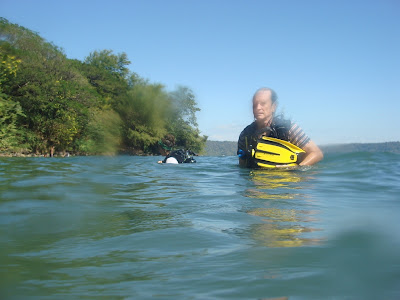
After a scuba dive in Laguna de Apoyo, the clearest lake in Nicaragua. Photo by Martin Cabrera.
Lake Apoyo is the easiest of all locations for scuba diving in Nicaragua. We are located only one hour from downtown Managua. Estacion Biologica collects data at four sites in Laguna de Apoyo, all have easy reach from the shore, and great views below. We enter our study areas from the shore, along property managed by Estacion Biologica.
Life is good after a dive. Photo by Martin Cabrera.
One vital reason for our monitoring program is the bigmouth sleeper, Gobiomorus dormitor. This fish looks a lot like a goby, only much larger as an adult. This voracious predator sits quietly on the lake bottom, where it awaits an injudicious move by any appropriately sized fish, when it strikes with lightning speed. The fish of Lake Apoyo spent thousands of years without the threat of bigmouth sleepers or anything similar, so they are now evolutionarily naive to the grave threats this fish presents.
The Bigmouth Sleeper (Gobiomorus dormitor) is a dangerous predator. It was introduced into Lake Apoyo in 1991. Photo by Martin Cabrera. 
Bright blotches, usually randomly placed, are not exactly uncommon among fish. These colors are usually caused by a specific mutation, such as in the goldfish, which is simply a selectively bred variant of a wild carp. Midas cichlids have a similarly brightly colored variation in the wild, although the "golds" are much more common in some locations than in others. Lake Apoyo, for instance, is considered to have no gold forms. Nonetheless, as the photo below demonstrates, gold forms may also be found in Lake Apoyo.
Gold form Midas cichlids are relatively common in some lakes, but not in Lake Apoyo. Fish such as the one in this photo are exceedingly rare. Photo by Martin Cabrera. 
Which gene(s) control the gold color form in the Midas cichlids is not known. Nor does anyone understand why Lake Apoyo has so few golds. In comparison to most other natural habitats of the Midas cichlids, Lake Apoyo has far fewer golds.
Some Midas cichlids show 
This clownish coloration is quite common among Midas cichlids in Lake Managua, some parts of Lake Nicaragua, and other volcanic crater lakes such as Lake Masaya and Lake Xiloa. Why is it so rare in Lake Apoyo? We don't know.
Amphilophus in Lake Apoyo, Nicaragua
This breeding, gold form Midas cichlid stays near the nesting hole. Photo by Martin Cabrera.
Midas cichlids are territorial when nesting. A breeding pair will occupy a natural or constructed hole, often at the base of rocks, in which a hard, flat, usually vertical surface can be utilized to adhere eggs. The pair will defend the site vigorously against predators and usurpers.
The gold-normal breeding pair linger near the nesting cavity. Photo by Martin Cabrera. 
The great majority of Midas cichlid nests do not result in the eventual creation of new adults. Hundreds of eggs are produced in each spawning, but very few fry will reach the age to swim away from the parental units and begin life independently of them.
The Bigmouth Sleeper has occupied Lake Apoyo only two decades, but is now very common. Photo by Martin Cabrera.
The newest reason for the demise of nests in Lake Apoyo, the bigmouth sleeper, has become very common in the lake. Some of the Midas cichlid species of Lake Apoyo are so rare that the bigmouth sleeper could even make the species disappear. Who would even know if a fish species in Lake Apoyo went extinct?
Filamentous algae forms a carpet on the lake bottom where Chara macroalgae was once abundant, placing much of the life in the lake at risk. Photo by Martin Cabrera. 
The bigmouth sleeper has a neutrally colored, mottled pattern along its sides and back, making its detection difficult. It sits on the bottom, awaiting a false move by some other fish. It strikes rapidly, with the intention to sink its long, fine teeth into the prey and then gradually move the prey into the mouth to swallow it.
bigmouth sleeper
A Bigmouth Sleeper (Gobiomorus dormitor) pair in courtship in Laguna de Apoyo. Photo by Martin Cabrera. 
The success of bigmouth sleeper (Gobiomorus dormitor) during the two decades of its time in Lake Apoyo is startling. They are extremely common. Recent research conducted by Topi Lehtonen and the research team at FUNDECI/GAIA demonstrated that the Midas cichlids of Lake Apoyo do not recognize the threat these fish present to their fry.
Amphilophus fry
These Midas cichlid fry must share their nest space with garbage left by humans. Photo by Martin Cabrera.
Lake Apoyo's fish species are facing several threats from humans. Soil introduction into the lake is higher than ever, coming from constructions in the watershed. Predation and loss of habitat by introduced species have done lots of damage to the species found here. And of course, garbage follows humans everywhere we go. The fish of Lake Apoyo have no choice but to utilize garbage-filled areas of the lake to feed and reproduce.
dive Nicaragua
Juvenile Amphilophus cichlids in Lake Apoyo, Nicaragua. Photo by Martin Cabrera. 
Lots of juvenile Midas cichlids are present year-round in Lake Apoyo. By diving during the different seasons, one can see the smaller fish grow and, by the end of about a year, start their first anniversary as members of the next breeding stock. The intense uses (and misuses) of Lake Apoyo by human beings requires that we assure adequate habitat for these fishes in all their life stages.
blind Amphilophus
A blind Amphilophus astorquii in Lake Apoyo, Nicaragua. Photo by Martin Cabrera.
To date, six species of the Midas cichlid species complex have been described in Lake Apoyo. All of them are only found in this lake. There are eight volcanic crater lakes such as Lake Apoyo, near the Nicaraguan Great Lakes, which have multiple species of Midas cichlids in them. What was once thought to be only one or a few species is now considered to be dozens of species, with very small ranges, and in some cases, populations of only a few thousands of adults. One of those species with a very small population is the chancho cichlid, Amphilophus chancho. It is the largest of the Midas cichlid species complex found in Lake Apoyo, with males sometimes reaching well over a kilogram weight.
Amphilophus chancho nest
Amphilophus chancho defending fry in a nesting hole in Lake Apoyo. Photo by Martin Cabrera. 
Child-rearing is an expensive venture for most species. It is especially so for the Midas cichlid species of Lake Apoyo, too. Providing care for the fry means eating less and lower quality food. It also means getting in harm's way. The parental units must confront potential predators and utilize displays, threats, and if nothing else works, direct attacks to drive away the fish and crabs that would want to eat the fry. Adults often look emaciated and battered at the end of the breeding season.
Amphilophus fishes near a hole beneath a rock in Lake Apoyo, Nicaragua. Photo by Martin Cabrera.
A scuba dive with the staff at FUNDECI/GAIA usually means seeing most of the six species of the Midas cichlid species complex, perhaps about five hundred individuals in total. Occasionally, we get to see jaguar cichlids (Parachromis managuensis) up close, while nesting. It also means seeing the ubiquitous bigmouth sleeper, lots of them, perhaps upward of a hundred individuals in a single dive. Other fish, crabs, and the dramatic undwater views round out most dives. Some of the dives take you to thermal vents, where clear, warm water flows from between rocks into the lake. And especially during the appropriate season (November through February), lots of fry in nests!
An adult bigmouth sleeper uses a hole beneath a rock as a hiding spot, from which to hunt. Photo by Martin Cabrera.
Diving in Lake Apoyo is different than in the ocean and generally much easier. No currents, waves, poisonous animals produce dangers here. The dives are rewarding and especially so when contemplating the rarity of some of the fishes, to which our divers contribute to study and protect them. Please contact us if you would like to dive with us in Lake Apoyo.
Parachromis managuensis
Jaguar cichlid (Parachromis managuensis) fry are feeding in open water outside their nest cavity in Lake Apoyo, Nicaragua. A small clump of Chara vegetation can be seen in the lower left. 
dive Lake Apoyo
Click on the "escudo" to contact us.