Showing posts with label reforestation. Show all posts

Sunday, November 26, 2017

CIAT visits Laguna de Apoyo

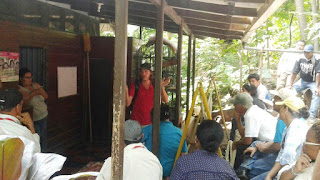
Recently, the participants in a course organized by the International Center for Tropical Agriculture (CIAT, its initials in Spanish) visited Estación Biológica Laguna de Apoyo to learn about land management in a protected area.

CIAT
CIAT course members tour the native tree nursery managed by GAIA. Hundreds of trees are grown in the nursery and transplanted into reforestation plots to re-created natural forest in the Laguna de Apoyo Nature Reserve. Photo Patricia Gómez.
Although most of their course dealt with the traditional problems facing poor farmers in the country, such as weather insecurity, labor, credit, and technical assistance, here the issues are shaped by the special aspects of the protected area. GAIA Director Jeffrey McCrary discussed with them the legal and technical issues facing land management in the area. Masaya Department, where the northern half of the reserve is located, is highly populated, but is historically a very productive agricultural area, with yuca, beans, sesame, and even coffee in the area near the Laguna de Apoyo Nature Reserve, in addition to the standard slate of smallholder crops which are often destined for personal use with excess production directed to the market, such as corn, plantains, and tree fruits.

protected area

The classification of the lands inside Laguna de Apoyo Nature Reserve as part of the SINAP protected area system regulated by the Nicaraguan government, however, imposes overriding restrictions and prohibitions on several activities, among them agriculture. The area is dictated by a number of laws, regulations, and policies, which specifically prohibit agriculture, cutting plants, killing or capturing animals, and even building structures. Enforcing the policies has its own set of challenges, particularly because much of the land is in the hands of private landowners who wish to put houses on subdivided plots and sell them for profit. Even subdividing land is forbidden, as part of the Law 559.

Land management

The management plan in effect in Laguna de Apoyo Nature Reserve, approved by decree in 2010, was produced by a team coordinated by GAIA director Jeffrey McCrary, who provided a brief review of the successes and failures of the plan since its implementation. Different interest groups were considered, such as mostly-foreign tourism business owners and vacation home owners, Nicaraguan renters on public land, the local community, and the community at large which includes all Nicaraguans, who have a voice in the way all natural areas are managed.

protected area
Course members contemplate wild animal rescue and rehabilitation, another activity conducted by GAIA at Estación Biológica Laguna de Apoyo. Photo Pablo Somarriba.
The most important single element of Laguna de Apoyo Nature Reserve is the lake at the bottom of its crater. In it, several fish species have evolved; six currently recognized species are only found in this lake. The lake provides unequaled views from near and far, and watersports opportunities, as well as serving as the only habitat in nature for these six species of fish. Strict policies are necessary to ensure that the lake remain pristine and uncontaminated. Issues discussed included the constant introduction of garbage from visitors and from a set of bars managed by Nicaraguans on municipal property, and the scandalous introduction of hundreds of tires into the lake by a group of non-Nicaraguan scuba divers puporting to represent a non-profit organization. Although the introduction of tires is regarded as patently illegal, the Nicaraguan government has found the challenges behind stopping this practice greater than their technical capacity to enforce the law.

protected area management
CIAT course participants enjoy views of Laguna de Apoyo and take selfies. Photo Jeffrey McCrary.
We can make presentations for your group at Estación Biológica or elsewhere on environmental and development issues. GAIA works in Laguna de Apoyo Nature Reserve and throughout the country. We have worked in every department in the country, and most of the 78 nationally recognized protected areas. Contact us by clicking on the "escudo" below to let us know how we can help you. 


course
Click on the "escudo" to contact us.


Saturday, July 8, 2017

Reforestation III: Saving the planet, one tree at a time

Any well-grounded person would agree that saving the planet is a goal beyond our reach. No one reading this blog controls enough resources to dream of something so big. But it is not beyond our reach to plant a tree in a place that once was a forest and could again return to the wild.
reforestation
Gapforce volunteers planted dozens of trees in a reforestation plot. Photo Pablo Somarriba.
For most folks in most circumstances, several factors inhibit their capacity to make a lasting contribution, however small, to the forests as they rapidly vanish before us. We all recognize that the issues facing our forests are far greater and more complex than simply taking a sapling and sticking it into the ground. Resolving the fundamental issues behind the disappearance of trees from a site is almost always difficult or impossible. Planting trees in a rapidly deforesting world may be of no more benefit than that of Sisyphus rolling a rock up the hill.

reforestation in Nicaragua
Volunteers work among trees planted earlier, already reaching some six meters height. Photo Pablo Somarriba.
Our reforestation activities aim for a high survival of trees to reach maturity, by taking a series of steps to get stakeholders interested, involved, and committed. GAIA reforests lands inside the Laguna de Apoyo Nature Reserve, through commitments from the individual landowners, or when land is not privately held, the Ministry of Natural Resources and the Environment and the municipal authorities. Our contribution to the forest cover within the protected area is relatively small, with a total of some 8,000 trees planted to date. Many of these trees have survived and some have already reached at least eight meters height, and howler monkeys have been observed climbing in them, demonstrating a very important level of success.

environmental volunteer
Gapforce volunteers taking care of saplings in the garden. We grow trees from seeds harvested from the forests of Laguna de Apoyo Nature Reserve. Photo Psblo Somarriba. 
There is another good reason for conducting our reforestation project. Others see what we do, and little by little, people begin to appreciate the value of their own energy and effort in a collective force to save the wild areas in Nicaragua. Teachers and their students from schools come to participate, adding their efforts, of a a few hours or a few days, to bring more wild nature habitat to this area. Individuals and even families come and spend a day, a week, or even a few months as reforestation volunteers.
Seeds are gathered in the forest, and then processed by hand, as part of the reforestation activity. Photo Jeffrey McCrary.
Spending a couple of hours once in a while to make the world a better place is not just an idea among the foreigners here. Our own neighbors have become environmentalists. When we organize a tree-planting activity, some neighbors want to be involved. Nicaraguans are increasingly finding ways to make their environment greener and cleaner.

Tree seedlings are planted in reforestation plots during the rainy season. Photo Michael Lowery
Seeing the reactions of so many people toward reforestation convinces us that growing, planting, and caring for trees is one of the best ways we can work in Laguna de Apoyo Nature Reserve. We feel validated by the people who join us and we think they do, as well.

Reforestation volunteers process seeds and share good times together. Photo Jeffrey McCrary.
It is easy for one who visits Nicaragua to think that people are pessimistic or indifferent to environmental matters. We have found quite a different reaction from the Nicaraguans who live in and around Laguna de Apoyo Nature Reserve. Many people want to be involved, to have their desire for a green nation to be taken into account. The following photos show how locals came to help plant trees with us. 

A new reforestation area is getting its first trees, with collaborations including GAIA, Cooperativa Ebert Silva, MARENA, and members of the local community. Photo Pablo Somarriba. 
On a recent day in the 2017 rainy season, we carted trees into a new reforestation plot, and the local population joined in to lend their effort. The first trees were placed in the ground in an area that has resisted the return of forests for years.
Members of the local community in Laguna de Apoyo Nature Reserve prepare holes for planting seedlings. Photo Pablo Somarriba.
There was a time when people seemed more pessimistic and skeptical of any request for help from the government or any group for effort in environmental protection. Today, however, more people think they can make a difference.
Park guards and the community prepare the site for planting trees. Photo Pablo Somarriba.
The idea that physical work such as planting trees is not for women, is pretty much a thing of the past, as well. Women participate in all kinds of activities in the local community. To see women digging and carting trees is not at all unexpected.
Trees are on their way! Photo Pablo Somarriba.
You can help to save the planet, one tree at a time, too. Just like the people in these photos, you can help to plant trees and make monkeys and other wildlife have bigger and better habitats, while protecting the water of Laguna de Apoyo. If you would like to be an Eco-Warrior Volunteer, please contact us.

Click on the "escudo" to contact us.

Sunday, April 9, 2017

Donations to Gaia

We at GAIA feel honored when people want to donate their time, money or materials to help us in our objectives to protect the wild natural resources of Nicaragua. Some people help with our activities as Eco-Warrior Environmental Volunteers, conducting lots of tasks that are important to nature such as reforestation, maintenance, and assistance with wild animal rescue. We love to share our time and efforts with people who share our opinions about the importance of protecting wild nature.

Not everyone can give a block of time to a project such as reforestation. Some people prefer to help by making a small financial donation, or provide some of the materials that are required for our operations, such as foods for animals and containers for planting trees. We want to express our gratitude to the many people who have given small, or sometimes, not so small, material or financial donations to help us do what we do. A few such donations received during the most recent days are mentioned below.

Seeds were donated by the owners of Apoyo Lodge-thank you!
The great folks at Apoyo Lodge dropped by to share with us and they shared their wealth by donating sunflower seeds. It is worth noting that Apoyo Lodge has changed hands, and the new proprietors are particularly kind and conscientious, as is evidenced by their donation of sunflower seeds for the benefit important nutrients.  Our rescue macaw has a flexible diet but, like all parrots, requires certain components, among them, seeds which carry certain small-scale nutrients that this bird may not obtain from the other foods in its daily diet in captivity.

The kinds veterinarians at WorldVets donated a surgery for Juju the kinkajou, and some juicy fruits which were readily devoured. 
Steve and the team from WorldVets donated a costly treatment of surgeries to Juju, a wild kinkajou that was found badly beaten in Laguna de Apoyo Nature Reserve. The animal was given a chance to live by these operations, which included the removal of a foot and an eye, and closure of an open wound on one cheek. The team dropped in a couple of times to see Juju, and they brought the animal some fruit. From all appearances, watermelon ranks highly in the list of preferred foods for a kinkajou. We often receive severely injured wildlife, and sometimes the success of seeing them heal is worth it all!

wildlife
Juju the kinkajou likes watermelon. Photo Andras Dorgai. 

There are lots of options for a visit to Laguna de Apoyo these days. The people who visit us often want to be involved in some way in doing something good for the environment. Part of keeping the environment safe for wild nature is patrolling to reduce vandalism, hunting, other bad things that harm the public good. We at Gaia support the local institutions in the ways we can. We had noticed the local patrol motorcycle for the police department was using a completely treadless tire, worn dangerously bald from overuse. Mark Connell, a student of Apoyo Spanish School, took note of our concern and provided a cash donation which covered most of the cost of the tire.

We compared prices and models and acquired the best fit for the job, and made an official delivery to the police representative. Now he can participate in hot pursuit safely!

animal rescue
Our local police representative in Laguna de Apoyo desperately needed a new front tire for his patrol motorcycle, which was donated by Mark Connell and funds from Gaia. Here, Juan Carlos presents the new tire along with Pablo and Mileidy from Gaia. Photo Jeffrey McCrary.
The next time we saw him pass by on the motorcycle, we stopped to ask about the tire, and sure enough, he had already had it mounted on the bike.

gaia
Our local police motorcycle now sports a fully new front tire! Photo Jeffrey McCrary.
We don't have any large bank accounts to fund projects without some sort of financing, which is a cruel reality for most not-for-profits that are really doing things of benefit to our society. We depend on contributions from our allies and friends. Sometimes, the contributions are small, but really, no contribution is ever to small. Every penny can be put to use in the protection of wild nature in Nicaragua. Missie and Stephen Lavergne recently gave us two (yes, two!) animal transporters-not exactly a small contribution. The transporters are in nearly-new condition and capable of handling animals of different sizes. Who said Christmas doesn't come in April? It will now be more feasible to transport animals-both wildlife and pets such as Lassie.

wildlife
Lassie tries our our new large-animal transporter, donated by Missy and Stephen Lavergne. Photo Jeffrey McCrary.
wildlife
The smaller animal transporter donated generously by Stephen and Missy Lavergne is just right for small and medium-sized animals. Thank you! Photo Andras Dorgai.

gaia
Lassie, our newest pet addition, was rescued from the street in Managua. For the next long trip, she now has some very comfortable conditions for traveling. Photo Andras Dorgai.
Andras Dorgai has been learning Spanish and helping as an Eco-Warrior Environmental Volunteer. Not only has he provided lots of great help, he also donated a bag of walnuts to the animals. Anyone who has been in Nicaragua knows that they can be very expensive and the cost can seem even more prohibitive when contrasting to the incomes found in Nicaragua. It is not easy for us to keep the animals fed with high-quality foods that meet their special, nutritional needs without donations. Midorna, our rescue Scarlet Macaw, needs nuts as part of her diet, so she is getting a small quantity daily.

animal rescue
Dorgai is passing a walnut to Midorna, part of their daily ritual. Photo Jeffrey McCrary.
Lots of others have donated items and cash recently, particularly in support of our studies of the wild natural resources in the area. The examples mentioned here are presented to demonstrate the diversity of ways to help available. We want to thank everyone who has made a donation. If you would like to donate to Gaia, please click on the "escudo" below or just come by Estacion Biologica Laguna de Apoyo any time!

Gaia
Click on the "escudo" to contact us.

Monday, December 19, 2016

Environmental Volunteering in Laguna de Apoyo

reforestation
Students of the American Nicaraguan School are helping to maintain a reforestation plot in Laguna de Apoyo Nature Reserve. Gaia works with the local community to keep Laguna de Apoyo hospitable for wildlife. Photo John Jackson
Nicaragua is a country widely recognized for activism. During the 1980's, people came to Nicaragua individually and in groups to help with "the cause" which was, depending on the person, eradicating poverty and illiteracy, confronting the imperialism in its hostile acts against small and poor countries, or promoting socialism or some kind of bottom-up social and political organization. There were even food-based initiatives, promoting soy products and helping farmers produce with fewer chemicals and other costly inputs.

Lots of things have happened in a few decades, but Nicaragua is still poor, and other nations are still wealthy and privileged. It is like a dream that the Sandinistas are again prominent in Nicaraguan politics, as they were in the 1980's. Things are very different between the two periods, some of them being the focus of foreigners today. Whereas back then solidarity and similar issues were the focus of most visitors from developed countries, lots of people come to Nicaragua today to enjoy sun and surf, which simply didn't happen decades ago. The millenial culture in wealthy countries, however, is not entirely hedonistic. No one is willing to risk a bullet to go to war zones, as a few, notable activists did back then. Nonetheless, there is a kindness and concern for the earth that is each day greater among people from the developed countries of the world. And, climate change is real, so the environment is among the themes most attractive to young people today.


volunteer
Young people heading to reforestation sites to provide assistance in forest restoration plots. Photo John Jackson. 
Another very big change over the thirty-year interval is in the connectivity worldwide that exists today. Back then, a telephone call to the US might take hours to connect, if at all, thanks to the embargo of the US government which blocked adequate development of communications systems. Today, most Nicaraguans are looking at their facebook accounts daily, sending messages to their mothers in distant countries, and reading the latest from all their friends both near and far. Long-distance communication is no longer the domain of the wealthy. With it, people know more about each other than ever before.

laguna de apoyo
Eco-Warrior Environmental Volunteers in Laguna de Apoyo can be drafted to take on even some simple tasks such as painting labels. Photo Pablo Somarriba. 

The closeness of people has also created a mutual affinity for some causes that transcend national boundaries. The environment, nature, and climate change are all issues that inspire people everywhere, today. GAIA is providing opportunities for both Nicaraguans and visitors to the country to give back to the environment, through forest restoration, wildlife rescue, monitoring of forest and wildlife conditions, and other activities that benefit the wild nature in Laguna de Apoyo Nature Reserve.

volunteer
Trash collected along the beach of Laguna de Apoyo, much of which is to be recycled by the staff of Gaia. Thanks to so many who volunteered their energy to keep Laguna de Apoyo free of plastic! Photo John Jackson.

volunteer
One person's trash is another's treasure. These plastic bottles are recycled or reused as reforestation planters. Photo John Jackson. 

GAIA works with groups of people from inside and outside Nicaragua, to support the environment. The idea that Nicaraguans can care and provide a benefit to the environment is a relatively new one, in which the influence of people visiting have helped to form opinions and demonstrate that even small groups of people can make a difference.

Lots of our visitors at Estación Biológica Laguna de Apoyo help with the care of wild animals. We at GAIA tend to have some or another wild animal around which needs a lot of care. We cooperate with the Ministry of Natural Resources and the Environment to care for any wild animals that need some kind of special treatment, usually because of an inappropriate reaction with a human. Some people stay for longer volunteer assignments and get more involved in the care and policies, even constructing and repairing enclosures.

volunteer
This baby bird is a Montezuma Oropendola. Its nest was destroyed by a North American landowner who didn't like the idea of having a colony of nesting birds in his yard, and had the branch which held this baby's nest cut down. The local park guard from the Ministry of Natural Resources and the Environment brought the bird to us to raise until the bird can fly and return to the wild. Photo John Jackson. 
We at GAIA would love to involve more Nicaraguans as volunteers in conservation activities. That's where you come in. We need your help to conduct these activities, either as a volunteer or a supporter with food, animal cages and transporters, or other resources. You can also provide assistance to our monitoring programs, where we follow bird, monkey and fish populations.  Please consider joining us or making a donation!

reforestation
The forest restoration program managed by Gaia in Laguna de Apoyo Nature Reserve means a lot more than what most people think when they consider "reforestation". Planting trees is just part of making a forest. These young people are heading to tend to trees planted in prior years, to assure maximum survival. Photo John Jackson. 

Nicaragua
Click on the serpiente emplumada to contact us.

Sunday, May 31, 2015

Natural Forest Habitat Restoration in Laguna de Apoyo Nature Reserve

More than 400 species of plants inhabit the Laguna de Apoyo Nature Reserve. In spite of the immense diversity of plant life found here, and the official status of a protected area, deforestation is rampant. Some areas have been deforested for a few decades, when the areas were developed as cattle pasture. Although cattle are no longer legally permitted in the reserve, there are still large areas that continue to have few trees from that period. Some locals cut firewood and timber illegally, menacing the trees especially on the northern side of the reserve. GAIA works with local landowners, MARENA and the municipalities to reforest areas sustainably, using seeds from the same forest, with species native to the area. This point offers one strong distinction between our reforestation project and almost every other reforestation project in Nicaragua. At Gaia, we discourage the use of neem, eucalyptus, Benjamin's fig, and any other non-native tree in the area, and we never plant those species.

Nicaragua
Ceiba seeds (Ceiba pentandra) are highly nutritious, attracting parrots, parakeets and many other birds. The wood from the ceiba tree is not of high value, making it of limited use to illegal forest raiders. The trees tend to form hollow cavities, providing excellent animal habitat, also. Photo Jen Moran. 
Most reforestation projects are directed at wood production for construction or furniture woods, using few species, and managed in even-age stands. Reforestation projects of these types rarely contribute to wildlife habitat in any significant way. Wildlife, however, need diverse species, of diverse ages, and including hollow trees which are definitely unwanted by production forest managers.
Nicaragua
The ceiba seeds come in a pod with a fluff that is used by many animals as nest material, and it has been used as packing for bedding until recently among rural people. Photo Jen Moran. 
One challenge to reforestation and natural forest restoration is to maximize the diversity of tree species expected in a natural forest in the area. This challenge means harvesting a wide diversity of tree seeds, cleaning and classifying them, then seeding them before eventually taking the small trees to the forest for planting. Most of the tree species found in nature in the Nicaraguan forests have never been grown in commercial tree nurseries. There is no readily available information on how to maximize the survivability of those species. We are learning as we go, and enjoying every minute, while making small successes which help the Laguna de Apoyo Nature Reserve to remain as biologically diverse as it can be.
nature
In this box, a diverse sampling of forest seeds that have been collected and processed in Laguna de Apoyo Nature Reserve. Our Eco-Warrior Volunteers help with every stage of reforestation. 
Some trees such as ceiba (also known as kapok) have known uses for nature as well as for man. Other tree species may contribute to the local ecology in ways we do not know. We do try to emphasize the selection of species most appropriate for each particular area, according to the physical features present such as shade, access to water, slope, rockiness, and soil conditions, but in the end, we want to see as many trees of as many species planted in areas that can eventually return to mature forest.
forest
Another very attractive species for natural forest restoration is the Guanacaste or Elephant-ear tree (Enterolobium cyclocarpum) The seeds are consumed by many birds and mammals, and were once consumed by locals. Photo Jen Moran. 
Another challenge to a successful reforestation project is to obtain seed stocks that are robust, healthy and genetically diverse. Furthermore, we want to use seed stocks from local strains. We collect seeds locally, monitoring productive trees for the best moments to make seed collections. Once collected and processed, the seeds are planted in seed bags or other containers, often using materials such as plastic bottles, jet-packs for milk, etc., which give another "life" to these artificial materials that we just can't seem to rid from our lives. If we can eliminate the use of artificial materials, at least we should re-use and recycle, and our reforestation project gives us a good place to put lots of material which otherwise would be waste.
trees
Volunteers help seed new trees in nursery bags made from recycled plastics. Photo Jen Moran.
We grow out the majority of our seedlings during the dry season in Laguna de Apoyo Nature Reserve, from December through April. Our tree nursery is shaded by a partial tree cover, keeping the intense sun rays down and the evaporation rates lower, as well. Even then, we have to supply lots of water to each seedling as it grows, as well as some tender, loving care to be sure each seedling gets the best chance to grow surely into a small tree. 
reforestation
These volunteers filled seedling bags with compost made from our own kitchen! Photo Jen Moran.
Most successful seedlings require at least a few months to grow up to size appropriate for planting in the forest. Once up to size, the seedlings must await the first rains, to be taken out and planted in a forest area. In Nicaragua, the seasons revolve around rain, rather than temperature.
volunteer
Eco-Warrior volunteers place seeds in bags with lush soils. Although these volunteers will be long gone from Laguna de Apoyo Nature Reserve when these seeds become trees in the forest, they have left an important contribution to nature in Nicaragua. Photo Jen Moran.
There are at least 10,000 mature trees in the forests of Laguna de Apoyo today, which started life in the GAIA tree nursery. Each was planted and attended by volunteers, summing up to many, many hours of donated time. Even then, there are costs that can not be avoided, including water costs, which are very expensive. We maintain a well which entails pumping costs and yearly well maintenance, adding up to almost one hundred dollars per month.
Eco-Warrior volunteers
Ear guanacaste seeds are not only good for planting, they make very attractive seed jewelry! Photo Jen Moran.
Once the seasonal rains begin, seedlings of sufficient size to survive are transplanted into forest habitat restoration plots. Most of the Laguna de Apoyo Nature Reserve is steeply sloped, and the soils are recently formed volcanic ash. The volcano last exploded some 23,000 years ago. As a result, the soils can be quite week, lacking in nitrogen, and extremely susceptible to erosion in the deforested areas. Furthermore, the deforested areas are generally covered with annual grasses which often burn during the dry season, presenting one of the most dangerous hazards to the small, new trees. Our care of these trees must include periodic cleaning of the plots to reduce the risks of fire and constant vigilance against forest fires, especially in March and April, when the risks are greatest.
volunteering in Nicaragua
Small trees begin their new life on the steep slopes of Laguna de Apoyo Nature Reserve, in a reforestation plot. If these trees survive, they will grow to increase wildlife habitat and reduce erosion rates into the lake. Photo Jen Moran.
During the rainy season, small trees can be planted into reforestation plots. We don't just plant anywhere. We have agreements with landowners who want to return their plots to natural forest and ask us to help them. We agree with them to conditions for land management and together, we make a strategy for handling the problems in their land.
volunteer
In this brushy site, soon there will be a growing forest with trees that will provide a complete cover. This cover is vital to protect the ground against transpiration (drying out during the windy, dry season) and erosion. The native tree species we plant also provide ideal habitat for wildlife. Photo Jen Moran.
Our forest habitat restoration project in Laguna de Apoyo Nature Reserve is run entirely by volunteers and donations. We count on people like yourself to participate or donate small amounts to pay for the costs involved. If you, like us, love Laguna de Apoyo Nature Reserve and you would like to see it remain green and full of wildlife, and its waters clear and blue, you might consider helping us with reforesting the reserve as an Eco-Warrior Volunteer. If you can not participate, or by making a small donation to offset the expenses associated with each tree. Contact us if you have any questions or comments!

Thanks to our Eco-Warrior Volunteer Jen Moran for the photography in this entry! 

You can help us keep nature wild in Nicaragua, by volunteering your time with us or making a small donation to support our projects in wild nature conservation.


Gaia
Click on the "escudo" to contact us.

Monday, May 27, 2013

Reforesting Volcano Masaya National Park

The dry season in Nicaragua, which encompasses the first several months of the year, was especially hot and dry this year. Forest fires raged through parched lands throughout the country, especially in protected areas, such as Volcano Masaya National Park.

Almost all forest fires in the tropics are started by humans, and we are sure that the fires which burned hundreds of hectares of brush and forest on the sides of the Masaya Volcano were no exception. In fact, someone was caught setting fires, although catching someone does not return the great losses caused in nature. It was a severe dry season, so the elements were especially susceptible to a forest fire.

This weekend, FUNDECI/GAIA participated in a tree-planting activity in Volcano Masaya National Park, and here are some photos which depict the activity. Volunteers came from all directions, and together, we planted about one hundred stakes which will, hopefully, become trees. Special thanks to Apoyo Spanish School student Elizabeth Loudon for doing her part!
volunteer Nicaragua
The Masaya Volcano is smoking behind the reforestation volunteers. Photo Jeffrey McCrary.
The reforestation activity was done with stakes from trees with branches that can be planted directly. Not all trees do this, of course, but some of these species are found in the Volcano Masaya National Park. We cut branches from some large trees, and planted them in holes 1/2-meter depth in the areas where forest fires raged during April.
volunteer nicaragua
Trees were planted from cut stakes. Photo Jeffrey McCrary.
Our reforestation project was done by volunteers from all directions-Nicaragua, Europe, and the United States. Every volunteer was enthusiastic about helping their natural heritage prosper. Work as a volunteer in Nicaragua is not always meaningful, but we came back knowing we participated in a great activity.
environmental volunteer
Burned areas are all around! Ilse plants a Sacuanjoche tree. Photo Jeffrey McCrary.

volunteer nicaragua
More stakes arrive foor planting. Photo Jeffrey McCrary.

nicaragua volunteer

reforestation volunteer

reforestation


Environmental volunteers arrive. Photo Jeffrey McCrary.

The Volcano Masaya crater gapes behind Elizabeth. Photo Jeffrey McCrary.

volunteering in Nicaragua

environmental volunteer

environmental volunteer
Natasha digs like a pro. Reforestation volunteers came from Carazo, Managua, Nindiri, Masaya, and Laguna de Apoyo. Photo Jeffrey McCrary. 

reforestation volunteer
The reforestation volunteers were enthusiastic! Photo Jeffrey McCrary.
The reforestation activity, performed by environmental volunteers and the staff of the Volcano Masaya National Park, was covered by the national newspaper, La Prensa. Every volunteer was happy to participate. The event was actually fun!
The ground was covered in black ash from the forest fire, and charcoal from the branches and stems that were burned.. We found rich soil in a shallow layer, followed by volcanic gravel beneath, as we dug holes for planting stakes. Photo Jeffrey McCrary.

reforestation in Nicaragua
Volunteers for the reforestation project came from Masaya, Nindiri, Managua, and Laguna de Apoyo. Photo Jeffrey McCrary.
Reforestation in Nicaragua is greatly needed in many areas. So many forests have been degraded or destroyed by fires, expansion of agriculture and clearing for wood use. We are happy to have participated, especially because we saw the enthusiasm of the Nicaraguan volunteers. No one provided meals or expense accounts, everyone just came and gave their time and energy, and returned home sweaty and covered in dirt and ash, knowing that Volcano Masaya is better protected than before.
reforestation
The ash from the fire is evident around the hole dug by these volunteers. Photo by Jeffrey McCrary.
If you would like to participate in meaningful projects which have a place in the greater benefit of Nicaraguans, then consider being a volunteer with FUNDECI/GAIA. You can help save the planet, one tree at a time. It is easy to be an environmental volunteer in Nicaragua. There are many environmental projects and activities, and there is always something to do for every volunteer.

reforestation
Our contribution was small, but these reforestation volunteers are happy to have participated! Photo Lenin Medina.

environmental volunteer
Click on the "escudo" for more information.