Showing posts with label Laguna Masaya. Show all posts

Thursday, August 31, 2017

Charles Darwin en Nicaragua

Durante aproximadamente un siglo, las ideas de Charles Darwin sobre la selección de pareja como un motor hacia el desarrollo de especies nuevas, fueron efectivamente desvaloradas dentro del Reino Animalia. Es difícil encontrar un caso donde es probable que dos especies se formaron dentro de una, en una sola población, con sus miembros en permanente contacto. Mientras siempre ha existido la idea que la selección de pareja puede ser un factor importante en el desarrollo de una especie nueva, en la gran mayoría de los casos, es poco probable que no hubiera otro factor, como una barrera geográfica, en la historia del desarrollo de las especies, en particular con animales vertebrados.

El tipo de formación de dos especies de una población de una sola especie, a través de la selección de pareja, es llamado especiación simpátrica. Sin embargo, el caso de la especiación entre un grupo de peces en las aguas de Lago Cocibolca (Lago Nicaragua) y las lagunas cratéricas alrededor, ha sido fundamental en el regreso de este concepto. El grupo de peces lleva el nombre "mojarra" en Nicaragua, y son varias especies, algunas descritas y otras no, del genero Amphilophus.

El tiempo de existencia de las lagunas cratéricas de Nicaragua varía entre unos diez mil y cien mil años, relativamente poco para los procesos de evolución típicos que forman especies nuevas. A pesar de su relativamente reducido tiempo de existencia en esas lagunas, se ha comprobado que procesos rápidos de evolución han sucedido en varias lagunas, a través de estudios morphológicos en Xiloá y Apoyo, y estudios genéticos en varias lagunas. Las aguas de cada laguna son aisladas de otros cuerpos de agua.

Las mojarras se hacen pareja y se anidan dentro de la planta que se llama Chara, en la Laguna de Apoyo. Foto Topi Lehtonen.
Un reportaje sobre los estudios ejecutados por GAIA en las lagunas fue publicado esta semana en El Nuevo Diario, en el cual se mencionan las especies endémicas de este grupo ya identificadas y descritas, de las lagunas de Apoyo, Xiloá y Asososca Managua, y también se menciona un estudio en curso en la Laguna de Masaya, sitio reconocido en desahucio por su nivel de contaminación por basura y aguas residuales que entran en la laguna desde las ciudades aledañas.

Del reportaje en El Nuevo Diario, 30 Agosto, 2017.

Para los científicos, además de que sean especies nuevas que en si tienen importancia, estas mojarras demuestran evidencia de haber sufrido procesos de especiación simpátrica durante el relativamente corto tiempo que habitan las lagunas cratéricas, por lo que sean de gran importancia como sujetos de estudio. Es una lástima que Charles Darwin nunca vino a Nicaragua, para que vea las mojarras que adornan a los lagos y las lagunas de Nicaragua. Si estuviera vivo hoy Charles Darwin, estaría en la Laguna de Apoyo, buceando con nosotros!

De Geiger, McCrary, y Schliewen, 2010.

Estudios de campo en la Laguna de Apoyo. Foto Jeffrey McCrary.

Los peces en la Laguna de Apoyo abundan entre estructuras rocosas. 


Oprime el escudo para contactarnos.

Friday, June 30, 2017

Estacion Biologica Laguna de Apoyo in El Nuevo Diario

The volcanic crater lakes of Nicaragua were once again the subject of a news article in El Nuevo Diario this week. Anyone who has visited the volcanic crater lakes of Nicaragua would agree that they are quite unique. As a group, they are isolated lakes, without any open water channel connecting any of them to any other water body. Their connection through the water table, with slow filtering of water through the sediments and rocks which eliminates the passage of animals and even microorganisms to and from each lake.
GAIA has been active in studying and protecting the fauna and flora of Laguna de Apoyo Nature Reserve. 
It is precisely this isolation that makes the volcanic crater lakes of particular importance to the study of biodiversity and evolution, and consequently, gives them priority as objects of protection for the conservation of the unique fauna in each lake. The majority of the volcanic crater lakes in Nicaragua have been studied to determine what fish species are found in them. The principal study which documented these lakes was conducted by our group in eight of the volcanic crater lakes, resulting in twenty new distributional records for fish in the country. Prior work had been performed by Jaime Villa, Padre Ignacio Astorqui, and George Barlow, all of whom had conducted some amount of fish studies in one or more volcanic crater lakes.

Each of these eight lakes that have been studied contain unique fauna. Laguna de Apoyo, for instance, is the only wild habitat in the world for six species of fish; Laguna de Xiloa, for another five species. The other, less well-studied lakes on this list, definitely contain unique fish species, as well.

A former employee of our group has more recently sounded the call to name the volcanic crater lakes, collectively, a World Heritage Site, through UNESCO. This idea is not new; in fact, it has been floated repeatedly for the past twenty or so years. While some people host press conferences to hijack ideas for their personal aggrandizement, we are busy doing the things that protect the natural areas of Nicaragua and the biodiversity at risk found in them. For years, GAIA has been on the front lines of defense of the lakes from senseless destruction of the natural resource base in these fragile ecosystems. Although many of the actions go unnoticed by the public, a few have had a larger profile. For instance, GAIA director Jeffrey McCrary served as the coordinator for the development and approval of the official management plan for the Laguna de Apoyo Nature Reserve. The majority of the entries in this blog deal with the activities of GAIA inside that protected area, although several entries deal with other volcanic crater lakes, as well. In summary, we have been there, advocating for the protection of each of these jewels, with real actions resulting in new knowledge and better policy and protection.

In places like Nicaragua, it is easy to find people who want to be in the spotlight, especially foreigners who jet around from country to country, who talk about peace, or saving children from poverty, or the environment. Sometimes, such as in this example, there is not much behind their grandstanding. The real struggle is not about press conferences with grand proposals, but rather, in the trenches, building schools for poor people, spending countless hours dedicated to community involvement in the decision-making processes for natural resource use and protection, and sleepless nights in the thankless job of making a few hours in the forest or under the water turn into peer-reviewed, accepted research publications that provide meaningful justification to protect special places such as the volcanic crater lakes of Nicaragua.

Estacion Biologica
GAIA is present and active in Laguna de Apoyo Nature Reserve. 

It was not lost on us that someone would discuss the volcanic crater lakes of Nicaragua in the press as if there were no current and historic initiatives to protect them, and even less surprising that it would come from a foreigner who feels the need to plant himself as protagonist in an effort that needs him to accomplish something that no one in Nicaragua could accomplish without his grandeur. It is absurd to think that someone would propose research stations in these natural areas, as if no research had ever been conducted and published already. We have come accustomed to this type of attitude, and we continue to do what we do, as small as it may seem at times. Our organization, unlike other supposed organizations, is real, solvent, and active. We are in constant communication with the communities where we have alliances and with the relevant institutions of government to assure that what we do is appropriate on all levels.

We invite you to visit us at Estacion Biologica Laguna de Apoyo or write us and get to know us. We seek alliances of all kinds, to work hand in hand wherever possible, to keep nature wild and free in Nicaragua. Please contact us!

gaia
Click on the "escudo" to contact us.

Sunday, February 28, 2016

Volcano Craziness

Nicaragua has been called the land of lakes and volcanoes. Both dominate the views throughout the Pacific region of the country. Lately, volcanic activity has dominated the national news and the minds of all who live near them. The authorities have evacuated employees from some locations and some residents from a few locations, while intense monitoring of the situation continues. Here is a video of the dramatic volcanic activity in the Santiago Crater of Volcano Masaya.


There are, currently, five volcanoes in Nicaragua that are declared "active", which means something far beyond just heat on the surface or active fumaroles. These are Masaya, Momotombo, Cerro Negro, San Cristobal, and Telica. All are worth a view. The Volcano Masaya National Park is closed until further notice. In this area, the volcanic activity far exceeds anything that has happened there in more than 200 years. Views are best during the evening, particularly during a new moon, either from the Masaya-Managua highway or along the Malecon in the city of Masaya.

Volcano Masaya
The INETER Volcano Cam from 4 March 2016, shows an intense glow on the smoke emitted from the volcano. 


The Masaya Volcano is the main attraction of the Volcano Masaya National Park, located just north of the city of Masaya. The top portion of the crater is devoid of vegetation, hot and arid, and much of its flanks are covered only in annual plants which burn during the occasional dry season forest fires. Trees can not grow in these areas because of the intense heat which reaches to very near the surface of the soil. A volcanic crater lake, one of eleven found in the country, also can be seen in the park.

Make a trip to see them, but remember to be safe and obey the laws and current prohibitions!

Masaya Volcano
The smoke emerging from the mouth of the Santiago crater at Volcano Masaya National Park. Photo Jeffrey McCrary.

Volcano Masaya
Even on a good day, Volcano Masaya emits enormous quantities of smoke and noxious, corrosive gases. It is the largest source of mercury emission in the western hemisphere. On the flanks of the crater interior, a parakeets roost and reproduce in holes, some of which can be seen in the photo. Photo Jeffrey McCrary.

Momotombo
Momotombo Volcano rises from the north edge of Lake Managua. Its sister volcano, Momotombito, can be seen in the distance, an island in the lake. Photo Brenda McCrary.


Casitas Nicaragua
Casitas Volcano has active fumaroles near the summit.

Nicaragua Volcano
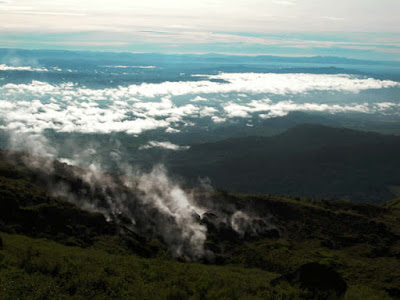
The smoking crater of El Hoyo Volcano, as seen from the summit of Casitas. 
Nicaragua
Click on the escudo to contact us.

Tuesday, May 1, 2012

World Water Day

Some folks think the twenty-first century will be the century of concern for water. We very well may run out of useful water before other resources are exhausted, especially given our predisposition to destroy the quality of many water resources. The Nicaraguan government has declared that access to water is a priority for all people.

We at FUNDECI/GAIA celebrated World Water Day March 22 with the Nicaraguan government and civil society at the Masaya Volcano National Park. The people present represented the Ministry of Natural Resources and the Environment (MARENA), the Ministry of Health (MINSA), the Nicaraguan Water Company (ENACAL), members of the municipal governments of Masaya, Nandasmo, Nindiri, and Masatepe, and many people from non-governmental organizations, including FUNDECI and the Indigenous community of Monimbo. Our focus for this day was Lake Masaya, a marvelous but tragically contaminated volcanic crater lake inside the Volcano Masaya caldera. We spent the morning with local schoolchildren, observing the fish and water of the lake, and in the afternoon, we participated in a forum discussing the situation of this lake.

World Water Day
Solid waste from surrounding communities collects along the waterline in Lake Masaya. Photo by Wendy van Kooten.

Lake Masaya receives inconceivable quantities of liquid and solid waste. Hundreds of gallons of polluted wastewater from Masaya pour into Lake Masaya each hour, and trash enters from communities in several directions. The lake is filling in from sediments and solid waste, and the fish are dying in large numbers. The incredible scenery of this lake from a distance is ruined by the shoreline littered with plastic and the putrid water.

Nicaragua has so many great sources of water, and so many of them have been destroyed. Lake Managua, also known as Xolotlan, is terribly polluted, but once was a source of drinking water for Managua. Tiscapa, like Lake Masaya, receives overwhelming quantities of municipal runoff and garbage with each rain. Nejapa went completely dry recently. Lake Apoyo is still beautiful but facing enormous quantities of trash from visitors.

World Water Day
Volcano Masaya National Park Director Liliana Diaz and a local youth admire a fish from Lake Masaya. Photo by Wendy van Kooten.
In spite of horrendous quantities of trash in and along the shore of Laguna de Masaya, the lake is teeming with life. Local children and park rangers admired the fishes dredged from the lake with seine nets. The local children knew all the names, because they eat the fish!
water
Members of MARENA, the local community, and staff from FUNDECI/GAIA debated the dilemma facing Laguna de Masaya. Photo by Wendy van Kooten.
Presentations on water issues in the lake and vicinity were made throughout the afternoon. The presentations were attended by members of the municipal governments throughout the region, along with the ministries of health, agriculture, and the environment, and members of communities including Masaya, Masatepe, Nindiri, and Nandasmo.

World Water Day Nicaragua
Jeffrey McCrary demonstrates the varieties of fish inhabiting Lake Masaya to members of the government and civil society on World Water Day. 

Nicaragua World Water Day
Lilian Diaz, the Director of Volcano Masaya National Park, shares with the public on World Water Day. 
Masaya Nicaragua
Lake Masaya as seen from the Santiago Crater of Volcano Masaya.
Would you like to help protect the water bodies of Nicaragua? FUNDECI/GAIA can arrange volunteer projects and internships in Lake Apoyo and other locations. You can make a difference and save the most precious single resource for future generations. Please contact us if you would like to volunteer.
World Water Day Masaya
Click on the "escudo" to contact us.

Tuesday, September 28, 2010

Fish Research in Laguna de Masaya


The Masaya volcanic complex, lying just north of Apoyo, also contains a lake full of fish-and very interesting fish! The FUNDECI/GAIA research team are executing a study of the Midas cichlid species complex in Lake Masaya, in search of evidence that sympatric speciation has also occurred in this lake, as has been demonstrated in Lake Apoyo.
Lake Masaya cichlids
Maarten fishing for new species. Photo by Jeffrey McCrary.
Here is Maarten Hogenkamp, fishing in Laguna de Masaya. And take another look at the foreground!!!! Yes, that is trash. This lake is severely damaged by solid waste and liquid waste from the municipalities of Masaya and Masatepe. Nonetheless, the lake has fish, and very interesting ones!

Midas cichlid research in Nicaragua
Lorenzo and Jeffrey examine the catch. Photo by Marlene Kroner.
Here, Lorenzo hauls in a juvenile Midas cichlid by harpoon, and passes it off to Jeffrey McCrary of FUNDECI/GAIA while Erico from the Masaya Volcano National Park looks on.

A new species from Lake Masaya. Photo by Jeffrey McCrary.
Some of the catch: a probable new species! FUNDECI/GAIA is working with Jay Stauffer from Penn State to describe new species in Lake Masaya.


fish research Nicaragua
Lorenzo and Maarten discuss the color details of the fish. Photo by Jeffrey McCrary.

Amphilophus fish Nicaragua
Maarten and Elmer at work. Photo by Jeffrey McCrary.
And yes, fishing also means.... repairing nets, and getting ready for the next round. 
Fish studies Nicaragua
Click on the "escudo" to contact us.