Showing posts with label fish. Show all posts

Monday, July 3, 2017

Scientific Tourism in Estación Biológica Laguna de Apoyo

For the second time in a week, Estación Biológica Laguna de Apoyo has received reportage in the edition 3 July, 2017 of El Nuevo Diario. Our research station is a point of participation for the protection of Laguna de Apoyo Nature Reserve, through activities in scientific research, environmental education, and conservation activities. Click on the link above and take a look!

scuba dive Nicaragua
GAIA scientist Jeffrey McCrary conducts underwater monitoring in Laguna de Apoyo. Photo Garey Knop.

How to make a center for research, conservation, and education work, we have found, is not easy. We often are in debt, but we carry on. There are plenty of gratifying moments and activities for all of us, which is why we continue. We get to help in small ways to cure nature of the ills caused by humans, through rescue of wild animals, planting and caring for trees, recycling, organizing, educating, coordinating with communities and the government, studying the issues facing the continued protection of the area, and developing policy recommendations. One of the many examples of our success is found in the long list of publications in which we have been involved.

A few areas in which we have worked are mentioned in the cited article. We were involved in getting motorboats and jet skis off the lake permanently. This has been a great advance in the protection of the nature inside the lake, and also makes for a much more pleasant and safe experience for all. Boats have meant ugly noises and danger from constant encroachment onto the spaces of swimmers. Everyone, except the few boaters, are glad they are gone. There are plenty of places to take motorboats, such as Lake Nicaragua, so all people win by the elimination of motorboats from Laguna de Apoyo.

Laguna de Apoyo
The chancho cichlid, Amphilophus chancho, is one of five fish species from Laguna de Apoyo discovered in studies coordinated by GAIA. Photo Adrianus Konings.
Our group has discovered five species of fish that are only found in Laguna de Apoyo. All of these species are descendants of the parent fish of the so-called Midas cichlid (Amphilophus citrinellus). Research coordinated by GAIA demonstrated that the five species in Laguna de Apoyo are genetically distinct from forms in all the other natural areas inhabited by the Midas cichlid.

Scuba divers can join us in monitoring activities on the fish populations in the lake. We are the only approved dive center in Laguna de Apoyo Nature Reserve, and we conduct all our activities in cooperation with the local municipal authorities, MINSA, MARENA, and INTUR.

GAIA maintains the costs of operation of Estación Biológica Laguna de Apoyo through visits, donations, sales of lunch and coffee, hostel stay, and training activities such as intensive Spanish courses. We hope you visit us and get to know what we do. Please come by or write us.

Click on the "escudo" to contact us.

Thursday, July 16, 2015

Laguna de Apoyo in view


As the largest volcanic crater lake in Nicaragua, Laguna de Apoyo has a lot to see. There are lots of angles and facets, and the perspective changes from hour to hour. Here are a few photos shared by our friends to give you an idea of the different ways people see the lake.

Laguna de Apoyo
Sunrise is a great moment to be on the lake. Vera Neumann
Usually at dawn, the lake is relatively quiet. During the rainy season, that may mean the volcanic crater lake is so smooth as to reflect the mountains on the opposite side. During the dry season, when winds blow constantly, the lake is just less choppy at dawn, whereas real waves may kick up during the day, as strong gusts build. Throughout the day, constantly changing, the water is never the same.
Laguna de Apoyo
Lake Apoyo may show patches of different colors, when viewed from above, as in this photo taken from Catarina. Ad Konings.
Because Laguna de Apoyo is extremely deep, reaching 178 meters depth, masses of water with different flow patterns may occur. And, of course, there are fish down there, interesting ones. At all times, the lake is a beautiful blue, but the shades of blue may vary in the patches and may also be muted by whitecaps during the strong winds of the dry season, from December through April.

laguna de apoyo
Sometimes views of the lake are sharp and clear, and other times there may be clouds or haze, but the view is always worth a smile. Jessica Lopez.
The forests surrounding the lake serve some very important environmental functions. The first is that the trees sustain the loose, volcanic ash-laden soils on the steep slopes surrounding the lake. Apoyo is a volcanic crater some 23,000 years old, with the water table emerging through the bottom of the crater. The interior sides of the crater are rapidly eroding. in areas where houses have been built or the land has been deforested for whatever reason. In some places where the trees have been cut, the land has given way in dramatic landslides.

Another important function of the forest is to retain the water in the ground. When the sun and wind reach the soils, as in deforested areas, the ground dries and compacts, drawing water out of the water table below and reducing the capacity of the soils to recharge water into the water table during precipitation. 

The forests of  Laguna de Apoyo Nature Reserve are also very important habitat for a wide variety of terrestrial mammals, most notably two species of monkeys and over 225 species of birds. Although the forests of Apoyo are not extensive, they are contiguous with forests of Mombacho and Volcano Masaya, linking a corridor which together makes an important contribution to the biodiversity of the region. 

swimming
Any visit to Laguna de Apoyo must include swimming. Photo Lucy Lia Real.
The best part of the lake for us bipeds is that the water is warm, clean, and inviting. We get into the lake to feel what only being in a natural water body can bring, a sense of renewal. It is no surprise that religions often use water in spiritual renewal rites. Laguna de Apoyo will inspire the most spiritual aspects of anyone, particularly when one gets away from the handful of tourist traps near the entrance.
Nicaragua
Stormy weather can be dramatic in Laguna de Apoyo, worth seeing at a safe distance. Photo Jen Moran.
GAIA is dedicated to keeping Laguna de Apoyo pristine, through working with scientists, tourists and locals to make the best choices for development in the area of the lake. We coordinated with another NGO, CLUSA to develop the management plan now in place in Laguna de Apoyo Nature Reserve, in which our personnel were deeply involved in the community involvement in all the negotiations.

GAIA scientists have discovered five species of fish in Laguna de Apoyo, all of which are only found in this lake.
Laguna de Apoyo
A serene moment at Laguna de Apoyo calls for yoga. Photo Jen Moran.
Laguna de Apoyo deserves your involvement and needs you to help ensure the lake is never destroyed, so that humans and wild nature can find harmony. Please contact us if you would like to join us. We want to year from you.
Laguna de Apoyo
Loving Laguna de Apoyo means leaving only a shadow behind. Catherine Bard-Dechesnau

Laguna de Apoyo
Click on the "escudo" to contact us at Gaia.

Wednesday, August 14, 2013

Under the water

We spend hundreds of hours per year under the water in Laguna de Apoyo, in counts of fish, documentation of the quality of the habitat where they live, the vegetation found there, and yes, even in retrieving the trash that folks discard which ends up all along the lake bottom. Here is a small collection of photos which show what we see when we are down there, in the most beautiful spot in Nicaragua. In the photoessay below, you can experience what one of our interns saw during a study of the fish with the director of the Gaia Program, Dr. Jeffrey McCrary. Dr. McCrary is leading an international team in the study of the fishes of Laguna de Apoyo, and to date five new species have been discovered as part of the program. 
These fry of an Amphilophus zaliosus pair recently hatched in a nest hole which is often seen with babies. 

Lots of fish are hanging out in this site, including a probable male Amphilophus zaliosus in breeding coloration in the center of the photo. 


Counting fish along a transect.

Juveniles and nonbreeding adult Amphilophus seek refuge under rocks in Laguna de Apoyo.

Breeding season is approaching, and breeding pairs are forming. A pair of Amphilophus zaliosus are in the foreground, and a pair of jaguar cichlids, Parachromis managuensis, are in the background. 
As can be seen from the photos, several Midas cichlid species are locally abundant in the waters of Laguna de Apoyo. Of the six species recognized in Laguna de Apoyo in this group, the most abundant of the group in most locations is the little Apoyo cichlid, Amphilophus astorquii. Other fish species are in the lake, too: Atherinella sardina, Poecilia sphenops, and Parachromis managuensis, as well as some invasive species.
Fish ahead!

A multispecies school of Amphilophus cichlids.

The species of Amphilophus cichlids in Laguna de Apoyo vary by body shape, spot pattern, and background colors. 

Dozens of cichlids are always under this rock!

Much of the lake bottom is covered with recently eroded sediments which cover the rocks and destroy all the high-quality habitat. Furthermore, ordinary garbage accumulates along our transects, such as this plastic cup, sold by the local bars. 


In some areas where waves clean the substrate, the lake bottom is covered with fine mud or sand. 

Fragments of snail shells (Pyrgophorus coronatus) litter the surface in many places. Snails are an important component of the diets of the Amphilophus species flock in Laguna de Apoyo. 

Filamentous algae has displaced Chara vegetation along the bottom in much of the lake. We do not understand why Chara often disappears from the lake, although it is known that tilapia will consume large quantities of it. 
In shallow areas with small rocks, juveniles of the invasive species Gobiomorus dormitor abound. 

Many shallow areas are covered with snail shell fragments, demonstrating the abundance of snails in Laguna de Apoyo.
A human-altered waterscape in Laguna de Apoyo. Filamentous algae and a plastic beverage bottle displace native fish and vegetation. 
Silversides, Atherinella sardina, put on a show in the water column. Silverside schools may exceed ten thousand individuals. 
Click on the "escudo" to contact us.

Tuesday, April 30, 2013

SCUBA diving in Lake Apoyo, Nicaragua


Amphilophus zaliosus
Hundreds of young arrow cichlids (Amphilophus zaliosus) are only perhaps sixty days from hatching. Although they have been abandoned by their parents, they continue to school at a nesting site. Photo by Martin Cabrera.
We often get asked what can be seen while SCUBA diving in Laguna de Apoyo. Nicaragua has lots of lakes and rives, but most tropical freshwater sites here and elsewhere have low visibility. Lake Apoyo visibility is almost always 5-12 meters at the locations where we dive.

The fish of Lake Apoyo are special, too. The most commonly seen fish are members of the Midas cichlid species complex. Six species in this group have been discovered  in Lake Apoyo, all of which evolved in the lake and inhabit only this lake. The first to be discovered was the arrow cichlid (Amphilophus zaliosus) in 1976 by a professor at University of California-Berkeley, George W. Barlow. Most of these six endemic species can be seen while scuba diving.

Arrow cichlids, like all the other members of the Midas cichlid species complex in Lake Apoyo, nest in rocky reefs, but they also nest often over sandy bottoms in water from 4 to 8 m depth. All the fish in this species complex, which is found throughout the San Juan River watershed and a few rivers to the north and south, provide parental care to their fry for several weeks after hatching. Here is a photo of the arrow cichlid fry after the parents have abandoned them. These fish are no longer defended from predation by the parental units. 

Amphilophus zaliosus
These arrow cichlids have not yet dispersed but are no longer receiving parental care. Photo by Martin Cabrera. 
The parental units expend a lot of energy during the seven weeks of care of the fry. Predators constantly attempt to capture the small fish and they are fended off by the parental units. It's a long seven weeks, not including the courtship and egg-incubation. Parental units often look battered and even emaciated at the end of the period of parental care. However, the great majority of nests never make it to seven weeks fry age, because predation and disease will have killed of the entirety of their nests.
Dive Lake Apoyo
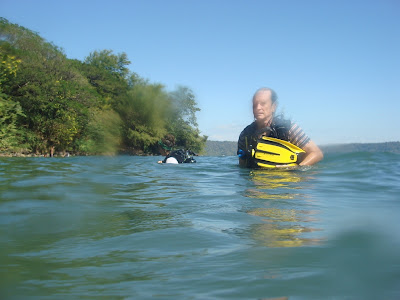
After a scuba dive in Laguna de Apoyo, the clearest lake in Nicaragua. Photo by Martin Cabrera.
Lake Apoyo is the easiest of all locations for scuba diving in Nicaragua. We are located only one hour from downtown Managua. Estacion Biologica collects data at four sites in Laguna de Apoyo, all have easy reach from the shore, and great views below. We enter our study areas from the shore, along property managed by Estacion Biologica.
Life is good after a dive. Photo by Martin Cabrera.
One vital reason for our monitoring program is the bigmouth sleeper, Gobiomorus dormitor. This fish looks a lot like a goby, only much larger as an adult. This voracious predator sits quietly on the lake bottom, where it awaits an injudicious move by any appropriately sized fish, when it strikes with lightning speed. The fish of Lake Apoyo spent thousands of years without the threat of bigmouth sleepers or anything similar, so they are now evolutionarily naive to the grave threats this fish presents.
The Bigmouth Sleeper (Gobiomorus dormitor) is a dangerous predator. It was introduced into Lake Apoyo in 1991. Photo by Martin Cabrera. 
Bright blotches, usually randomly placed, are not exactly uncommon among fish. These colors are usually caused by a specific mutation, such as in the goldfish, which is simply a selectively bred variant of a wild carp. Midas cichlids have a similarly brightly colored variation in the wild, although the "golds" are much more common in some locations than in others. Lake Apoyo, for instance, is considered to have no gold forms. Nonetheless, as the photo below demonstrates, gold forms may also be found in Lake Apoyo.
Gold form Midas cichlids are relatively common in some lakes, but not in Lake Apoyo. Fish such as the one in this photo are exceedingly rare. Photo by Martin Cabrera. 
Which gene(s) control the gold color form in the Midas cichlids is not known. Nor does anyone understand why Lake Apoyo has so few golds. In comparison to most other natural habitats of the Midas cichlids, Lake Apoyo has far fewer golds.
Some Midas cichlids show 
This clownish coloration is quite common among Midas cichlids in Lake Managua, some parts of Lake Nicaragua, and other volcanic crater lakes such as Lake Masaya and Lake Xiloa. Why is it so rare in Lake Apoyo? We don't know.
Amphilophus in Lake Apoyo, Nicaragua
This breeding, gold form Midas cichlid stays near the nesting hole. Photo by Martin Cabrera.
Midas cichlids are territorial when nesting. A breeding pair will occupy a natural or constructed hole, often at the base of rocks, in which a hard, flat, usually vertical surface can be utilized to adhere eggs. The pair will defend the site vigorously against predators and usurpers.
The gold-normal breeding pair linger near the nesting cavity. Photo by Martin Cabrera. 
The great majority of Midas cichlid nests do not result in the eventual creation of new adults. Hundreds of eggs are produced in each spawning, but very few fry will reach the age to swim away from the parental units and begin life independently of them.
The Bigmouth Sleeper has occupied Lake Apoyo only two decades, but is now very common. Photo by Martin Cabrera.
The newest reason for the demise of nests in Lake Apoyo, the bigmouth sleeper, has become very common in the lake. Some of the Midas cichlid species of Lake Apoyo are so rare that the bigmouth sleeper could even make the species disappear. Who would even know if a fish species in Lake Apoyo went extinct?
Filamentous algae forms a carpet on the lake bottom where Chara macroalgae was once abundant, placing much of the life in the lake at risk. Photo by Martin Cabrera. 
The bigmouth sleeper has a neutrally colored, mottled pattern along its sides and back, making its detection difficult. It sits on the bottom, awaiting a false move by some other fish. It strikes rapidly, with the intention to sink its long, fine teeth into the prey and then gradually move the prey into the mouth to swallow it.
bigmouth sleeper
A Bigmouth Sleeper (Gobiomorus dormitor) pair in courtship in Laguna de Apoyo. Photo by Martin Cabrera. 
The success of bigmouth sleeper (Gobiomorus dormitor) during the two decades of its time in Lake Apoyo is startling. They are extremely common. Recent research conducted by Topi Lehtonen and the research team at FUNDECI/GAIA demonstrated that the Midas cichlids of Lake Apoyo do not recognize the threat these fish present to their fry.
Amphilophus fry
These Midas cichlid fry must share their nest space with garbage left by humans. Photo by Martin Cabrera.
Lake Apoyo's fish species are facing several threats from humans. Soil introduction into the lake is higher than ever, coming from constructions in the watershed. Predation and loss of habitat by introduced species have done lots of damage to the species found here. And of course, garbage follows humans everywhere we go. The fish of Lake Apoyo have no choice but to utilize garbage-filled areas of the lake to feed and reproduce.
dive Nicaragua
Juvenile Amphilophus cichlids in Lake Apoyo, Nicaragua. Photo by Martin Cabrera. 
Lots of juvenile Midas cichlids are present year-round in Lake Apoyo. By diving during the different seasons, one can see the smaller fish grow and, by the end of about a year, start their first anniversary as members of the next breeding stock. The intense uses (and misuses) of Lake Apoyo by human beings requires that we assure adequate habitat for these fishes in all their life stages.
blind Amphilophus
A blind Amphilophus astorquii in Lake Apoyo, Nicaragua. Photo by Martin Cabrera.
To date, six species of the Midas cichlid species complex have been described in Lake Apoyo. All of them are only found in this lake. There are eight volcanic crater lakes such as Lake Apoyo, near the Nicaraguan Great Lakes, which have multiple species of Midas cichlids in them. What was once thought to be only one or a few species is now considered to be dozens of species, with very small ranges, and in some cases, populations of only a few thousands of adults. One of those species with a very small population is the chancho cichlid, Amphilophus chancho. It is the largest of the Midas cichlid species complex found in Lake Apoyo, with males sometimes reaching well over a kilogram weight.
Amphilophus chancho nest
Amphilophus chancho defending fry in a nesting hole in Lake Apoyo. Photo by Martin Cabrera. 
Child-rearing is an expensive venture for most species. It is especially so for the Midas cichlid species of Lake Apoyo, too. Providing care for the fry means eating less and lower quality food. It also means getting in harm's way. The parental units must confront potential predators and utilize displays, threats, and if nothing else works, direct attacks to drive away the fish and crabs that would want to eat the fry. Adults often look emaciated and battered at the end of the breeding season.
Amphilophus fishes near a hole beneath a rock in Lake Apoyo, Nicaragua. Photo by Martin Cabrera.
A scuba dive with the staff at FUNDECI/GAIA usually means seeing most of the six species of the Midas cichlid species complex, perhaps about five hundred individuals in total. Occasionally, we get to see jaguar cichlids (Parachromis managuensis) up close, while nesting. It also means seeing the ubiquitous bigmouth sleeper, lots of them, perhaps upward of a hundred individuals in a single dive. Other fish, crabs, and the dramatic undwater views round out most dives. Some of the dives take you to thermal vents, where clear, warm water flows from between rocks into the lake. And especially during the appropriate season (November through February), lots of fry in nests!
An adult bigmouth sleeper uses a hole beneath a rock as a hiding spot, from which to hunt. Photo by Martin Cabrera.
Diving in Lake Apoyo is different than in the ocean and generally much easier. No currents, waves, poisonous animals produce dangers here. The dives are rewarding and especially so when contemplating the rarity of some of the fishes, to which our divers contribute to study and protect them. Please contact us if you would like to dive with us in Lake Apoyo.
Parachromis managuensis
Jaguar cichlid (Parachromis managuensis) fry are feeding in open water outside their nest cavity in Lake Apoyo, Nicaragua. A small clump of Chara vegetation can be seen in the lower left. 
dive Lake Apoyo
Click on the "escudo" to contact us.

Monday, February 4, 2013

Jaguar cichlid in Laguna de Apoyo, Nicaragua

-->
Many cichlid fish species evolved in the Nicaraguan Great Lakes system. Among the more popular of the fish of this region are the guapotes, fish of the genus Parachromis. Guapotes can make a very nice fish dinner. The most abundant of the guapotes in the San Juan River and the Nicaraguan Great Lakes is the Jaguar cichlid, Parachromis managuensis. In Nicaragua, it is known as the guapote barcino, in reference to its checkerboard spotted pattern. Along with several species from the Midas cichlid species complex, the Jaguar cichlid make nests in which parental care observations can be made easily during SCUBA diving.
All the mating cichlids native to Nicaragua protect their young for several weeks after hatching. The guapotes have some important structural advantages to parental care over the more common Midas cichlids found in their range. First of all, the guapotes are large, and therefore can sustain large egg loads. It is not uncommon to see over 2000 fry at Jaguar cichlid nest. Secondly, the guapotes all have large mouths adapted to capture fast-swimming fishes. A bite of the Jaguar cichlid could be fatal even to a medium-sized fish. Potential predators know this and tend to avoid the risk of a bad bite.
These hatchling Jaguar cichlids are less than a week old. They stay near the parental units within reach of a natural or dug cave, and they receive parental care up to about 60 days after hatching. Photo by Martin Cabrera. 
Along with several bird species, the Jaguar cichlid sits atop the food web in Lake Apoyo, Nicaragua. It is the only fish in the lake that can kill and consume up to medium-size fish. Adult Jaguar cichlids only eat fish and perhaps crabs.
Hatchling P. managuensis are prone to move toward the diver, a camera, a hand. Photo by Martin Cabrera.
Male Jaguar cichlids differ morphologically from females in its upturned mouth and other aspects of head shape. Like all the other cichlids native to Nicaragua, the males in breeding pairs always exceed the females in size.
This female Jaguar cichlid is never far from her free-swimming fry. Photo by Martin Cabrera.
All cichlid nests can be fascinating, and the Jaguar cichlids are not unique in this respect. Parents may move little in defense of their fry, but they usually don't have to do much, to get the point across to potential predators.
Most cichlids in Nicaragua utilize natural features such as caves and holes to defend their offspring. This Jaguar cichlid is watching her fry just outside of this crevice. Photo by Martin Cabrera.
Breeding seasonality of the Jaguar cichlid is not as strong as in the Midas cichlids in Lake Apoyo. Whereas the Midas cichlids may reproduce in only two to four months during the year, the Jaguar cichlid is found in reproduction most of the year.
A female Jaguar cichlid (P. managuensis) in her nesting site. Photo by Martin Cabrera.
All cichlid fishes in Nicaragua provide extensive parental care to their fry for the first several weeks after they hatch. There is fierce competition among the Jaguar cichlids for high-quality breeding sites such as this one in our photographs. This site is actually a cave under a large rock, with openings on both ends. The male parent of this nest has little or no continued relation with the nest, however. Big male P. managuensis are scarce, and the males tend to abandon nests earlier than the female, in contrast with many other Nicaraguan cichlids. Big males are easily harpooned when on nest, and unscrupulous SCUBA divers often harvest this fish, as a trophy and for a great meal.
This female is emaciated from the physical stress and reduced food intake associated with reproduction. Photo by Martin Cabrera.
Fry feed on detritus and phytoplankton/zooplankton. They stay close to their fellow fry at all times, depending on the maxim safety in numbers. Among the most dangerous predators of cichlid fry are the Bigmouth Sleepers (Gobiomorus dormitor), introduced into Lake Apoyo only 22 years ago. Both adults and juveniles can catch cichlid fry, especially when a single fish has separated from the group. Fry face a much greater risk of capture when separated from their siblings.
Mother P. managuensis and her fry in Lake Apoyo, Nicaragua. Photo by Martin Cabrera.
We at FUNDECI/GAIA are working to determine the population structure of the fishes, plants and other life in Lake Apoyo, Nicaragua. This delicate lake is under tremendous pressure from people who want to do things that affect the lake: fish unsustainably, cultivate agricultural products using agrochemicals, build houses and install grassy gardens which use copious quantities of water and leave pollution in the lake. With a population baseline, we can determine variations in populations of the different fishes and plants which may result from human-induced alterations in the lake.
Parachromis managuensis
This female guapote barcino tends to thousands of fry. Photo by Martin Cabrera.
Click on the "escudo" to contact us.