Showing posts with label animal rescue. Show all posts

Saturday, August 26, 2017

Rescate Animal XXVI: Yuyu, la Cuyusa

El ser humano es igualmente capaz de hechos heroicos como de cobardías. Así fue algún hechor que dejó un animal silvestre indefenso, dado por muerto, en el bosque de la Reserva Natural Laguna de Apoyo.

El cuyuso, de nombre científico Potos flavus, es un animal que no ataca ni al ser humano, ni a animales pequeños. Es nocturno y se alimenta principalmente de frutas, sin tener que bajarse a la tierra de los árboles. Por sus hábitos, es poco visto y mucha gente que vive en el campo no reconoce que la existencia del animal en el bosque cercano.

Yuyu disfruta de un banano mientras sea admirada. Foto Jeffrey McCrary.
Yuyu es una cuyusa, una hembra adulta, que vivía en los bosques de la Reserva Natural Laguna de Apoyo. Una mañana, ella fue encontrada por trabajadores en un hotel en la zona, en estado de salud grave. Fue víctima de una garroteada. Porque no hubo testigos, no sabemos quién fue el culpable, y solo podemos suponer sus motivos. Solo sabemos que el pobre animal agonizaba, incapaz de caminar. Los guardaparques del MARENA nos encomendó el animal.

Potos flavus
En su primer día después de ser encontrada herida, Yuyu es triste y en agonía. Foto Jeffrey McCrary.
La cuyusa llegó con varias heridas. La más serias fue de una pata desgarrada en la articulación de la rodilla. Los huesos de la pata se encontraron expuestos en una herida abierta, y la pata quedó inútil. Su ojo derecho se encontraba totalmente cerrado por el hinchazón alrededor. La mejilla debajo del ojo derecho sufrió una cortadura profunda y de más de dos centímetros de largo. El ojo derecho también se encontró golpeado.

rescate animal
Aunque se encuentra gravemente herida, Yuyu goza de un mango bien maduro. Se nota el ojo derecho en mal estado, la mejilla derecha con una laceración y el ojo izquierdo opacado. Foto Andras Dorgai.
Pensábamos que Yuyu iba a morir pronto. Se encontraba muy mal, muy triste. Pero cuando le ofrecimos comida, ella la devoraba con enormes ganas. Estuvo en agonía, con dolores fuertes, y sujeto a condiciones que nunca hubiera aceptado si pudiera escapar. Nosotros estábamos tristes por ella, y vimos que ella manifestaba grandes deseos de vivir.

rescate animal
En evidente agonía y con una pata desgarrada, la cuyusa demostraba sentirse dolores fuertes. Foto Andras Dorgai.
Convencimos a algunos veterinarios que valía la pena darle una oportunidad, aunque fuera evidente que ella iba a enfrentar a otro mundo, si bien pudiera curarse en salud después de las cirugías necesarias para salvarle la vida. Nosotros en GAIA asumimos el compromiso de cuidarla y asegurar una vida que valga la pena para ella, aunque todavía no sabíamos qué implicaba. Los veterinarios generosamente regalaron a Yuyu tres cirugías necesarias para salvarle la vida, quitándole un ojo, limpiando y cerrando la herida abierta de su mejía, y amputándole su pata desgarrada. Es mucho que hacer a cualquier animal, y más aún a un animal silvestre.

Después de tres cirugías regaladas por los ángeles de World Vets en Granada, Yuyu parecía otro animal. Qué felicidad! Foto Andras Dorgai.


Yuyu regresó de World Vets adormecida, y pronto estuvo despierta y hasta con hambre. Pronto se estuvo moviendo. Su comportamiento reflejaba una diferencia de inmediato, de mayor nivel de identificación con los seres humanos a quiénes ella tuvo que permitir estar cerca a ella. Y, más importante, ella manifestaba evidente gozo, alegría, y curiosidad. Se dormía de día, despertándose solo para comer cuando se le traía fruta, pero de noche, comenzaba conocer a toda su jaula espaciosa. Resultó, tristemente, que su solo ojo remanente tampoco funcionaba; el color opaco no se quitó, evidentemente por daños severos, dejándola totalmente ciega. Pero si, encontraba chispas de alegrí en su vida, tan lejos de la que dejó atrás unas semanas antes.

Yuyu es y seguirá siendo un animal silvestre. Por las cosas de la vida, es obligada a depender a los seres humanos, ya que es totalmente ciega. Foto Jeffrey McCrary.
La calamidad que cayó a Yuyu le quitó todo de lo que era su vida de antes. No puede caminar por los árboles nunca más. No puede buscar una pareja, ni procrear en la forma que su especie suele hacerlo. No puede vivir y morir en el bosque como era su derecho y deber, siendo un animal silvestre. Ese día en marzo del 2017, cuando fue atacada por una persona con malas intenciones, ella dejó su vida en el bosque. Ahora, tiene otra. Es embajadora para su especie y para el bosque, contra el maltrato y el tráfico en animales silvestres.


Yuyu la cuyusa disfruta de su encierre de madera, donado por un voluntario. Ella siempre está a la orden para visitas, especialmente si el visitante trae regalías de fruta. Todos están invitados a visitarle y traerle bananos, sandía, melón, u otra fruta.

Todos están invitados a visitar a la Estación Biológica Laguna de Apoyo, y conocer a Yuyu. Ella es enamorada de las frutas nativas del bosque-nancite, jobo, jocote, aceituna-y también come de frutas introducidas, como el melón, sandía, banano, y mango. Yuyu siempre quiere recibir visitantes, y también quiere el contacto de algunos voluntarios que ayuden a limpiar su jaula, velar por ella, y darle a comer. Quieres ser voluntario eco-guerrero?  Contáctanos para saber cómo puedes ayudar.

Saturday, August 12, 2017

Rescate Animal XXV: La Ardilla Centroamericana


Durante varios años, hemos estado ayudando a rescatar animales silvestres cuando sea necesario. Nuestra contribución de GAIA a la vida silvestre en Nicaragua, a través del rescate, rehabilitación, y liberación de animales, siempre ha sido pequeña, sin embargo, ha crecido notablemente recientemente. La diferencia mas notable que ha marcado los últimos años es que la conciencia de las personas que tienen animales silvestres como mascotas se ha ido levantando. Cada día hay mas gente en Nicaragua que reconoce que un animal silvestre debe vivir y morir en su hábitat natural, no en una jaula.

El hecho de que lleguen animales, o de que llamen o escriban personas preocupadas que quieren reportar a un animal, o que quieren entregar un animal, que quieren apuntarse como voluntarios en el trabajo de cuidar a los animales o donar para que hayan condiciones y alimento para ellos, es en si, una manifestación de la conscientización que se esta dando entre la gente por encontrarse con la posibilidad de que los animales silvestres tengan su segunda oportunidad de vivir libres, una vez capturados.

A esta ardilla le encanta el banano! Foto Jeffrey McCrary.

Recientemente, una joven nos escribió, porque había comprado una ardilla centroamericana (Sciurus variegatoides), la cuidó como suya, la trató muy bien, hasta dormía con ella. Pero con el tiempo, la joven reconoció que la ardilla no es un animal domesticado. Una ardilla debe vivir y morir entre los árboles, haciendo lo que hacen las ardillas y no obligada a vivir como el ser humano dicta.


La ardilla centroamericana (Sciurus variegatoides) es común en la región del Pacífico en Nicaragua. Foto Jeffrey McCrary.
Igual como en otras ocasiones, la ardilla presentaba una gran aficion al ser humano. Se dejaba tocar, llevar, y hasta dormia encima de las personas. Cuando la trajimos a la Estacion Biologica Laguna de Apoyo, ella fue cargada por dos adolescentes voluntarios. Comia traquilamente cuando estaba en casa, pero al ver a los arboles y el gran verdor del bosque, se ponia inquieta.

La ardillita come mientras es observada. Foto Jeffrey McCrary.
Ya sabia la ardilla que los arboles se encuentran en su ADN. No se satisfacía con la atención de las personas. Se quiso ir, y pronto, se fue! 

La ardilla socializaba fácilmente con los jóvenes voluntarios en la Estación Biológica Laguna de Apoyo. Foto Jeffrey McCrary.
Esta ardilla, igual como muchas otras, se fue. Tres dias despues, fue vista, jugando con una ardilla grande, señalando que ya esta bien, fue aceptada entre las muchas ardillas que viven arriba de la Estación Biológica. Esperamos que tenga larga vida, y lo mas importante, que viva segun su naturaleza, que sea corta o larga. Hasta siempre, amiga.


Durante el 2017, muchas ardillas han sido traídas a la Estación Biológica, para su rehabilitación y regreso al bosque para que viva y muera libre. En el vídeo abajo, hay algunas mas ardillas que vinieron para ser liberadas.


Si deseas ayudar a cuidar a la naturaleza, escríbenos y dinos como puedes participar. Estamos siempre a la orden para cualquier comentario. Échanos una mano y trabajemos juntos para cuidar la vida silvestre en Nicaragua. 

Oprime el escudo para contactarnos.

Saturday, July 1, 2017

Animal Rescue XXIII: Variegated Squirrels

Some wild animals can be cute, at least at a distance, under controlled conditions, or perhaps just when they are juveniles. Most wild animals, however, demonstrate at some moment that they are wild by acting aggressively, or by feeling depressed or stressed in conditions of confinement. The cuteness and uniqueness of an exotic animal can seduce the most logical of people into thinking that they can provide adequate conditions to a wild animal so that it will actually be happy and willing to act like a domesticated animal, by showing attachment, obeying commands, and generally acting in a safe manner.

An entire genre of movies has recently emerged, showing wild animals acting in human-like ways, sometimes in Happy Feet-style fantasies. A common theme among them is the connection between humans and the animals. The wildness of the animals is almost always conquered by the goodness of people.

The best term for this sentiment is hubris.

One of several variegated squirrels taken from the pet trade and brought to Estacion Biologica Laguna de Apoyo to transition back to the wild. Photo Andras Dorgai. 

This hubris is multiplied when a poor animal is placed for sale at a street light in Managua. So often, we see wild animals such as parrots, toucans, monkeys and even an occasional feline for sale, all bidding to enchant someone enough to plop down a little money and take the animal home to convert it into a family pet.

Purchasing wild animals as pets presents a terrible threat to the populations of animals in the wild. Captures of wild animals for use as pets have decimated the populations of animals such as Scarlet Macaw and the white-faced capuchin monkey in almost all areas throughout the country.

Once wild animals have been made into pets, they may face a difficult transition back into the wild. Photo Jeffrey McCrary.
But the impacts humans have over wild animals because of the pet trade does not stop with the placement of animals who were once wild into cages and forcing them to live in captivity. The habitats where these animals lived is often ravaged to get the animals out. Fire is an effective hunting technique, driving animals from holes in the ground or in large trees. These sites as effective refugia for wild animals are lost, and often, the fires rage onward because the hunters rarely make special efforts to put out the fires they started.

Juvenile squirrels sleep as much as twenty hours per day, in confined spaces in nests, which can be imitated by a bundle of cloths. Photo Jeffrey McCrary.
We do get a particular pleasure from the rehabilitation of variegated squirrels (Sciurus variegatoides). Baby squirrels are often captured by animal traffickers by knocking down nests from the tops of trees, and picking up the baby squirrels that survive the fall. The adults, strong and hostile with sharp teeth, are much less interesting as potential pets than the docile and dependent babies. Once in our hands, they must be handled to give the animals the social interactions they need and to assure that they are feeding well and getting sufficient stimulation and exercise.

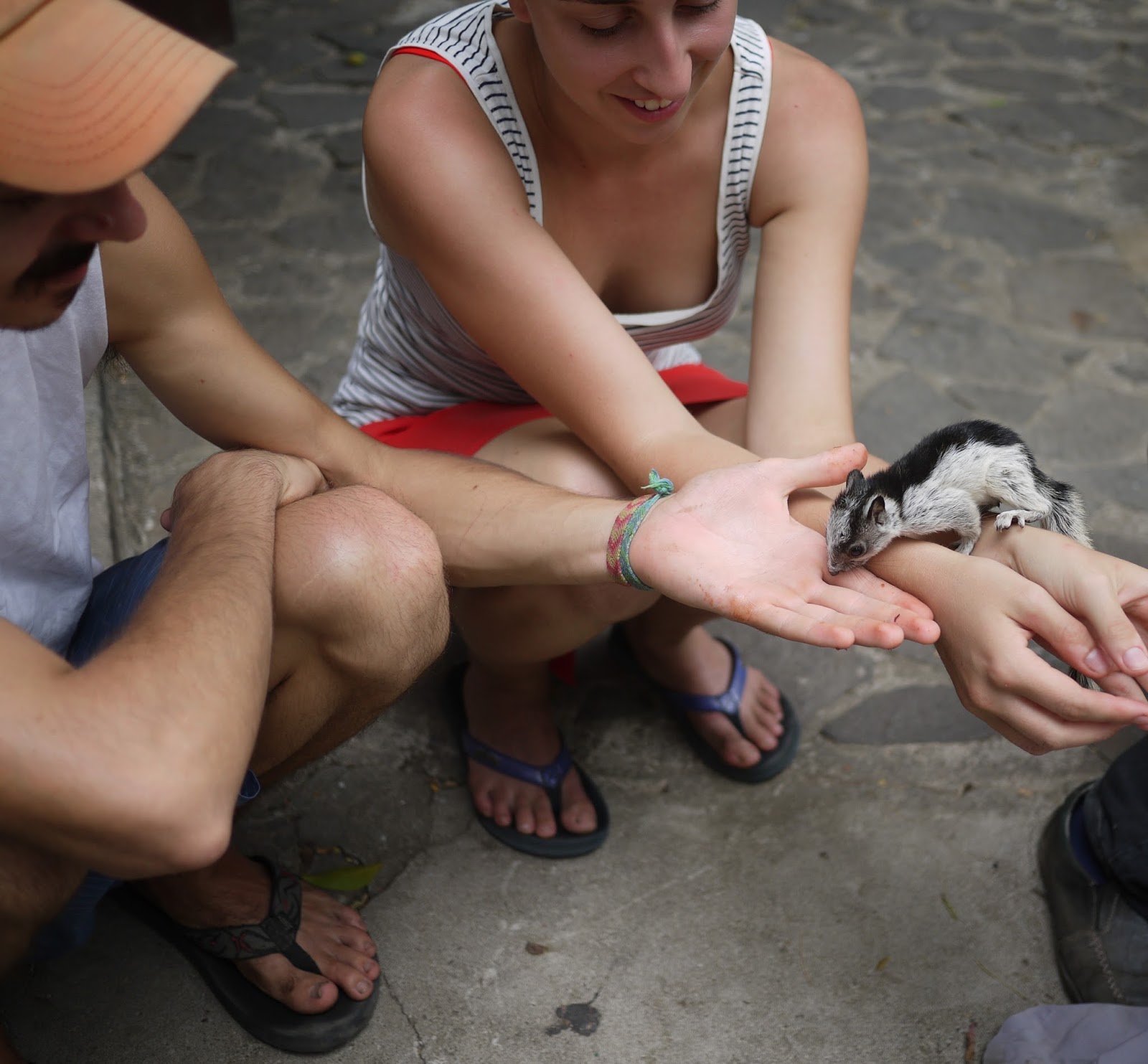
Squirrels adapted to humans may even prefer to climb on them over scaling trees. Photo Jeffrey McCrary.

Little by little, squirrels can be reacquainted with their natural habitats. This species of squirrel rarely comes to the ground, finding plenty of bark, small insects and other fauna, fruits and nuts, year-round, high in trees. By coming and going from the security of a well-equipped cage, with a door open, the squirrels can choose to sleep, play, feed, and so on, all through the day. Juvenile squirrels can develop their interest in these foods and habitats little by little, until they may lose their interest in humans entirely.

Whenever safe to do so, juvenile squirrels are allowed to enter and leave their cage at will, so they can get exercise, explore, and socialize with wild squirrels nearby. Photo Jeffrey McCrary.
Whenever squirrels or other wildlife have lost their fear of humans, the dangers they face are abundant. First, they may wander into the hands of people who will capture them all over again and carry them back into the pet trade. Second, they face dangers from domestic animals, cars, and even the risk of being stepped upon can be high. Third, pets may also carry viruses that can affect them.

Squirrels quickly learn whose hand does the feeding. Photo Jeffrey McCrary.
Once a squirrel has become accustomed to humans, it must learn to find food, socialize with wild squirrels, and stay away from danger. Perhaps the single most difficult barrier to returning to the wild, however, is to have a shelter in which to sleep. Young squirrels may make a shelter on their own, without the help of other squirrels, or they may be allowed to enter into the nests made by other squirrels.

Even though Laguna de Apoyo Nature Reserve is a protected area with priority given to native species, cats abound in properties controlled by foreigners. This squirrel, once free and living in the trees above us, was caught by a cat from The Peace Project, and did not survive its wounds. Photo Jeffrey McCrary.

Sometimes, a wild animal is successfully reintroduced into the wild. Squirrels will sometimes survive, and their wild character may return, and they may reintegrate into the community of squirrels in the area. When this happens we are always grateful for all the efforts of so many people who participated in bringing food, spending time to provide care, clean cages, and even provide logistics. Each successful reintroduction into the wild results as the culmination of the efforts of many people.

Socialization from humans may substitute for the relationships lost from the members of their species for social animals such as squirrels. Eventually, however, they must develop relationships with their own species in the wild setting, to prosper in the wild. Photo Jeffrey McCrary.

These squirrels are beginning to learn to spend their days foraging in trees. They are still returning each night to sleep in their cage. Photo Jeffrey McCrary.

Variegated squirrels may lose their fear of humans after being caught, so that they may actually prefer to be with people to spending their days in the trees. But little by little, with encouragement, they learn skills for feeding and socialization in their arboreal environment, eventually to never return. Photo Jeffrey McCrary.

Would you like to help us rescue and rehabilitate wild animals in Nicaragua? Please contact us to find out how you can help by donating food, a cage, or by giving your time as a volunteer.

Click on the "escudo" to contact us.

Sunday, April 9, 2017

Donations to Gaia

We at GAIA feel honored when people want to donate their time, money or materials to help us in our objectives to protect the wild natural resources of Nicaragua. Some people help with our activities as Eco-Warrior Environmental Volunteers, conducting lots of tasks that are important to nature such as reforestation, maintenance, and assistance with wild animal rescue. We love to share our time and efforts with people who share our opinions about the importance of protecting wild nature.

Not everyone can give a block of time to a project such as reforestation. Some people prefer to help by making a small financial donation, or provide some of the materials that are required for our operations, such as foods for animals and containers for planting trees. We want to express our gratitude to the many people who have given small, or sometimes, not so small, material or financial donations to help us do what we do. A few such donations received during the most recent days are mentioned below.

Seeds were donated by the owners of Apoyo Lodge-thank you!
The great folks at Apoyo Lodge dropped by to share with us and they shared their wealth by donating sunflower seeds. It is worth noting that Apoyo Lodge has changed hands, and the new proprietors are particularly kind and conscientious, as is evidenced by their donation of sunflower seeds for the benefit important nutrients.  Our rescue macaw has a flexible diet but, like all parrots, requires certain components, among them, seeds which carry certain small-scale nutrients that this bird may not obtain from the other foods in its daily diet in captivity.

The kinds veterinarians at WorldVets donated a surgery for Juju the kinkajou, and some juicy fruits which were readily devoured. 
Steve and the team from WorldVets donated a costly treatment of surgeries to Juju, a wild kinkajou that was found badly beaten in Laguna de Apoyo Nature Reserve. The animal was given a chance to live by these operations, which included the removal of a foot and an eye, and closure of an open wound on one cheek. The team dropped in a couple of times to see Juju, and they brought the animal some fruit. From all appearances, watermelon ranks highly in the list of preferred foods for a kinkajou. We often receive severely injured wildlife, and sometimes the success of seeing them heal is worth it all!

wildlife
Juju the kinkajou likes watermelon. Photo Andras Dorgai. 

There are lots of options for a visit to Laguna de Apoyo these days. The people who visit us often want to be involved in some way in doing something good for the environment. Part of keeping the environment safe for wild nature is patrolling to reduce vandalism, hunting, other bad things that harm the public good. We at Gaia support the local institutions in the ways we can. We had noticed the local patrol motorcycle for the police department was using a completely treadless tire, worn dangerously bald from overuse. Mark Connell, a student of Apoyo Spanish School, took note of our concern and provided a cash donation which covered most of the cost of the tire.

We compared prices and models and acquired the best fit for the job, and made an official delivery to the police representative. Now he can participate in hot pursuit safely!

animal rescue
Our local police representative in Laguna de Apoyo desperately needed a new front tire for his patrol motorcycle, which was donated by Mark Connell and funds from Gaia. Here, Juan Carlos presents the new tire along with Pablo and Mileidy from Gaia. Photo Jeffrey McCrary.
The next time we saw him pass by on the motorcycle, we stopped to ask about the tire, and sure enough, he had already had it mounted on the bike.

gaia
Our local police motorcycle now sports a fully new front tire! Photo Jeffrey McCrary.
We don't have any large bank accounts to fund projects without some sort of financing, which is a cruel reality for most not-for-profits that are really doing things of benefit to our society. We depend on contributions from our allies and friends. Sometimes, the contributions are small, but really, no contribution is ever to small. Every penny can be put to use in the protection of wild nature in Nicaragua. Missie and Stephen Lavergne recently gave us two (yes, two!) animal transporters-not exactly a small contribution. The transporters are in nearly-new condition and capable of handling animals of different sizes. Who said Christmas doesn't come in April? It will now be more feasible to transport animals-both wildlife and pets such as Lassie.

wildlife
Lassie tries our our new large-animal transporter, donated by Missy and Stephen Lavergne. Photo Jeffrey McCrary.
wildlife
The smaller animal transporter donated generously by Stephen and Missy Lavergne is just right for small and medium-sized animals. Thank you! Photo Andras Dorgai.

gaia
Lassie, our newest pet addition, was rescued from the street in Managua. For the next long trip, she now has some very comfortable conditions for traveling. Photo Andras Dorgai.
Andras Dorgai has been learning Spanish and helping as an Eco-Warrior Environmental Volunteer. Not only has he provided lots of great help, he also donated a bag of walnuts to the animals. Anyone who has been in Nicaragua knows that they can be very expensive and the cost can seem even more prohibitive when contrasting to the incomes found in Nicaragua. It is not easy for us to keep the animals fed with high-quality foods that meet their special, nutritional needs without donations. Midorna, our rescue Scarlet Macaw, needs nuts as part of her diet, so she is getting a small quantity daily.

animal rescue
Dorgai is passing a walnut to Midorna, part of their daily ritual. Photo Jeffrey McCrary.
Lots of others have donated items and cash recently, particularly in support of our studies of the wild natural resources in the area. The examples mentioned here are presented to demonstrate the diversity of ways to help available. We want to thank everyone who has made a donation. If you would like to donate to Gaia, please click on the "escudo" below or just come by Estacion Biologica Laguna de Apoyo any time!

Gaia
Click on the "escudo" to contact us.

Sunday, April 2, 2017

Animal Rescue XXI: Jamaican Fruit Bat

Bats give most people a creepy feeling when they intrude into a certain safe-space that people have just for animals that could cause irreparable harm. Seeing bats up in the sky is generally acceptable, because most people have come to terms with bats being "up there" and doing the things bats do, for as long as anyone can remember. But bats in the house, for instance, provoke a concern that comes from the subconscious, that is not easily controlled. Not even great admiration for Batman can dissolve the uneasiness they provoke.

Seeing a bat up close in a safe, controlled situation, however, usually works to endear people to them. Bats, after all, have faces, and they are small, and most of them, we know consciously, don't drink the blood of unfortunate humans. Most bats fall into one or another of three categories of diet: fruit, insects, and nectar. All of those bats provide tremendous environmental services that make our natural world work better. They keep down pesky insects, disperse seeds, and fertilize flowers.

We were recently blessed with a project - a juvenile Jamaican Fruit Bat (Artibeus jamaicensis), not fully grown, that was found on the ground and would not fly. It would, however, drink and chew fruits. We at Gaia decided we would take on the project to rescue and try to bring the bat back to a healthy animal, if there was something we could do.

Artibeus jamaicensis
This little guy did not want to fly, but readily drank milk. Photo Jeffrey McCrary

The bat was still not nearly fully grown. As a mammal, it thoroughly enjoyed drinking milk, and it would suck on watermelon and other juicy fruits. We gave it plenty of food, at intervals of less than two hours over a ten-day period.

Artibeus jamaicensis
Eco-Warrior Volunteers diligently cared for the baby bat, feeding and cleaning the animal at frequent intervals. Photo Jeffrey McCrary. 

Our Eco-Warrior Enviromental Volunteers were enthusiastic about the animal. The baby bat had all the expected basic, biological functions, but did not grow or get stronger, and eventually succumbed. Meanwhile, we learned a few things.

animal rescue
The bat readily sucked milk out of a cloth, but paper was more easily extracted from his mouth after a feeding. Photo Jeffrey McCrary.

The first thing we learned, is that a bat is capable of responding positively to human attention and comfort. This little animal evidently enjoyed the attention and drank surprisingly large quantities at times. This all made us feel that the effort was not in vain. The bat did not live long, but it was not suffering and it even seemed to enjoy its life at moments.

Eco-Warrior Enviromental Volunteers
Another feeding session with the baby bat. Photo Jeffrey McCrary.
We also learned that we can try to do things that may not always succeed. Success is to often defined by the absence of failure. Even though we did not see the bat grow to an independent creature and fly away to live in the wild, we learned and gave, and this one bat also gained a benefit, by living comfortably a few more days. So, we are happy.

The attempted rescue of this little animal also gave us the opportunity to share with others the story of bats as beneficial creatures. Not all animals we rescue survive to return to the wild, but we try to give them all a chance to live and, if it happens, to die with dignity, especially those animals affected by humans. Some, but not all the stories of wild animal rescue are positive, and some are downright tragic. All of us know, sadly, that the antagonistic relationship that humans sustain with wildlife requires new ways to engage people. We hope that this story reaches people who have not considered what happens to wildlife in the vicinity of humans. This little bat has gone on, but here, the story of this animal continues to reach people who may begin to consider that much of the harsh treatment toward wildlife is unnecessary and even counterproductive. Our staff, visitors, local neighbors and volunteers, and now, our readers can consider that even animals such as this little bat deserve both life and death with dignity.

A bat adorns the wall in Laguna de Apoyo. Photo Pablo Somarriba.

We are engaged in different types of activities at Gaia, not only wild animal rescue. Please read through our blog and visit us, to discuss with us the ways we can protect wild natural resources in Nicaragua. We hope you are engaged, too. If you would like to help us with cages, food, time, or money, to provide care for wild animals in distress, we would be grateful. Please contact us or drop by at Estación Biológica in Laguna de Apoyo Nature Reserve, any time.


Artibeus jamaicensis
Click on the "escudo" to contact us.

Animal rescue XX: Kinkajou (honey bear)

Animal rescue
The kinkajou is much more inclined to walk upright, after surgery. Thanks to the team of veterinarians who donated their time and resources to this animal. Photo by Jeffrey McCrary.

For some people, seeing wildlife in its natural habitat is a marvel that should be cherished. Unfortunately, we as humans have been conditioned to react to the sight of a wild animal by trying to kill it. The urge to manifest one's dominance over weaker individuals can be seen all too often where wild animals and humans meet. Far too often, when some wild animal appears near people, someone takes it upon himself to try to cause the animal pain or death.

This scenario recently occurred in Laguna de Apoyo Nature Reserve, resulting in a wounded wild animal of a species not often seen. A kinkajou (Potos flavus) was recently brought to us at Estación Biológica by the park guards in Laguna de Apoyo Nature Reserve. The animal had been severely injured, with deep cuts and abrasions to the face, both eyes badly damaged, and one paw almost completely severed. We placed it into a cage where it rested and soon arose to the smell of fruit. The animal devoured an entire banana and part of a watermelon, then went back into a trance.

kinkajou
A wounded kinkajou was recently found in Laguna de Apoyo Nature Reserve. Photo Jeffrey McCrary
The injuries that the animal suffered could not have been given by another wild animal; some person or persons who meant the animal harm. His face had been struck with a hard object, perhaps a rock. A leg was nearly severed. The animal was blinded and lame, with deep wounds on the face and leg. Nonetheless, the animal was hungry and strong when it arrived at Estación Biológica.


We observed the animal for a day, and sought a veterinarian. Soon enough, a veterinarian volunteered the extensive services necessary to give the kinkajou an opportunity to survive. An eye was amputated, as was a foot. A badly infected wound on the cheek was cleaned and closed.


The enormous appetite of the kinkajou was manifested from the day it arrived. In spite of his extensive injuries to his nose and face, its sense of smell would lead him to any fruit placed in the cage. It ate ravenously.


The poor kinkajou was taken to a clinic where kind and caring veterinarians gave it a second chance at life. Without a paw and an eye, it is not clear what quality of life it may have in the future. The animal will be observed to see how it recovers, how much eyesight remains, and what conditions could be provided that will be good for the animal.

kinkajou
Gaia Program Director Jeffrey McCrary gives a banana to the wounded kinkajou, which is eaten quickly. Photo Andras Dorgai. 

The kinkajou (Potus flavus) is also called, in English, honey bear, for its rounded face, solid color, and tendency to eat sweet fruits. The species is found over a wide range in the tropics of the Americas, but is little seen because of its strongly nocturnal and arboreal tendencies. Its prehensile tail and feet make it at home in the trees. The kinkajou is superficially similar to monkeys and even cats, but is a close relative to the raccoon, both in the Family Mustelidae. Its diet is mostly fruit, in spite of long fangs and sharp claws which are used by other members of the same family to hunt. Although not particularly stealthy, its habits make it largely unknown to people who live with them nearby. Even the park guards at Laguna de Apoyo Nature Reserve had never seen a kinkajou before!

We can only speculate on the motivations of the culprits that harmed this poor animal. Perhaps they wanted to make it a pet, given that some famous people today even think having kinkajous as pets is a good thing. Perhaps it was a simple act of savagery, of anger and machismo that was not diluted by any other emotion than to show one's power over a harmless animal. Harming animals in the forest seems to be a pastime for far too many people.

The staff and Eco-Warrior Volunteers at Gaia are caring for it, giving the wounded animal food and cleaning up. We are in need of food-bananas, papayas, watermelon, dog food, beans and rice.... all of which require funding. We also need caregivers to spend there time as volunteers. More enclosures, cages, and even fencing materials are needed. You are welcome to scan through our blog entries to find more animal rescue accounts. Can you donate a small amount of your time or money to help us to care for this animal?

kinkajou
The kinkajou relaxes among the remains of several slices of watermelon after a feast. Photo Jeffrey McCrary.
We at Gaia think that providing a small refuge for wounded or mistreated,wild animals is vital to a protected, natural area. Many animals become injured or in need as a result of conflicts with humans over habitat that is supposedly dedicated for their use. Although the actual number of animals saved is low, they can provide the foundations for conversations and start people on the thought processes that may challenge one's view of nature here.

We need your participation to accomplish this. Please visit us at Estación Biológica Laguna de Apoyo, and meet the kinkajou and other rescue animals that we may helping. We want your support and participation, so please visit us!

kinkajou
Juju, as the kinkajou has been named, devours a banana within moments of sensing its presence. Photo Jeffrey McCrary.

kinkajou
Click on the "escudo" to contact us.

Friday, March 17, 2017

Una nueva mascota en Laguna de Apoyo


mascota


La Estación Biológica Laguna de Apoyo ya es dotada de un animal más. Esta vez, no es un animal silvestre, sino una perra. Lassie, una pitbull viejita que pertenecía a un músico de reggae y calypso de renombre en Managua, fue botada a la calle, por ser vieja, por ya no tener el encanto de ser cachorra, por estar enferma, por depender de una familia sin recursos para pagar el costo de curar sus heridas. Pero la verdad es que Lassie no fue botada a la calle por ninguna de esas razones. Fue botada a la calle por la falta de afecto, de conciencia, por tener el corazón encogido los miembros de la familia que decidió olvidarse de ella.

rescate
Lassie al momento de su rescate en Managua. Foto Lorena. 
Cuando nos dimos cuenta de Lassie, nos hizo pensar que podríamos asumir la responsabilidad de darle cariño, comida y casa el resto de su vida. Estamos acostumbrados a los animales silvestres, pero esta vez adoptamos una perra!

rescate animal
Lassie en su hogar temporal en Managua, después de ser rescatada por los ángeles de la Fundación ADAN. Foto Lorena.
Los voluntarios de la Fundación ADAN se llevó a la perrita Lassie hasta la Laguna de Apoyo, donde nuestro equipo la adoptó. La pobre perra, viejita y enferma, ya en un lugar nuevo, tuvo que ir adaptándose a nuevas personas, y lugar nuevo, y hasta una perrita con quien estaría compartiendo espacio. Poco a poco, iba reconociendo a las personas nuevas en su vida, hasta decidir adueñarse de un pequeño solar con techo, en el patio de la propiedad de la Estación Biológica.

animal
Lassie comiendo en su solar. Foto Julie Comeau.
Rápidamente, Lassie desarrollaba confianza con nosotros. También, ella aprendía del terreno físico, dónde es de ella y dónde no. Ahora, después de pocos días, ella se siente en casa. Su rescate ha sido exitoso!

rescate
Lassie quiere mucho a las personas que manifiestan amor con ella. Foto Julie Comeau.
Esperamos dar mucho a Lassie, amor, comida, salud. Ya sabemos que a nosotros, nos va a dar mucho más que nosotros a ella. Ella fue olvidada por una familia, pero ahora es parte de otra familia que promete a cuidarla y compartir amor con ella. Nuestros voluntarios se dedican a darle cuido y afecto.

Si quieres ayudarnos con alimento o con tu tiempo para nuestros animales silvestres (y domésticos) rescatados, contáctanos! Puedes ayudarnos con el rescate animal!

rescate animal
Haz click en el escudo para contactarnos!