Although we all enjoy watching butterflies in passing, not many people give them much attention. We all know that they pass from caterpillars to flying beauties via a dramatic physical transformation we call metamorphosis. But of the thousands of butterflies and moths (Order
Lepidoptera) found in Nicaragua, much is not known. Only a fraction of the species found in Nicaragua of the moths-those which fly at night-are even documented in Nicaragua, and many species of the butterflies-those that are active in the daytime-have not been documented in the country.
 |
| Several species of Hamadryas genus butterflies are found in Laguna de Apoyo Nature Reserve. Photo Max Schellekens. |
There are hundreds of butterfly species in Laguna de Apoyo Nature Reserve. Researchers at
FUNDECI/GAIA have documented well over 200 diurnal butterfly species so far (see this link for a
publication). One group of butterflies, called the brushfoots (family Nymphalidae), is notable for its tendency to feed on fermented fruit on the forest floor. This ample group is represented in this area by dozens of species. Some of these species are quite numerous during appropriate seasons.
 |
| Una mariposa grande! Photo Max Schellekens. |
The great species richness of this group in Laguna de Apoyo Nature Reserve depends on diversity of vegetation. The larval forms of butterflies are usually limited to only a few species of plants for each species. Many species are very particular about the host plants for their larval forms. Wherever a butterfly species is found, one or more of a small number of potential host plants for the caterpillars of that species must also be found.
 |
| The eyespots on the underside of the wing of Morpho helenor. Photo Max Schellekens |
This means, quite simply, that butterflies can be important indicators of the conservation status of a natural area. Activities such as selective cutting, forest fires, and clearing vegetation from the forest floor may impact some butterfly species by altering the number of potential host plants available. We have been studying the butterflies of the Nymphalidae family with quantitative methods for a few years, with the intention to compare the communities of this group in different areas of the forests with different land use patterns.
 |
| The Malachite (Siproeta stelenes) is quite common in Laguna de Apoyo Nature Reserve. Muy bonita mariposa! Photo Max Schellekens. |
Two interns from Holland, Max Schellekens and Hessel van der Weide, reviewed the accumulated data on Nymphalidae butterfly communities and reported on their findings in a presentation in July, 2013. As we expected, the
butterfly communities were altered dramatically by more intense land uses such as housing and in secondary forest formed after deforestation.
 |
| The underside of the Malachite (Siproeta stelenes) is far less colorful and dramatic than the upperside, aiding in avoiding predators while perched on the forest floor. Photo Max Schellekens. |
Meanwhile, these interns developed some interesting information on when the populations peaked for each species of the group, and where they were most common. This information can be used to determine what environmental factors can be most important for each species, to develop conservation strategies to protect the forests and the animals in them.
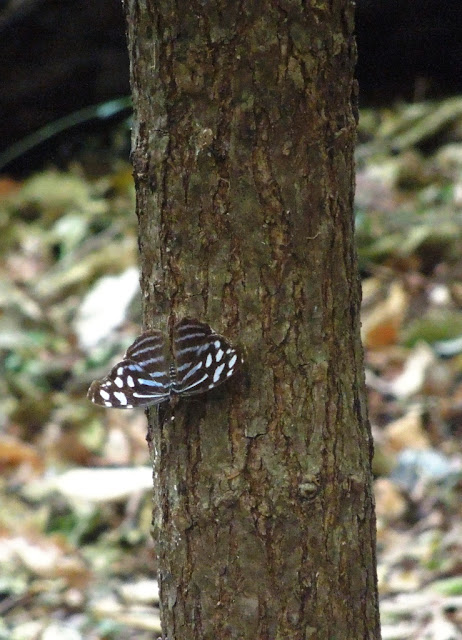 |
| Although well-camouflaged when the wings are vertical, many butterflies of Nymphalidae family are conspicuous when viewed along the dorsal side. Photo Max Schellekens. |
As consumers of the juices of fruit on the forest floor, these species require strategies against potential predators in trees as well as on the ground. Most Nymphalidae are well-camouflaged when sitting on the forest floor, where checkered patterns of dark and light, neutral colors dominate among leaf litter. When these butterflies as perched on the forest floor, they maintain their wings erect, showing complex patterns of neutral colors on the ventral sides of the wings, which blend with the surroundings.
 |
| Some Nymphalidae butterflies are particularly subtle, with cryptic patterns on both sides of the wing. These butterflies tend to inhabit altered areas more, where greater need for hiding is necessary. Photo Max Schellekens. |
When dropping their wings, other patterns and colors appear, more vibrant and spectacular. Most brushfoots show dramatic coloration above. Perhaps the most popular of the butterflies of the forests in Nicaragua is the Morpho butterfly (
Morpho helenor montezuma), whose dorsal side glows with metallic blue, whereas the underside of the wings are dark with eyespots. One particularly large eyespot near the rear of the hindwing may aid the butterfly by giving the impression of an owl. Many potential predators of a Morpho butterfly would not want to run up against an owl, so this spot may reduce the pressure of predation.
 |
| Even when butterflies are practically invisible from a distance, the wing patterns upon close examination may be very attractive. Photo Max Schellekens. |
As the photographs show in this essay, studying the brushfoot butterflies does not require harming them. The butterflies are trapped passively when they come to the fermented fruit bait, and there they are held a few hours without harm until they are removed, identified, and then released. These butterflies have colors and design patterns that are much better appreciated up close, too, as the photos show. They are all beautiful!
 |
| Hamadryas butterflies are especially abundant in altered areas in Laguna de Apoyo Nature Reserve. Photo Max Schellekens. |
By making careful observations, the interns were able to make commentaries on the abundance of the butterflies during different seasons and in different locations in
Laguna de Apoyo Nature Reserve. Furthermore, they gathered information regarding the sex on the
butterflies. Males and females of many species act very differently. Often, females are not very active. Many aspects of the basic biology of the Nymphalidae butterflies is simply not known, and we hope to make a small contribution to the knowledge base, while learning about the butterfly diversity in the different areas of the reserve.
 |
| La Mariposa Aliazul, or the Bluewing, is far more conspicuous on the dorsal side than the ventral side. Photo Max Schellekens. |
By learning when and where each butterfly species is most common, we can build patterns of the web of diversity in the forests of this reserve. Seasonality of
butterfly abundance depends on environmental factors such as appropriate conditions for feeding caterpillars in the host plants.
 |
| Hamadryas butterflies show dramatic colors and patterns on the dorsal side of the wings. Photo Max Schellekens. |
The interns Max and Hessel built on a substantial database developed over five years. During this time, we counted on the labor of several interns and volunteers, and the volunteer support of the students of
Apoyo Spanish School as well. Their
final presentation was attended by a standing-room-only crowd of conservation professionals, tourism operators, biologists and students. More work is to be done, so potential
interns and volunteers are invited to apply!
 |
| Wing underside patterns of the Nymphalidae butterflies are subtle but, on close observation, filled with fascinating detail. Photo Max Schellekens. |
All visitors are welcome to visit us and discuss the butterflies, or to volunteer to participate in our studies. Please contact us for any information you request.


