Showing posts with label pet trade. Show all posts

Friday, August 4, 2017

Animal Rescue XXIV: Midorna, the Scarlet Macaw

Many wild animals that have been captured and submitted to the pet trade can be given their fair opportunity to live and die in their natural habitat, instead of a cage. Over the last decade, we have participated in the return to the forest of parrots, toucans, squirrels, monkeys, owls, doves, among many other animals. We have also provided a kind of hospice for lots of wild animals that were mortally injured, almost always as a consequence of some kind of human-wildlife conflict. Many times, these conflicts have been non directly intentional. Other times, conscious intent to harm or at least use harmful force against some wild animal occurred. Wild animal rescue may be needed for any of several, different reasons.

animal rescue
Midorna, a Scarlet Macaw, is a long-term resident of Estacion Biologica Laguna de Apoyo. Photo Andras Dorgai.
One of the ways wildlife encounter conflict with humans is because of the pet trade. Almost any animal can be found for sale on the side of the road at likely locations, many of them offered as pets, others as meat. A few species of animals in Nicaragua, however, are overwhelmingly victimized by the pet trade. One of those species is the Scarlet Macaw (Ara macao).

scarlet macaw
New blood feathers, still covered in sheaths, are emerging along the neck of Midorna. Photo Andras Dorgai.
The Scarlet Macaw was first listed in Appendix III in the list of protected species of the Convention on International Trade in Endangered Species (CITES), in 1976. Its status was elevated to the more restrictive Appendix II in 1981, then to the most restrictive category for international trade, Appendix I, in 1985. In spite of this listing, the subspecies found in Mexico and Central America, Ara macao cyanoptera, has continued on a precipitous decline in wild populations. They had disappeared from El Salvador in the wild by 1987, and today in Nicaragua, fewer than 100 individuals are found in the wild, thanks principally to the pet trade.

ara macao
For the few who earn her utmost trust, Midorna can be quite a playmate. Photo Andras Dorgai. 
Midorna is a female Scarlet Macaw that has lived a fairly typical life for its species in Nicaragua. There has never existed a macaw hatchery in Nicaragua, so she, like all the others of her species in captivity, were once wild animals, flying free over forests and fields. Because Scarlet Macaws fly above the canopy, and make tremendous rackets while flying, they do not go unnoticed, making their presence-and their absence-conspicuous. Until 1983, several individuals that roosted in the Chiltepe Peninsula would routinely fly over Lake Managua to reach the capital, where they were easily observed. Likewise, the last corroborated accounts of the Scarlet Macaw in the villages around Laguna de Apoyo were from 1969, where they were regarded as potential sources of income for those who could catch them for the pet trade, and as pests by farmers whose corn could be decimated quickly by a flock. Although we don't know her age, Midorna is evidently decades old already. 

pet trade
Midorna craves attention and loves especially the company of males. Photo Andras Dorgai.
The pet trade has meant for Midorna, and for hundreds of other Scarlet Macaws in Nicaragua, a lot more than the tragedy of passing decades of her life in cages instead of the wild, where she belongs. During her capture and handling, or more bones in one of her wings was broken, leaving her absolutely incapable of flight. She knows perfectly well that nature gave her wings to fly, yet she cannot fly, or even make a soft landing if she falls from a height. She has been codemned to a flightless life in her conscious being, albeit she surely flies in her dreams. She loves to raise her wings and feel the wind in them, and to observe below from a high perch.

cites
Midorna and her special friend. The majority of the red feathers that should provide a complete covering over her breast have been plucked by her. Photo Andras Dorgai.
Prisoners go mad when faced with extreme boredom in their incarceration. It should not be any surprise that a Scarlet Macaw would also react poorly to years in a cage. Boredom and isolation are guaranteed. Midorna has developed a behavioral disorder involving breaking and/or plucking her feathers. This disorder is chronic and recurrent: her feathers periodically regrow, only to be broken or plucked again. Even if she were to fly, this disorder would make her life in the wild impossible.

animal rescue
Midorna benefits from company, and becomes visibly happier with more interactions. Photo Andras Dorgai.
In these ways, not only has her life been robbed of years; her sentence for captivity is lifelong, and her own behavior is now plagued with pernicious actions that prejudice her own happiness. These issues are extremely common among macaws in captivity.

ara macao
The Scarlet Macaw is no longer seen in the wild, almost anywhere in Nicaragua. Photo Andras Dorgai.
There are many issues at stake with what to do with Midorna. First and foremost, is the issue of the integrity of the wild populations that currently exist in Nicaragua and the region. If there is any way that Midorna's life can contribute to the healing and recovery of a stable, continuous, wild Scarlet Macaw population, then she should be at its service. There are many, many Scarlet Macaws in captivity throughout Nicaragua, and they could be placed into a captive reproduction program with the intention to create a new generation for release into the wild. Unfortunately, releasing Scarlet Macaws supposes a safe place for them to be released, which effectively does not yet exist. First, we need to create the conditions which discourage people from capturing them in the wild. At the moment, those conditions do not exist. So, Midorna is waiting.
pet trade
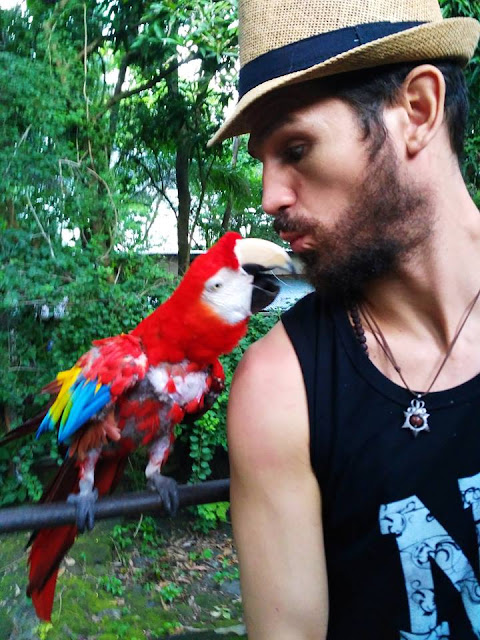
Not just anyone would risk a kiss from Midorna. As a Scarlet Macaw, she has powerful mandibles that could rip flesh with ease. Photo Andras Dorgai.
Midorna can help to create the conditions for a future with Scarlet Macaws once again flying overhead in Laguna de Apoyo and similar areas. She is an ambassador for her species, for the tragedy of the pet trade. Nicaraguans and foreigners alike get to hear her story and contemplate the issues that are behind her condition. More is needed to change the tide, however.

Scarlet Macaw
The role of the Scarlet Macaw in wilderness policy in Nicaragua is the story that Midorna has to tell others. Photo Andras Dorgai.

Research, conservation policy advocacy, and education on the pet trade in wild animals are still needed in Nicaragua in a big way. You can help. First of all, don't buy wild animals as pets. Make your opinion heard among your friends. Second, get involved. Volunteer your time to care of wild animals, donate your spare change to help feed and care for them, or join us for a study of the issues behind the pet trade. Contact us at GAIA if you are interested!
Ara macao
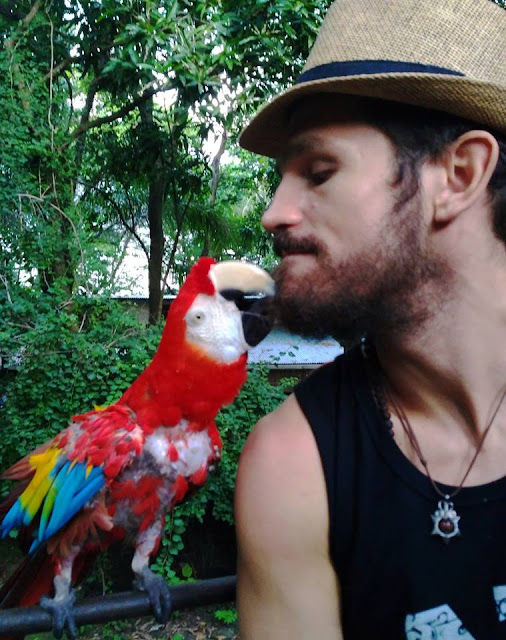
Beards are a special attraction to Midorna. Our goal is that she is the happiest Scarlet Macaw in the country, because liberty is no longer an option. Photo Andras Dorgai.

pet trade
Midorna loves attention, particularly from boys. Photo Jeffrey McCrary.

Ara macao
Midorna having an intense conversation. Photo Jeffrey McCrary.

Scarlet Macaw
Click on the "escudo" to contact us.

Saturday, June 6, 2015

Animal Rescue XV: Life behind bars

We are amazed and saddened when we hear yet another story of "wild animal rescue" with an all-too common thread. The story begins with a person with a wild animal in a cage, accompanied by photography thanks to Jen Moran. Not just any type of person, however; this story begins with a person who pretends to be socially and environmentally concerned and conscious. That's the hook that makes the rest of this archetypal story so sad. 


Nicaragua
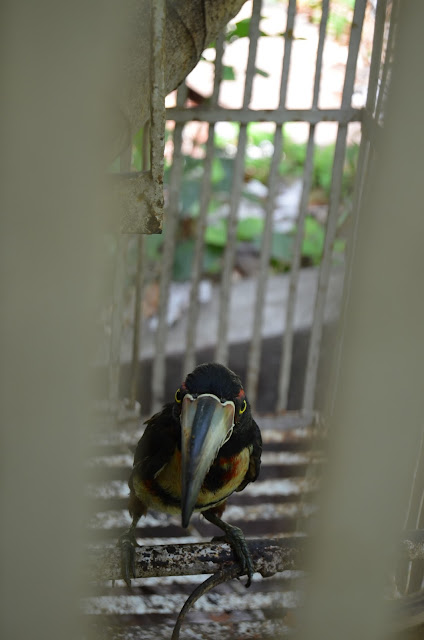
This Collared Aracari never asked to be put in a cage. Photo Jen Moran.
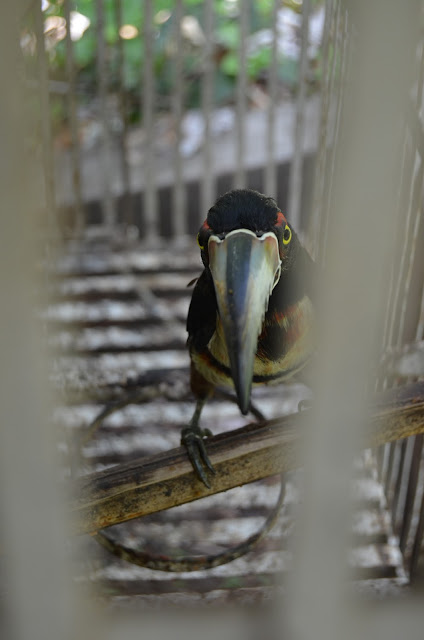
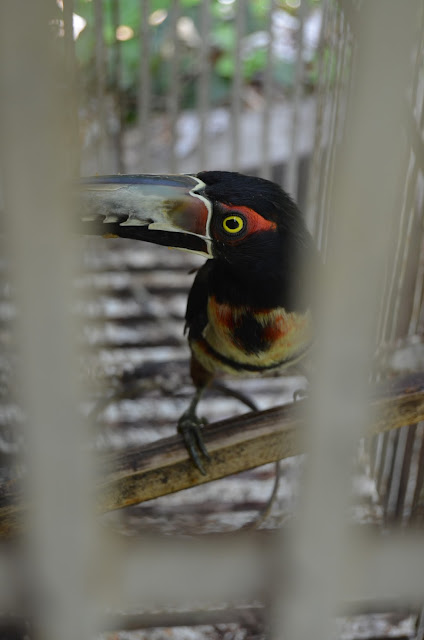
This bird is called a Collared Aracari (Pteroglossus torquatus). It is one of the two species of toucans found in Laguna de Apoyo Nature Reserve, and by far the most common. Collared Aracari tend to be seen in the forest canopy, flying about in family groups. Their diet is principally fruits, but their long bill with razor-edge sides provide toucans with an effective tool for predation. Small birds, especially chicks in the nest, can be consumed by the toucans. Their size, bright colors and substantial bill warn other birds, and they are generally feared by the smaller birds in the forest. 


Collared aracari
It is obvious that this Collared Aracari seeks freedom! Photo Jen Moran.
Those same bright colors and distinctive body that make the Collared Aracari a prominent member of the forests here, also bring its attention to its most dangerous predator: Homo sapiens. As if life in the forest is not complicated enough, toucans attract the attention of humans, who have learned that people will pay money for them. Although the Collared Aracari rarely descends to the lower levels of the forest, it is particularly vulnerable to capture, because it roosts and nests in tree cavities, where humans participating in the illegal trade in wild animals can spot them and reach them with relative ease. 


illegal pet trade
Such a majestic animal should never be forced to live in captivity. Photo Jen Moran.
Lots of birds live in accessible places, but when the birds are as spectacular as a Collared Aracari, someone is likely to follow them, learn their habits, capture them, and then sell them for money. That is where the supposedly well-meaning, well-educated and conscientious people of this world come in. Just seeing a toucan-any of the several species existing in Nicaragua-brings a state of awe to the observer. Its grace and beauty are elusive in nature, to be valued only by the hardiest and most disciplined and prepared birdwatchers. Suddenly The Discovery Channel is live and before us, when we see this bird up close. And as is often depicted on The Discovery Channel, our imagination is inspired to dream of becoming the toucan whisperer. We are all motivated by our consumer culture, to acquire what is attractive. We may go to perverse lengths to justify our desire to possess and control. Some people end up justifying the payment of money to a person engaging in illegal trafficking of wild animals, in spite of all their knowledge and perspective. It is sad to see birds like this little toucan in the pet trade, because they are obviously happier free and not in a cage.


Pteroglossus torquatus
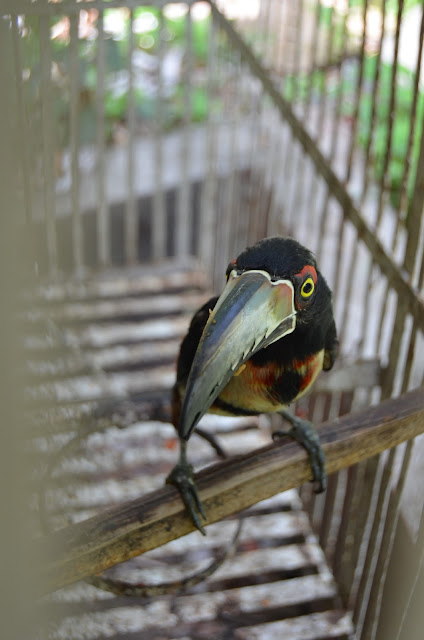
The Collared Aracari is common and prominent in Laguna de Apoyo Nature Reserve. This rescue bird daily hears the calls of his free friends. Soon, when ready, this bird will meet them up close! Photo Jen Moran.
With astonishing frequency, we are contacted by people with animals such as this one. A few people are honest about their mistake: they bought an animal that really needed to be free and not in a cage. The majority, however, try to justify their purchase of a captured and caged animal, by claiming that by purchasing the animal, they can help to rescue it. It's as if these people had never taken a simple course in economics, on the law of supply and demand. Simply put, by investing money into the supply chain for the illegal pet trade in wild animals, these supposedly well-meaning individuals empower the people who destroy the natural resource base, guaranteeing doom for this toucan's relatives. 


animal rescue
This is not the way to live! Wild animals should live and die in the forest, not in a cage. Photo Jen Moran.
This is where we come in at GAIA: We receive, care for, rehabilitate, and release wild animals. This process has included lots of type of animals, from monkeys to wrens, over the years. We have made a small contribution to the process of educating people about the wild animal trade, as we go along. The animals receive the best humane treatment we can give, and when appropriate, they are released where they have the best opportunity to reintegrate themselves into the wild. 

Soon, this bird will return to the wild, to live and die as nature intended, free from its greatest menace. Meanwhile, we are learning from this bird, especially we are learning how misguided and destructive is the the illegal traffic in wild animals. Every day we find yet another well-educated person in Nicaragua with some monkey, parrot, or other animal that deserves to be away from the claws of humans. We tell them this practice needs to end and they need to be involved in ending it, although not everyone wants to hear such a message.

We at GAIA would like to do more, too. We have hungry mouths to feed and transport and infrastructure costs. We need your help. Your donation can provide a second chance for many animals, and help to put an end to the illegal trade in wild animals in Nicaragua. We want to build more cages and make a bigger impact. There are many animals that we can not take, because we do not have the resources to do so. You can volunteer to help us with wild animal rescue. Our animals need people to feed and clean cages, and perform repairs and maintenance on cages, and help to keep the animals happy and every day coming closer to returning to the wild. Not everyone can come and give their time, however. By making a ten-dollar donation, you can provide fresh fruit and other appropriate foods to this toucan for an entire month. By donating eighty dollars, you can provide the materials for another large enclosure which would aid in the preparation of animals for release. Please donate to GAIA for this worthy cause. 


toucan
Click on the "escudo" to contact us.

Monday, April 1, 2013

Animal Rescue XI: Variegated Squirrel in Laguna de Apoyo Nature Reserve

Sciurus variegatoides
Baby squirrels can be mischievous! Photo by Pablo Somarriba.
Some wild animals can be affectionate and cute, especially before they reach sexual maturity. We are so often daunted by how many people want to promote the traffic in wild animals to satisfy their passion for making animals their pets. The wildlife of Nicaragua has been harmed by turning wild animals into pets. This week, we have taken in yet another animal that had fallen into the hands of some misguided individuals using the name "The Peace Project" who thought it would be fun to keep a Variegated Squirrel (Sciurus variegatoides) as a pet. This animal, however, is not a domesticated species, it is a wild animal. What kind of "Peace Project" steals wildlife from its natural habitat?
The Peace Project
This juvenile Variegated Squirrel covers himself with his tail to protect himself from predators from above. Photo by Laura Ruysseveldt. 
Several animals make good pets, especially dogs and even cows. These animals, after thousands of years of strictly close association with humans, can no longer live as wild animals. Instead of seeking an animal that lives well in its environment, however, many foreigners put wildlife in Nicaragua at risk of extinction by purchasing wildlife sold as pets from wild animal traffickers.
Estacion Biologica recovered a Variegated Squirrel which had gotten ill from the abuse it had received in the hands of others. The squirrel was ill, weak, and infected with large sore on its side.

Wildlife in Nicaragua
The squirrel was very ill when we recovered him. He had a fever and a very large, pus-filled boil on his side. Our biology interns drained and cleaned his wound and assured that the squirrel received plenty of rest and nutritious food. Photo by Laura Ruysseveldt. 
Our interns drained and disinfected the sore, and gave the little guy lots of care and observation. Two days afterward, his disposition changed, he became energetic, curious, and confident. The illness began to subside.
A Variegated Squirrel eats a ripe, juicy mango. Photo by Laura Ruysseveldt.
Wild animals should live and die in their natural habitat, not as toys for humans. We are confident that this squirrel will get the opportunity to return to the wild soon, in spite of the abuse he received at "The Peace Project". We hope to see him running along the branches of the trees in Laguna de Apoyo Nature Reserve, with other squirrels, instead of captive to foreigners who treat him as a toy. Would you like to work with us to protect wild natural resources in Nicaragua? Please contact us for more information on how you can help, whether in your home country or during a visit to Nicaragua.
squirrel
This baby squirrel quickly healed of his wound, although the hair returned slowly. He is still wild and living with the other squirrels in the trees above Estacion Biologica Laguna de Apoyo. Photo by Laura Ruysseveldt.
The Peace Project Nicaragua
Click on the "escudo" to contact us.

Thursday, January 17, 2013

Illegal traffic in Nicaraguan wildlife II

Human nature drives us to want to acquire things that are beautiful. We can't be satisfied to see a beautiful object in nature and then leave it there. For instance, some kinds of Nicaraguan wildlife are subject to the willfulness of humans to treat wild animals as objects that can be bought and sold.
Macaws are the largest members of the New World Parrot family (Psittacidae); they are spectacular, gregarious, and "smart" birds. Two species of this group are found in nature in Nicaragua: the Scarlet Macaw (Ara macao), and the Great Green Macaw (Ara ambiguus, previously named Ara ambigua). The Nicaraguan populations of both these species have suffered greatly because of the pet trade.
CITES
This is a Scarlet Macaw (Ara macao), which has been subjected to coloration, through chemicals such as hydrogen peroxide, to make it appear to be something even more exotic. Sale of these majestic animals should be banned, as well as mistreatment by processes such as feather bleaching. Photo by Matthias Geiger.
Scarlet Macaws (Ara macao) no longer inhabit almost all of the Pacific region of Nicaragua, thanks to the illicit pet trade. This species is listed on CITES Appendix I, which means, basically, that it is quite difficult to export an individual. In spite of the ban on international trade, Scarlet Macaws are much easier found on tethered to sticks on roadsides than in the skies overhead, in Nicaragua. There is a robust trade and virtually no prosecution of pet owners. Many birds find their way to small watercraft which transit contraband from Nicaragua to the much wealthier neighbor, El Salvador, where the birds bring much more money. A Scarlet Macaw in good condition in Nicaragua can cost much more than five hundred dollars. 
macaw
Bumbelina is a pet rescue, Great Green Macaw (Ara ambiguus).  She is receiving care at Estacion Biologica in Laguna de Apoyo Nature Reserve. Photo by Joyce Procure.
We have handled a number of rescue animals over the years at Estacion Biologica. Most of these animals have been taken from people who captured them for use as pets, or the animals have been found injured in or around Laguna de Apoyo Nature Reserve. When we have a little success, the animals survive, heal, and eventually, return to the wild. Not all can heal and return to the wild, however. One pet rescue bird in Estacion Biologica FUNDECI/GAIA, is a Great Green Macaw (Ara ambiguus). Its native range is considerably more limited than that of the Scarlet Macaw. The majority of the birds of this species are found in southeastern Nicaragua, where jungles are thick and rain is practically year-round. Bumbelina is a female, like her fellow rescue Scarlet Macaw, Midorna. Bumbelina is very angry and aggressive, and large and heavy, so she is best admired from a safe distance!
The Great Green Macaw is Endangered and is also listed on CITES Appendix I. Nonetheless, current law enforcement does not prevent the ownership of these birds inside Nicaragua, and they can be found in many homes.
macaws in Nicaragua
Bumbelina was captured in the wild, and her injuries were severe from the brutal mistreatment. She still dreams of flight, but her amputated right wing prevents her from ever returning to the wild. Photo by Joyce Procure.
Midorna is a Scarlet Macaw, also a pet rescue living at Estacion Biologica Laguna de Apoyo. Bumbelina weighs about twice Midorna, much bulkier with a much heavier bill and larger claws, but the two birds make great friends. Like Bumbelina, she has been mistreated in captivity, and her permanently injured wing prevents her from taking flight. During her lifetime of incarceration in a cage, she has developed a feather-plucking disorder, making her look much less majestic than she would look if living in the wild. We are hoping that her feather plucking will reduce with lots of activity and contact. The two birds are destined for delivering the message that wild animals deserve to be free, not in cages! They will be visiting schools and social events around our area, throughout 2013.
Ara macao
Midorna is affectionate with those whom she trusts. Photo by Joyce Procure.
As lovers of nature, we are disturbed by the illegal traffic in wild animals. Our desire to "own" a beautiful bird has harmed many birds, and their loud screeches are no longer heard in much of the forests they once inhabited. Would you like to help us prevent the capture and trade in endangered wild animals in Nicaragua? There is plenty to do. Please contact us!
wildlife in Nicaragua
Click on the "escudo" to contact us.

Friday, March 9, 2012

Trafficking in Wild Animals in Nicaragua

The traffic in wild animals pervades the Nicaraguan society. As one drives along a highway, parrots and macaws are sold alongside monkeys, armadillos, iguanas and virtually any other animal that can be made a pet or eaten. The pet trade in wild animals affects the populations of many wild animals which have gone extinct in large areas of the country. We dedicate this blog entry to the wild animals who are bought and sold illegally.

wildlife
The Yellow-naped Amazon (Amazona auropalliata) in the foreground is protected but, nonetheless, is more easily found tied to a stick or in a cage than in the forest. The bird in the background, an Orange-fronted Parakeet (Aratinga canicularis), has been dyed to change its appearance by these traffickers. Photo by Jeffrey McCrary.
The Yellow-naped Amazon, like many of its relatives, is a very social bird, residing in colonies of up to a few dozen individuals. Its range is the tropical dry forest along the Pacific coast, from Oaxaca in Mexico to northwestern Costa Rica. The soft vocalizations and great capacity to learn make this bird a highly prized pet. Its range, furthermore, has been highly impacted by man, leaving the remaining population with small populations at great risk of capture. The Yellow-naped Amazon population in Laguna de Apoyo Nature Reserve is very small, with only a few individuals and a single nest documented to date. 

wildlife
Nicaraguans actively hunt and eat armadillos. Photo by Ron Reagh.
The nine-banded armadillo is common in Nicaragua, and is not protected from hunting in Nicaragua. We picture it here to show how hunters market their products daily along the highways of Nicaragua, whether legal or not. In fact, marketing wild animals is not permitted, even when they are hunted legally. Next to these armadillos, seen on the Managua-Leon "new" highway, there were numerous iguanas for sale.
wildlife
Roadside armadillo sale. Photo by Ron Reagh. 
Three species of monkeys are found in Nicaragua. The most charismatic of them is the Nicaraguan spider monkey (Ateles geoffroyi geoffroyi), listed as Critically Endangered. Throughout the Pacific region of Nicaragua, spider monkeys are rare or completely extirpated. Nonetheless, some people seek spider monkeys as pets-among the most important reasons for their sad situation in the wild. The pet trade is driving the species into local extinction throughout the Pacific region of the Nicaragua. And the monkeys in captivity are placed in chain-link cages or on chains, like the poor monkey below. This is a wild animal, not a pet, and it should be free to live and die in the trees, not on a chain, dependent upon man for every aspect of his life.
pet trade
This sad Nicaraguan spider monkey is confined to a leash on wire suspended between two trees on the property of some wealthy owner of one of the Isletas near Granada. 


pet trade
A juvenile Nicaraguan spider monkey sulks in its cage in El Coche Cafe in Managua. 
What can you, an ordinary Nicaraguan or visitor to this beautiful country, do? Here are some suggestions.

1. Do you know of any illegal traffic in wild animals in Nicaragua? Please let us know at FUNDECI/GAIA. We will protect your identity, confirm and document the situation, and provide the information to the Nicaraguan Police and the Ministry for Natural Resources and the Environment. 

2. NEVER purchase wild animals for sale. If you are concerned about the welfare of a wild animal in someone's custody, let that person know that a law may be getting broken. By giving traffickers money, you perpetuate the illegal business, thereby endangering even more animals by fortifying their market chain. By calling them out, they and others around you are emboldened to defend Nicaragua's natural heritage against the dealers in wild animals.

3. Discuss the issue with your friends in Nicaragua. Sharing information and opinions is healthy and leads to better-informed decisions among the entire public. Many well-meaning people participate in the illegal traffic in wild animals in Nicaragua without thinking they have done anything wrong or illegal. Let them know you don't approve and they will consider your opinion. 
wildlife
Click on the "escudo" to contact us. 

Tuesday, September 20, 2011

Animal Rescue VI: Collared Peccary


The javelina or collared peccary (Pecari tajacu) is called sahino in Spanish. It is native to much of Nicaragua, and in the wild, is to be feared. It can be aggressive, and has long, sharp teeth, strong jaws, a stout body with the capacity to run fast, and they are social, usually found in packs of around twelve. In some natural areas where they are common, picnic tables may be placed in strategic places for the visitor who might find a need for refuge. They are not commonly domesticated, because they often remain aggressive even when bred in captivity.

In 2003, Estacion Biologica inherited a rescue animal that the zoo could not keep. After living in an impoundment for years, he was released. He made friends with one of the dogs, and they played fondly. He was dubbed Greggery in honor of an opera composed by Frank Zappa. As all pets, he had his troubles, but with people he was never aggressive, and in time, his repulsive odor for which the peccaries are known diminished. Or perhaps we just didn't notice as much.
Greggery Peccary in Nicaragua

Much like the protagonist in Frank Zappa's operetta Greggery Peccary, our peccary became a star. He even had a video made and published! See the video below, thanks to Fabio Buitrago.


As cute as Greggery was (may he rest in peace), we think wild nature should stay wild. The pet trade threatens our wild nature in Nicaragua. Greggery was brought from the wild to be a pet, and was traded commercially for that purpose. When you see wild animals in the street, remember that buying them only promotes the trafficking in wild animals further.
wildlife photography Nicaragua
The head of the collared peccary seems disproportionately large. Photo by Jeffrey McCrary.

nature photography tourism Nicaragua
Greggery was good at charming the girls.
Collared peccary in Nicaragua
Click on the "escudo" to contact us.

Thursday, June 16, 2011

Video-variegated squirrel in Laguna de Apoyo Nature Reserve, Nicaragua


Belen Camino and baby squirrel
Dozens of mammal species can be found in Laguna de Apoyo Nature Reserve, Nicaragua, although most mammals are, by nature, retiring and difficult to observe. Among the exceptions is the variegated squirrel (Sciurus variegatoides). This species ranges from southern Mexico to Panama, but as its name suggests, its color pattern varies from one part of its range to another. Ours (subspecies S. v. dorsalis) are black and white, suggestive of an inverse polecat coloration. They are a prominent component of the wildlife, very visible and active during the day. For more pictures of the squirrels of Laguna de Apoyo Nature Reserve, click here.

We have rescued several variegated squirrels over the years. One baby female survived a long fall (which killed one of its siblings) when Montezuma Oropendolas attacked the nest on the property of Estacion Biologica. She was so young and small that should could not climb, yet too large for her mother to carry her. We kept her, initially feeding her milk with a syringe. She knew where to find milk and a mango or banana awaiting her in the kitchen, and soon was able to scale the kitchen table.

nature tourism Nicaragua birdwatching
A rescued variegated squirrel drinks milk and enjoys a neck scratch. Photo by Jeffrey McCrary.
Eventually, she built a nest in a tree overhead and stopped sleeping in the armpit of the station director! She continued to visit for a few months longer, but each day became less interested in people. Today she is a breeding adult and no longer descends from the trees to visit us.
Local wild squirrels have readily accepted our rescued animals. They are very social animals, and each morning, they play ecstatically, chasing each other round the trees. Below is another picture of a rescued squirrel who enjoyed his freedom early but loved to visit us - especially when we had peanuts or cooked red beans! He is also now a member of our neighborhood squirrel clan.
wildlife photography Nicaragua ecotours

Special thanks to David McKnight for this video! 
FUNDECI/GAIA manages a long term monitoring program on the flora and fauna of Laguna de Apoyo Nature Reserve, and we are involved in several actions to promote the protection of native flora and fauna in the area. We need volunteers and donations. Volunteers can help by doing such things as: assisting in field work to monitor birds, rodents, bats, moths, butterflies, monkeys, fish or birds; processing data; management and/or maintenance assistance at Estacion Biologica; reforestation; and other areas. If you can not give time as a volunteer, please consider making a small donation to us (apoyo@gaianicaragua.org via paypal). Our budget is small and needs are large.
By participating in one of our programs such as the Laguna de Apoyo Spanish School, you also help. Would you like to learn or improve your Spanish? All our students provide volunteer hours in reforestation and other conservation activities. And a portion of the proceeds of the Spanish training goes directly to our study and conservation of wildlife and their habitats. Or you can visit and hire a guide for nature tourism in our area. Our guides know the local fauna better than anyone! Please let us know how we can help you.
nature tourism backpacker Nicaragua
Click on the "escudo" to contact us.