Spanish school, Research Station, Sustainable tourism, Ecotourism, Fish studies, Bird and other nature studies, Reforestation and Conservation Activities and Hostel in Laguna de Apoyo Nature Reserve, Nicaragua. Birdwatching, SCUBA diving, swimming, hiking, nature and wildlife watching. Hostel, great meals, great friends. Saving the planet and enjoying every minute of it!
www.gaianicaragua.org.
www.twitter.com/lagunaapoyo
In most of Nicaragua, the most abundant and visible of the three primate species is the golden-mantled howler monkey (Alouatta palliata palliata). Howler monkeys have always been found in the Laguna de Apoyo Nature Reserve, but their populations have increased dramatically in recent years. Years ago, howler monkeys were heard from Estación Biológica Laguna de Apoyo, at distances of up to a kilometer to the south. Today, they are within sight at least half the days of the year.
This baby howler monkey seems to be holding on to its mother as if on a roller coaster. Photo Jeffrey McCrary.
We think this special population of howler monkeys in Laguna de Apoyo Nature Reserve merits a lot of attention. The species is protected by local law from hunting and capture for purposes such as the pet trade, and the populations are very sensitive to habitat destruction. They may never touch ground during their lifetimes, making arboreal connectivity vital to their habitat. In areas where the forest is used for fuelwood, pasture, or other purposes, entire areas may be blocked from access by them.
Howler monkey. Photo Jeffrey McCrary.
The howler monkeys of Laguna de Apoyo, are doubly protected, as species occupying a protected area where fauna, flora and other aspects of natural habitat and landscape receive some measure of protection. Beyond these justifications for lending special attention to the howler monkeys of Laguna de Apoyo Nature Reserve, exists yet another important reason to focus on this population. The visible success of this species as a population during the past years, in a context of diminishing populations in most species and locations in the country,
Howler monkeys often are easily seen from the patio of Estación Biológica. Photo Andras Dorgai.
The dramatic increases in the howler monkey population in Laguna de Apoyo Nature Reserve has meant that monkeys are found in places and circumstances that present new challenges for coexistence between humans and nature. Most of the homes along the shore now find howler monkeys in their yards many days of the year. The electric wires running through the populated areas present yet another challenge to them. Several electrocutions of monkeys have been documented over the years.
What can we do to make monkeys a priority in natural areas? Photo Jeffrey McCrary.
Howler monkeys are classified as folivores, that is, they tend to eat leaves as their sustenance. During the dry season, when leaves are scarce, or old and dry, they may consume larger amounts of fruits. There have been notable occurrences of monkey mortality in other parts of Nicaragua, where the dry season can be quite marked, so monitoring of the monkey populations is quite important.
There are lots of reasons to be studying the monkey populations. One is to ensure that the populations remain abundant and healthy, with adequate numbers of juveniles that reflect a population in constant reproduction. The quality of a healthy environment for monkeys is also important to know and understand. One aspect of a healthy monkey habitat is a selection of trees that provides year-round food in adequate amounts. The species of trees preferred as food items by howler monkeys can provide indications for reforestation activities in the area.
Howler monkeys eat leaves of Bursera simaruba, a locally abundant tree species. Photo Jeffrey McCrary.
Anyone visiting Laguna de Apoyo Nature Reserve may want to spend some time finding and watching howler monkeys. If one exercises common sense regarding the respect that monkeys deserve, it can be easy to enjoy watching them without causing them any distress. One should remember always that the monkeys deserve to live in peace without any distress caused by humans.
The howler monkeys of Laguna de Apoyo Nature Reserve are easy to find and admire. Watch them with respect. Photo Jeffrey McCrary.
When the howler monkeys decide to come to our patio, we are always happy, and we are careful to give them the as much private space as is necessary. They are not here for our entertainment only; they exist for their own reasons, and they should be permitted to come and go as they deem appropriate, without feeling bothered by humans.
Baby rides while mother searches for food. In the dry season, monkeys tend to eat more fruits than leaves. Photo Jeffrey McCrary.
Our concern for wildlife and the habitats they use and require is not shared by everyone, but many people agree that wildlife should receive a greater priority than people in areas designated as wild space such as the Laguna de Apoyo Nature Reserve. There is a growing number of hotels and other spaces where the environment is completely incompatible with wildlife such as howler monkeys. At Estación Biológica Laguna de Apoyo, we stand for wildlife.
This baby howler monkey is still breastfeeding. She observes as her mother eats a mango. Photo Jeffrey McCrary.
GAIA has conducted surveys and studies of the monkeys and other wildlife in the forests surrounding Laguna de Apoyo. If you are interested in helping to protect monkeys, study them, or just watch them, Laguna de Apoyo Nature Reserve is among the most ideal of locations.
A baby monkey watches us as her mother is relaxing. Photo Jeffrey McCrary.
Volunteers and interns can arrange stays to help with our conservation projects and to study the relationships between wildlife and the environment in our area. We gladly receive guests and visitors any time, as well. Please come to meet us, discuss what is the latest happening in conservation in the area, and stay as long as you like.
An adult female golden-mantled howler monkey scales a tree. Photo Jeffrey McCrary.
If you are interested in getting involved in the protection or study of these magnificent animals, please contact us.
Some wild animals can be cute, at least at a distance, under controlled conditions, or perhaps just when they are juveniles. Most wild animals, however, demonstrate at some moment that they are wild by acting aggressively, or by feeling depressed or stressed in conditions of confinement. The cuteness and uniqueness of an exotic animal can seduce the most logical of people into thinking that they can provide adequate conditions to a wild animal so that it will actually be happy and willing to act like a domesticated animal, by showing attachment, obeying commands, and generally acting in a safe manner.
An entire genre of movies has recently emerged, showing wild animals acting in human-like ways, sometimes in Happy Feet-style fantasies. A common theme among them is the connection between humans and the animals. The wildness of the animals is almost always conquered by the goodness of people.
The best term for this sentiment is hubris.
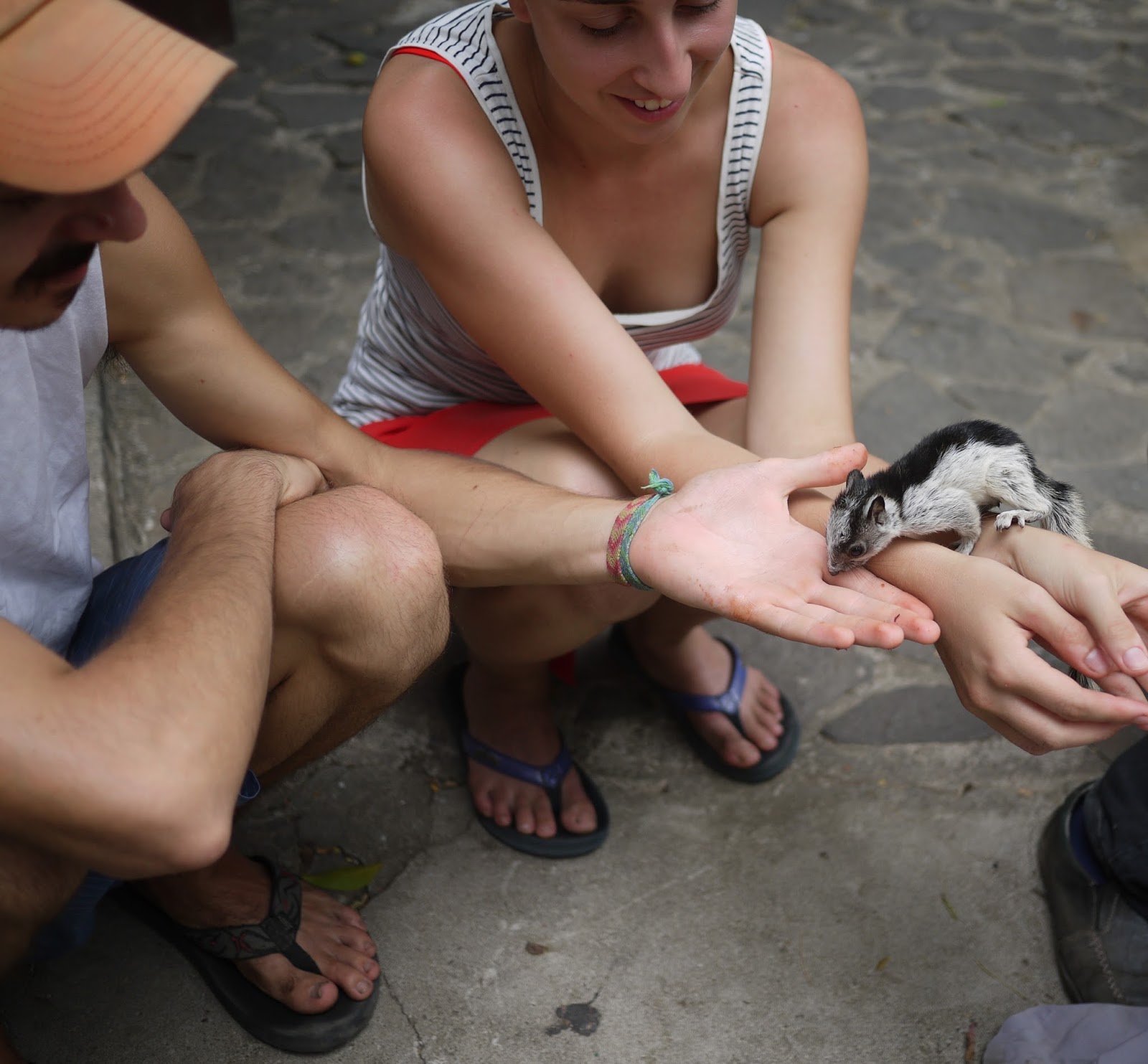
One of several variegated squirrels taken from the pet trade and brought to Estacion Biologica Laguna de Apoyo to transition back to the wild. Photo Andras Dorgai.
This hubris is multiplied when a poor animal is placed for sale at a street light in Managua. So often, we see wild animals such as parrots, toucans, monkeys and even an occasional feline for sale, all bidding to enchant someone enough to plop down a little money and take the animal home to convert it into a family pet.
Purchasing wild animals as pets presents a terrible threat to the populations of animals in the wild. Captures of wild animals for use as pets have decimated the populations of animals such as Scarlet Macaw and the white-faced capuchin monkey in almost all areas throughout the country.
Once wild animals have been made into pets, they may face a difficult transition back into the wild. Photo Jeffrey McCrary.
But the impacts humans have over wild animals because of the pet trade does not stop with the placement of animals who were once wild into cages and forcing them to live in captivity. The habitats where these animals lived is often ravaged to get the animals out. Fire is an effective hunting technique, driving animals from holes in the ground or in large trees. These sites as effective refugia for wild animals are lost, and often, the fires rage onward because the hunters rarely make special efforts to put out the fires they started.
Juvenile squirrels sleep as much as twenty hours per day, in confined spaces in nests, which can be imitated by a bundle of cloths. Photo Jeffrey McCrary.
We do get a particular pleasure from the rehabilitation of variegated squirrels (Sciurus variegatoides). Baby squirrels are often captured by animal traffickers by knocking down nests from the tops of trees, and picking up the baby squirrels that survive the fall. The adults, strong and hostile with sharp teeth, are much less interesting as potential pets than the docile and dependent babies. Once in our hands, they must be handled to give the animals the social interactions they need and to assure that they are feeding well and getting sufficient stimulation and exercise.
Squirrels adapted to humans may even prefer to climb on them over scaling trees. Photo Jeffrey McCrary.
Little by little, squirrels can be reacquainted with their natural habitats. This species of squirrel rarely comes to the ground, finding plenty of bark, small insects and other fauna, fruits and nuts, year-round, high in trees. By coming and going from the security of a well-equipped cage, with a door open, the squirrels can choose to sleep, play, feed, and so on, all through the day. Juvenile squirrels can develop their interest in these foods and habitats little by little, until they may lose their interest in humans entirely.
Whenever safe to do so, juvenile squirrels are allowed to enter and leave their cage at will, so they can get exercise, explore, and socialize with wild squirrels nearby. Photo Jeffrey McCrary.
Whenever squirrels or other wildlife have lost their fear of humans, the dangers they face are abundant. First, they may wander into the hands of people who will capture them all over again and carry them back into the pet trade. Second, they face dangers from domestic animals, cars, and even the risk of being stepped upon can be high. Third, pets may also carry viruses that can affect them.
Squirrels quickly learn whose hand does the feeding. Photo Jeffrey McCrary.
Once a squirrel has become accustomed to humans, it must learn to find food, socialize with wild squirrels, and stay away from danger. Perhaps the single most difficult barrier to returning to the wild, however, is to have a shelter in which to sleep. Young squirrels may make a shelter on their own, without the help of other squirrels, or they may be allowed to enter into the nests made by other squirrels.
Even though Laguna de Apoyo Nature Reserve is a protected area with priority given to native species, cats abound in properties controlled by foreigners. This squirrel, once free and living in the trees above us, was caught by a cat from The Peace Project, and did not survive its wounds. Photo Jeffrey McCrary.
Sometimes, a wild animal is successfully reintroduced into the wild. Squirrels will sometimes survive, and their wild character may return, and they may reintegrate into the community of squirrels in the area. When this happens we are always grateful for all the efforts of so many people who participated in bringing food, spending time to provide care, clean cages, and even provide logistics. Each successful reintroduction into the wild results as the culmination of the efforts of many people.
Socialization from humans may substitute for the relationships lost from the members of their species for social animals such as squirrels. Eventually, however, they must develop relationships with their own species in the wild setting, to prosper in the wild. Photo Jeffrey McCrary.
These squirrels are beginning to learn to spend their days foraging in trees. They are still returning each night to sleep in their cage. Photo Jeffrey McCrary.
Variegated squirrels may lose their fear of humans after being caught, so that they may actually prefer to be with people to spending their days in the trees. But little by little, with encouragement, they learn skills for feeding and socialization in their arboreal environment, eventually to never return. Photo Jeffrey McCrary.
When we receive a wild animal to rescue at Estacion Biologica Laguna de Apoyo, we can not always predict what will happen. Sometimes, the animals are injured so badly that little can be done, beyond securing a peaceful hospice for its last hours of life. But, sometimes, animals with injuries may recover, even when their injuries may have appeared gruesome or grave, initially. The owl brought to us last week is another surprise of this sort, with an unexpectedly happy ending.
Perhaps the most common of the owls in the inhabited portion of the Laguna de Apoyo Nature Reserve is the Pacific Screech-Owl (Megascops cooperi). Its range is limited to the dry tropical forest habitats, farmlands and even residential areas, near the Pacific coast from the Isthmus of Tihuantepec to northwestern Costa Rica.
This species is called corococa locally, in homage to its lively call, which is often answered in kind among the members of a social group. It consumes mostly arthropods, although it is thought to take small rodents, as well. A biological control over some potential nuisances may be managed by its presence, making it a beneficial species to have nearby. Nonetheless, local people often kill any wildlife within view, especially when associated with negative myths, as are owls in the Nicaraguan culture.
Although the Pacific Screech-Owl is not active during the daytime, it often roosts in plain view, on low branches of trees, where its camouflage may keep it unnoticed by humans and other fauna. Nonetheless, if seen, it is likely that Nicaraguans, full of myths about owls and generally hostile to any wild animals within view, will attack an owl with intent to harm. In fact, the Pacific Screech-Owl is among the more commonly received bird species by us at GAIA. The subject of this report, brought to us just a couple of weeks ago in Laguna de Apoyo Nature Reserve, was an injured fledgling.
Juvenile Pacific Screech-Owl, rescued in Laguna de Apoyo Nature Reserve, Nicaragua. Photo Jeffrey McCrary.
This young owl, surely having been flying only days of its life, was found by neighbors, Claudio Arnaudo and Jimmy, who work at a nearby hotel in Laguna de Apoyo. The poor bird was plagued with lesions of different kinds. One eye had swollen shut from trauma. Another lesion, possibly caused in a fall, was evident beneath the beak. A wing was bruised and missing about ten of its flight feathers. As owls tend to be, the little animal was hostile to all who approached. Its injuries impeded flying, however, so there was little it could do, beyond menacing looks and tight grips with the sharp talons, against those who bothered it.
The Pacific Screech-Owl perched on a wall at Estacion Biologica, Laguna de Apoyo, Photo Pablo Somarriba.
After several days, during which it refused all food offered, we thought that the poor owl would soon be dead. Yet, it maintained strength. Then, one evening, we noticed that the owl was communicating with the local, wild owls. Small peeps were emanating from the cage, in evident response to the characteristic calls from the trees.
The wing, still missing half its flight feathers, had nonetheless recovered mobility and some of its strength. We left the owl out of its cage to see what would happen. After a few false starts, the owl was gone.
The following dawn, however, the owl appeared once again, at the same place where it was left free. Its adventure over, it had returned to familiar, if confined, surroundings. This time, the owl was placed back into the cage, but with the cage door maintained open, in case it developed an urge to go back to the wild.
The next evening, owls were heard and spotted nearby. The fledgling owl was once again taken out and placed outside the cage, and this time, we watched as the other owls flew in. The injured owl had friends, this was clear, and this time, it took flight and left with them, not to return. One more wild bird in the forests of Nicaragua, mission accomplished.
In the following video, the fledgling owl is approached by another owl. Whether the owl was fed or simply visited, what is clear is that a firm association was developed.
The story of this fledgling owl, adopted by the local owl-family, was unexpected. Furthermore, we are left to wonder if, indeed, the owl had been getting fed by the local owls through the bars of the cage, all along. That possibility would explain why the health of the owl improved, even though it seemingly was not eating. Regardless, we are glad that the owl could enjoy another day as a free animal, to live and die in the forest instead of in a cage. One more animal that was a victim to the aggression of senseless people was saved and returned to the wild. This owl, given another chance at life in the wild, is free in its natural environment, thanks to the attentiveness and kindness of Claudio and Jimmy. Wild animal rescue, sometimes, can be very gratifying.
We at GAIA are working to make Laguna de Apoyo Nature Reserve, and other places in Nicaragua, friendly habitats for wild nature. You can help us to reduce human-wildlife conflicts, provide environmental education, and conduct scientific research on topics of importance to the environment in Nicaragua. Please join us by sending a contribution or volunteering.
We at GAIA feel honored when people want to donate their time, money or materials to help us in our objectives to protect the wild natural resources of Nicaragua. Some people help with our activities as Eco-Warrior Environmental Volunteers, conducting lots of tasks that are important to nature such as reforestation, maintenance, and assistance with wild animal rescue. We love to share our time and efforts with people who share our opinions about the importance of protecting wild nature.
Not everyone can give a block of time to a project such as reforestation. Some people prefer to help by making a small financial donation, or provide some of the materials that are required for our operations, such as foods for animals and containers for planting trees. We want to express our gratitude to the many people who have given small, or sometimes, not so small, material or financial donations to help us do what we do. A few such donations received during the most recent days are mentioned below.
Seeds were donated by the owners of Apoyo Lodge-thank you!
The great folks at Apoyo Lodge dropped by to share with us and they shared their wealth by donating sunflower seeds. It is worth noting that Apoyo Lodge has changed hands, and the new proprietors are particularly kind and conscientious, as is evidenced by their donation of sunflower seeds for the benefit important nutrients. Our rescue macaw has a flexible diet but, like all parrots, requires certain components, among them, seeds which carry certain small-scale nutrients that this bird may not obtain from the other foods in its daily diet in captivity.
The kinds veterinarians at WorldVets donated a surgery for Juju the kinkajou, and some juicy fruits which were readily devoured.
Steve and the team from WorldVets donated a costly treatment of surgeries to Juju, a wild kinkajou that was found badly beaten in Laguna de Apoyo Nature Reserve. The animal was given a chance to live by these operations, which included the removal of a foot and an eye, and closure of an open wound on one cheek. The team dropped in a couple of times to see Juju, and they brought the animal some fruit. From all appearances, watermelon ranks highly in the list of preferred foods for a kinkajou. We often receive severely injured wildlife, and sometimes the success of seeing them heal is worth it all!
Juju the kinkajou likes watermelon. Photo Andras Dorgai.
There are lots of options for a visit to Laguna de Apoyo these days. The people who visit us often want to be involved in some way in doing something good for the environment. Part of keeping the environment safe for wild nature is patrolling to reduce vandalism, hunting, other bad things that harm the public good. We at Gaia support the local institutions in the ways we can. We had noticed the local patrol motorcycle for the police department was using a completely treadless tire, worn dangerously bald from overuse. Mark Connell, a student of Apoyo Spanish School, took note of our concern and provided a cash donation which covered most of the cost of the tire.
We compared prices and models and acquired the best fit for the job, and made an official delivery to the police representative. Now he can participate in hot pursuit safely!
Our local police representative in Laguna de Apoyo desperately needed a new front tire for his patrol motorcycle, which was donated by Mark Connell and funds from Gaia. Here, Juan Carlos presents the new tire along with Pablo and Mileidy from Gaia. Photo Jeffrey McCrary.
The next time we saw him pass by on the motorcycle, we stopped to ask about the tire, and sure enough, he had already had it mounted on the bike.
Our local police motorcycle now sports a fully new front tire! Photo Jeffrey McCrary.
We don't have any large bank accounts to fund projects without some sort of financing, which is a cruel reality for most not-for-profits that are really doing things of benefit to our society. We depend on contributions from our allies and friends. Sometimes, the contributions are small, but really, no contribution is ever to small. Every penny can be put to use in the protection of wild nature in Nicaragua. Missie and Stephen Lavergne recently gave us two (yes, two!) animal transporters-not exactly a small contribution. The transporters are in nearly-new condition and capable of handling animals of different sizes. Who said Christmas doesn't come in April? It will now be more feasible to transport animals-both wildlife and pets such as Lassie.
Lassie tries our our new large-animal transporter, donated by Missy and Stephen Lavergne. Photo Jeffrey McCrary.
The smaller animal transporter donated generously by Stephen and Missy Lavergne is just right for small and medium-sized animals. Thank you! Photo Andras Dorgai.
Lassie, our newest pet addition, was rescued from the street in Managua. For the next long trip, she now has some very comfortable conditions for traveling. Photo Andras Dorgai.
Andras Dorgai has been learning Spanish and helping as an Eco-Warrior Environmental Volunteer. Not only has he provided lots of great help, he also donated a bag of walnuts to the animals. Anyone who has been in Nicaragua knows that they can be very expensive and the cost can seem even more prohibitive when contrasting to the incomes found in Nicaragua. It is not easy for us to keep the animals fed with high-quality foods that meet their special, nutritional needs without donations. Midorna, our rescue Scarlet Macaw, needs nuts as part of her diet, so she is getting a small quantity daily.
Dorgai is passing a walnut to Midorna, part of their daily ritual. Photo Jeffrey McCrary.
Lots of others have donated items and cash recently, particularly in support of our studies of the wild natural resources in the area. The examples mentioned here are presented to demonstrate the diversity of ways to help available. We want to thank everyone who has made a donation. If you would like to donate to Gaia, please click on the "escudo" below or just come by Estacion Biologica Laguna de Apoyo any time!
Bats give most people a creepy feeling when they intrude into a certain safe-space that people have just for animals that could cause irreparable harm. Seeing bats up in the sky is generally acceptable, because most people have come to terms with bats being "up there" and doing the things bats do, for as long as anyone can remember. But bats in the house, for instance, provoke a concern that comes from the subconscious, that is not easily controlled. Not even great admiration for Batman can dissolve the uneasiness they provoke.
Seeing a bat up close in a safe, controlled situation, however, usually works to endear people to them. Bats, after all, have faces, and they are small, and most of them, we know consciously, don't drink the blood of unfortunate humans. Most bats fall into one or another of three categories of diet: fruit, insects, and nectar. All of those bats provide tremendous environmental services that make our natural world work better. They keep down pesky insects, disperse seeds, and fertilize flowers.
We were recently blessed with a project - a juvenile Jamaican Fruit Bat (Artibeus jamaicensis), not fully grown, that was found on the ground and would not fly. It would, however, drink and chew fruits. We at Gaia decided we would take on the project to rescue and try to bring the bat back to a healthy animal, if there was something we could do.
This little guy did not want to fly, but readily drank milk. Photo Jeffrey McCrary
The bat was still not nearly fully grown. As a mammal, it thoroughly enjoyed drinking milk, and it would suck on watermelon and other juicy fruits. We gave it plenty of food, at intervals of less than two hours over a ten-day period.
Eco-Warrior Volunteers diligently cared for the baby bat, feeding and cleaning the animal at frequent intervals. Photo Jeffrey McCrary.
Our Eco-Warrior Enviromental Volunteers were enthusiastic about the animal. The baby bat had all the expected basic, biological functions, but did not grow or get stronger, and eventually succumbed. Meanwhile, we learned a few things.
The bat readily sucked milk out of a cloth, but paper was more easily extracted from his mouth after a feeding. Photo Jeffrey McCrary.
The first thing we learned, is that a bat is capable of responding positively to human attention and comfort. This little animal evidently enjoyed the attention and drank surprisingly large quantities at times. This all made us feel that the effort was not in vain. The bat did not live long, but it was not suffering and it even seemed to enjoy its life at moments.
Another feeding session with the baby bat. Photo Jeffrey McCrary.
We also learned that we can try to do things that may not always succeed. Success is to often defined by the absence of failure. Even though we did not see the bat grow to an independent creature and fly away to live in the wild, we learned and gave, and this one bat also gained a benefit, by living comfortably a few more days. So, we are happy.
The attempted rescue of this little animal also gave us the opportunity to share with others the story of bats as beneficial creatures. Not all animals we rescue survive to return to the wild, but we try to give them all a chance to live and, if it happens, to die with dignity, especially those animals affected by humans. Some, but not all the stories of wild animal rescue are positive, and some are downright tragic. All of us know, sadly, that the antagonistic relationship that humans sustain with wildlife requires new ways to engage people. We hope that this story reaches people who have not considered what happens to wildlife in the vicinity of humans. This little bat has gone on, but here, the story of this animal continues to reach people who may begin to consider that much of the harsh treatment toward wildlife is unnecessary and even counterproductive. Our staff, visitors, local neighbors and volunteers, and now, our readers can consider that even animals such as this little bat deserve both life and death with dignity.
A bat adorns the wall in Laguna de Apoyo. Photo Pablo Somarriba.
We are engaged in different types of activities at Gaia, not only wild animal rescue. Please read through our blog and visit us, to discuss with us the ways we can protect wild natural resources in Nicaragua. We hope you are engaged, too. If you would like to help us with cages, food, time, or money, to provide care for wild animals in distress, we would be grateful. Please contact us or drop by at Estación Biológica in Laguna de Apoyo Nature Reserve, any time.
The kinkajou is much more inclined to walk upright, after surgery. Thanks to the team of veterinarians who donated their time and resources to this animal. Photo by Jeffrey McCrary.
For some people, seeing wildlife in its natural habitat is a marvel that should be cherished. Unfortunately, we as humans have been conditioned to react to the sight of a wild animal by trying to kill it. The urge to manifest one's dominance over weaker individuals can be seen all too often where wild animals and humans meet. Far too often, when some wild animal appears near people, someone takes it upon himself to try to cause the animal pain or death.
This scenario recently occurred in Laguna de Apoyo Nature Reserve, resulting in a wounded wild animal of a species not often seen. A kinkajou (Potos flavus) was recently brought to us at Estación Biológica by the park guards in Laguna de Apoyo Nature Reserve. The animal had been severely injured, with deep cuts and abrasions to the face, both eyes badly damaged, and one paw almost completely severed. We placed it into a cage where it rested and soon arose to the smell of fruit. The animal devoured an entire banana and part of a watermelon, then went back into a trance.
A wounded kinkajou was recently found in Laguna de Apoyo Nature Reserve. Photo Jeffrey McCrary
The injuries that the animal suffered could not have been given by another wild animal; some person or persons who meant the animal harm. His face had been struck with a hard object, perhaps a rock. A leg was nearly severed. The animal was blinded and lame, with deep wounds on the face and leg. Nonetheless, the animal was hungry and strong when it arrived at Estación Biológica.
We observed the animal for a day, and sought a veterinarian. Soon enough, a veterinarian volunteered the extensive services necessary to give the kinkajou an opportunity to survive. An eye was amputated, as was a foot. A badly infected wound on the cheek was cleaned and closed.
The enormous appetite of the kinkajou was manifested from the day it arrived. In spite of his extensive injuries to his nose and face, its sense of smell would lead him to any fruit placed in the cage. It ate ravenously.
The poor kinkajou was taken to a clinic where kind and caring veterinarians gave it a second chance at life. Without a paw and an eye, it is not clear what quality of life it may have in the future. The animal will be observed to see how it recovers, how much eyesight remains, and what conditions could be provided that will be good for the animal.
Gaia Program Director Jeffrey McCrary gives a banana to the wounded kinkajou, which is eaten quickly. Photo Andras Dorgai.
The kinkajou (Potus flavus) is also called, in English, honey bear, for its rounded face, solid color, and tendency to eat sweet fruits. The species is found over a wide range in the tropics of the Americas, but is little seen because of its strongly nocturnal and arboreal tendencies. Its prehensile tail and feet make it at home in the trees. The kinkajou is superficially similar to monkeys and even cats, but is a close relative to the raccoon, both in the Family Mustelidae. Its diet is mostly fruit, in spite of long fangs and sharp claws which are used by other members of the same family to hunt. Although not particularly stealthy, its habits make it largely unknown to people who live with them nearby. Even the park guards at Laguna de Apoyo Nature Reserve had never seen a kinkajou before!
We can only speculate on the motivations of the culprits that harmed this poor animal. Perhaps they wanted to make it a pet, given that some famous people today even think having kinkajous as pets is a good thing. Perhaps it was a simple act of savagery, of anger and machismo that was not diluted by any other emotion than to show one's power over a harmless animal. Harming animals in the forest seems to be a pastime for far too many people.
The staff and Eco-Warrior Volunteers at Gaia are caring for it, giving the wounded animal food and cleaning up. We are in need of food-bananas, papayas, watermelon, dog food, beans and rice.... all of which require funding. We also need caregivers to spend there time as volunteers. More enclosures, cages, and even fencing materials are needed. You are welcome to scan through our blog entries to find more animal rescue accounts. Can you donate a small amount of your time or money to help us to care for this animal?
The kinkajou relaxes among the remains of several slices of watermelon after a feast. Photo Jeffrey McCrary.
We at Gaia think that providing a small refuge for wounded or mistreated,wild animals is vital to a protected, natural area. Many animals become injured or in need as a result of conflicts with humans over habitat that is supposedly dedicated for their use. Although the actual number of animals saved is low, they can provide the foundations for conversations and start people on the thought processes that may challenge one's view of nature here.
We need your participation to accomplish this. Please visit us at Estación Biológica Laguna de Apoyo, and meet the kinkajou and other rescue animals that we may helping. We want your support and participation, so please visit us!
Juju, as the kinkajou has been named, devours a banana within moments of sensing its presence. Photo Jeffrey McCrary.
There is an amazingly complex set of conflicts between people and wildlife, much more extensive and complex than anyone can appreciate. Humans impact wild animals in their natural environment in numerous ways, and for most wildlife, the impacts are negative. Birds may almost always be seen near areas of human activity, but several species of birds are not compatible with humans or with the birds that are compatible with humans and accompany them.
At Estación Biológica Laguna de Apoyo, we often see, up close and personally, the clashes between humans and wildlife, and wildlife rarely prospers from the impact. Animals may end up hunted, abused, captured for the pet trade, or victims of habitat alterations and destruction provoked by humans. Often, wildlife die or appear injured or disabled and in need of wild animal rescue, thanks to the many ways humans encroach on wild environments.
We feel gratified and awed, however, by the kindness shown by a family visiting the area and the happy ending for an owl. This family had noted an owl in distress in standing water, near the lake, and upon our suggestion, brought us the poor bird. It was obviously in severe distress, completely defenseless, and at risk of getting attacked by pet cats in a yard. The owl appeared to be in shock. We took the owl, wrapped in an old shirt, and placed it in a cage, and waited. We gave it a small amount of water, and then left it alone, warm inside a cocoon to recover from the shock it was experiencing and guarded from the distractions of daytime in a draped cage.
The owl was clearly an adult Pacific Screech-Owl (Megascops cooperi). This is perhaps the most common and definitely the most evident of the owl species in Laguna de Apoyo Nature Reserve, particularly because of their willingness to reside in areas inhabited by humans. We have had some positive experience with this species, so we felt confident that we could feed it and give it a chance to survive and return to the wild. In the worst of cases, we could give it a restful end in a quiet place, if it indeed would not survive.
The Pacific Screech-Owl is taken from the cage, prepared to return to the wild. Photo Lars Sanger.
Within a few hours, the owl had recovered considerable energy. By the end of the day, it was sitting on a perch, and showing a much better posture. Then, an egg appeared under the perch! The egg had cracked in the fall, but nonetheless, it helped explain the distress of the poor animal. Encouraged by the event and the improvement of the spirits and energy of the bird, we gave it lots of food, in the form of Asian house geckos (Hemidactylus frenatus), an invasive species which abounds around artificial lights in the area. After two evenings and days of comfort and food, it had not produced another egg yet, but it (or rather, she) was calling in the evening and receiving a response from the trees above. Could it be her mate?
Pablo Somarriba prepares to release the Pacific Screech-Owl. Photo Lars Sanger.
A recent evening, Pablo removed her from her cage, took her to a nearby secluded area, and released her. She did not hesitate. Within a fraction of a second, she had flown. She landed in a nearby tree, where she perched to assess her new freedom and examine the surroundings.
The Pacific Screech-Owl returns to the wild. Photo Lars Sanger.
Most birds and other wildlife affected by humans perish without notice, victims to cats, dogs, and to the transformations to habitat caused by human inhabitation. Even when people think they are making their country home compatible to wildlife, they may be eliminating a lot of elements of habitat vital to the natural order that is found in the ecosystem, such as undergrowth. Other impacts may involve pets. Cats are now understood to present a huge threat to wildlife.
These issues are grave in the context of the Laguna de Apoyo Nature Reserve, where human activity is intense. It is one of the most visited protected areas in Nicaragua, with some 100 residences and hotels along the shores of the lake.
Flight to freedom! Photo Lars Sanger.
Seeing an owl in flight is always a great surprise. They seem to command the air, appearing without notice, and moving swiftly, without noise or flutter. This owl, in only a few wing-strokes, flew to a nearby branch and landed. Below is a video of her first flight.
Our member of the neighborhood owl family is again in the wild, where she will, hopefully, reintegrate and go on to reproduce. She was saved from a sure death by dogs in a yard, and now, she has another opportunity to live and die in the wild as she was destined.
We can appreciate the Pacific Screech-Owl in Laguna de Apoyo Nature Reserve almost any evening, by following the calls made within a family group. The members of a group frequently interchange a pleasant, bouncy call each evening. Occasionally during daytime, they can be spotted roosting in trees, sometimes just overhead of us in our daily activities. They are occasionally spotted during birdwatching excursions as well, because they may be roosting in plain view. This is one of the owls most tolerant of the presence of humans, so they are more easily found than most other owl species in the inhabited areas of the reserve.
The Pacific Screech-Owl is now in the wild again! Photo Lars Sanger.