Showing posts with label scarlet macaw. Show all posts

Friday, August 4, 2017

Animal Rescue XXIV: Midorna, the Scarlet Macaw

Many wild animals that have been captured and submitted to the pet trade can be given their fair opportunity to live and die in their natural habitat, instead of a cage. Over the last decade, we have participated in the return to the forest of parrots, toucans, squirrels, monkeys, owls, doves, among many other animals. We have also provided a kind of hospice for lots of wild animals that were mortally injured, almost always as a consequence of some kind of human-wildlife conflict. Many times, these conflicts have been non directly intentional. Other times, conscious intent to harm or at least use harmful force against some wild animal occurred. Wild animal rescue may be needed for any of several, different reasons.

animal rescue
Midorna, a Scarlet Macaw, is a long-term resident of Estacion Biologica Laguna de Apoyo. Photo Andras Dorgai.
One of the ways wildlife encounter conflict with humans is because of the pet trade. Almost any animal can be found for sale on the side of the road at likely locations, many of them offered as pets, others as meat. A few species of animals in Nicaragua, however, are overwhelmingly victimized by the pet trade. One of those species is the Scarlet Macaw (Ara macao).

scarlet macaw
New blood feathers, still covered in sheaths, are emerging along the neck of Midorna. Photo Andras Dorgai.
The Scarlet Macaw was first listed in Appendix III in the list of protected species of the Convention on International Trade in Endangered Species (CITES), in 1976. Its status was elevated to the more restrictive Appendix II in 1981, then to the most restrictive category for international trade, Appendix I, in 1985. In spite of this listing, the subspecies found in Mexico and Central America, Ara macao cyanoptera, has continued on a precipitous decline in wild populations. They had disappeared from El Salvador in the wild by 1987, and today in Nicaragua, fewer than 100 individuals are found in the wild, thanks principally to the pet trade.

ara macao
For the few who earn her utmost trust, Midorna can be quite a playmate. Photo Andras Dorgai. 
Midorna is a female Scarlet Macaw that has lived a fairly typical life for its species in Nicaragua. There has never existed a macaw hatchery in Nicaragua, so she, like all the others of her species in captivity, were once wild animals, flying free over forests and fields. Because Scarlet Macaws fly above the canopy, and make tremendous rackets while flying, they do not go unnoticed, making their presence-and their absence-conspicuous. Until 1983, several individuals that roosted in the Chiltepe Peninsula would routinely fly over Lake Managua to reach the capital, where they were easily observed. Likewise, the last corroborated accounts of the Scarlet Macaw in the villages around Laguna de Apoyo were from 1969, where they were regarded as potential sources of income for those who could catch them for the pet trade, and as pests by farmers whose corn could be decimated quickly by a flock. Although we don't know her age, Midorna is evidently decades old already. 

pet trade
Midorna craves attention and loves especially the company of males. Photo Andras Dorgai.
The pet trade has meant for Midorna, and for hundreds of other Scarlet Macaws in Nicaragua, a lot more than the tragedy of passing decades of her life in cages instead of the wild, where she belongs. During her capture and handling, or more bones in one of her wings was broken, leaving her absolutely incapable of flight. She knows perfectly well that nature gave her wings to fly, yet she cannot fly, or even make a soft landing if she falls from a height. She has been codemned to a flightless life in her conscious being, albeit she surely flies in her dreams. She loves to raise her wings and feel the wind in them, and to observe below from a high perch.

cites
Midorna and her special friend. The majority of the red feathers that should provide a complete covering over her breast have been plucked by her. Photo Andras Dorgai.
Prisoners go mad when faced with extreme boredom in their incarceration. It should not be any surprise that a Scarlet Macaw would also react poorly to years in a cage. Boredom and isolation are guaranteed. Midorna has developed a behavioral disorder involving breaking and/or plucking her feathers. This disorder is chronic and recurrent: her feathers periodically regrow, only to be broken or plucked again. Even if she were to fly, this disorder would make her life in the wild impossible.

animal rescue
Midorna benefits from company, and becomes visibly happier with more interactions. Photo Andras Dorgai.
In these ways, not only has her life been robbed of years; her sentence for captivity is lifelong, and her own behavior is now plagued with pernicious actions that prejudice her own happiness. These issues are extremely common among macaws in captivity.

ara macao
The Scarlet Macaw is no longer seen in the wild, almost anywhere in Nicaragua. Photo Andras Dorgai.
There are many issues at stake with what to do with Midorna. First and foremost, is the issue of the integrity of the wild populations that currently exist in Nicaragua and the region. If there is any way that Midorna's life can contribute to the healing and recovery of a stable, continuous, wild Scarlet Macaw population, then she should be at its service. There are many, many Scarlet Macaws in captivity throughout Nicaragua, and they could be placed into a captive reproduction program with the intention to create a new generation for release into the wild. Unfortunately, releasing Scarlet Macaws supposes a safe place for them to be released, which effectively does not yet exist. First, we need to create the conditions which discourage people from capturing them in the wild. At the moment, those conditions do not exist. So, Midorna is waiting.
pet trade
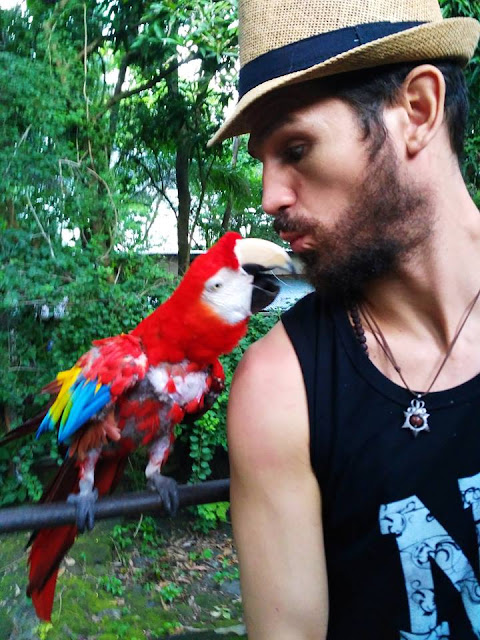
Not just anyone would risk a kiss from Midorna. As a Scarlet Macaw, she has powerful mandibles that could rip flesh with ease. Photo Andras Dorgai.
Midorna can help to create the conditions for a future with Scarlet Macaws once again flying overhead in Laguna de Apoyo and similar areas. She is an ambassador for her species, for the tragedy of the pet trade. Nicaraguans and foreigners alike get to hear her story and contemplate the issues that are behind her condition. More is needed to change the tide, however.

Scarlet Macaw
The role of the Scarlet Macaw in wilderness policy in Nicaragua is the story that Midorna has to tell others. Photo Andras Dorgai.

Research, conservation policy advocacy, and education on the pet trade in wild animals are still needed in Nicaragua in a big way. You can help. First of all, don't buy wild animals as pets. Make your opinion heard among your friends. Second, get involved. Volunteer your time to care of wild animals, donate your spare change to help feed and care for them, or join us for a study of the issues behind the pet trade. Contact us at GAIA if you are interested!
Ara macao
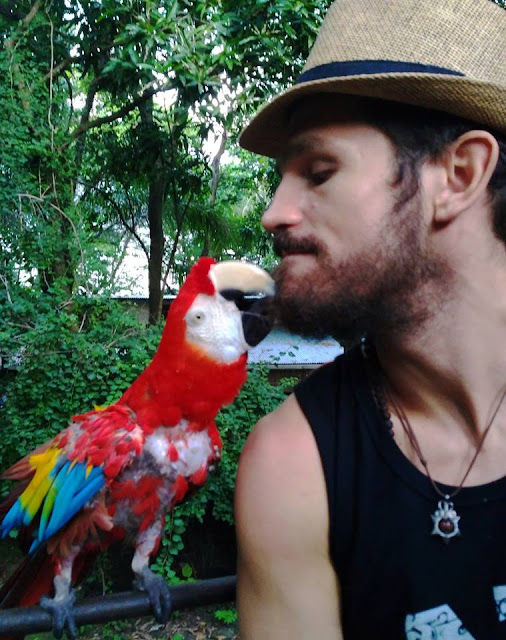
Beards are a special attraction to Midorna. Our goal is that she is the happiest Scarlet Macaw in the country, because liberty is no longer an option. Photo Andras Dorgai.

pet trade
Midorna loves attention, particularly from boys. Photo Jeffrey McCrary.

Ara macao
Midorna having an intense conversation. Photo Jeffrey McCrary.

Scarlet Macaw
Click on the "escudo" to contact us.

Thursday, June 11, 2015

Animal Rescue XVI: Macaws in Estacion Biologica Laguna de Apoyo, Nicaragua

Life is good when you are caring for injured animals. Click on the photo to learn more about Bumbelina and Midorna, our most loved members of Estacion Biologica. Photo Jen Moran.
Everyone likes pet animals. Animals bring happiness to our life in a lot of ways, by showing affection, their physical attractiveness, and by humoring us with their actions. Animals like dogs and cats have evolved thousands of years in the presence of humans, to the point that they are incapable of living distant from us. It might even seem that we are co-dependent on them, too, sometimes we can't live without them. 

These two macaws have been rescued from the pet trade, and we care for them at Estacion Biologica in Laguna de Apoyo. Photo Jen Moran.
We humans have a disconcerting tendency to interfere with the other species with whom we share this planet, however. It isn't enough that we eat some, use others to make housing, clothing and utensils. We like the idea of having animals around us, doing our bidding. We see a beautiful animal such as a macaw in the forest, and we think, "I want one". Even the precolombian people were known to capture these majestic animals and keep them as pets. It is difficult for us to accept and appreciate animals in the wild without giving in to the urge to dominate them, by capturing or killing them. 
Feather-plucking is one of several responses to years of captivity for animals that were never meant to be in cages. This bird can never return to the wild, so we are giving her the best treatment we can. Photo Jen Moran. 
Our fascination with wild animals has some perverse consequences. We insist on demonstrating our strength and courage by dominating wild animals by riding wild bulls and roping calves in rodeos, for instance. Ernest Hemingway wrote long and eloquent of his fascination with hunting animals and with the bullfight, a continuing tradition in Spain and Latin America, in which the bullfighter is pitted in a life-and-death struggle with a large, angry animal, albeit armed with deadly lances. We all know this to be an unfair fight, but millions are thrilled when the animal is conquered violently. 

This bird's broken wing has doomed her to a long lifetime in captivity. The pet trade in wild animals is extremely cruel, and should never be supported. Please do not ever pay for a wild animal! Photo Jen Moran.
Among most of us today, bullfights and rodeos are not popular. But our fascination with wild animals is such that having a wild animal as a pet is common and few people criticize this practice. However, unlike dogs and cats, wild animals suffer greatly in captivity, in ways that we may ignore as pet owners. 

These two birds are best friends and inseparable. Both are severely psychologically and physically scarred by their handling in the pet trade. Photo Jen Moran.
The pet trade in wild animals has been devastating to wildlife in Nicaragua. Today, very few people have ever seen a macaw in the wild. Nicaragua has two species, the Scarlet Macaw (Ara macao) and the Great Green Macaw (Ara ambiguus). Until about 1983, a flock of Scarlet Macaws was easily spotted flying over urban Managua, during the day, returning to roost in the Chiltepe Peninsula before dark. The pet trade took that flock away. Along the Pacific region of Nicaragua, all of which is native habitat for this glorious animal, only perhaps ten or fifteen animals remain, in the northwest corner, in the Cosiguina Peninsula. It is sad that one can not enjoy these majestic animals by birdwatching, but rather, we have to watch them through the bars of cages in zoos and the homes of wealthy individuals. 

Although both these birds suffer dramatic psychological effects from captivity, they are dying for attention. Our Eco-Warrior Volunteers at Estacion Biologica Laguna de Apoyo help with their care. Photo Jen Moran.
Most of the wild animals we rescue at GAIA end up getting released into the wild, if all goes well, and they have their opportunity to live and die in the forest, not in a cage as subjects of the whims of humans. These two animals, however, will never return, thanks to the horrible abuse they have received in captivity. We are giving them the wildest experience possible, with cages that look to the forest, lots of space, and as diversified a set of experiences as we can manage. We hope that through our small efforts, Nicaragua is a better place for wild animals and humans, alike.

These macaws will love you!! But they still bite! Photo Jen Moran.
Would you like to help us care for rescued wild animals? Please consider volunteering with GAIA or making a donation. We need spare cages, money for food and veterinary costs, and volunteers to spend time serving them! Please contact us.

Click on the "escudo" to contact us.

Monday, April 20, 2015

Los Derechos de los Animales

Ley 747
Los animales llegaron hasta con ropa formal! Foto Jeffrey McCrary.
Animales en Nicaragua
Marchando para reglamentar la Ley 747. Photo Wendy Pavón
El ser humano es capaz de lindas bondades, actos de amor y entrega. Pero a su vez, podemos ser indiferentes o hasta crueles, muchas veces sin reconocerlo. Vivimos en un mundo donde gente mata con justificaciones como "guerra" y luego expresamos cariño a nuestros queridos, familia, y hasta las mascotas. En este sentido, no debe sorprender a uno que nuestra manera de ver a los animales como seres con derechos absolutos que tenemos que respetar es algo nuevo. 


Ley 747
Se realizó la marcha con el apoyo de la Policía Nacional. Photo Jeffrey McCrary.

rescate animal
Los animales llegaron para exigir la Ley 747 reglamentada.
Como muchos otros paises, Nicaragua se encuentra en una discusión sobre cómo reconocer los derechos de los animales en nuestro entorno. Al inicio, luchar a favor de los animales parece una causa quixótica. En las ciudades, y en los pueblos, se ven perros en las calles con sarna, sin cuido, sin suficiente alimento, sin cariño y cuido de ningún ser humano. Muchas veces, estos perros tienen dueños, pero se considera apropiado mantener un perro en un estado miserable, casi siempre alegando falta de recursos. Lo mismo pasa con caballos. En ambos casos, cuando no son Ãºtiles o convenientes a sus dueños, son abandonados en la calle, para buscar como defenderse en una situación que no permite que no prosperen.
ley 747
Hasta los gallos marcharon! Photo Jeffrey McCrary.
animales en Nicaragua
El entrañable Scooby llegó, también. Foto Wendy Pavón.
Hay otras Ã¡reas en las cuales hay conflictos sobre los derechos de los animales. Sigue en alto el deporte de pelea de gallos. Es un deporte de todos los domingos entre todo el interior del país, a pesar de que es nada más ni menos que una imposición cruel sobre dos animales. 
ley 747
Pancartas pasaron los mensajes durante la marcha. Foto Jeffrey McCrary.
Otro serio problema en Nicaragua es la mezcla de los deseos de tener una mascota con la abundante vida silvestre alrededor. Frecuentemente, vemos monos, felinos, lapas, y otros animales que no son aptos para cautiverio, que fueron cazados y capturados del bosque para vender. Y lo más sorprendente y decepcionante es que hay personas que compran esos animales, pensando que pueden darles lo que realmente no se puede dar a un animal silvestre en una jaula. Cada animal silvestre debe vivir y morir en el bosque, no en una jaula. Estas y otras razones son las causas que nos motivan a promover una ley efectiva para proteger a los animales domesticados igual como los animales no domesticados. Hasta los circos tienen animales silvestres en exhibicion

ley 747
De toda edad llegaron para reclamar por los derechos de los animales. Foto Jeffrey McCrary.
El recientemente aprobada Ley 747 ha sido un avance sustantivo en la materia de la defensa de los animales. Sin embargo, hasta la fecha, no se ha emitido un reglamento para la ley, lo que significaría las indicaciones para sanciones en casos de violaciones de la ley. Sin reglamento, la ley lleva mucho menos poder, porque es de menos utilidad cuando se toca llamar a las autoridades para resolver a un abuso. 


ley 747
Los animales y sus amigos se tomaron la Carretera a Masaya. Foto Jeffrey McCrary.
La existencia de la Ley 747, a pesar de que sigue sin reglamentación, ha ayudado a dar publicidad sobre la criminalidad de los actos que perjudican a animales innecesariamente, y ha hecho muchos cambios en las actitudes de las personas en la sociedad. Las actitudes sobre el control de fertilidad de los perros, por ejemplo, han cambiado mucho recientemente. Otra señal es que un circo se presentó en Nicaragua sin animales en su espectáculo, por primera vez. 
Nicaragua sin maltrato animal
Todos con ropa que lleva mensaje de la Ley 747. Foto Alejandra Zeledón.

Pero la evidencia mayor de cambios en las actitudes se están dando, es el gran número de personas que sumaron a la Marcha por los Animales el pasado 18 de abril 2015. Cientos de personas, con perros, hasta conejos, cobayos y gallos! Con pancartas y mantas, reclamando por la reglamentación de la Ley 747. Aunque no fuera cubierta por los medios nacionales, la marcha recibió atención de la prensa internacional en Europa (Euronews). 
ley 747
Perros y personas, descansando en el Parque Cuba, después de la marcha. Foto Marvis Espinoza Smith.
Ayude a estos animales, sumando fuerzas con los grupos que ya existen, dando apoyo mutuo y compartiendo el trabajo. Si se siente con poco tiempo para ayudar, regale una bolsa de comida, una fruta (para los animales que las comen como lapas), etc. Te necesitamos!

Puedes contactarnos para decirnos que piensas de nuestro blog, o colgar un comentario abajo. 

Puedes ayudarnos a mantener la naturaleza salvaje en Nicaragua, dando de su tiempo con nosotros, o donar para apoyar a nuestros proyectos de conservacion.

Tropical Kingbird
Click on the "escudo" to contact us. 

Sunday, August 24, 2014

Animal Rescue XVI: Wild animals deserve to live free

Capturing an animal in the wild to make a pet of it is doubly insidious. The pressure on some animal species by the pet trade has caused the complete elimination of their populations in large areas. Macaws are a good example of this. We care for two macaws at Estacion Biologica Laguna de Apoyo, both were wild animals that suffered capture and brutal treatment in captivity.
Great Green Macaw
Bumbelina is a Great Green Macaw. Photo Pablo Somarriba.
Both the macaws have broken wings, as a result of the rough treatment given to them in captivity. These poor animals will never fly again. Because of the cruelty of the commerce in wild animals in Nicaragua, they are permanently condemned to live with humans. At least we can give them natural surroundings where they can be happy. The have large enclosures which permit them to move around and see in all directions, into the sky and the forest. They are allowed to leave their enclosures daily, and they get an ample, varied diet, with lots of interactions with people and other birds.

We kept the two macaws in a common enclosure several months. The Scarlet Macaw (Ara macao), however, has developed a common ailment among captive new world parrots-feather plucking. She plucks not only her own feathers, but also the feathers of her best friend Bumbelina, the Great Green Macaw (Ara ambiguus). We have placed a mesh divider between them, so they can see each other and even touch through the mesh, but no more plucking! Feather plucking is one of many pathological manifestations of wild animals in captivity when they should be free in their natural habitats.

wild animals
These baby opossums were brought to us by kind-hearted folks who found them abandoned. Photo Pablo Somarriba.
We at GAIA provide shelter for wild animals that have been found injured or unable to survive in the wild without rehabilitation, and pets that owners request to return to the wild. Recently, we received two young common opossums (Didelphis virginianus). These animals were found by a Nicaraguan family who gave them lots of care while they grew. But they found that the animals were needing more space and soon should be ready to be liberated. We took them and quickly returned them to the wild. They lived a few weeks in a hollow tree on our property, before moving on to the forest behind Estacion Biologica in Laguna de Apoyo Nature Reserve.

wild animals'
This White-throated Magpie-Jay (Calocitta formosa) chick was raised at Estacion Biologica and released into the wild, where he continues to live happily. Photo Jeffrey McCrary.
We have great plans to continue, to improve and amplify our capacity to handle wild animals. We need your help. Would you like to volunteer some time to care for wild animals? Or donate food or money to pay for their well-being? We need lots of cashews, fresh fruit, and materials for cages, among other things. Please contact us if you would like to volunteer or make a donation. Please help us make Nicaragua a better place for all beings.

wild animal
Contact us to participate in animal rescue!

Saturday, July 5, 2014

Los animales silvestres deben vivir y morir en el bosque, no en una jaula

La Asamblea Nacional de Nicaragua se encuentra en el proceso de reglamentar la Ley de Bienestar Animal, también conocida como la Ley 747. Esta ley noble prohibe al maltrato y requiere a todo dueño de animales, que sean de tiro, de alimento o de mascota, que brinde condiciones dignas para el curso de su vida.

Nicaragua, siendo un país con bosques alrededor, se ha acostumbrado a tratar a algunos animales como si fueran domesticables. Todos tenemos algún amigo que tiene un mono encadenado en su patio. Loras y lapas abundan entre la clase media alta, se han convertido en manifestaciones de poder adquisitivo. Y hay quienes en Nicaragua con tigrillos, leoncillos o hasta un jaguar enjaulado en su casa, extraño o perverso que sea.

Los perros y los gatos son animales que derivan de la vida silvestre, pero después de miles de años de acompañamiento a los seres humanos, ya dependen de ellos. Los gatos y perros no pueden sostenerse como especie sin alguna relación con el ser humano. 

Sin embargo, las lapas, las loras, los chocoyos, las culebras, y todos los animales silvestres, no prefieren vivir con el ser humano como si fueran gatos y perros. En jaulas, amarrados con cadenas, o con sus alas cortadas, se encuentran miles de animales de la vida silvestre en Nicaragua. El comercio en estos animales es tan fuerte que casi nadie en este país ha visto una lapa en su vida libre, pero todos hemos visto lapas en jaulas dentro de casas de amigos. 


Los animales silvestres en Nicaragua sí dependen de los seres humanos, para que se acabe con el tráfico de mascotas. Sin una ley y coacción contra las personas que participan en el tráfico de animales silvestres, vamos a seguir perdiendo animales del bosque, como ya ha pasado con la lapa y los monos en gran parte de Nicaragua. 


animales

ley 747

El Nuevo Diario ha publicado una entrevista sobre los rescates de animales silvestres del tráfico en mascotas. FUNDECI/GAIA maneja un pequeño albergue donde recuperamos animales silvestres heridos o abandonados del tráfico en mascotas. Por nuestra experiencia como voluntarios a favor de los animales silvestres, FUNDECI/GAIA participa con los miembros de la Asamblea Nacional en la formulación del reglamento para esta ley. Quieres ayudarnos a cuidar estos animales y prepararlos para su regreso al bosque? Necesitamos voluntarios, donaciones de comida, servicios veterinarios y buena voluntad! Si deseas donar un paquete de marañones o un día de trabajo, estaríamos nosotros y los animales muy agradecidos. Contáctennos. 

Monday, February 3, 2014

Illegal traffic in Nicaraguan wildlife IV

Wildlife in Nicaragua are facing two very critical issues. The first is that forests are disappearing rapidly, as the country prospers and develops more. Enforcement of the protection of natural areas is a big challenge to the government, which does not grow at the same pace as the economic forces behind deforestation and habitat destruction of all kinds.
But for many wild animals in Nicaragua, the greatest challenge to their continued existence in the wild is the pet trade. It is simply illegal to buy or sell many animals, or to exhibit them publicly, yet they are found daily in public places on display in restaurants and hotels, or along the road for sale. Again, authorities have little capacity to respond to this type of crime.
One of the most egregious groups of violators of the rights of protected wild animals is found along the Panamerican Highway at Moyua. Here are some images of animals for sale, openly on display.

pet trade
This young man is holding a Scarlet Macaw (Ara macao) for sale along the Panamerican Highway at Moyua. Photo Maggie Folkesson.
All day long, people drive by these folks with animals for sale, offering Nicaragua's natural heritage on a stick as if the macaw were fast food. Although people may be offended by the spectacle of these animals for sale, few do anything, because people may not feel capable of doing anything about such crimes.
This view shows even more clearly the Scarlet Macaw for sale along the Panamerican Highway in Nicaragua. Photo Maggie Folkesson. 
Among the animals which has suffered the most from the pet trade in Nicaragua is the Scarlet Macaw (Ara macao). This majestic animal once filled the skies with color and sound, flying in groups above the treeline and even in cities. Managua had Scarlet Macaws visit daily until they were all captured from their roosts in the Chiltepe Peninsula in 1983. A handful of these birds fly freely in the Cosiguina Peninsula, in the northwest corner of the country, their nests most likely protected from nest raiders by the steep slopes of the crater interior of the Volcano Cosiguina.
pet trade
There were two Scarlet Macaws on display this day at this site. Photo Maggie Folkesson.
FUNDECI/GAIA postdoctoral scientist Maggie Folkesson documented the wildlife on sale illegally in this location recently. Not only were there Scarlet Macaws, there were also several other species, most notably Yellow-naped Parrots (Amazona auropalliata), and White-faced Capuchin Monkeys (Cebus capuchinus). The woman in the photo below is holding one of each on display. 

pet trade
White-faced Capuchin Monkey and Yellow-naped Parrot for sale. Photo Maggie Folkesson.
Monkeys and macaws present many problems as pets, so it is typical that people who purchase them regret their actions later. Furthermore, their promotion of the illegal traffic in wild animals helps to empty the forests of wild animals, which is the principal reason Scarlet Macaws are no longer seen throughout most of Nicaragua.
The Yellow-naped Amazon is a common bird in the pet trade, but its status on the CITES list was recently adjusted to Appendix II, which means that it is not permitted for international commerce except within the context of an approved, successful captive breeding program, which does not exist in Nicaragua. Its range in Nicaragua is throughout the tropical dry forests of the Pacific side and some of the humid tropical forests on the Caribbean side of the country.
A new initiative is needed to stop the pet trade. What do you suggest?

pet trade
Here is a clear photo of a Yellow-naped Amazon parrot and a White-faced Capuchin Monkey for sale in Moyua. Their sale is illegal in Nicaragua. Photo Maggie Folkesson..
All of these animals are prohibited from sale in Nicaragua, although as anyone an see, the law is little respected. We share these photos in the hope that people will react. Do you want to see wild animals in the forests of Nicaragua? Then do something to stop the illegal traffic in wild animals.
pet trade
Click on the "escudo" to ontact us.

Thursday, January 17, 2013

Illegal traffic in Nicaraguan wildlife II

Human nature drives us to want to acquire things that are beautiful. We can't be satisfied to see a beautiful object in nature and then leave it there. For instance, some kinds of Nicaraguan wildlife are subject to the willfulness of humans to treat wild animals as objects that can be bought and sold.
Macaws are the largest members of the New World Parrot family (Psittacidae); they are spectacular, gregarious, and "smart" birds. Two species of this group are found in nature in Nicaragua: the Scarlet Macaw (Ara macao), and the Great Green Macaw (Ara ambiguus, previously named Ara ambigua). The Nicaraguan populations of both these species have suffered greatly because of the pet trade.
CITES
This is a Scarlet Macaw (Ara macao), which has been subjected to coloration, through chemicals such as hydrogen peroxide, to make it appear to be something even more exotic. Sale of these majestic animals should be banned, as well as mistreatment by processes such as feather bleaching. Photo by Matthias Geiger.
Scarlet Macaws (Ara macao) no longer inhabit almost all of the Pacific region of Nicaragua, thanks to the illicit pet trade. This species is listed on CITES Appendix I, which means, basically, that it is quite difficult to export an individual. In spite of the ban on international trade, Scarlet Macaws are much easier found on tethered to sticks on roadsides than in the skies overhead, in Nicaragua. There is a robust trade and virtually no prosecution of pet owners. Many birds find their way to small watercraft which transit contraband from Nicaragua to the much wealthier neighbor, El Salvador, where the birds bring much more money. A Scarlet Macaw in good condition in Nicaragua can cost much more than five hundred dollars. 
macaw
Bumbelina is a pet rescue, Great Green Macaw (Ara ambiguus).  She is receiving care at Estacion Biologica in Laguna de Apoyo Nature Reserve. Photo by Joyce Procure.
We have handled a number of rescue animals over the years at Estacion Biologica. Most of these animals have been taken from people who captured them for use as pets, or the animals have been found injured in or around Laguna de Apoyo Nature Reserve. When we have a little success, the animals survive, heal, and eventually, return to the wild. Not all can heal and return to the wild, however. One pet rescue bird in Estacion Biologica FUNDECI/GAIA, is a Great Green Macaw (Ara ambiguus). Its native range is considerably more limited than that of the Scarlet Macaw. The majority of the birds of this species are found in southeastern Nicaragua, where jungles are thick and rain is practically year-round. Bumbelina is a female, like her fellow rescue Scarlet Macaw, Midorna. Bumbelina is very angry and aggressive, and large and heavy, so she is best admired from a safe distance!
The Great Green Macaw is Endangered and is also listed on CITES Appendix I. Nonetheless, current law enforcement does not prevent the ownership of these birds inside Nicaragua, and they can be found in many homes.
macaws in Nicaragua
Bumbelina was captured in the wild, and her injuries were severe from the brutal mistreatment. She still dreams of flight, but her amputated right wing prevents her from ever returning to the wild. Photo by Joyce Procure.
Midorna is a Scarlet Macaw, also a pet rescue living at Estacion Biologica Laguna de Apoyo. Bumbelina weighs about twice Midorna, much bulkier with a much heavier bill and larger claws, but the two birds make great friends. Like Bumbelina, she has been mistreated in captivity, and her permanently injured wing prevents her from taking flight. During her lifetime of incarceration in a cage, she has developed a feather-plucking disorder, making her look much less majestic than she would look if living in the wild. We are hoping that her feather plucking will reduce with lots of activity and contact. The two birds are destined for delivering the message that wild animals deserve to be free, not in cages! They will be visiting schools and social events around our area, throughout 2013.
Ara macao
Midorna is affectionate with those whom she trusts. Photo by Joyce Procure.
As lovers of nature, we are disturbed by the illegal traffic in wild animals. Our desire to "own" a beautiful bird has harmed many birds, and their loud screeches are no longer heard in much of the forests they once inhabited. Would you like to help us prevent the capture and trade in endangered wild animals in Nicaragua? There is plenty to do. Please contact us!
wildlife in Nicaragua
Click on the "escudo" to contact us.