Saturday, February 1, 2014

Conservation Science - Birds in Laguna de Apoyo Nature Reserve, Nicaragua

Although many people only think of Laguna de Apoyo as a place to swim or to build a house, fascinating wildlife can still be found in its forests. Our bird monitoring program, managed by the biologist Jeffrey McCrary in coordination with the Ministry of the Environment and Natural Resources (MARENA), is now in its fifth year, is intended to demonstrate what is important about this forest as a natural area. We have been very successful in identifying some of the more important places as bird habitat in the Laguna de Apoyo Nature Reserve. In one of the sites we study, a pair of Pale-billed Woodpeckers (Campephylus guatemalensis) is regularly seen. Here is a picture of the female, taken by the FUNDECI/GAIA intern Pauline Pearse.
Jeffrey McCrary
Female Pale-billed Woodpecker in Laguna de Apoyo Nature Reserve, Nicaragua. Photo Pauline Pearse.
Our list of birds documented inside Laguna de Apoyo Nature Reserve now reaches well over 225 species. Although we are surveying only a small fraction of the 2500 hectares of land, well over a quarter of all the birds documented in Nicaragua have appeared here. We continue to press upon the authorities at MARENA and community to enforce policies against hunting, wood extraction, building and other land uses which destroy the habitats for birds like the Pale-billed Woodpecker. For instance, this bird is not found in the less mature forests on the north side of the lake, but rather only where there is a greater amount of intact, mature forest, in the southwest corner of the reserve. There are not so many places in Nicaragua where this glorious bird can be seen easily, so we are always happy to get a glimpse.
Jeffrey McCrary
This juvenile Grey Hawk (Buteo nitidus) is a typical sighting in Laguna de Apoyo Nature Reserve. Photo Pauline Pearse.
The documentation of biodiversity and the environmental effects on it by human activity requires detailed work, much of which is performed by the conservation science interns at FUNDECI/GAIA. Their assistance in our long-term bird studies is essential to understanding how an area so heavily used by humans can retain its qualities as a natural area for wildlife.
Jeffrey McCrary
Laguna de Apoyo Nature Reserve is home for many birds, including the colonial nesting Montezuma Oropendola (Psaracolius montezuma). Photo Belen Camino.
We recognize that the threats are palpable to these wild animals. For instance, on two occasions, the Montezuma Oropendola (Psaracolius montezuma) colonies in the area have been affected by landowners destroying their nesting colonies. In many areas where houses are found, large trees that would attract the birds are downed, limiting the potential habitat for these and many other birds.
conservation science intern
FUNDECI/GAIA conservation science intern, Ruben Pelckmanns, at work on a study of the motmots. Photo Pablo Somarriba.
We are continuing to gather information on the wildlife of the area, with the aid of visiting scientists, interns and volunteers. Our studies have recently been widened to consider nest sites, in which two of our conservation science interns have participated. We invite interested people to contact us and participate in the study and protection of this special natural area.
Jeffrey McCrary
Migratory birds such at the Summer Tanager (Piranga rubra) are important components of the birdlife in Laguna de Apoyo Nature Reserve. Photo Onno Bierman.
conservation science internships
Click on the "escudo" to contact us.

Sunday, January 19, 2014

Animal Rescue XV: Our nicest Christmas

We at FUNDECI/GAIA think that wild animals should not be in cages. Obviously, not everyone feels the same way, because wild animals can be found in cages throughout Nicaragua. Even foreigners often feel the need to keep a bird in a cage or a monkey on a chain, and often they try to convince themselves that they are "rescuing" the animal by purchasing it. After all, caged wild animals can be found everywhere in Nicaragua, even animals that are legally prohibited from the trade in wild animals. So whenever we see someone with a caged animal, we consider it an opportunity to discuss what is best for the animal and also for the entire situation for the wild animals that suffer from the pet trade in Nicaragua.
So, we are no longer surprised when people just call us up and ask us to take their caged animals. This is an increasingly common event. The good folks at the Redwoods Resort did that back in October, wishing to place their Keel-billed Toucan back into the wild. We have had a single experience, and it was successful, so we responded enthusiastically.
Keel-billed Toucan
This Keel-billed Toucan narrowly escaped returning to the pet trade when employees of The Peace Project tried to convince the owners of the bird that they were Estacion Biologica! Photo by Pablo Somarriba.
In anticipation of his arrival, we augmented our cage space, with ample dimensions and natural conditions to permit flying and perching at different levels. We fenced the cage with high-quality, galvanized wire chosen in consultation with the National Zoo. Special help was provided by our volunteers, especially from Ruben Pelckman from On-Stage in Holland. When we were prepared, we called the good folks at the Redwood Resort and they delivered the bird. 
Ruben and Elmer are hard at work on the new cage for the Keel-billed Toucan. Photo Pablo Somarriba. 
The folks from the Redwood Resort had a beautiful bird, in perfect health and with intact plumage, worth easily 600 dollars in the pet trade in Managua. When they delivered him, they asked to find us at The Peace Project, where the employees immediately told them that they represented us and could take the bird. But thanks to the fast response of Elmer, this toucan narrowly escaped returning to the pet trade through the inappropriate intentions of these people. 
The Peace Project
The toucan in his new cage at Estacion Biologica in Laguna de Apoyo Nature Reserve. Photo Pablo Somarriba.
Our new Keel-billed Toucan was beautiful, and quite wild. He had no intention of remaining in captivity. Likely captured as an adult, he did not like people and he was not satisfied with a cage, from the very beginning. This was a good sign.
We kept the toucan almost two months, feeding him well and observing him. He croaked often and loudly. He flew from side to side in his new cage. 
Keel-billed Toucan
Wild birds should not be in cages, and this toucan certainly agreed. He had ample food, attention, and room to fly, and he still wanted to be free! Photo Pablo Somarriba.
After all, this bird was in a cage. Although his conditions were better than ever, he wanted to be free, and having the abundant nature all around him inspired his desires even more. So, we began to prepare for his release. 
animal rescue
We carried the toucan to the southwestern corner of Lake Apoyo, where Keel-billed Toucans are common. FUNDECI/GAIA staff and volunteers helped to make the transfer to the wild, making the trip in our Road Warrior, also known as the Land Rover. Photo Pablo Somarriba. 
Keel-billed Toucans are common in the Laguna de Apoyo Nature Reserve, only in the southwestern quadrant of the caldera. We took him to near the San Simian hotel, where their very conscientious staff participated in seeing off this beautiful bird on his first flight into freedom.
animal rescue
Having reached his launching point, the FUNDECI/GAIA staff prepare to take the toucan from his transport cage. Photo Topi Lehtonen. 
It is always exciting to see an animal return to the wild, but especially so when the animal shows his desire so strongly. This bird never liked captivity and he was ready to return!
pet trade
Hotel San Simian staff prepare to document the liberation moment. Photo Topi Lehtonen.
Keel-billed Toucans are quite large, as birds go. So he is best handled with two hands. The bill can cut skin, and the serrations are sharp. But a little cut was no deterrent to our staff who are devoted to protecting nature.
wild animals
Pablo and Elmer in the last moment of captivity for this lucky bird. Photo Topi Lehtonen.
Not all birds are so lucky. The pet trade is driven by the money many people are willing to pay to keep such an animal in a cage. We hope some people will read about this bird and remember that wild animals should live and die in the wild, not in cages.
Keel-billed Toucan
We hope to see you from a distance again some day! Photo Pablo Somarriba.
Would you like to help with wild animal rescue? FUNDECI/GAIA needs volunteers to care for animals, cages and supplies and good food for animals which frequently appear for our care. Or go birdwatching with us! You can help, by participating as a volunteer or by a donation to help to purchase food and supplies. Please contact us for more information.
animal rescue
Click on the "escudo" to contact us.


Monday, October 7, 2013

The Mountain School I: Coffee Tasting


Nicaraguan coffee
Quality control in a coffee farm culminates in the most tempting of all jobs: coffee tasting. At The Mountain School, Spanish students learn about the coffee production process, including how the coffee is taste-tested professionally. Coffee tasting is still an art, but a fine art, with diligent procedures involved in the tasting process. Here are some photos of the coffee taster, Nelson McKuen, explaining the process to our group.
coffee in Nicaragua
When coffee leaves the wet mill, there is still a papery husk covering the bean, having the pulpy outer "cherry" removed and washed. Samples taken from the coffee are taken, measured and stored for documentation purposes.
coffee in Nicaragua
In the quality control laboratory, the coffee is dried under controlled conditions, in a cabinet dryer.
green coffee
Coffee drying in a cabinet in the quality control laboratory. Photo by Tania Company.
We gave the green coffee a taste-it doesn't taste like anything at all. Someone wondered aloud how anyone ever would have discovered the great taste of coffee, given that the raw product has no strong flavor.
coffee tasting
Nelson shows us how the coffee from the wet mill is dried before testing and storing samples. Photo by Tania Company.
As in any factory, there are lots of tests made by the quality control laboratory, including the quantity of "reject" material, moisture, and other things, but we were wanting to taste the coffee!
coffee roasting
A sample of coffee was wieghed before roasting for a taste test. Photo Tania Company.
The coffee roasted in the laboratory smelled wonderful. We were all excited before even drinking any coffee. Then someone reminded us that the taste test did not involved drinking coffee. To the contrary, the tasted coffee is spat out by the professional taster. How can they do that?
Nicaraguan coffee
Freshly roasted coffee has an incomparable flavor. Photo Tania Company.
Nelson ground the roasted coffee and placed a spoonful in each of several cups with hot water. The foam was removed by hand, then sampling began. Coffee makes The Mountain School even better!
The Mountain School
Nelson guides each participant through the tasting process.
Our results, however, were abysmal. None of our group recognized the differences between the different lots of coffee. Perhaps our group was anxious to drink coffee, not just swish it around in our mouths and then spit it out. Gaia Program director Jeffrey McCrary gave the coffee a taste, and yep, it was good.
coffee farm
Tasting coffees is diligent work. Photo Tania Company.
The coffee tasting and quality control processes are essential to any high quality coffee farm. We learned more about how good coffee is made by participating.
coffee
Click on the "escudo" to contact us.

Sunday, October 6, 2013

Camouflage and hiding animals of Laguna de Apoyo

Laguna de Apoyo Nature Reserve is known for its deep, blue lake, whether from near or far. The forest around the lake, however, holds a reservoir of life in great diversity. Animals large and small climb its trees and hide under its rocks. Some wildlife fly, others crawl, and many hide while in plain view. Here are a few images of the wonders we have encountered recently.

laguna de apoyo
Order Phasmatodea in Laguna de Apoyo Nature Reserve. Photo Laura Ruysseveldt.
The walking sticks (Order Phasmatodea) are insects, widely distributed in warm climates. Over 3000 species are found in this group. Generally, the females have broader abdomens than the females. They have additional defenses against being detected, by swaying as if a twig in the wind, and falling to the forest floor if molested. Some walking sticks may flash bright colors when they detect danger, and some even emit foul-smelling substances when attacked. The walking sticks are easily overlooked, as their natural disguise is quite successful.
Praying mantis (Order Mantodea) in Laguna de Apoyo Nature Reserve. Photo Laura Ruysseveldt.
The praying mantis (Order Mantodea) is also an immensely diverse group of species. There are more than 2400 species of praying mantis throughout the earth. Which is this one? Who knows!
scorpion nicaragua
Scorpion in Laguna de Apoyo Nature Reserve, Nicaragua. Photo Laura Ruysseveldt.
Scorpions are much feared, in some places even deadly. Thankfully, we have no deadly scorpions in Nicaragua, but that consolation only reduces the pain of a sting to annoyance. In the forests of Laguna de Apoyo, the scorpions can be abundant. The Order Scorpiones contains more than 1500 species, but only about 25 of them are deadly. They are not insects, but closer relatives to the spiders. Their colors are usually neutral to the human eye, but they remain undetected often because they stay still long periods in crevices. The scorpions can last long periods without food or water.
nicaraguan satyr
Nicaraguan Satyr, Cissia themis, in Laguna de Apoyo Nature Reserve, Nicaragua. Photo Max Schellekens.
Our research group at FUNDECI/GAIA has been studying the butterflies of Laguna de Apoyo Nature Reserve for a few years already. Among the species which spend extensive time on the forest floor among leaf litter, the undersides of the wings are usually more brightly colored and patterned than the uppersides. The underside of the Nicaraguan SatyrCissia themis, demonstrate this tendency. The ventral wing pattern, seen above, is delicate and more complex, especially along the posterior edge of the hindwing. The dorsal wing patter, seen below, is contrastingly dull and simple.
Cissia themis
Dorsal view, Nicaraguan Satyr (Cissia themis) in Laguna de Apoyo Nature Reserve, Nicaragua. Photo Max Schellekens.
walking stick


Sunday, September 15, 2013

Animal Rescue XIV: White-faced Capuchin Monkey

It is human nature to love animals and want to be near them. Humans domesticated dogs from wolves over 10,000 years ago, for instance, and today the two are inseparable. But not all animals are evolved to live dependent upon humans, however. Our love of animals sometimes becomes a kind of fetish, in which we twist our appreciation and admiration into a desire to own and control. Wild animals, in general, do not make good pets. Trying to make a wild animal such as a monkey into a pet almost always ends badly.

A young child bonded with this monkey, but she knows it's best for the monkey to live and die in the jungle, where it can live wild. Photo Pablo Somarriba.
Something may happen, however, that triggers in us a realization about something we had never considered before. Surely this was the case with a Nicaraguan family who decided on their own to place their pet monkey with us in the interest in having it return to the wild.

This white-faced capuchin monkey loved to run free, and now he lives with other monkeys of his kind, deep in the forests of Laguna de Apoyo Nature Reserve. Photo Pablo Somarriba.
This monkey cared little for adults, but was gentle with children. He was rambunctious, and insisted in making a mess in the kitchen. We soon hoped that he would indeed want to find his kind and rejoin them in the wild! This wild animal rescue was a real challenge.Fortunately, we had volunteers available to attend him and even to help him return to the wild.
Nicaragua
Our Spanish students-turned-environmental volunteers preparing for a monkey release mission. Photo Julie Akey.


It amazes us at GAIA how often well-educated people from the US and other developed countries end up with wild animals as pets when they come to Nicaragua to live. These people obviously are not thinking of the long-term welfare of the animal nor of the entire commodity chain in capture and sale of wild animals, when they purchase one of these poor animals that was stolen from its natural habitat. We often encounter foreigners in Nicaragua claiming to "rescue" the animals from the pet trade by purchasing them. Who do they think they are fooling?

wildlife
This poor White-faced Capuchin was brought to Estacion Biologica for return to the wild. Photo Julie Akey. 
Sooner or later, these people face reality. An animal such as a white-faced monkey is not the same as a dog. Its ancestors did not live hundreds of generations in dependence upon humans. The monkeys are wild animals and putting one in a cage or on a chain does not domesticate it. The animal suffers in captivity and usually, the owners do, too.
wildlife
Our volunteers carry the white-faced capuchin monkey through the forest to a site inhabited by a troop of its same species, to be re-united with its friends. Photo Julie Akey. 
Recently, we received such a donation. A white-faced capuchin (Cebus capucinus), friendly enough and very active, was nonetheless, no longer invited by its owners to be a captive animal. We are amazed athow easily people can "un-adopt" their animals, but so be it, this one was brought to us in that way. We agreed to take the animal, and we immediately contacted the local office of the Ministry of Natural Resources that this animal was a likely candidate to return to the wild.
After a week of observation, we decided that this guy could make it in the wild, if he could only re-integrate with a group of his species. There has been plenty of good news over the past few years regarding the white-faced capuchin populations, which also encouraged us to release him here. Once reduced to three small groups in precipitous canyons along the western side of the lake, the populations have been expanding and even colonizing new areas. We have even sighted a small group in the north section of the reserve, directly behind Estacion Biologica, with an infant born in early 2013.
volunteer
FUNDECI/GAIA staff member Elmer Nicaragua observes a group of white-faced capuchins nearby, assessing where and when to release the rescue animal to make contact with the group. Photo Julie Akey. 
White-faced capuchins are very intelligent animals. They often use tools in the wild, using rocks to break open seed pods. Their social hierarchies have been the subjects of numerous scientific studies. They live many decades in captivity, often exceeding fifty years age.
wildlife
The released white-faced capuchin monkey begins his first steps as a free animal in many years. Photo Julie Akey.
Because this animal had been accustomed to humans, we chose to release him into a troop located far from any houses, in the southwestern corner of Laguna de Apoyo Nature Reserve. The largest troop of this species is found there. The release required a drive in our sturdy Land Rover, followed by a hike through the forest to reach a troop and then assess the situation. Elmer Nicaragua, accompanied by the students of Apoyo Spanish School, found the troop easily and there made the release.
wildlife
Unlike their close relatives the Golden-mantled howler monkeys, white-faced capuchins often make their way to the ground where they forage for fruits and arthropods, turning over leaves and rocks. Photo Julie Akey.
As we expected, the monkey was quite timid in the new, wild surroundings. After some time on the ground, he ascended the trees where his new friends were watching. Another wild animal returned to his place in Nicaragua!
Nicaragua
Another wild animal release has been made! Photo Julie Akey.
Releasing a wild animal is always a nervous scene. The wild is full of predators and prey, and any animal new to its surroundings is likely to become prey quickly. Our objective is to give the animal an opportunity to integrate into its environment with appropriate skills to survive especially until making its way into the community. We were relieved with the monkey scaled a tree and began acting like the wild animal we hoped he would remember he was.
animal rescue
Our rescue animal examines his surroundings with other monkeys observing him from nearby trees. Photo Julie Akey.

monkey
Higher is better, up he goes! Photo Julie Akey. 

wildlife
Now he's looking like a wild animal again. Photo Julie Akey.

The monkey moves from tree to tree, exploring cautiously but surely. Photo Julie Akey.
We at FUNDECI/GAIA promote the protection of the wild areas of Nicaragua and the flora and fauna found in them. Learning how to appreciate our wild nature is a process, and we are learning as we go, too. We are happy when we can make a small contribution.
monkey
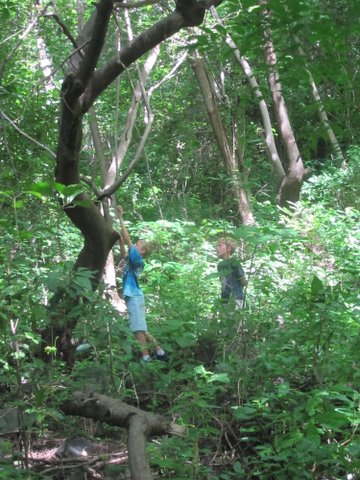
Our volunteer helpers in the animal release watch the monkey as he adapts to his new home in the forest. Photo Julie Akey.
Would you like to help us with wild animal rescue? We need funding to build cages for more animals, such as monkeys and squirrels, and purchase special foods such as cashews for our macaws. We also need assistance in care for the animals-volunteers are especially welcome. You can donate here, or volunteer here!
white-faced capuchin
Click on the "escudo" to contact us.