Wednesday, August 14, 2013

Under the water

We spend hundreds of hours per year under the water in Laguna de Apoyo, in counts of fish, documentation of the quality of the habitat where they live, the vegetation found there, and yes, even in retrieving the trash that folks discard which ends up all along the lake bottom. Here is a small collection of photos which show what we see when we are down there, in the most beautiful spot in Nicaragua. In the photoessay below, you can experience what one of our interns saw during a study of the fish with the director of the Gaia Program, Dr. Jeffrey McCrary. Dr. McCrary is leading an international team in the study of the fishes of Laguna de Apoyo, and to date five new species have been discovered as part of the program. 
These fry of an Amphilophus zaliosus pair recently hatched in a nest hole which is often seen with babies. 

Lots of fish are hanging out in this site, including a probable male Amphilophus zaliosus in breeding coloration in the center of the photo. 


Counting fish along a transect.

Juveniles and nonbreeding adult Amphilophus seek refuge under rocks in Laguna de Apoyo.

Breeding season is approaching, and breeding pairs are forming. A pair of Amphilophus zaliosus are in the foreground, and a pair of jaguar cichlids, Parachromis managuensis, are in the background. 
As can be seen from the photos, several Midas cichlid species are locally abundant in the waters of Laguna de Apoyo. Of the six species recognized in Laguna de Apoyo in this group, the most abundant of the group in most locations is the little Apoyo cichlid, Amphilophus astorquii. Other fish species are in the lake, too: Atherinella sardina, Poecilia sphenops, and Parachromis managuensis, as well as some invasive species.
Fish ahead!

A multispecies school of Amphilophus cichlids.

The species of Amphilophus cichlids in Laguna de Apoyo vary by body shape, spot pattern, and background colors. 

Dozens of cichlids are always under this rock!

Much of the lake bottom is covered with recently eroded sediments which cover the rocks and destroy all the high-quality habitat. Furthermore, ordinary garbage accumulates along our transects, such as this plastic cup, sold by the local bars. 


In some areas where waves clean the substrate, the lake bottom is covered with fine mud or sand. 

Fragments of snail shells (Pyrgophorus coronatus) litter the surface in many places. Snails are an important component of the diets of the Amphilophus species flock in Laguna de Apoyo. 

Filamentous algae has displaced Chara vegetation along the bottom in much of the lake. We do not understand why Chara often disappears from the lake, although it is known that tilapia will consume large quantities of it. 
In shallow areas with small rocks, juveniles of the invasive species Gobiomorus dormitor abound. 

Many shallow areas are covered with snail shell fragments, demonstrating the abundance of snails in Laguna de Apoyo.
A human-altered waterscape in Laguna de Apoyo. Filamentous algae and a plastic beverage bottle displace native fish and vegetation. 
Silversides, Atherinella sardina, put on a show in the water column. Silverside schools may exceed ten thousand individuals. 
Click on the "escudo" to contact us.

Monday, August 12, 2013

Apoyo Spanish School

Learning Spanish is not always easy. A good teacher is important. An appropriate environment is equally important. We try to emphasize both at Apoyo Spanish School. Ours is the longest operating of the Nicaragua Spanish schools, and our teachers have the most experience of those of any of the schools in Nicaragua. Our teachers have conducted numerous teacher trainings; many of the teachers in other Spanish schools in Nicaragua have learned to teach Spanish with us.
Apoyo Spanish School
Students of Apoyo Spanish School enjoy private Spanish classes with the most experienced teachers in Nicaragua. Photo Pablo Somarriba.
Learning Spanish in Laguna de Apoyo Nature Reserve means receiving high-quality classes with experienced teachers in the longest-running program in the country. It also means enjoying a natural environment, in which monkeys are overhead, the clear water of Lake Apoyo is a few steps away, and interactions with rural people are the order of the day.
Apoyo Spanish School
Spanish classes at Apoyo Spanish School are held from 8 am to 12:30 pm, and lots of homework keep the students busy and learning afterward. Photo Pablo Somarriba.
Our teachers at Apoyo Spanish School have developed our own study materials, based on more than twenty years of accumulated experience. Our methods are so successful that many Spanish teachers in other schools use our materials as their instruction guides.
Nicaragua Spanish School
Spanish classes are adapted to the level of the student, from the most basic beginner to advanced students needing academic or business Spanish skills. Photo Pablo Somarriba.
Students at Apoyo Spanish School receive exposure to the local culture during their stay, including Nicaragua foods and cooking, popular culture, history and politics. Nicaragua is a poor country in many ways, but its culture and history are rich beyond comparison.
Apoyo Spanish School
How do they make that sopa de queso? Spanish lessons may extend into the kitchen. Photo Pablo Somarriba. 
Laguna de Apoyo Nature Reserve is a great place to see wildlife. Every week, bird experts on our staff take Spanish students, visitors, and volunteers on nature walks. Howler monkeys, oropendolas, trogons and motmots abound in our vicinity, easily seen during the day. Evening walks may uncover owls, snakes, and tarantulas! 
Nicaragua Spanish School
International topics are common among the many nationalities who visit us at Estacion Biologica. The patio is a great spot to relax and share with others. Photo Pablo Somarriba.
There are also some spectacular views in the volcanic landscapes in and around Laguna de Apoyo. The views, for instance, from Coyotepe are expansive, both across Masaya and the Volcano Masaya with its laguna hidden in the caldera, and toward Tisma and Lake Nicaragua. The horrific history of Coyotepe, with invasions of the gringos, and later, imprisonment and torture of the opponents to the dictatorship, can be heard in the echoes throughout the cavernous structure of the fort. 
Nicaragua Spanish Schools
Lake Masaya and the city of Masaya are below Coyotepe, one of the sites visited by students of Apoyo Spanish School. Photo Pablo Somarriba.
By walking the paths of Laguna de Apoyo Nature Reserve, one can retrace the steps of Cacique Diriangen and view the landscapes which motivated his people to resistance against the Spanish invasion. His spirit lives on in the resistance of the people of Masaya and Los Pueblos. 
Everything done with a smile! Photo Pablo Somarriba.
Most students of Apoyo Spanish School enjoy the multinational company at Estacion Biologica, but one can make an entirely Nicaraguan experience en espanol easily. Our staff conduct all activities in Spanish. 

Nicaragua Spanish School
Afternoon activities are designed to expose the students of Apoyo Spanish School to the language in new settings. Photo Pablo Somarriba.
Apoyo Spanish School is in a rustic but clean and safe setting, with toucans, monkeys and forests overhead. The lake is best enjoyed by a daily swim or SCUBA dive, but the spectacular views from along the edge of the Apoyo crater are to be appreciated, too.
Apoyo Spanish School
Granada and Lake Nicaragua are seen in the distance from the Catarina mirador. Photo Pablo Somarriba.
The people who live around Laguna de Apoyo are artisans from centuries past. Leather working, wood carving, weaving natural fibers, and fired ceramics are among the products made in the region. The lifestyle of the Nicaraguan is one of farming, artisanry, and rural values, even when people move to the big cities. Every Nicaraguan has artisan crafts on display at home. 
How to embellish a ceramic object before its firing is the lesson of the day, in San Juan de Oriente, the pottery capital of Nicaragua. Photo Pablo Somarriba.
The teachers of Apoyo Spanish School come from the area, and know the reality of the rural people of our area. In their families vegetables, fruits, and grains are grown, artisan crafts are made, and vendors hawk all kinds of dry goods in the municipal market. Educations have come to the younger generation, thanks to the advances of the Nicaraguan Revolution, but the lifestyles still value the country style life.
Nicaragua Spanish School
Throwing a pot on a wheel is not as easy as it looks, especially when the motor for the wheel is your foot! Photo Pablo Somarriba.
Nicaragua Spanish School
Click on the "escudo" to contact us.

Thursday, August 8, 2013

Laguna de Apoyo in Mongabay

Here is the text from an article by our volunteer and student of Apoyo Spanish School, Elizabeth Loudon, which appeared in Mongabay.

Laguna de Apoyo Nicaragua
Foto L. Eisenberg.
Laguna de Apoyo, a volcanic crater lake between two of Nicaragua’s most populated cities, is known as a tourist destination for locals and backpackers. This section of  tropical dry forest is part of a corridor that is vital for many long and short distance migrations. Unbeknownst to many visitors, this site is also rich in pre-Columbian history and biodiversity. Ancient Chorotega petroglyphs remain intact and often unvisited, wrapped in the roots of chilamate trees. The vibrant Turquoise Browed Motmot, the national bird of Nicaragua, can be sighted eating Jacote fruits when they are in season.
Jeffrey McCrary

Since the creation of the reserve in 1991, Estacion Biologica Proyecto Ecologico has produced research and partnered with the Ministry of Environment and Natural Resources  to protect the threatened ecosystem. Currently funded by the Nicaraguan Organization FUNDECI, it is the only research facility in the reserve. This protected area is home to a variety of flora and fauna, some of which evolved inside the 24,000 year old crater. Many unique species of fish have been discovered within the freshwater laguna, but there are still plants and animals that are yet unstudied.

Unfortunately, Estacion Biologica struggles against development and environmental degradation within the reserve as scientists and volunteers from around the world attempt to learn about this seldom studied ecosystem. Funding can be scarce for research and outreach programs, and there are many paradigms to battle. Promoting awareness and providing environmental education for the community is a massive effort. Considering the problems with waste disposal nationwide, the Nicaraguan Government has recently adopted slogans in an attempt to encourage people not to litter. While this represents a step in the right direction, there is much progress left to make before Nicaragua adopts an anti-littering culture.
Estacion Biologica is allied with the local high school, which has recently begun to collect plastic bottles for recycling. The teachers and students benefit from the money that the recycling earns, as well as from the value of the program for teaching the benefits of environmental sustainability. The students within the local schools often participate in service activities like lake clean ups and reforestation projects. This type of community engagement allows them to gain experience caring for the Laguna.
Photo L. Eisenberg.

The shores of the Laguna de Apoyo, although cleaner than other Nicaraguan lakes, are still littered with plastic debris left by visitors. The government has provided trash cans within the reserve, but many people don’t use them. According to Dr. Jeffrey McCrary, the Director of Estacion Biologica, “The situation in Nicaragua parallels the situation in the United States 50 years ago…It’s a tough problem. It’s sort of seen as a victimless crime by a lot of people.”
Teaching Earth Rights and helping Nicaraguan youth to see the interconnectedness of actions and environmental impacts is no small task. While we are all victims of the tragedy of the commons, it is especially challenging to address environmental issues in developing countries.  Problems such as deforestation and waterway pollution, common to many developing countries, weigh heavily on Nicaragua. While the government is responding to some of these problems, it faces many economic challenges that often inhibit preservation efforts. The Laguna de Apoyo Reserve is just one at risk area, among the 78 protected areas in the contry.  Nicaragua is the poorest country in the the Western Hemisphere behind Haiti, but it contains many biodiversity sites that require protection.
In spite of the many challenges, many small organizations like Estacion Biologica continue to make a small but meaningful impact.The increasing popularity of Nicaragua for tourism could represent a threat to the environment, but perhaps it is possible to nurture a symbiotic relationship between tourism and nature. Laguna de Apoyo is a hidden gem that retains a rare exotic charm. Tourists are attracted by the opportunity to watch howler monkeys feasting on mangoes in the trees above their heads. The fireflies come out in abundance at night, especially before the rain. Hopefully, with the efforts of local nonprofits like FUNDECI, these environmental treasures can be preserved for future generations.


Wednesday, July 31, 2013

Brushfoot Butterlies (Nymphalidae): Mariposa!

Although we all enjoy watching butterflies in passing, not many people give them much attention. We all know that they pass from caterpillars to flying beauties via a dramatic physical transformation we call metamorphosis. But of the thousands of butterflies and moths (Order Lepidoptera) found in Nicaragua, much is not known. Only a fraction of the species found in Nicaragua of the moths-those which fly at night-are even documented in Nicaragua, and many species of the butterflies-those that are active in the daytime-have not been documented in the country.
mariposa
Several species of Hamadryas genus butterflies are found in Laguna de Apoyo Nature Reserve. Photo Max Schellekens.
There are hundreds of butterfly species in Laguna de Apoyo Nature Reserve. Researchers at FUNDECI/GAIA have documented well over 200 diurnal butterfly species so far (see this link for a publication). One group of butterflies, called the brushfoots (family Nymphalidae), is notable for its tendency to feed on fermented fruit on the forest floor. This ample group is represented in this area by dozens of species. Some of these species are quite numerous during appropriate seasons. 
butterfly
Una mariposa grande! Photo Max Schellekens.
The great species richness of this group in Laguna de Apoyo Nature Reserve depends on diversity of vegetation. The larval forms of butterflies are usually limited to only a few species of plants for each species. Many species are very particular about the host plants for their larval forms.  Wherever a butterfly species is found, one or more of a small number of potential host plants for the caterpillars of that species must also be found. 
butterfly
The eyespots on the underside of the wing of Morpho helenor. Photo Max Schellekens
This means, quite simply, that butterflies can be important indicators of the conservation status of a natural area. Activities such as selective cutting, forest fires, and clearing vegetation from the forest floor may impact some butterfly species by altering the number of potential host plants available. We have been studying the butterflies of the Nymphalidae family with quantitative methods for a few years, with the intention to compare the communities of this group in different areas of the forests with different land use patterns. 
butterfly
The Malachite (Siproeta stelenes) is quite common in Laguna de Apoyo Nature Reserve. Muy bonita mariposa! Photo Max Schellekens.
Two interns from Holland, Max Schellekens and Hessel van der Weide, reviewed the accumulated data on Nymphalidae butterfly communities and reported on their findings in a presentation in July, 2013. As we expected, the butterfly communities were altered dramatically by more intense land uses such as housing and in secondary forest formed after deforestation. 
la mariposa
The underside of the Malachite (Siproeta stelenes) is far less colorful and dramatic than the upperside, aiding in avoiding predators while perched on the forest floor. Photo Max Schellekens.
Meanwhile, these interns developed some interesting information on when the populations peaked for each species of the group, and where they were most common. This information can be used to determine what environmental factors can be most important for each species, to develop conservation strategies to protect the forests and the animals in them. 
butterfly
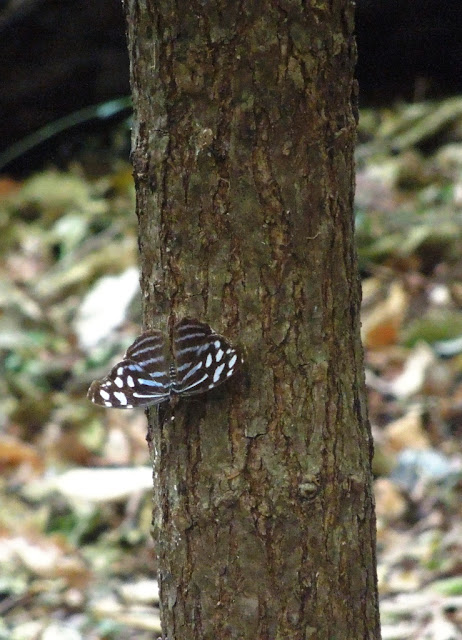
Although well-camouflaged when the wings are vertical, many butterflies of Nymphalidae family are conspicuous when viewed along the dorsal side. Photo Max Schellekens.
As consumers of the juices of fruit on the forest floor, these species require strategies against potential predators in trees as well as on the ground. Most Nymphalidae are well-camouflaged when sitting on the forest floor, where checkered patterns of dark and light, neutral colors dominate among leaf litter. When these butterflies as perched on the forest floor, they maintain their wings erect, showing complex patterns of neutral colors on the ventral sides of the wings, which blend with the surroundings.  
butterflies
Some Nymphalidae butterflies are particularly subtle, with cryptic patterns on both sides of the wing. These butterflies tend to inhabit altered areas more, where greater need for hiding is necessary. Photo Max Schellekens.
When dropping their wings, other patterns and colors appear, more vibrant and spectacular. Most brushfoots show dramatic coloration above. Perhaps the most popular of the butterflies of the forests in Nicaragua is the Morpho butterfly (Morpho helenor montezuma), whose dorsal side glows with metallic blue, whereas the underside of the wings are dark with eyespots. One particularly large eyespot near the rear of the hindwing may aid the butterfly by giving the impression of an owl. Many potential predators of a Morpho butterfly would not want to run up against an owl, so this spot may reduce the pressure of predation.
mariposa
Even when butterflies are practically invisible from a distance, the wing patterns upon close examination may be very attractive. Photo Max Schellekens.
As the photographs show in this essay, studying the brushfoot butterflies does not require harming them. The butterflies are trapped passively when they come to the fermented fruit bait, and there they are held a few hours without harm until they are removed, identified, and then released. These butterflies have colors and design patterns that are much better appreciated up close, too, as the photos show. They are all beautiful!
mariposa
Hamadryas butterflies are especially abundant in altered areas in Laguna de Apoyo Nature Reserve. Photo Max Schellekens.
 By making careful observations, the interns were able to make commentaries on the abundance of the butterflies during different seasons and in different locations in Laguna de Apoyo Nature Reserve. Furthermore, they gathered information regarding the sex on the butterflies. Males and females of many species act very differently. Often, females are not very active. Many aspects of the basic biology of the Nymphalidae butterflies is simply not known, and we hope to make a small contribution to the knowledge base, while learning about the butterfly diversity in the different areas of the reserve.
butterfly
La Mariposa Aliazul, or the Bluewing, is far more conspicuous on the dorsal side than the ventral side. Photo Max Schellekens.
By learning when and where each butterfly species is most common, we can build patterns of the web of diversity in the forests of this reserve. Seasonality of butterfly abundance depends on environmental factors such as appropriate conditions for feeding caterpillars in the host plants. 
butterfly
Hamadryas butterflies show dramatic colors and patterns on the dorsal side of the wings. Photo Max Schellekens.
The interns Max and Hessel built on a substantial database developed over five years. During this time, we counted on the labor of several interns and volunteers, and the volunteer support of the students of Apoyo Spanish School as well. Their final presentation was attended by a standing-room-only crowd of conservation professionals, tourism operators, biologists and students. More work is to be done, so potential interns and volunteers are invited to apply!
Nymphalidae
Wing underside patterns of the Nymphalidae butterflies are subtle but, on close observation, filled with fascinating detail. Photo Max Schellekens.
All visitors are welcome to visit us and discuss the butterflies, or to volunteer to participate in our studies. Please contact us for any information you request.
mariposa
Click on the "escudo" to contact us.

Thursday, July 25, 2013

Wildlife Monitoring in Laguna de Apoyo

It is no secret to us who frequent Laguna de Apoyo Nature Reserve that it is under siege from several types of human activities. Forests disappear without anyone taking note and speaking out. Usually, this happens not in fell swoops of forest, but rather, one branch, or a small stem, at a time. Areas get cleared by surreptitious actions of hired workers, a little at a time. Trash and concrete slowly creep across what was jungle.
colibri

How this process, of conversion of land from wild jungle to farmland and summer homes and gardens, affeds wildlife on the scale it is conducted in Laguna de Apoyo, has not been tested much. Common sense would tell us that small alterations to the forest make big changes in the animals that live in it. But we live in a society where lies and misconstructions are stated and accepted as facts, so we set out to compare the fauna of different parts of the forests in Laguna de Apoyo.

mariposa
The title page of the presentation by three interns from Holland. Photo Pablo Somarriba.
 At FUNDECI/GAIA, we have been studying the impacts of human activity in the forests of Laguna de Apoyo Nature Reserve for some five years. The results are now being prepared for publication. A presentation of the results of the impacts on fruit-eating butterflies (family Nymphalidae) and hummingbirds (family Trochilidae) was made at Volcano Masaya National Park, Tuesday 23 July, 2013. Bart Verdicjk, Hessel van der Heide, and Max Schellekens, biology interns from Holland, produced the following videos on the process, which were presented along with results of the studies on butterfly and hummingbird communities in Laguna de Apoyo Nature Reserve.
Intern Max Schellekens presenting the results of butterfly studies while dozens of participants observe. Photo Pablo Somarriba.
These three interns collected data and then they analyzed data on hummingbirds and butterflies during the past five years in different locations in Laguna de Apoyo Nature Reserve. Their presentation was well-attended, not a single seat was found in the house!
Volcano Masaya National Park Director, Liliana Diaz, during an animated discussion after the presentations by the interns. Photo Pablo Somarriba.
A rising consciousness and concern for wild nature is seen in Nicaragua today. The young people of the area of Laguna de Apoyo, many of whom attend Instituto Augusto Flores Silva, made an important representation of the audience, which pleased us infinitely to see.
A standing-room-only crowd in the auditorium of Volcano Masaya National Park! Photo Pablo Somarriba.
The risks that wildlife face in Laguna de Apoyo Nature Reserve are enormous, and as many people recognized in the discussion, tourism provides important elements to a strategy to protect this beautiful natural site. Several professional tour guides were present as well, some of whom added important comments.
Las mariposas de la Laguna de Apoyo. Video Max Schellekens.

Los colibries de la Laguna de Apoyo. Video Max Schellekens.

butterflies
Click on the "escudo" to contact us.