Sunday, February 28, 2016

Volcano Craziness

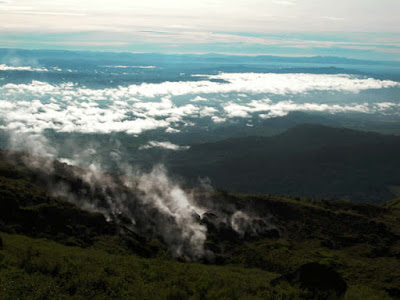
Nicaragua has been called the land of lakes and volcanoes. Both dominate the views throughout the Pacific region of the country. Lately, volcanic activity has dominated the national news and the minds of all who live near them. The authorities have evacuated employees from some locations and some residents from a few locations, while intense monitoring of the situation continues. Here is a video of the dramatic volcanic activity in the Santiago Crater of Volcano Masaya.


There are, currently, five volcanoes in Nicaragua that are declared "active", which means something far beyond just heat on the surface or active fumaroles. These are Masaya, Momotombo, Cerro Negro, San Cristobal, and Telica. All are worth a view. The Volcano Masaya National Park is closed until further notice. In this area, the volcanic activity far exceeds anything that has happened there in more than 200 years. Views are best during the evening, particularly during a new moon, either from the Masaya-Managua highway or along the Malecon in the city of Masaya.

Volcano Masaya
The INETER Volcano Cam from 4 March 2016, shows an intense glow on the smoke emitted from the volcano. 


The Masaya Volcano is the main attraction of the Volcano Masaya National Park, located just north of the city of Masaya. The top portion of the crater is devoid of vegetation, hot and arid, and much of its flanks are covered only in annual plants which burn during the occasional dry season forest fires. Trees can not grow in these areas because of the intense heat which reaches to very near the surface of the soil. A volcanic crater lake, one of eleven found in the country, also can be seen in the park.

Make a trip to see them, but remember to be safe and obey the laws and current prohibitions!

Masaya Volcano
The smoke emerging from the mouth of the Santiago crater at Volcano Masaya National Park. Photo Jeffrey McCrary.

Volcano Masaya
Even on a good day, Volcano Masaya emits enormous quantities of smoke and noxious, corrosive gases. It is the largest source of mercury emission in the western hemisphere. On the flanks of the crater interior, a parakeets roost and reproduce in holes, some of which can be seen in the photo. Photo Jeffrey McCrary.

Momotombo
Momotombo Volcano rises from the north edge of Lake Managua. Its sister volcano, Momotombito, can be seen in the distance, an island in the lake. Photo Brenda McCrary.


Casitas Nicaragua
Casitas Volcano has active fumaroles near the summit.

Nicaragua Volcano
The smoking crater of El Hoyo Volcano, as seen from the summit of Casitas. 
Nicaragua
Click on the escudo to contact us.

Workshop for Spanish Language Teachers

Learning Spanish requires a lot of effort over a long period on the part of the learner and accurate guidance from well-planned classes to keep the student out of grammatical pitfalls. Gaia has been training Spanish language teachers for decades, and the best school in Nicaragua use teachers that have been trained by us. We take seriously the goal of Spanish language learning and we invest in the training of our teachers to provide the best pedagogical tools for learning. Our Spanish courses in Estación Biológica Laguna de Apoyo are famous, having existed for longer than at any other Spanish school in Nicaragua.

Managua Spanish School
Mayela explains Spanish class organization with workshop
participants looking on. Photo Jeffrey McCrary.
January is always a busy month in Estación Biológica in Laguna de Apoyo, and this past January was no different. Among our many activities was a workshop for Spanish language teacher training, held in the shade of our marvelous trees 29 January. Mayela Blas, who herself began her career as a Spanish language teacher with us in Apoyo Spanish School, conducted the workshop with thirteen participants. Our teachers were exposed to some of the theoretical aspects of language transmission, as well as some of the practical elements of Spanish language instruction such as lesson planning techniques.

spanish
Participants in the workshop combined a power-point
presentation with the informality of our shaded patio for a
relaxing setting to learn. Photo Jeffrey McCrary.
Participants came from neighboring departments and Managua, and were given an excellent presentation by Mayela. More of these events will be programmed during the year 2016 at Apoyo Spanish School. We consider our job to teach our students and to make all the Spanish language teachers, throughout the country, as capable and responsive to the needs of the students as is possible. We have been the Spanish school that teaches the teachers for a long time, and as this workshop demonstrates, we continue to provide assistance to the entire community of Spanish teachers. In addition, we used the workshop as our moment to launch our newest project at Gaia: Managua Spanish School.

Now, Gaia provides two different options for learning Spanish, both in Laguna de Apoyo, and in the Managua area. Professionals who can't travel far from the capital may find Managua Spanish School just the right fit.

Spanish instruction
Some of the participants in the January workshop. Photo Jeffrey McCrary.
Would you like to be involved as a Spanish language teacher? Additional workshops will be conducted during the year 2016, including topics from the use of poetry and prose in teaching Spanish, how to evaluate student language progress, and teaching techniques for specific applications.

Or perhaps you would like to learn to speak Spanish. We are prepared to help you learn Spanish, from the most elementary levels to the finer points of fluency. We can provide Spanish instruction for you in Laguna de Apoyo or in Managua. Please contact us for more information.

Managua Spanish School


Tuesday, February 23, 2016

Enjoying Laguna de Apoyo

Among the most powerful images that come to mind when one thinks of Nicaragua are those of Laguna de Apoyo. Both foreign travelers and Nicaraguans are stunned by the views. The lake occupies a deep, wide volcanic crater, with relatively steep interior sides, making the lake essentially occupy a hole in the ground. Its clear water is warm, inviting and clean.

Laguna de Apoyo
Photo Lucy Lia Real.
Although most references to Apoyo characterize it as a lake, it is a true volcano. The lake is often called a crater lake, in which its water has no open flows outward. In fact, its volcanic origins are demonstrated, as there are warm water vents in the lake at several points. Its shape is considerably different from other, more typical volcanoes, such as Masaya and Mombacho, between which Apoyo lies. There is no overground flow of water out of the lake, and its water is slightly salty.

Laguna de Apoyo
Photo Enrique Palacios Jeyson Hondoy.
Especially on the weekends, Nicaraguans from the neighboring towns love to visit Laguna de Apoyo, where they can picnic and relax in a natural setting, and the few who can swim my get into the water. The entire shoreline is public, making access to the lake wide, although many property owners along the shoreline may not cooperate with access to the water easily.

Laguna de Apoyo
Photo Jeffrey McCrary.
There really is nothing better than being on the lake, in the water. But that is not the only way to enjoy the lake. The view from Catarina, for instance, is spectacular, and one is often serenaded by folk musicians. There, one can enjoy an ice cream or even a full dinner while marveling at the constantly changing hues in patchwork style across the water, with Volcano Mombacho to the right, Granada and Lake Nicaragua beyond, and Volcano Masaya to the left.
Laguna de Apoyo, Nicaragua
Photo Belen Camino.
The lake can produce whitecaps during the dry season, but when still, especially in the mornings of the rainy season (May through November), the lake can reflect the profiles on the opposite side. Mombacho, often capped by lenticular clouds, faces the viewer when observing from behind Estacion Biologica.
Laguna de Apoyo
Photo Anne Sutton.
Tourism to Laguna de Apoyo can be massive during certain periods, especially around Easter week. Other times, such as in October, can be relatively quiet. Not only the traffic varies with the season, but also the water and the surrounding forests. Winds are constant during the dry season, making the lake more choppy, whereas the surface may be smooth and reflective as a mirror during the rainy season.
Laguna de Apoyo
Photo Regina Bernheim Delgadillo.
Some of the beaches, such as in front of Estacion Biologica, are made of black, volcanic sand. Others are rocky and steep. The lake varies from place to place. The water is warm (28 degrees C) year-round.
Laguna de Apoyo
Photo Lucy Lia Real.


Laguna de Apoyo
The sirens of Ulysees may appear along the shore of Lake Apoyo. Photo Jen Moran.
Although the black sand is characterized by eroded, volcanic obsidian, but other rocks are prominent along the water's edge, particularly pumice which floats and accumulates along the water's edge. Beaches may also contain patches of clay in some locations, and large, composite boulders are found alongside obsidian.

Laguna de Apoyo
Clouds tend to set in during the rainy season, from May through November. Photo Jeffrey McCrary.
The water of Laguna de Apoyo is slightly salty with volcanic minerals. There are no currents and the waves are very small. The lakefront in most places has a steeply inclined shoreline, but in front of Estacion Biologica, the shoreline is gently sloped, providing a large area in which one can stand and relax, while swimming in deeper water is possible just a few meters further inward.

Laguna de Apoyo
Photo Heyling Aviles.


Laguna de Apoyo
Photo Lucy Lia Real.
Would you like to visit us for a swim and lunch? Or stay a few days? Please contact us to enjoy our wonderful Lake Apoyo.

Laguna de Apoyo

Sunday, January 24, 2016

The Nicaragua Canal

Colombus and other early explorers to the Americas came in search of a passage to the Pacific Ocean which would permit water access to east Asia. This link counted among the inspirations of diverse adventurers in the Central American isthmus, from Cortes to Humboldt. In fact, Lake Nicaragua, also known as Lake Cocibolca, was repeatedly investigated for the possibilities of a direct water link to the Pacific coast.

The shifts in global economies did not lay the issue to rest. Humans had great interest in moving by water from the Atlantic Ocean to the Pacific, and vice versa. The Spanish empire, obliged to trek gold eastward by mule from Peru, dedicated many resources to transoceanic route possibilities, followed in the postcolonial period by other powerful European and US efforts to open a canal. Nicaragua became the principal focus of these efforts, given the natural advantages its topography offered.

Even without a canal, interoceanic travel in Nicaragua spiked during the middle of the nineteenth century, fueled by the massive human movement toward California during the Gold Rush. Cornelius Vanderbilt developed a system of transport along the San Juan River, across Lake Nicaragua, and then by land to San Juan del Sur on the Pacific coast, which benefited thousands of travelers who wished to circumvent the conflicts between whites and indigenous people along the Great Plains. Mark Twain documented the reverse journal with ample detail on Nicaragua in his Travels with Mr. Brown.


History was written with the production of a canal across the Central American isthmus, but in Panama rather than in Nicaragua. But this did not end the ambitions of some to create another canal in Nicaragua. Analyses continued through the twentieth century, as pressure continually rose on the already existing Panama Canal's limited capacity in terms of water to move ships and its limited size. As the Panama Canal widened, ever larger ships could pass, yet an entire class of cargo ship was still left isolated from easy movement between the oceans. A further widening of the Panama canal is simply not feasible.

Undoubtedly, the world would benefit from another, wider canal, built closer to the US, in which transportation costs for many products could be dramatically lowered and greenhouse gas emissions could be cut. For this reason, near the end of the twentieth century, the Nicaraguan government and civil society developed feasibility studies for potential canal routes in Nicaragua, ranging from a "dry canal" consisting essentially of two ports connected by a highway transited by hundreds or thousands of container trucks or a train, to a dug canal crossing Lake Nicaragua at some point.

The canal is now closer than ever a reality. A concession has been awarded to HKND, a venture capital firm located in Hong Kong. Although official canal construction has not begun, an Environmental and Social Impact Study, produced by ERM, has been reviewed and accepted in Nicaragua, which has provided a conceptual approval but many additional studies are pending.

GAIA scientists Jeffrey McCrary and Pablo Somarriba participated in the field studies and analyses for this study, moving throughout the route. Dr. McCrary composed several sections of the extensive Environmental and Social Impact Assessment. As the study progressed, several points of discussion emerged among the public, as well. Although some aspects of the pending canal have been defined, many important aspects must be resolved. GAIA scientists continue to participate in discussions regarding the canal with HKND, the Nicaraguan government, and the civil society, to assure that each anticipated impact and risk be resolved. This is a gargantuan task, for a project which promises to be the largest of its kind in the world, in a country as poor and marginalized as Nicaragua, and crossing such precious natural resources as Lake Nicaragua.
Nicaragua Canal
Lake Nicaragua with storms on the horizon. Photo Jeffrey McCrary.
Numerous arguments have been made to question the viability of a canal in Nicaragua, particularly the concession given to HKND. Some of the issues have been of an environmental nature, such as the emminent, total destruction of hundreds of thousands of hectares of tropical forests and wetlands, as was alleged by Jorge Huete and Axel Meyer in Nature. GAIA scientist Jeffrey McCrary participated with other Nicaraguan scientists to rebut this position in separate communication in Nature. The differences in opinion between different members of the scientific community in Nicaragua and a few people such as Jorge Huete was later revealed in further detail in an interview in Global Construction Review, another in a Swedish journal, and finally, an investigative report in Science.

Richard Condit from the Smithsonian Institution in Panama wrote a article in PLoS Biology, in which he discusses the possibilities that a canal in Nicaragua can mean, given the century of experience in the Panama Canal.
canal
Photo Jeffrey McCrary.

While everyone is concerned about the effects of the Nicaragua Canal on water pollution and effects on nature, others see these problems as technical, with solutions within the grasp of those pretending to undertake such a large project. Differences of opinion about the canal abound, but a few things are certain. The Nicaragua Grand Oceanic Canal could be made wrong, and the economy and environment could suffer by water pollution and various other possible calamities. Another scenario is also looming, however, where things are done right and Nicaragua gains, along with the entire planet. It is a big project, and demands a great deal of attention, but it also holds great promise.

Nicaragua Grand Interoceanic Canal
Click on the "escudo" to contact us. 

Tuesday, November 3, 2015

Wild Animal Rescue XVIII: White-faced Capuchin Monkey

There is something dark inside us humans, that makes us want to possess what pleases us. This dark urge to possess sometimes focuses on some poor, wild animal who deserves to live and die in its natural habitat, not in a cage or on a chain. This week, the Gaia staff gave back to the world, to nature and to one White-faced capuchin monkey, who had been cruelly imprisoned by humans who thought a monkey should be an object for humans to own.

animal rescue
This monkey certainly was assertive! Photo Pablo Somarriba.
Of course, the humans who bought and sold this poor monkey as if she were a commodity never considered that she had never wanted to be on a chain. Perhaps they realized that she was unwilling, because they kept her on a metal chain, not just any cord, because she would have chewed through anything else. But even though their consciences were dulled to the point that they could abuse an animal in this way, their threshold of physical pain could still be reached. This monkey, as most White-faced capuchins do, tends to bite, unpredictably.

After a few bites, the owners who once thought having a monkey on a chain would make them popular among their friends, and perhaps bring them happiness to fill that void that is formed when one is in an endless cycle of abuse, decided that a monkey was no longer as interesting as before. She was brought to us by volunteers from Fundacion ADAN, in Managua, and we monitored the monkey several days before releasing her into the wild, in an area where she would quickly encounter others of her species.

White-faced capuchin monkeys are clever and cute. This monkey wanted and attracted attention very well. She made friends fast. Her mischief was generally benign, and she kept people laughing.

white-faced capuchin monkey
The monkey made a special bond with Elmer, who has a special way with animals. Photo Pablo Somarriba.
But recently, her happy day came. With volunteers and GAIA staff in tow, she made the trek from Estacion Biologica to an area in Laguna de Apoyo Nature Reserve where others of her species (Cebus capucinus) are found. 

cebus capucinus
This White-faced capuchin monkey was very active, while at Estacion Biologica! Today, she lives wild and free, in the forests of Laguna de Apoyo Nature Reserve. Photo Pablo Somarriba.
Laguna de Apoyo Nature Reserve is a natural habitat for this species, and for the Golden-mantled howler monkey (Alouatta palliata). There has recently been a great resurgence in the latter species, thanks to better conservation practices in the reserve, especially regarding poaching of wild animals. The White-faced capuchin monkeys, however, have yet to occupy large areas of the reserve. Their populations were almost completely eliminated by unscrupulous hunters and pet traders, which have affected the Golden-mantled howler monkeys less, because they are not attractive as pets, and possibly because their diet is much less dependent on fruit, since they can digest leaves in enormous quantities.


Once on their way to the spot she will find as her new, wild home, the monkey continued to play. She had already developed a bond with Elmer, and she went without making any problems. She had no idea of the big adventure ahead of her.


Once they were in an area with White-faced capuchin monkeys, they entered on a path into the forest. It was important to leave the monkey as close as possible to others with whom she will bond and associate. 


Once she was released from her cruel collar, she slowly tested her new limits. First, she only sat and observed her human friends, glancing at the abundant forest without moving. Then, she was taken by bravery. She tested a small tree, and found it to her liking. Her memories of the wild had not left her. Within seconds, she jumped from one small tree to another, then scaled to several meters height. Within a few minutes, she was gone, not to return. What an emotional start to a new, free life!


Wistful but satisfied that one more sentient being in this universe will live and die according to her biological mandates, and not in captivity, the crew of volunteers and GAIA staff went back to Estacion Biologica to contemplate it all. After all, White-faced capuchin monkeys have many human qualities. It seems so natural that someone would see a monkey act cute and adorable and think, "I want one". Yet, when we see how this monkey acted, once free, the answer was clear. She tolerated us but she knew where she belonged. She scaled the trees and never returned. We hope someday to see her again, but from afar, and hopefully, in the company of her new simian friends. She, and all wild animals, deserve to live and die in their natural habitat, not in a cage or on a chain.

This monkey is now in the forest, where she wants to be, but there are still many things to do in Nicaragua, to combat the illegal traffic in animalsWould you like to help us protect the wild nature of Nicaragua? You can work with us in many ways. One is to adopt a rescue animal. We have animals that need food and care, and their costs average fifteen dollars per month each. You can help us expand our capacity to care for wild animal rescues by helping to finance new enclosures and transportation costs. And, most importantly, you can help by volunteering with us. 

GAIA eco-warrior volunteers help care for our rescued animals, as well as conduct other environmental activism such as planting native trees in deforested areas inside the reserve. We also monitor bird and monkey populations, and our volunteers help us make the surveys in combination with GAIA experts. Our volunteers have plenty to do in rewarding, if tiring, labor.

It makes us emotional to think that we can bring happiness into the life of a small animal that looks so much like us, so easily. It seems like so little, but at the same time, so much to bring a monkey back to her life that she abandoned unwillingly, by the cruel acts of other humans. When we saw her go away and not look back, we knew we had done something good.

We want to know what you think. We need your participation and support, to work together to save wild nature in Nicaragua. Please contact us and tell us what is on your mind.

monkey
Click on the "escudo" to contact us at Gaia Nicaragua.

Tuesday, July 28, 2015

Una denuncia ciudadana contra un norteamericano por asesinar a un león

Esta semana, se ha publicado un reporte noticioso de un norteamericano de nombre Walter James Palmer, un dentista de Minnesota, que supuestamente pagó US$50,000.00 a unos guías para matar a un león en Zimbabue. El hecho fue ampliamente reportado en El Nuevo Diario y en otros medios en Nicaragua.

El león africano, Panthera leo, se ubica en la Lista Roja a nivel Vulnerable, y en la lista CITES en el Apéndice II. Siendo un animal protegido por ley, también es emblemático de la selva africana, de un continente abatido por las secuelas de la colonización y las desigualdades entre los ciudadanos en nuestro planeta.


caceria
Walter James Palmer, un dentista de Minnesota, Estados Unidos, ha sido nombrado responsable de la muerte de este león africano, que llevaba el nombre Cecil. 
El león, además, es un animal utilizado en forma deplorable en los circos y zoológicos por todo el mundo. Por ser grande y feroz, es utilizado es estos espectáculos como si el pobre animal no tiene alma, como si no sienta el dolor por la represión a que se somete para vivir en una jaula. 

Este animal en particular llevaba un nombre con que muchos lo conocían. Cecil tenía una melena negra, y era el león mas grande en todo el país, era un individuo único por lo que fue conocido por muchos turistas. Las famosas "safari de cámara" lo incluyeron como un atractivo especial. 


Por lo dicho, ese detestable dentista pago a unos guías, quienes lo llevaron a un lugar en las afueras de un parque nacional en Zimbabue, donde Cecil vivía protegido de la cacería. Los guías ilegalmente ocuparon un animal muerto como cebo para atraerlo a salir de los limites del Parque Natural de Hwange. Según los reportes, la persona que le llevaba al dentista Walter James Palmer a ese punto se llama Theo Bonkhorst


Si no fuera poco que ese dentista Walter James Palmer se fuera a Zimbabue con intenciones de matar a un león, la manera utilizada para matarlo era especialmente cruel e inhumana. Utilizando flecha, Palmer supuestamente hirió a Cecil, y logro encontrarlo unas 40 horas después, cuando encontraron al animal con vida y tuvieron que sacrificar a Cecil con arma de fuego.

leon
Esta foto de la pagina de facebook de Bushman Safaris demuestra el tipo de atracción ofrecido por la empresa de Theo Bonkhorst, quien supuestamente se encuentra involucrado con Walter James Palmer en el asesinato del león Cecil. 
Los temas del colonialismo del siglo pasado se entremezclan tristemente con la crueldad del ser humano y la soberbia de un hombre con muchísimo dinero para andar en muchos países en todos los rincones del planeta para matar a animales. Estamos avergonzados por el estado de la humanidad. Es difícil creer que una persona que se ha dedicado su vida a la salud de otros como debe de ser un dentista puede considerar matar a un animal tan importante a un país pobre como una osadía que ameritaría una pequeña fortuna. Esta historia refleja una mente enferma protegida por grandes sumas de dinero. La próxima visita que hace Walter James Palmer a Zimbabue, recomendamos que lleve una cámara y salga con fotos en vez de sangre de animales.

Estamos en la lucha por los derechos de los animales silvestres en Nicaragua. Deseas participar? Contáctanos

caceria
Haga "clic" en el escudo para contactarnos.