Spanish school, Research Station, Sustainable tourism, Ecotourism, Fish studies, Bird and other nature studies, Reforestation and Conservation Activities and Hostel in Laguna de Apoyo Nature Reserve, Nicaragua. Birdwatching, SCUBA diving, swimming, hiking, nature and wildlife watching. Hostel, great meals, great friends. Saving the planet and enjoying every minute of it!
www.gaianicaragua.org.
www.twitter.com/lagunaapoyo
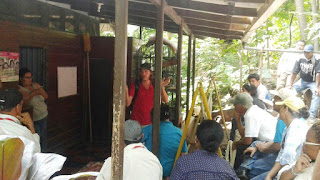
Recently, the participants in a course organized by the International Center for Tropical Agriculture (CIAT, its initials in Spanish) visited Estación Biológica Laguna de Apoyo to learn about land management in a protected area.
CIAT course members tour the native tree nursery managed by GAIA. Hundreds of trees are grown in the nursery and transplanted into reforestation plots to re-created natural forest in the Laguna de Apoyo Nature Reserve. Photo Patricia Gómez.
Although most of their course dealt with the traditional problems facing poor farmers in the country, such as weather insecurity, labor, credit, and technical assistance, here the issues are shaped by the special aspects of the protected area. GAIA Director Jeffrey McCrary discussed with them the legal and technical issues facing land management in the area. Masaya Department, where the northern half of the reserve is located, is highly populated, but is historically a very productive agricultural area, with yuca, beans, sesame, and even coffee in the area near the Laguna de Apoyo Nature Reserve, in addition to the standard slate of smallholder crops which are often destined for personal use with excess production directed to the market, such as corn, plantains, and tree fruits.
The classification of the lands inside Laguna de Apoyo Nature Reserve as part of the SINAP protected area system regulated by the Nicaraguan government, however, imposes overriding restrictions and prohibitions on several activities, among them agriculture. The area is dictated by a number of laws, regulations, and policies, which specifically prohibit agriculture, cutting plants, killing or capturing animals, and even building structures. Enforcing the policies has its own set of challenges, particularly because much of the land is in the hands of private landowners who wish to put houses on subdivided plots and sell them for profit. Even subdividing land is forbidden, as part of the Law 559.
The management plan in effect in Laguna de Apoyo Nature Reserve, approved by decree in 2010, was produced by a team coordinated by GAIA director Jeffrey McCrary, who provided a brief review of the successes and failures of the plan since its implementation. Different interest groups were considered, such as mostly-foreign tourism business owners and vacation home owners, Nicaraguan renters on public land, the local community, and the community at large which includes all Nicaraguans, who have a voice in the way all natural areas are managed.
Course members contemplate wild animal rescue and rehabilitation, another activity conducted by GAIA at Estación Biológica Laguna de Apoyo. Photo Pablo Somarriba.
The most important single element of Laguna de Apoyo Nature Reserve is the lake at the bottom of its crater. In it, several fish species have evolved; six currently recognized species are only found in this lake. The lake provides unequaled views from near and far, and watersports opportunities, as well as serving as the only habitat in nature for these six species of fish. Strict policies are necessary to ensure that the lake remain pristine and uncontaminated. Issues discussed included the constant introduction of garbage from visitors and from a set of bars managed by Nicaraguans on municipal property, and the scandalous introduction of hundreds of tires into the lake by a group of non-Nicaraguan scuba divers puporting to represent a non-profit organization. Although the introduction of tires is regarded as patently illegal, the Nicaraguan government has found the challenges behind stopping this practice greater than their technical capacity to enforce the law.
CIAT course participants enjoy views of Laguna de Apoyo and take selfies. Photo Jeffrey McCrary.
We can make presentations for your group at Estación Biológica or elsewhere on environmental and development issues. GAIA works in Laguna de Apoyo Nature Reserve and throughout the country. We have worked in every department in the country, and most of the 78 nationally recognized protected areas. Contact us by clicking on the "escudo" below to let us know how we can help you.
Durante aproximadamente un siglo, las ideas de Charles Darwin sobre la selección de pareja como un motor hacia el desarrollo de especies nuevas, fueron efectivamente desvaloradas dentro del Reino Animalia. Es difícil encontrar un caso donde es probable que dos especies se formaron dentro de una, en una sola población, con sus miembros en permanente contacto. Mientras siempre ha existido la idea que la selección de pareja puede ser un factor importante en el desarrollo de una especie nueva, en la gran mayoría de los casos, es poco probable que no hubiera otro factor, como una barrera geográfica, en la historia del desarrollo de las especies, en particular con animales vertebrados.
El tipo de formación de dos especies de una población de una sola especie, a través de la selección de pareja, es llamado especiación simpátrica. Sin embargo, el caso de la especiación entre un grupo de peces en las aguas de Lago Cocibolca (Lago Nicaragua) y las lagunas cratéricas alrededor, ha sido fundamental en el regreso de este concepto. El grupo de peces lleva el nombre "mojarra" en Nicaragua, y son varias especies, algunas descritas y otras no, del genero Amphilophus.
El tiempo de existencia de las lagunas cratéricas de Nicaragua varía entre unos diez mil y cien mil años, relativamente poco para los procesos de evolución típicos que forman especies nuevas. A pesar de su relativamente reducido tiempo de existencia en esas lagunas, se ha comprobado que procesos rápidos de evolución han sucedido en varias lagunas, a través de estudios morphológicos en Xiloá y Apoyo, y estudios genéticos en varias lagunas. Las aguas de cada laguna son aisladas de otros cuerpos de agua.
Las mojarras se hacen pareja y se anidan dentro de la planta que se llama Chara, en la Laguna de Apoyo. Foto Topi Lehtonen.
Un reportaje sobre los estudios ejecutados por GAIA en las lagunas fue publicado esta semana en El Nuevo Diario, en el cual se mencionan las especies endémicas de este grupo ya identificadas y descritas, de las lagunas de Apoyo, Xiloá y Asososca Managua, y también se menciona un estudio en curso en la Laguna de Masaya, sitio reconocido en desahucio por su nivel de contaminación por basura y aguas residuales que entran en la laguna desde las ciudades aledañas.
Del reportaje en El Nuevo Diario, 30 Agosto, 2017.
Para los científicos, además de que sean especies nuevas que en si tienen importancia, estas mojarras demuestran evidencia de haber sufrido procesos de especiación simpátrica durante el relativamente corto tiempo que habitan las lagunas cratéricas, por lo que sean de gran importancia como sujetos de estudio. Es una lástima que Charles Darwin nunca vino a Nicaragua, para que vea las mojarras que adornan a los lagos y las lagunas de Nicaragua. Si estuviera vivo hoy Charles Darwin, estaría en la Laguna de Apoyo, buceando con nosotros!
De Geiger, McCrary, y Schliewen, 2010.
Estudios de campo en la Laguna de Apoyo. Foto Jeffrey McCrary.
Los peces en la Laguna de Apoyo abundan entre estructuras rocosas.
New friends are made easily, because we are small and we share with people who visit. People come and go, from Nicaragua and beyond. Some to learn, others to give. Everyone ends up doing a little of both.
Bella, our faithful canine, hangs with the gang in front of Estacion Biologica Laguna de Apoyo. Foto Jeffrey McCrary.
Estacion Biologica is not at all pretentious or upscale. We have a simple place, and we are doing simple things: planting trees, studying the environment, birdwatching, sharing our knowledge of the language and culture, and collaborating with the neighbors and the government of Nicaragua to make Laguna de Apoyo Nature Reserve a great place for nature, for decades to come. Our visitors are welcome to pitch in. Our prices are very low, but we are comfortable, and we eat very well! Special food options can always be arranged: gluten- or dairy-free, vegetarian, or vegan.
This is how Spanish homework ends some evenings. Photo Andras Dorgai.
We are perhaps best known in some circles for the Spanish courses we offer, at Apoyo Spanish School. Each year, we impart at least one hundred fifty course units of a week each, custom-designed to fit the abilities and needs of each person. Our students are often travels who want to engage with locals better. Many, however, are learning Spanish for professional reasons, using their language skills in Nicaragua or other nearby countries in their jobs.
Early morning in Lake Apoyo, while clouds cover Pacaya, above the rim of the crater. Photo Andras Dorgai.
Undoubtedly, the best part of spending time at Estacion Biologica Laguna de Apoyo is the lake. Mornings, the lake can be calm and smooth as glass, without a soul to be seen near the water. As the day progresses, however, locals and tourists may come for a dip. There is no water body anywhere that is as comfortable and naturally clean as Laguna de Apoyo, for a great swim. Visibility underwater during a scuba dive may be as much as 10 meters on a calm day.
All ages get involved when monkeys are to be seen. Everyone becomes a kid again! Photo Jeffrey McCrary.
Our property at Estacion Biologica is humble, but blessed with great trees and often with lovely wild animals. Golden-mantled howler monkeys, known locally as mono congo, are over our heads these days, perhaps two hundred days each year. We thank effective conservation policies enacted as part of the management plan that our director, Jeffrey McCrary, coordinated for the Ministry of the Environment and Natural Resources. Several years ago, there were fewer monkeys and they were found in more limited locations than currently.
Apoyo Spanish School students gather for some extra tutoring from Bela. Photo Andras Dorgai.
Volunteers come to Estacion Biologica to participate in specific projects, or in whatever is most needed. One example is the Murrieta family, who recently spent a couple of weeks engaged in all kinds of environmental conservation activities, including the planting of 56 new trees in a reforestation plot in the hillside behind Estacion Biologica. The evenings were filled with discussions ranging from poetry and literature, to politics and saving the environment, to our favorite places in the many cities each of us had lived or visited.
Visits to Estacion Biologica are often a family affair. Photo Jeffrey McCrary.
Each day at Estacion Biologica brings a new, unexpected blessing. The people in these photos are just a sampling of the blessings that have come our way in the most recent months. We are grateful for every hand lent and each voice raised. Please come by or write us!
El ser humano es igualmente capaz de hechos heroicos como de cobardías. Así fue algún hechor que dejó un animal silvestre indefenso, dado por muerto, en el bosque de la Reserva Natural Laguna de Apoyo.
El cuyuso, de nombre científico Potos flavus, es un animal que no ataca ni al ser humano, ni a animales pequeños. Es nocturno y se alimenta principalmente de frutas, sin tener que bajarse a la tierra de los árboles. Por sus hábitos, es poco visto y mucha gente que vive en el campo no reconoce que la existencia del animal en el bosque cercano.
Yuyu disfruta de un banano mientras sea admirada. Foto Jeffrey McCrary.
Yuyu es una cuyusa, una hembra adulta, que vivía en los bosques de la Reserva Natural Laguna de Apoyo. Una mañana, ella fue encontrada por trabajadores en un hotel en la zona, en estado de salud grave. Fue víctima de una garroteada. Porque no hubo testigos, no sabemos quién fue el culpable, y solo podemos suponer sus motivos. Solo sabemos que el pobre animal agonizaba, incapaz de caminar. Los guardaparques del MARENA nos encomendó el animal.
En su primer día después de ser encontrada herida, Yuyu es triste y en agonía. Foto Jeffrey McCrary.
La cuyusa llegó con varias heridas. La más serias fue de una pata desgarrada en la articulación de la rodilla. Los huesos de la pata se encontraron expuestos en una herida abierta, y la pata quedó inútil. Su ojo derecho se encontraba totalmente cerrado por el hinchazón alrededor. La mejilla debajo del ojo derecho sufrió una cortadura profunda y de más de dos centímetros de largo. El ojo derecho también se encontró golpeado.
Aunque se encuentra gravemente herida, Yuyu goza de un mango bien maduro. Se nota el ojo derecho en mal estado, la mejilla derecha con una laceración y el ojo izquierdo opacado. Foto Andras Dorgai.
Pensábamos que Yuyu iba a morir pronto. Se encontraba muy mal, muy triste. Pero cuando le ofrecimos comida, ella la devoraba con enormes ganas. Estuvo en agonía, con dolores fuertes, y sujeto a condiciones que nunca hubiera aceptado si pudiera escapar. Nosotros estábamos tristes por ella, y vimos que ella manifestaba grandes deseos de vivir.
En evidente agonía y con una pata desgarrada, la cuyusa demostraba sentirse dolores fuertes. Foto Andras Dorgai.
Convencimos a algunos veterinarios que valía la pena darle una oportunidad, aunque fuera evidente que ella iba a enfrentar a otro mundo, si bien pudiera curarse en salud después de las cirugías necesarias para salvarle la vida. Nosotros en GAIA asumimos el compromiso de cuidarla y asegurar una vida que valga la pena para ella, aunque todavía no sabíamos qué implicaba. Los veterinarios generosamente regalaron a Yuyu tres cirugías necesarias para salvarle la vida, quitándole un ojo, limpiando y cerrando la herida abierta de su mejía, y amputándole su pata desgarrada. Es mucho que hacer a cualquier animal, y más aún a un animal silvestre.
Después de tres cirugías regaladas por los ángeles de World Vets en Granada, Yuyu parecía otro animal. Qué felicidad! Foto Andras Dorgai.
Yuyu regresó de World Vets adormecida, y pronto estuvo despierta y hasta con hambre. Pronto se estuvo moviendo. Su comportamiento reflejaba una diferencia de inmediato, de mayor nivel de identificación con los seres humanos a quiénes ella tuvo que permitir estar cerca a ella. Y, más importante,
ella manifestaba evidente gozo, alegría, y curiosidad. Se dormía de día, despertándose solo para comer cuando se le traía fruta, pero de noche, comenzaba conocer a toda su jaula espaciosa. Resultó, tristemente, que su solo ojo remanente tampoco funcionaba; el color opaco no se quitó, evidentemente por daños severos, dejándola totalmente ciega. Pero si, encontraba chispas de alegrí en su vida, tan lejos de la que dejó atrás unas semanas antes.
Yuyu es y seguirá siendo un animal silvestre. Por las cosas de la vida, es obligada a depender a los seres humanos, ya que es totalmente ciega. Foto Jeffrey McCrary.
La calamidad que cayó a Yuyu le quitó todo de lo que era su vida de antes. No puede caminar por los árboles nunca más. No puede buscar una pareja, ni procrear en la forma que su especie suele hacerlo. No puede vivir y morir en el bosque como era su derecho y deber, siendo un animal silvestre. Ese día en marzo del 2017, cuando fue atacada por una persona con malas intenciones, ella dejó su vida en el bosque. Ahora, tiene otra. Es embajadora para su especie y para el bosque, contra el maltrato y el tráfico en animales silvestres.
Yuyu la cuyusa disfruta de su encierre de madera, donado por un voluntario. Ella siempre está a la orden para visitas, especialmente si el visitante trae regalías de fruta. Todos están invitados a visitarle y traerle bananos, sandía, melón, u otra fruta.
Todos están invitados a visitar a la Estación Biológica Laguna de Apoyo, y conocer a Yuyu.
Ella es enamorada de las frutas nativas del bosque-nancite, jobo, jocote, aceituna-y también come de frutas introducidas, como el melón, sandía, banano, y mango. Yuyu siempre quiere recibir visitantes, y también quiere el contacto de algunos voluntarios que ayuden a limpiar su jaula, velar por ella, y darle a comer. Quieres ser voluntario eco-guerrero? Contáctanos para saber cómo puedes ayudar.
Each year, the city of Granada participates in the shameful, degrading practice of running of the bulls. Ostensibly, this event ritualizes the movement of bulls from one place to another, presumably from farm to beef processor. Regardless of its origin, it is now simply an opportunity to abuse animals with impunity. On a main road in northern Granada, bulls were supposedly guided with multiple ropes pulled by mounted cowboys. One bull, of magnificent stature, was stalled in the middle of the street, surrounded by thousands of frenzied spectators. The bull was obviously exhausted and in an altered state from the abuse leading up to the moment. The animal received not just jeering, but lashes and punches from daring young men who felt the need to prove something about their bravery by goading the animal.
A bull, stalled in the middle of the street, is goaded as a horse with rider approach. Photo Jeffrey McCrary.
The bull, of course, has no opportunity to escape. The ropes prevent him from running far in any direction. Each rope, at least 20 meters in length, was pulled by a rider from different directions, all attached to his rack. The bull was hyperventilating, and incapable of going further. He was provoked from behind by dozens of men baiting him. Then, a rider approached him to provoke him to advance, and the horse was guided directly to the side of the bull, leaving the flanks of the innocent horse exposed. The bull responded by planting a horn into the horse and lifting the horse, with rider still mounted, up until the hind feet were suspended in the air. He held the horse in this position, still, for at least fifteen seconds.
This abusive rider placed his horse in evident danger, causing the horse to be impaled by a bull. Photo Jeffrey McCrary.
The rider, dismounted, once the bull released them and was pulled further away, but it was too late for his horse. The abdomen suffered a complete tear through to the mesentery, about eight inches in diameter, and the intestines of the horse were exposed and falling out through the hole.
The wound suffered by this horse, gored by a bull while being ridden, was surely fatal. Photo Jeffrey McCrary.
This horse presumably lost his life due to the reckless and inhumane behavior of the rider. But his life was not lost in vain, if the delight of hundreds of drunken men is given any consideration. This event was an opportunity for all to participate and observe at close range the suffering of animals on a scale that is not so easy to find any more, in an urban setting. The blood sport which makes up this event, in its entirety, has no cultural value, and only serves to degrade and bring suffering to animals, as well as to put people at risk unnecessarily. Shortly after this occurrence, an ambulance was required to ferry a wounded person to seek emergency medical care. As would be expected, a dense crowd pressed on the victim, where hundreds of men competed for the best view of the misery of the poor man who had been trampled. The society of Nicaragua needs to rethink why this event occurs at all. Its only apparent objectives appear to be to allow large hordes of men, many of whom were drunk, to abuse animals or to watch and enjoy the abuse performed by others. This event provides no function for the beef industry, and the suffering of the bull and the horse both were in blatant violation of the Law 747 which protects the welfare of all animals. There can not be any justification for this event on behalf of the beef industry, either, because the bulls that are subjected to this torture surely lose weight and suffer injuries, which reduce their value as slaughtered animals. This is nothing more than blood sport, in which people are encouraged to harm animals and to consider the torture of animals as entertainment. The activities surrounding the running of the bulls is not only shameful because the animals are subjected to unnecessary suffering. The event encourages risky behavior among men and boys that invariably leads to serious injuries for a few unlucky, daring abusers. But a greater impact is the message, in the form of a call, to which thousands respond in each running of the bulls. That message is that making animals suffer needlessly is appropriate, and even to be enjoyed by humans. There is no argument that can be given to justify the suffering imposed on the bulls, other than as entertainment.
Durante varios años, hemos estado ayudando a rescatar animales silvestres cuando sea necesario. Nuestra contribución de GAIA a la vida silvestre en Nicaragua, a través del rescate, rehabilitación, y liberación de animales, siempre ha sido pequeña, sin embargo, ha crecido notablemente recientemente. La diferencia mas notable que ha marcado los últimos años es que la conciencia de las personas que tienen animales silvestres como mascotas se ha ido levantando. Cada día hay mas gente en Nicaragua que reconoce que un animal silvestre debe vivir y morir en su hábitat natural, no en una jaula.
El hecho de que lleguen animales, o de que llamen o escriban personas preocupadas que quieren reportar a un animal, o que quieren entregar un animal, que quieren apuntarse como voluntarios en el trabajo de cuidar a los animales o donar para que hayan condiciones y alimento para ellos, es en si, una manifestación de la conscientización que se esta dando entre la gente por encontrarse con la posibilidad de que los animales silvestres tengan su segunda oportunidad de vivir libres, una vez capturados.
A esta ardilla le encanta el banano! Foto Jeffrey McCrary.
Recientemente, una joven nos escribió, porque había comprado una ardilla centroamericana (Sciurus variegatoides), la cuidó como suya, la trató muy bien, hasta dormía con ella. Pero con el tiempo, la joven reconoció que la ardilla no es un animal domesticado. Una ardilla debe vivir y morir entre los árboles, haciendo lo que hacen las ardillas y no obligada a vivir como el ser humano dicta.
La ardilla centroamericana (Sciurus variegatoides) es común en la región del Pacífico en Nicaragua. Foto Jeffrey McCrary.
Igual como en otras ocasiones, la ardilla presentaba una gran aficion al ser humano. Se dejaba tocar, llevar, y hasta dormia encima de las personas. Cuando la trajimos a la Estacion Biologica Laguna de Apoyo, ella fue cargada por dos adolescentes voluntarios. Comia traquilamente cuando estaba en casa, pero al ver a los arboles y el gran verdor del bosque, se ponia inquieta.
La ardillita come mientras es observada. Foto Jeffrey McCrary.
Ya sabia la ardilla que los arboles se encuentran en su ADN. No se satisfacía con la atención de las personas. Se quiso ir, y pronto, se fue!
La ardilla socializaba fácilmente con los jóvenes voluntarios en la Estación Biológica Laguna de Apoyo. Foto Jeffrey McCrary.
Esta ardilla, igual como muchas otras, se fue. Tres dias despues, fue vista, jugando con una ardilla grande, señalando que ya esta bien, fue aceptada entre las muchas ardillas que viven arriba de la Estación Biológica. Esperamos que tenga larga vida, y lo mas importante, que viva segun su naturaleza, que sea corta o larga. Hasta siempre, amiga.
Durante el 2017, muchas ardillas han sido traídas a la Estación Biológica, para su rehabilitación y regreso al bosque para que viva y muera libre. En el vídeo abajo, hay algunas mas ardillas que vinieron para ser liberadas.
Si deseas ayudar a cuidar a la naturaleza, escríbenos y dinos como puedes participar. Estamos siempre a la orden para cualquier comentario. Échanos una mano y trabajemos juntos para cuidar la vida silvestre en Nicaragua.